Don’t Pooh-Pooh copyright expiry; good things can happen
Read this article for free:
or
Already have an account? Log in here »
To continue reading, please subscribe:

Digital Subscription
One year of digital access for only $205*
- Enjoy unlimited reading on winnipegfreepress.com
- Read the E-Edition, our digital replica newspaper
- Access News Break, our award-winning app
- Play interactive puzzles
*First annual payment billed as $205.00 + GST for one year. This annual subscription will automatically renew at $233.00 + GST every 52 weeks (10% off the regular annual price of $259.35). Offer available to new and qualified returning subscribers only. Cancel any time.
To continue reading, please subscribe:
Add Free Press access to your Brandon Sun subscription for only an additional
$1 for the first 4 weeks*
- Enjoy unlimited reading on winnipegfreepress.com
- Read the E-Edition, our digital replica newspaper
- Access News Break, our award-winning app
- Play interactive puzzles
*Your next Brandon Sun subscription payment will increase by $1.00 and you will be charged $17.95 plus GST for four weeks. After four weeks, your payment will increase to $24.95 plus GST every four weeks.
Read unlimited articles for free today:
or
Already have an account? Log in here »
Hey there, time traveller!
This article was published 22/01/2022 (1687 days ago), so information in it may no longer be current.
Winnie-the-Pooh, everyone’s favourite tubby little cubby all stuffed with fluff, entered the public domain on Jan. 1.
Not the red crop top-sporting, Disney version, mind you, but rather A.A. Milne’s classic 1926 short-story collection. This means that creators can create new stories — or reimagine the beloved ones — featuring the Hundred Acre Wood gang without legal restrictions.
Not Tigger, though. Tigger was introduced post-1926 and is, therefore, not yet public domain. To that end, some critics have used Winnie-the-Pooh’s entry into the public domain to shed light on America’s copyright system, which has been called everything from “flawed” (CBC) to “absurd” (L.A. Times). America’s already-lengthy copyright terms are often extended even further at the behest of companies such as Disney; in fact, 1998’s Copyright Extension Act was derisively dubbed the ‘The Mickey Mouse Protection Act.”

Still, despite Disney’s stranglehold on a pantsless bear that launched a billion-dollar franchise, there was already lots of borrowing going on in the origin story of Winnie-the-Pooh, who was, after all, a storybook bear named after a teddy bear who was named after a real bear who was named after Winnipeg. (Winnie-the-Pooh’s bolstered profile has also translated into plenty of civic pride for us.)
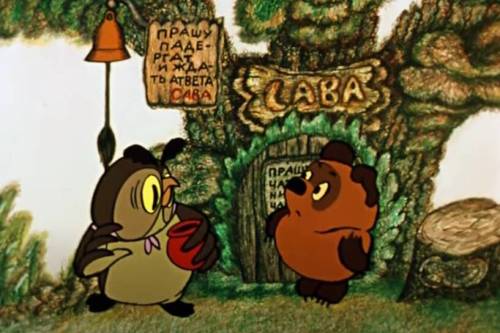
And there is another popular non-Disney adaptation of Milne’s pooh-bear out there, featuring a Winnie who has delighted generations of children, has been immortalized on postage stamps, and has had stuffed animals made in his likeness: Vinni Pukh, or Russian Winnie-the-Pooh.
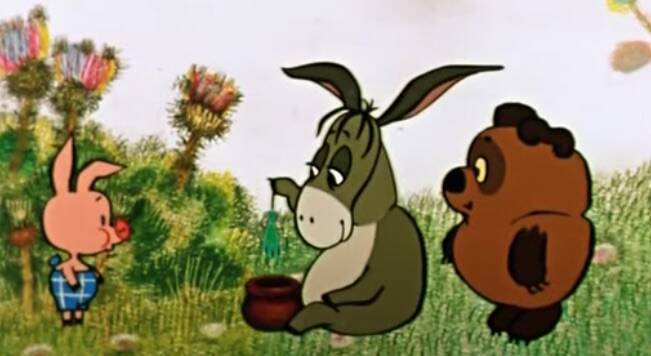
Vinni Pukh is featured in a Soviet-era trilogy of short films released between 1969 and 1972, helmed by animator Fyodor Khitruk and based on a translation of the first Milne book by Boris Zakhoder. Vinni Pukh is joined by Hundred Acre Wood pals Piglet, Eeyore, Rabbit and Owl, but that’s where the similarities end.
https://youtu.be/YCXegrxlKbI
There’s no Tigger here, either, nor is there a Christopher Robin. The 2D animation looks homemade but highly stylized, on colourful backgrounds that appear scribbled in a riot of pencil crayon. Piglet owns a gun. A cork gun. But still.
The most radical departure, especially for those who grew up with Disney’s version, is Vinni himself.
Vinni is a portly little brown bear with disjointed paws, which give the whole cartoon an unsettling look. He’s absent-minded and self-involved as opposed to silly and bumbly. He has the gruff speaking voice of a middle-aged man, and the deadpan delivery of a seasoned stand-up. He frequently bursts into made-up songs at top volume — or “shouties and screamies,” as he calls them.
He’s not even stuffed with fluff. In one scene, he explains to Owl that he cannot use her flowery language to wish Eeyore a happy birthday. “You see, I have sawdust in my head. Long words only upset me.” His spelling, he says, is wobbly. “It’s good spelling,” he says, reconsidering, “but it wobbles.” (Vinni’s either a stuffed bear come to life or a real bear making a self-deprecating comment, depending on your read.)
https://youtu.be/SvyZp0Xks54
“Where Winnie is dopey and cosy, Vinni is droll and crafty, dunking himself in a pond to disguise himself as a rain cloud (he’s hiding from bees) or paying a visit to Rabbit to score a free snack (‘When we enter, the main thing is to pretend that we don’t want anything,’ he instructs Piglet),” Natalia Winkelman observed in a 2018 Daily Beast article. “Like the natural-born comedian that he is, Vinni will often break the fourth wall to shoot the audience a look with wide, mock-innocent eyes whenever he screws up or is hit with something unexpected. By comparison, Winnie’s reaction in such cases is simply, ‘Oh, bother.’”
While obviously a childhood classic in Russia, Vinni Pukh is periodically re-discovered by Western audiences; his hilarious little songs occasionally go viral when people make delighted discoveries on YouTube. In 2017, British movie theatres screened Vinni Pukh.
For my part, I was introduced to Vinni Pukh by my friend Elina, who was born in the former Soviet Union. And I thought of him again given Winnie-the-Pooh’s entry into the public domain. What other versions of this beloved bear might we see in the future?
When a piece of culture isn’t “owned” by one person or entity, it allows for creative retellings, reinterpretations, and reimaginings. Works in the pubic domain beget other classics; Shakespeare’s plays, for example, have spawned more than 400 films.
“This is a good thing,” writes Katharine Trendacosta of the Electric Frontier Foundation. “We can all decide whether the Disney versions are the actual best ones or were simply the only ones.” And, as with Vinni Pukh, it also allows for non-English adaptions to incorporate specific cultural elements.
We see this kind of remixing and expression all the time via memes — including, yes, Winnie-the-Pooh memes. He’s been imagined as a body-positivity icon — “friendly reminder: Winnie-the-Pooh wore crop tops with no pants, ate his favourite food, and loved himself. You can too.”
“Tuxedo Winnie the Pooh” is another popular one, with the titular bear doing his best Bond. Eeyore, who is gloomy and grey in Vinni Pukh too, is often an avatar for depression but also acceptance, thanks to the compassion shown to him by his friends; as one meme goes, “they never leave him behind or ask him to change.”
Let’s hope A.A. Milne’s willy nilly silly old bear going public inspires more Vinni Pukhs.
jen.zoratti@winnipegfreepress.com
Twitter: @JenZoratti

Jen Zoratti is a columnist and feature writer working in the Arts & Life department, as well as the author of the weekly newsletter NEXT. A National Newspaper Award finalist for arts and entertainment writing, Jen is a graduate of the Creative Communications program at RRC Polytech and was a music writer before joining the Free Press in 2013. Read more about Jen.
Every piece of reporting Jen produces is reviewed by an editing team before it is posted online or published in print – part of the Free Press‘s tradition, since 1872, of producing reliable independent journalism. Read more about Free Press’s history and mandate, and learn how our newsroom operates.
Our newsroom depends on a growing audience of readers to power our journalism. If you are not a paid reader, please consider becoming a subscriber.
Our newsroom depends on its audience of readers to power our journalism. Thank you for your support.