Devotion in motion Minister on the move always willing to adapt to expansive western Manitoba parish’s shifting demographics and linguistic needs
Read this article for free:
or
Already have an account? Log in here »
To continue reading, please subscribe:
Digital Subscription
One year of digital access for only $1.44 a week*
- Enjoy unlimited reading on winnipegfreepress.com
- Read the E-Edition, our digital replica newspaper
- Access News Break, our award-winning app
- Play interactive puzzles
*Billed as $5.77 plus GST every four weeks. After 52 weeks, price increases to the regular rate of $19.95 plus GST every four weeks. Offer available to new and qualified returning subscribers only. Cancel any time.
To continue reading, please subscribe:
Add Free Press access to your Brandon Sun subscription for only an additional
$1 for the first 4 weeks*
- Enjoy unlimited reading on winnipegfreepress.com
- Read the E-Edition, our digital replica newspaper
- Access News Break, our award-winning app
- Play interactive puzzles
*Your next Brandon Sun subscription payment will increase by $1.00 and you will be charged $17.95 plus GST for four weeks. After four weeks, your payment will increase to $24.95 plus GST every four weeks.
Read unlimited articles for free today:
or
Already have an account? Log in here »
Hey there, time traveller!
This article was published 06/03/2026 (229 days ago), so information in it may no longer be current.
7 a.m.
It’s early on a Sunday morning. The city of Brandon is still sleeping. Downtown, across from the courthouse, the only sign of life stirs in the parking lot of St. Hedwig’s Catholic Church, as Rev. Philip Malayil climbs into his white SUV, ready to set out on his familiar journey.
The day before, the priest led mass in Rivers, about 40 kilometres northwest of Brandon; it’s one of four churches he serves in the sprawling parish. Today, he’ll tend the flocks at the other three. It’s a long day, one that will take him on a looping 210-kilometre journey: first to Baldur, then to Dunrea, and finally ending up back here, at St. Hedwig’s.
Malayil guides his vehicle south out of Brandon, and onto the open prairie. It’s a gorgeous winter morning, perfect for a drive. The rural roads are clear; a few tufts of cloud drift in the lightening sky. The sunrise peeks over snow-covered fields, painting the horizon pink and orange. A scatter of deer lift their heads curiously to watch Malayil’s vehicle pass by.

MELISSA MARTIN / FREE PRESS
Every Sunday, Fr. Philip Malayil departs Brandon and spends several hours driving throughout western Manitoba to deliver mass at three rural churches in his sprawling parish.
Not every winter Sunday is so forgiving. There are times he has to push carefully through unplowed roads; times he has to creep carefully in near-whiteout conditions. Storms forced him to cancel a mass twice this winter, including once when all the roads out of Brandon were closed.
Nor is it only for weekend drives he has to keep an eye on the weather. As the only priest in a large area, he gets emergency calls to drive out at all hours of the day and night to comfort the sick, or offer last rites; there are weddings, funerals, celebrations, visits with families and organizational meetings with congregations.
One Day
Our new One Day feature is just as it sounds: each month, we will spend one day documenting the everyday work that helps keep our communities going. If you know an organization, program or person you think readers would be fascinated to follow, drop writer Melissa Martin a line.
His parishioners worry about him. “He drives some Sundays he really shouldn’t,” one concerned parishioner later tells me. Malayil doesn’t see it that way. He always tries to be safe. But he also feels a heavy obligation to do whatever he can to bring pastoral care to every part of his parish, every week.
“I don’t consider this as a job,” he says, squinting against the glaring dawn light. “It’s a ministry. As a church, we have to meet their spiritual needs. Even though the communities are small, they’re also important.”
Besides, Malayil is used to judging weather by now. He’s served this parish since July 2008, an unusually long assignment for Catholic clergy: most often, priests cycle out after three or four years. Six at most. But there’s a good reason Malayil has stayed for so long: Brandon has a booming community of Hispanic workers. And Malayil speaks fluent Spanish.
This fact in itself speaks of a globe-crossing faith journey. Malayil was born in India’s southern Kerala state, a lush stretch of land along the coast of the Arabian Sea. Kerala is home to a large Christian minority that traces its lineage back nearly 2,000 years; Malayil grew up in a big Malayalam-speaking Catholic family that had produced many nuns and priests.
In 2000, he followed in those relatives’ footsteps, and was ordained as a priest. Two years later, he was sent to Guatemala.
Malayil arrived in the Central American country with little Spanish. He had no choice but to learn quickly. There, he would walk for hours to reach rural communities scattered in the hills and jungle, where no one spoke English; by the time he left for Canada, four-and-a-half years later, he could deliver a mass in Spanish.
Still, when Malayil arrived in Winnipeg in November 2006, he didn’t imagine he’d use his Spanish in Canada. For the first two years, serving at St. Peter’s Catholic Church on Inkster Boulevard, he wasn’t. But in 2008, he received a new assignment: that growing Hispanic community in Brandon was eager for mass in their mother tongue, and Malayil seemed just the right fit.
That year, he arrived at St. Hedwig’s, a former Polish Catholic church that had been shuttered due to lack of attendance. He began offering what is, as far as he knows, western Manitoba’s only weekly Spanish-language mass, tending to the spiritual needs of hundreds of Latino worshippers in and around Brandon.

MELISSA MARTIN / FREE PRESS
Malayil arrives at St. James’ Church in Baldur, where he will lead the 9 a.m. mass for a loyal congregation of about 25 people.
“That kind of opportunity here helped me to improve and still have that touch with the language,” he says.
As he drives, he nods out the window toward a farmhouse abutting the road; home to a couple that regularly comes to the Sunday mass in Dunrea. After nearly 18 years serving these communities, he can rattle off by memory where dozens of his parishioners live; and he’s also witnessed how the demographics of this part of Manitoba are evolving.
“When I started, and when I look at the communities now, a lot of changes,” he says.
Through the arc of the day’s three masses, we’re about to see exactly what he means.
8:35 a.m.
Baldur is a cosy place, unincorporated and with a population of about 300. At the edge of town on Highway 23, an old billboard welcomes visitors to the home of six-time NHL Stanley Cup champion Tom Johnson, a defensive stalwart with the Montreal Canadiens in the 1950s. Past that, there are a few key services: a school, a gas station, a nursing home where Malayil performs mass once a month.
On a corner of the main drag, nestled between the nursing home and the school, sits the white facade of St. James’ Church. It’s a humble building, built in 1954 on land donated by a local family. Its congregation has never been large, but they have been loyal: today, many drive in from other communities, even as far away as Brandon, for Sunday mass.
Malayil pulls up to the church parking lot just in time to see Leon Martens unlock the front door and stroll inside. Martens lives nearby and has been opening the church for about a decade; his late father had done that job years before. His family has marked many of their life milestones at the church: he and his wife Angela were married here in 1967.
In those days, things around the church — and in Baldur — were different. Back then, the congregation was brimming with young people, and they loved to hold dances in the church basement. There were also three historic Protestant churches in town, and each of the four congregations had a choir.
Now? It’s been years since St. James’ needed the basement, which is now just a crawl space after the building was lowered to make the entrance more accessible. Most of the other churches in Baldur no longer hold regular services, and “we have to get all the churches together to make one choir,” says Leon’s brother Henry, chuckling.
St. James’ Church is still going steady, but that may not last forever. Most of its regular worshippers are seniors.
MELISSA MARTIN / FREE PRESS
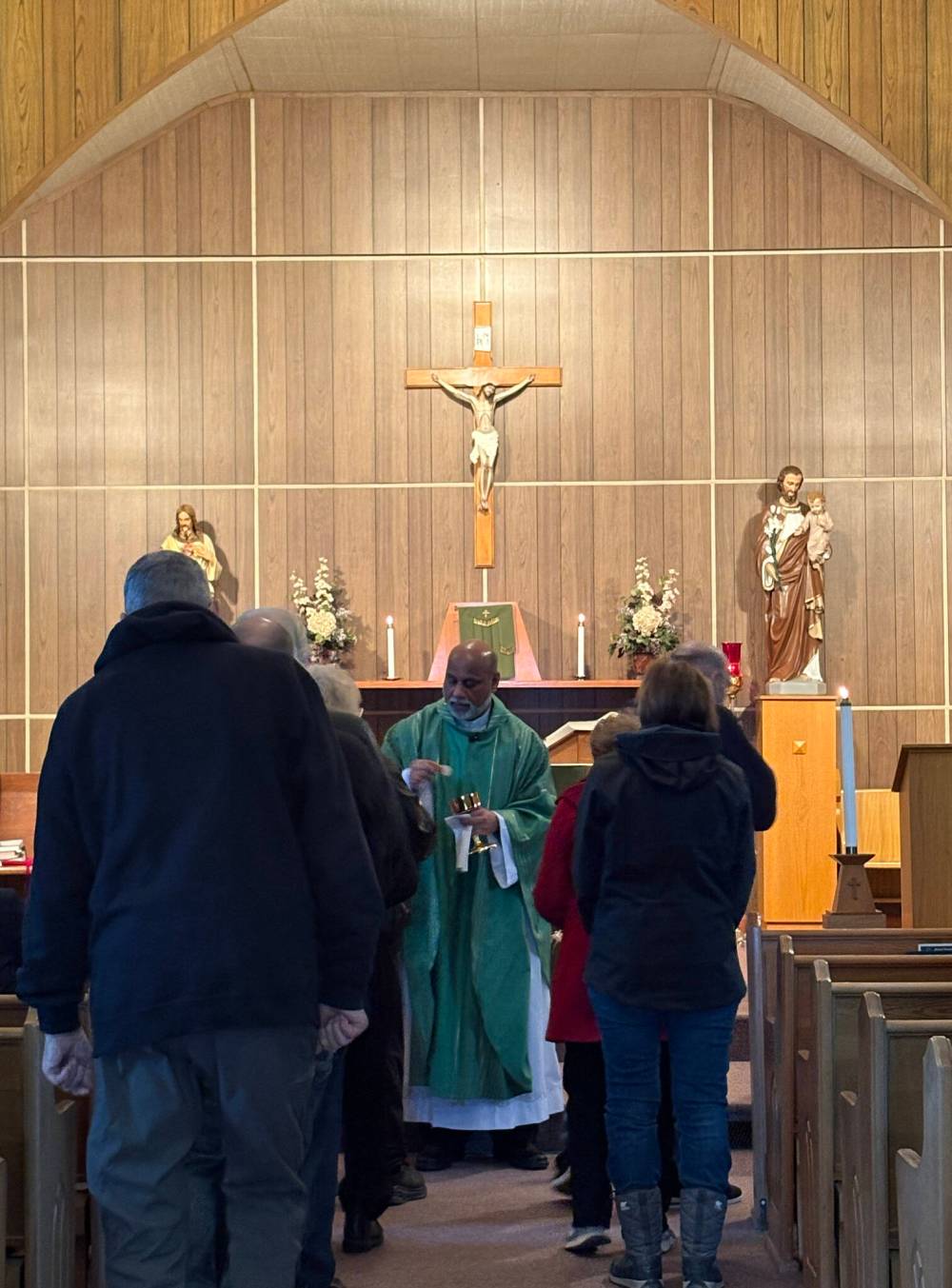
Malayil gives communion in Baldur.
“Like a lot of churches, I think attendance just keeps going down,” Henry says. “There are less children around and less young people. There are only so many jobs around here. But Sundays used to be different. On Sundays, you knew it was Sunday because you came into town, everything was closed. The stores were empty and the churches were full.”
Over the next 20 minutes, the congregation trickles in. Ronald DeKezel, 76, rolls up on his mobility scooter, having driven from the personal care home next door. “It doesn’t matter if it’s minus-20, minus-30,” he says, the scooter makes it easy to get to mass, though it’s a treat each month when Malayil visits the care home in person.
By 9 a.m., two dozen worshippers have arrived. As Malayil dons his green liturgical vestments, they take their places in the pews, waiting in quiet contemplation. It’s a welcoming place for that: the sanctuary is small but warm, with wood-panelled walls and lovingly maintained religious statues flanking the altar.
It’s time. Malayil takes his place at the end of the holy procession, behind a parishioner holding a crucifix, behind Leon and Angela Martens holding flickering candles. Members of the congregation raise their voices in an opening psalm, ready to share another hour of worship together, as most here have done for almost their whole lives.
10:40 a.m.
In tiny Dunrea, about 40 kilometres west of Baldur, Église de Saint-Félix-de-Valois stands as a discordantly magnificent structure. It’s a beautiful building, constructed in 1903, a grand edifice of brick and arched windows, framed by rows of towering old trees. Its pointed white bell towers soar over the hamlet, which is home to few services and no more than 100 people.
There was once a parish hall beside the church, though that was long ago demolished, and a convent behind it, long gone too. But the quaint wood-framed church office and rectory still stands next door; Malayil even lived there for two months when he first transferred to the parish, nearly 18 years ago.
Malayil pulls up to the church about 20 minutes before mass; enough time to hear a waiting parishioner’s confession. While he tends to this spiritual need, in the sacristy behind the sanctuary, parish secretary Carole Boulet points up at a long row of portraits on the wall, a record of all the priests who have served the community since 1881.
Those portraits stand as a fascinating visual testament to how this church and the surrounding area have changed. For more than a century, the priests here were mostly French Canadians or French; most Catholics around Dunrea then were Franco-Manitoban or French-speaking immigrants.
But starting in the early 1990s, the faces and names shown in the portraits diversify. Since then, Saint-Félix-de-Valois has hosted two priests from Nigeria, two from the Philippines, and two from India, including Malayil. It’s in part a sign of how the makeup of Catholic clergy in Canada is changing — right along with this congregation itself.
For years, Saint-Félix-de-Valois struggled with the same slow decline as St. James’ Church in Baldur. The rural population was shrinking, while the congregation was aging. Young people were moving to the cities, or just not coming to mass. Around the time Malayil arrived in 2008, Boulet says, they worried they’d have to close the beautiful church for good.

MELISSA MARTIN / FREE PRESS
Malayil leads mass at St-Felix-de-Valois Church in the hamlet of Dunrea. The church is more than 100 years old.
Then a wave of Filipino workers started arriving in western Manitoba, and everything changed.
Over the last 20 years, hundreds of Filipinos have settled around nearby Killarney, recruited to work at health-care facilities and industries such as the HyLife pork-processing plant. Coming from the Philippines, where faith and attending church play a larger role in community life than in most of Canada, the first thing many do is seek out a place to worship.
Emily Morissette is a shining example of that. It’s been a decade since she first came to Canada from the Philippines; four years ago, she and her husband moved to Killarney for work. Right away, she started coming to Saint-Félix-de-Valois: it’s an “excellent” parish, she says, full of people determined to help each other and keep the church thriving.
“Having a church with a parish like this is very important,” Morissette says. “You feel a belongingness to the community. You know that there are people around that support you, whatever you need in your daily life, whether it’s community service, or having a friend of the same faith and belief together.”
That energy has rejuvenated the historic church. Today, on any given Sunday, Filipino worshippers make up at least half the congregation; if all the regulars come at once, Boulet adds, it’s more than half. Many of the workers come with their growing families; Filipinos fill key spots in the church’s lively choir, and help lead its Sunday school program.
Still, there are challenges to keeping the church going. It’s a quirk of Saint-Félix-de-Valois that few of its faithful live in Dunrea. Most live in or near Killarney, about 30 kilometres away. But there is no Catholic church there, so just like their priest, they occasionally have to brave difficult winter drives to make it to church for mass.
Yet they come, and in healthy numbers for such a rural church. On this Sunday, there are about 40 people in the pews, and quite a few young children. That’s actually a low number, likely because it’s a long weekend; 75 is a more common recent average. It can get even busier: last Christmas Eve, the sanctuary was packed to standing room only.
Under that vaulted ceiling, precious connections are made.
Four years ago, Bonnie Schmitz and her husband Paul moved to nearby Wawanesa, from their home in Ontario. They first looked to buy a bungalow — a size suited for the two of them, with their children grown and living in different places — but they ended up finding a perfect property with a much larger house.
It has its perks: it’s a 20-minute drive from the church, which gave them a way to connect with the local community. Still, the house felt too empty, so when Morissette asked the couple if they’d host a Filipino engineer who was just arriving in Canada for work, they eagerly agreed.

MELISSA MARTIN / FREE PRESS
Emily Morissette (left), who is from the Philippines, and Bonnie Schmitz met at St-Felix-de-Valois Church in Dunrea.
That guest turned out to be a blessing, and since then, they’ve hosted other Filipino newcomers.
“We have a very big house, so it has really helped our loneliness,” Schmitz says. “Now we have people in it to share our lives with. We’ve learned so much from them, and they’ve learned from us. It’s just been a really great thing. We have been very fortunate through Emily.”
2:15 p.m.
Seven hours, two Sunday masses, and more than 100 kilometres since Malayil left Brandon, the priest rolls back into the parking lot at St. Hedwig’s. When he left, it was in the peaceful minutes on the edge of dawn; now, upon his return, the parking lot is buzzing.
Every few moments, another car or truck pulls up. Parents hop out, escorting children of all ages down the broad stairs that lead to the church basement, where Sunday school is about to begin. The parents head back out, ready to finish a few errands before returning for 4 p.m. mass.
The large basement is buzzing with voices and laughter. There are about 30 kids today — fewer than usual, but many families had plans for the long weekend. Portable room dividers separate the open space into grade-level classrooms, from kindergarten to Grade 9.
Each grade has its own volunteer teacher; and all the classes are held in Spanish, with bilingual Spanish-English learning materials.
It’s been more than 20 years since the first workers from Latin America started arriving in the region, recruited to work at local meat-processing plants and in other industries. By now, most of the kids were born in Canada; and the young arcs of their lives tell a story about how this community is growing.
In one classroom, friends Luis and Allison, both 10, are colouring a page for the upcoming Ash Wednesday observations.
“We get to learn new stuff every Sunday, which is kind of cool,” Allison says.
Luis was born in Colombia, and moved here just two years ago with his family; he’s still shy to speak English with a visitor. But Allison was born in Brandon — her Wheat Kings hoodie shows off her pride in the hometown junior hockey team — and her story is uniquely tied here. Her father is from El Salvador, her mom is from Honduras, and they met and married in Canada.

MELISSA MARTIN / FREE PRESS
Kindergarteners attend the Spanish-speaking Sunday school at St. Hedwig’s Church, where a thriving Hispanic community has put down roots.
As Sunday school winds down, the kids pour out of their classrooms and mingle near the steps that lead up to the sanctuary, where their families are arriving for mass. Although all live in Spanish-speaking homes, they giggle and joke with each other mostly in English — children accustomed to playing on the bridge between cultures.
4 p.m.
The pews under the soaring ceiling of St. Hedwig’s are full, and the sanctuary hums with life.
Today, there are about 120 worshippers for the afternoon mass, drawn from across Latin America: El Salvador, Honduras, Mexico, Colombia, Venezuela, Ecuador, Peru. There’s even a sprinkling of non-Hispanic worshippers: one family hails from Nigeria and speaks little Spanish. They come here for the energetic spirit, they say.
At the altar, Malayil begins his sermon, leading the worship in fluid, emotive Spanish. (Later, one worshipper tells me the priest’s Spanish has improved so much in his 18 years serving this community, parishioners occasionally forget it isn’t his native language.)
The service is joyful, welcoming, connecting. Children grin proudly as they parade past the pews, collecting offerings. From the choral loft, a choir of young singers leads the congregation in hymns lifted by a lilting Latin guitar.
In a pew near the front, René Ramos stands with his family, neatly dressed in a sport coat, his lively eyes shining as he sings along. In this community, Ramos is something of a leader: he was among just the second group of workers from Latin America to come to work at what is now the Canada Packers Brandon pork-processing plant.
Those first years were tough for Ramos and his peers. When he arrived in November 2003, he spoke little English, and was shocked by the weather: “I saw snow in movies, and pictures, but never before I could touch it,” he says, laughing. “That was my first experience.”
The work was hard. So was the culture shock. But Ramos was determined to succeed.
“The main reason I decided to stay here is because I had a better future for my family,” he says. “Most everybody, we left family in our countries. I left my daughter in El Salvador, she was four years old. It was my idea to stay in Canada to get a better future for her.”
Back then, the community was small. Not long after arriving in Canada, they sought connection in one of the places that felt most natural to them: the church.

MELISSA MARTIN / FREE PRESS
Malayil leads more than 100 worshippers in Spanish-language mass at St. Hedwig’s, where the congregants have come from across Latin America, including Honduras, El Salvador, Colombia, Venezuela, Mexico and Peru.
In those early years, many workers attended mass at a different church in Brandon — St. Augustine of Canterbury. But they struggled with the English-language services and the differences in how faith is practised in Canada as compared to their home countries: in much of Latin America, the church and its holidays are a far more central part of community life.
To help meet their spiritual needs, the Archdiocese of Winnipeg began sending out Spanish-speaking priests, but they couldn’t come every week: just twice a month in summer, Ramos recalls, and once per month in winter.
“Once a month was not enough for our faith,” Ramos says. “We have a different kind of celebration, and many things we do in celebration, many activities in the year. Every saint has a different celebration, a different kind of mass. So when we were coming to Canada, we didn’t have anything like that. So people were looking for that.”
In St. Hedwig’s, they and the archdiocese found the perfect opportunity. The church was founded in 1920 to serve what was then a bustling community of Polish Catholics; the current building, with its clean modernist design, was built in 1957. Over the ensuing decades, the congregation slowly dwindled and eventually regular services stopped.
In 2008, it re-opened as a Spanish-language congregation, with Malayil as its first — and still only — resident priest.
As the years turned, the workers began to put down roots in Brandon: buying houses, cementing long-term legal status here and bringing the rest of their families to Canada. More than a decade after he arrived, Ramos was able to bring his then-teenage daughter here; she’s now all grown up and thriving, living and working in Quebec.
And many threw themselves into developing the church community, turning it into a key hub for Hispanic community life in Brandon. They built the Sunday school program, held fundraisers and organized celebrations. Just last month, they completed one of the final steps to launch their own chapter of a Catholic men’s lay organization, the Knights of Columbus.
This Sunday, all of that hopeful energy is on display at St. Hedwig’s mass. The service lasts nearly two hours. When it ends, people mingle near the entrance for long minutes, chatting and laughing. Ramos works the crowd with a clipboard, selling tickets for a fundraiser sale of pupusas, a beloved El Salvadorean cornmeal cake stuffed with savoury fillings.
While Malayil stands at the door, chatting and shaking hands with departing congregants as they head into the cold, I fall into conversation with a member of the church in Baldur, who’d come to visit St. Hedwig’s for the afternoon service. As we talk, marvelling at the enthusiasm of the congregation, we notice something about the building.
All around St. Hedwig’s, there are traces of the church’s Polish-Catholic founders. Words in Polish remain on a few signs that linger from years past; Polish names are engraved on placards, in honour of those who donated to fund the church’s beautiful stained-glass windows. One of the religious icons near the altar even came directly from Poland.
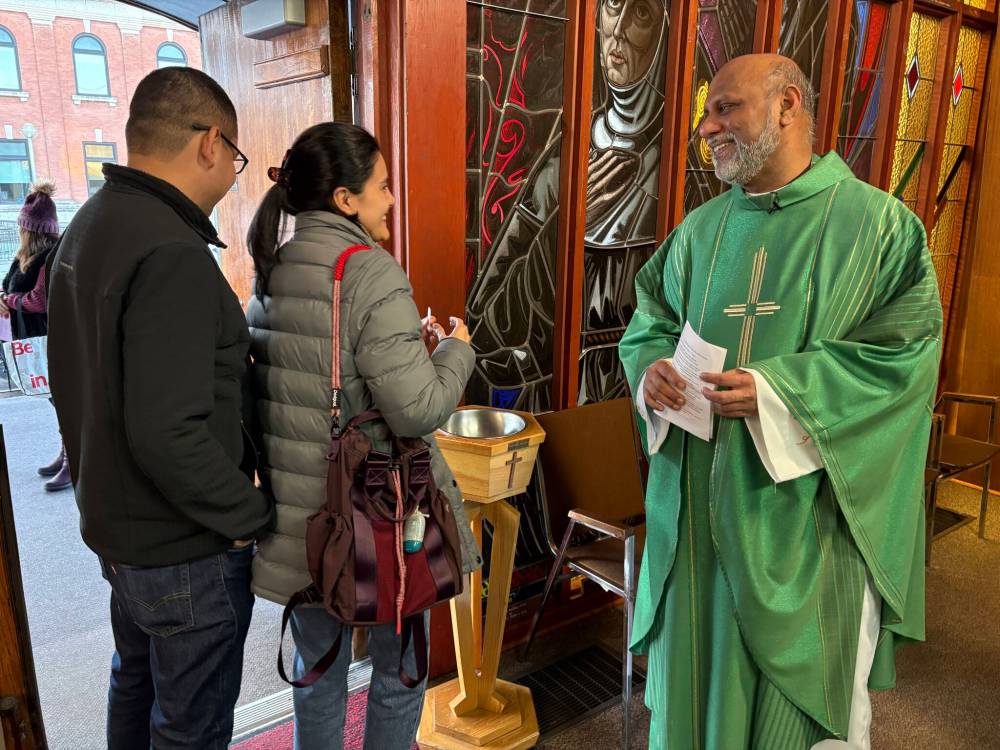
MELISSA MARTIN / FREE PRESS
Malayil shares a laugh with parishioners following afternoon mass at St. Hedwig’s.
Today, the notices on the bulletin board are mostly in Spanish; the Bibles in the pews are too.
There’s a beautiful sort of symmetry to this transformation. Once, newcomers from Poland left behind everything they knew to come to Canada, work hard, build a life, put down roots. To keep connected to their faith, and to each other, they established a church where they could share the joy of their traditions and their language.
Decades on, and that community changed. The efforts of those Polish newcomers were successful; their descendants grew up fully woven into the broader cultural fabric of Canada. Over time, they spread out and went different places; they didn’t need a Polish church as much as their ancestors did, and in time, the pews were left empty.
Now, the place of worship is being given a vibrant second life by a new community travelling that same path. One imagines that if the Polish Catholics who started St. Hedwig’s saw the Latino Catholics who animate it now, they might recognize in them the same hopes for a better life, the same hard work, the same challenges — and the same bright future.
Just one day in the life of a priest serving rural Manitoba, but a journey through a story of Canada, always renewing.
melissa.martin@freepress.mb.ca

The Free Press is committed to covering faith in Manitoba through our Religion in the News project. This reporting continues because readers like you step forward to fund it.
Donate now to support our reporting on religion.
Your donation is eligible for a charitable tax receipt.
BECOME A FAITH JOURNALISM SUPPORTER

Melissa Martin
Reporter-at-large
Melissa Martin reports and opines for the Winnipeg Free Press.
Every piece of reporting Melissa produces is reviewed by an editing team before it is posted online or published in print — part of the Free Press‘s tradition, since 1872, of producing reliable independent journalism. Read more about Free Press’s history and mandate, and learn how our newsroom operates.
Our newsroom depends on a growing audience of readers to power our journalism. If you are not a paid reader, please consider becoming a subscriber.
Our newsroom depends on its audience of readers to power our journalism. Thank you for your support.
The Free Press acknowledges the financial support it receives from members of the city’s faith community, which makes our coverage of religion possible.