Ad campaign’s claims put to the test ER doc troubled by claim marijuana 'doubles' chance of being in a crash
Read this article for free:
or
Already have an account? Log in here »
To continue reading, please subscribe:

Digital Subscription
One year of digital access for only $205*
- Enjoy unlimited reading on winnipegfreepress.com
- Read the E-Edition, our digital replica newspaper
- Access News Break, our award-winning app
- Play interactive puzzles
*First annual payment billed as $205.00 + GST for one year. This annual subscription will automatically renew at $233.00 + GST every 52 weeks (10% off the regular annual price of $259.35). Offer available to new and qualified returning subscribers only. Cancel any time.
To continue reading, please subscribe:
Add Free Press access to your Brandon Sun subscription for only an additional
$1 for the first 4 weeks*
- Enjoy unlimited reading on winnipegfreepress.com
- Read the E-Edition, our digital replica newspaper
- Access News Break, our award-winning app
- Play interactive puzzles
*Your next Brandon Sun subscription payment will increase by $1.00 and you will be charged $17.95 plus GST for four weeks. After four weeks, your payment will increase to $24.95 plus GST every four weeks.
Read unlimited articles for free today:
or
Already have an account? Log in here »
Hey there, time traveller!
This article was published 08/12/2017 (3229 days ago), so information in it may no longer be current.
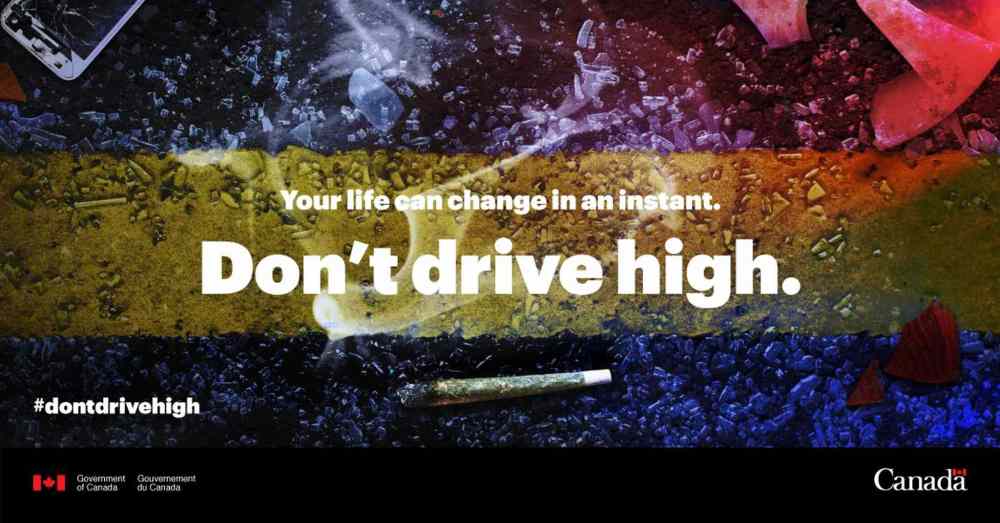
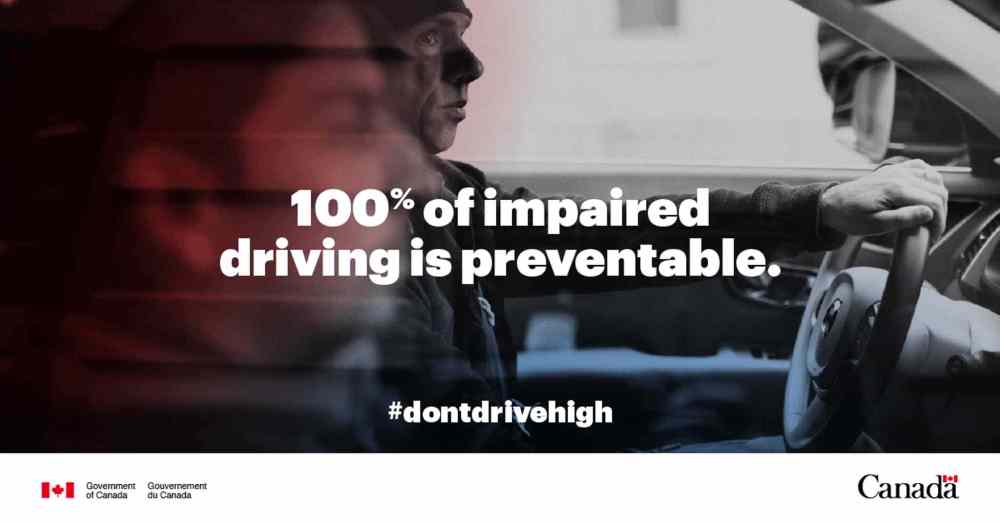
The new “Don’t Drive High” campaign from the federal government includes a polished, millennial-friendly TV ad, spots on radio and in cinemas, and online exposure.
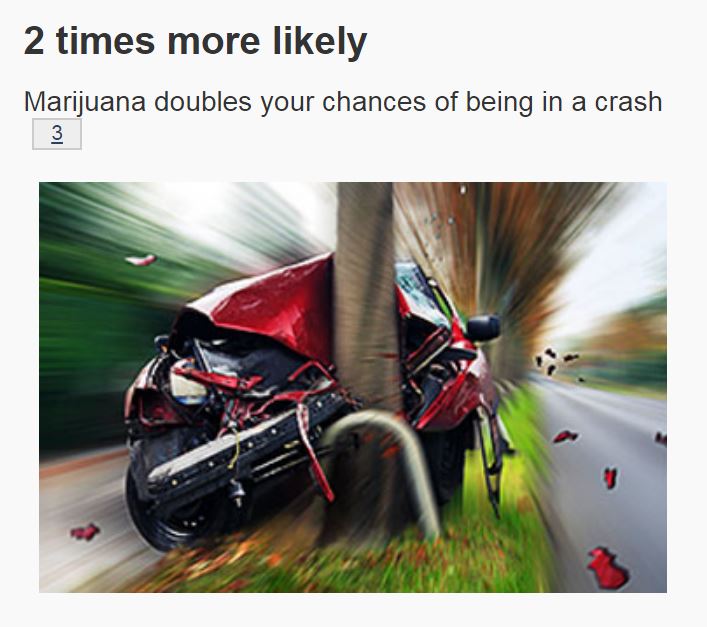
It also includes lots of statistics, including the stark claim, “Marijuana doubles your chances of being in a crash.”
That claim troubles Dr. Ian Mitchell, an emergency room physician in Kamloops, B.C., who researches cannabis.
“I think it’s a reasonable campaign, it’s something that needs to be brought to the public’s attention. Obviously, people are very concerned about it,” says Mitchell, who is also an associate professor of emergency medicine at the University of British Columbia.
“But I think that the message they’re giving out is not accurate. And I think because of that, they are going to be spending lots of resources in a wasteful manner.”
Researchers generally agree that using cannabis before getting behind the wheel increases the risk of a collision. The degree to which cannabis increases that risk, however, is in question.
The origin of the ‘doubles your chances’ claim
The federal government attributes its claim that cannabis “doubles” the risk of a collision to a 2012 paper by lead author Mark Asbridge, an associate professor at Dalhousie University’s department of community health and epidemiology.
That paper was a systematic review, a genre of academic research that involves critical analysis of the results of multiple studies by other academics.
Asbridge and his colleagues found “driving under the influence of cannabis was associated with a significantly increased risk of motor vehicle collisions compared with unimpaired driving,” at an odds ratio of 1.92.
In other words, they estimated a cannabis-impaired driver is 92 per cent more likely to experience a collision than an unimpaired driver — or roughly double the risk.

Had the federal government asked Asbridge about using his research in their campaign, however, he says he would have advised looking to newer studies on cannabis-impaired driving.
Asbridge said the most up-to-date analysis of the risks of cannabis-impaired driving is a 2016 analysis in the journal Addiction by Norwegian researchers Ole Rogeberg and Rune Elvik. The authors re-calculated Asbridge’s research using different methodological assumptions, and came up with a much lower estimate of the increased collision risk from cannabis-impaired driving, at an odds ratio of either 1.36 or 1.22 (36 per cent or 22 per cent) depending on the methodology used.
Put another way, write Rogeberg and Elvik, “this suggests that roughly 20 to 30 per cent of traffic crashes involving cannabis occur because of the cannabis use. By comparison, the comparable ‘average’ relative risk for accidents with fatalities after drinking alcohol… would imply that approximately 85 per cent of crashes involving alcohol occur because of alcohol.”
To the extent that there is an objective “truth” about the increased collision risk from cannabis impairment, Asbridge said, “the true estimate lies somewhere between their revised estimate and our estimate.”
The federal government’s position
Public Safety Canada, which launched the Don’t Drive High campaign on Tuesday, said it was aware of the more recent 2016 study by Rogeberg and Elvik that estimates much lower collision risk from cannabis impairment.
In an email, a Public Safety Canada spokesman said the department “has closely reviewed a number of reports related to the effects of cannabis on drivers,” and cited a new fact sheet from the Traffic Injury Research Foundation that “again cites research showing that cannabis-positive drivers are more than twice as likely to crash as cannabis-free drivers.”
(The Washington state research cited by that fact sheet, however, explicitly notes that “the information in this report cannot be used to determine if marijuana is or is not causing fatal crashes.”)
“Research in this area is relatively new, which is why the Government of Canada is investing in it so we can continue to make evidence-based decisions,” wrote the spokesman.
“Public Safety Canada will continue to support and review research to ensure statistics used in the campaign are as accurate and up to date as possible, and changes will be made over the course of the five-year campaign if they are needed.”
The spokesman pointed out that all these reports “make clear that driving under the influence of drugs significantly increases the risk of a person being involved in a collision.”
‘It’s still an increase in the risk’
Asbridge, who believes “any kind of impairing substance or impairing behaviour” should be avoided, says academic research on complex topics such as impaired driving is constantly being challenged.
“The evidence is always emerging and changing when we introduce new studies and better studies.”
Like Public Safety Canada, Asbridge says the bottom line is that the risk of collisions does increase after cannabis consumption.
“Even if it’s a marginal increased risk, it’s still an increase in the risk. That would be the more important message, rather than throwing (the ‘doubles the risk’) figure out at people.”
Mitchell says his emergency room doesn’t “see a lot of accidents necessarily related to cannabis, compared to alcohol.”
Any discussion about the risk of collisions caused by cannabis impairment, says Mitchell, needs to include “the context that this is a minor degree of impairment compared with what we’re used to dealing with, with alcohol.”
For example, Mitchell suggests, take Asbridge’s finding that cannabis use increases the risk of a collision by 92 per cent and compare it to estimates of increased collision risk from alcohol use.

As seen in chart 4 of this paper by the National Institute on Alcohol Abuse and Alcoholism in the U.S., a blood-alcohol content level of 0.07 — below Canada’s federal limit of 0.08 — would increase the risk of a collision by 109 per cent. A blood alcohol content of 0.08 would equal an increased risk of 169 per cent. Beyond the 0.08 legal limit, the odds of an alcohol-related crash increase even more dramatically.
In other words, Mitchell points out, the estimated risk of a crash from a level of alcohol impairment that’s legal under Canadian federal law is higher than the risk of a crash from cannabis impairment being cited by Public Safety Canada’s campaign.
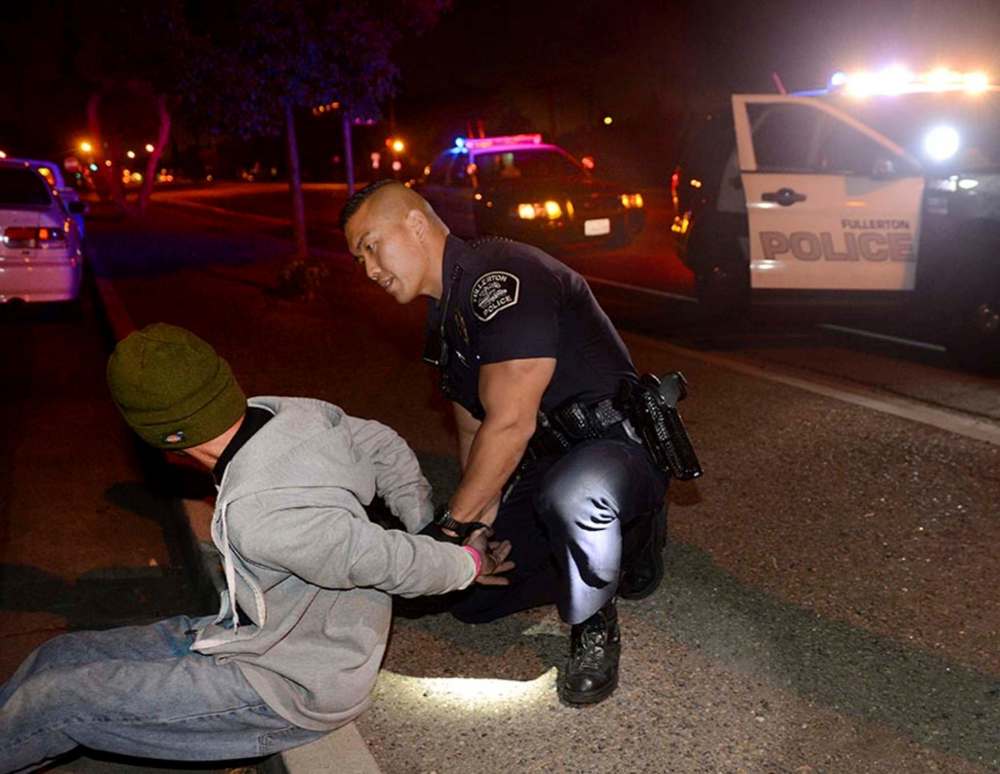
“And that correlates with how much resources you should be spending on the problem,” he says. “With the minimal amount of impairment that’s present in cannabis users, the focus really should be about decreasing alcohol further… but also addressing things that are much, much more impairing like distracted driving and people using their cellphones to watch movies.”
solomon.israel@theleafnews.com
@sol_israel

History
Updated on Saturday, December 9, 2017 3:09 PM CST: More information about the relative risks of collisions caused by cannabis and alcohol added.