Parish the thought At Winnipeg's historic places of worship, clergy and congregations must bend and adapt or risk dissolution and demolition
Read this article for free:
or
Already have an account? Log in here »
To continue reading, please subscribe:

Digital Subscription
One year of digital access for only $205*
- Enjoy unlimited reading on winnipegfreepress.com
- Read the E-Edition, our digital replica newspaper
- Access News Break, our award-winning app
- Play interactive puzzles
*First annual payment billed as $205.00 + GST for one year. This annual subscription will automatically renew at $233.00 + GST every 52 weeks (10% off the regular annual price of $259.35). Offer available to new and qualified returning subscribers only. Cancel any time.
To continue reading, please subscribe:
Add Free Press access to your Brandon Sun subscription for only an additional
$1 for the first 4 weeks*
- Enjoy unlimited reading on winnipegfreepress.com
- Read the E-Edition, our digital replica newspaper
- Access News Break, our award-winning app
- Play interactive puzzles
*Your next Brandon Sun subscription payment will increase by $1.00 and you will be charged $17.95 plus GST for four weeks. After four weeks, your payment will increase to $24.95 plus GST every four weeks.
Read unlimited articles for free today:
or
Already have an account? Log in here »
Hey there, time traveller!
This article was published 16/01/2026 (260 days ago), so information in it may no longer be current.
Dan Beauvais, Westminster United Church’s janitor, jokes that after a life of mischief he’s atoning by spending more than 40 hours a week in a house of worship.
And just because the 110-year-old church hasn’t hosted a service in its beautifully late-Gothic sanctuary in more than three years, that doesn’t mean he’s in want of things to do — from maintaining the building’s boilers and fire-detection systems to general cleaning and snow removal.
“I’ve worked here 25 years… so I’m part of the moulding,” he says. “Part of the mould, even.”
But the building’s biggest upkeep issue will need more than Beauvais’s sweat to fix. The general public isn’t allowed into the sanctuary because, to put it melodramatically, the roof might cave in.
RUTH BONNEVILLE / FREE PRESS Longtime Westminster United Church caretaker Dan Beauvais knows every nook, crack and cranny of one of Winnipeg’s most prominent churches. 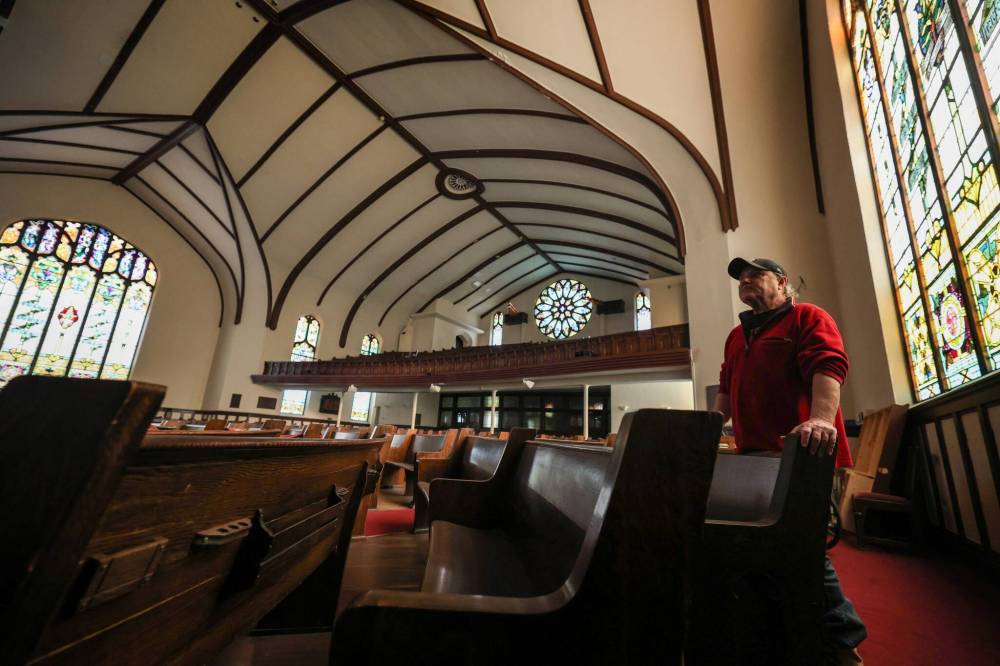
“They call it the zipper effect. So, if it fails there,” says Brandon Johnston, who chairs Westminster’s property committee, pointing at a patch of peeling plaster on the eastern edge of the sanctuary’s ceiling, “then it (could) all just fail… It’ll just propagate out, because then that beam fails, then the next one fails, and it works its way along.”
Millions of dollars in interventions are needed to repair the roof and ceiling, owing to moisture problems. It’s a lot for Westminster’s dedicated staff, volunteers and community to grapple with, and at the moment weekly services are hosted in the church’s lecture hall.
The church is carried by more than just faith. It’s methodically working on the problem, says Johnston. But it will take an intervention from beyond its walls to re-open the sanctuary.
“Whatever happens here is not going to be Westminster figuring it out on our own,” he says.
“Whatever happens here is not going to be Westminster figuring it out on our own.”
Westminster is still an important community hub. It can no longer support the weight of tower bells, though twice a day it projects bell peals through the Wolseley and West Broadway communities that signal the time and a church still ticking. But its regular activities, which extend well beyond religious services, won’t generate the necessary revenue for the fixes.
When it was available, Westminster’s acoustically serene sanctuary with its 1912 Casavant Frères pipe organ attracted dozens of concerts every year. The church’s second-floor loft space — which echoed with sing-along concerts of Handel’s Messiah in December — is still functional but smaller, and many of its regular renters have, for now, gone elsewhere to hold concerts.
There are also fewer parishioners today to whom to pass the collection plate. This isn’t just because they’re spending Sunday mornings at other churches.
The United Church of Canada, which turned 100 in June, reached its peak membership with over a million souls in the 1960s. Today, it has about 325,000 members. The extent to which this drop-off is unique to mainline — theologically liberal and socially progressive — churches like the UCC, or a feature of a more general secularization of Canadian society, is a matter of debate.
Either way, these changes are being felt in one of colonial Canada’s first key civic structures, namely its churches. And their legacies are much more deeply entwined in the country’s progressive and conservative traditions than is often recognized, with Prairie churches being especially notable for these connections.
In 2019, the National Trust of Canada reported 27,601 worship buildings existed nationwide and predicted a loss of 9,000 in the next 10 years — nearly a third.
This fate seems unlikely in Westminster’s case. Not only does it have heritage status — giving it legal protections against demolition and certain significant alterations — it also has the support of a broad and loyal community in Wolseley, West Broadway and River Heights. It’s a legacy institution, which also stays active through social-outreach programs, such as a well-known food hamper and daycare.
But there are reasons to believe the city’s mainline Protestant churches, particularly the Anglican and United, may be among the most vulnerable to closure. This seems true even though many generate millions of dollars in economic benefits every year — contributing significantly to the $443 million a year that, according to the 2022 Halo Project study, Winnipeg’s 300 or so places of worship generate annually.
If a church requires renovations that exceed their projected revenue for several years, it can create an existential crisis.
RUTH BONNEVILLE / FREE PRESS Millions of dollars in interventions are needed to repair the roof and ceiling, owing to moisture problems at Westminster United Church. 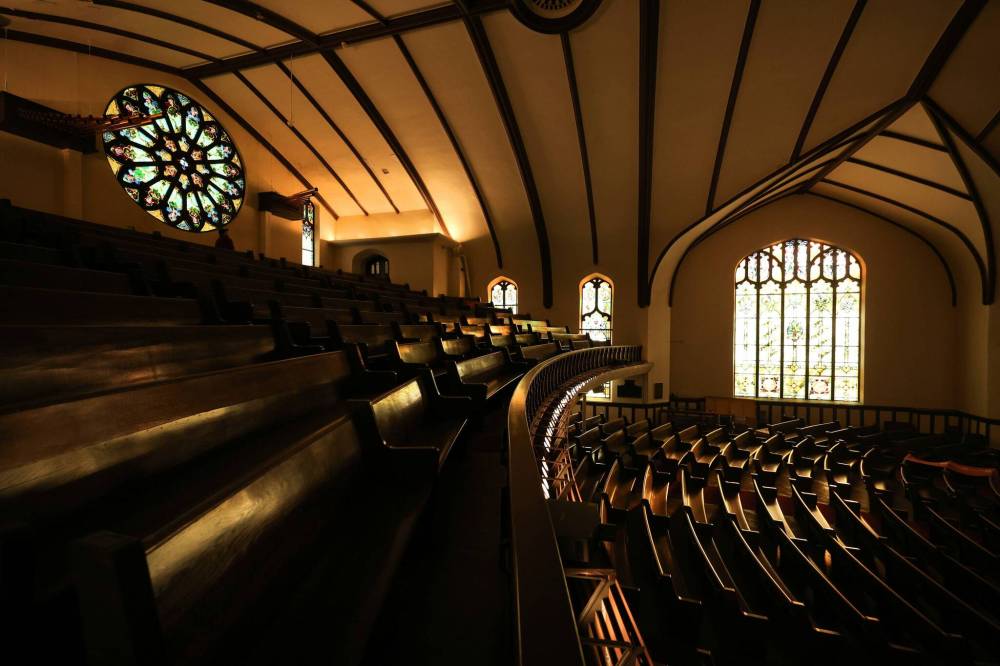
“When United Church of Canada minister Paul Derry moved to Winnipeg, Manitoba, in the early 2000s, there were seven United Church congregations in his quarter of the city. At the end of 2018, he told me, there was only one,” wrote Jason Byassee for The Christian Century in 2018. “Most mainline pastors paying attention these days — in Canada as well as the United States — know that their parish is perhaps 10 minutes away from closing.”
There’s no update on the National Trust’s prediction, but other data reinforce Byassee’s points. While the 2021 census shows the Anglican Church still ranking among the city’s five largest religious denominations, the number of Winnipeg residents identifying as Anglican has dramatically declined over recent decades: down to 2.7 per cent in 2021 from 7.1 per cent in 2001. Meanwhile, the UCC, the city’s third-biggest denomination, is down from 8.4 per cent in 2011 to 4.2 in 2021.
By contrast, the 2021 census shows the Catholic Church counts nearly a full quarter (24 per cent) of Winnipeggers within their fold, while the Sikh (4.4 per cent) and Muslim (3.3 per cent) religions are also in the top five. If the city’s immigration patterns continue from African and Asian countries, where these faiths are more dominant, it seems likely these proportions will continue to grow.
Secularization may be a general societal trend, but it’s complicated by the realities of immigration.
“Most mainline pastors paying attention these days – in Canada as well as the United States – know that their parish is perhaps 10 minutes away from closing.”
Exacerbating Anglican and United Church troubles is the fact their churches are among the city’s oldest, often standing for more than a century in the city’s urban core from which middle-class congregants have long since retreated to suburban living. Beneath their stately facades, they struggle with decay: wheezing boilers, cracked stained-glass, peeling plaster, stubborn mould.
Dwindling numbers of congregants mean fewer donors to help mend these issues. Eventually, there’s a breaking point: the church may be converted for other purposes or, if it lacks proper heritage designations, there’s even the risk it could be torn down.
“I’m a lapsed Anglican,” says architectural scholar Dan Menzies, author of Canadian Architectural Styles. “I think society has, in many ways, outgrown the church… (but) they’re an important part of our heritage and it is a big problem, because we have a surplus.”
Whatever their denomination or faith, the struggles Winnipeg’s places of worship are facing aren’t just their own. They raise an abiding civic challenge, prompting us to consider what to do with this key part of the city’s physical heritage. And they make us think about where and how we gather and what common devotions, secular or sacred, can still bring our communities together.
It’s not just out of pragmatism that many Winnipeg churches aim to serve a mission broader than just worship. They may see this mission as expressing a wider commitment to civics and social justice that is essential to an authentic Christian faith.
Among Canada’s mainline Protestants, the best-known example of this orientation — with a particularly strong activist bent — is the social gospel, closely associated with the United Church.
Some see this politically progressive tradition as having prolonged the church’s visibility and relevance, extending its reach beyond the sanctuary into the lows and highs of public life — from shelters and poorer neighbourhoods to the political chambers that shape their fates.
Others, most notably the eminent Canadian historian Ramsay Cook, see things differently, arguing that the social gospel’s political successes actually spelled the fraying of its religious moorings. One can’t leap into the corridors of policymaking with one foot still in the sanctuary, and eventually social-gospel types were bound to swap the authority of the church for that of the state.
Whatever the case, it’s impossible to think about the foundations of not just the United Church, but also Canada’s political left, without the social gospel.
L. B. FOOTE / WINNIPEG FREE PRESS ARCHIVES Thousands gather at Victoria Park during the 1919 General Strike.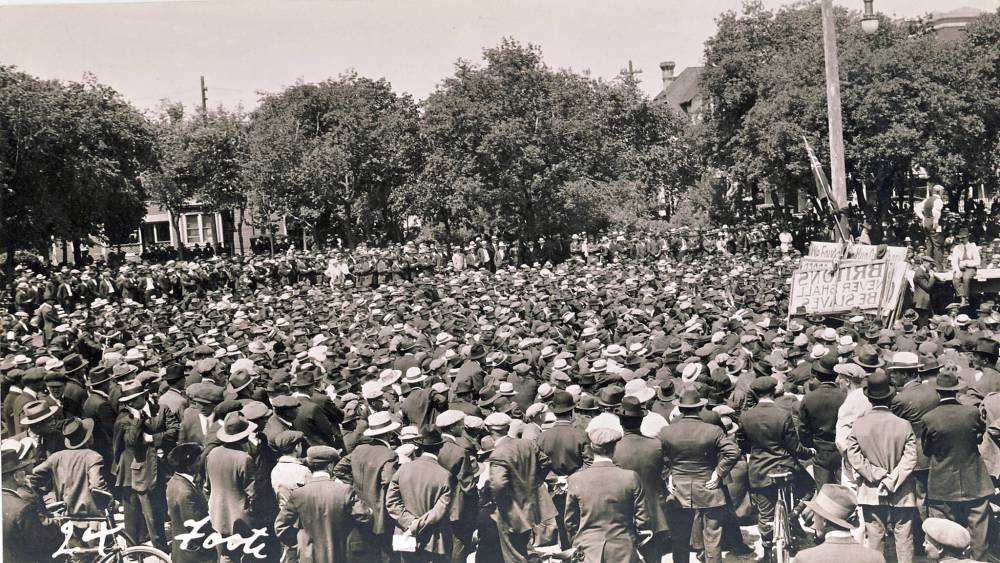
Its first moment on the national stage was during one of the country’s greatest political dramas, the Winnipeg General Strike of 1919.
It may be more precise to say poverty and exhaustion ground Winnipeg’s industrial and civic operations to a halt during that strike, rather than “communist insurrectionists.” But that’s not how Winnipeg’s establishment, from their South End homes and urban offices, saw things when they organized a private militia to strong-arm the “alien” and “Bolshevik” protesters into submission.
Yet many of the strike’s organizers were spreading pamphlets bearing crosses, not hammers and sickles. They used Christian imagery and moral rhetoric in their demands for higher wages, shorter working hours, better workplace conditions and the right to unionize.
If they were “outsiders,” it wasn’t by nationality — a racist myth spread by the strike’s opponents — even if many of its rank and file were labourers of eastern European heritage. But there was one sense in which a handful of the strike’s leaders were outsiders. Namely, they came from the pulpit, not the factory.
While clergy to the south of the Canada-U.S. border were taking evangelism in a more conservative direction, social-gospel types here saw their Christian duties compelling them to struggle against the evils of poverty, inequality and child labour.
Naturally, this attracted some to the strike.
The best known of these upstarts was J.S. Woodsworth, a founder of the Co-operative Commonwealth Federation, the NDP’s precursor. Like many of the NDP’s most famous Prairie figures — Tommy Douglas, Bill Blaikie, Stanley Knowles — Woodsworth was a minister by vocation. Though, ultimately, not a particularly devout one, as Allen Mills tells us in his intellectual biography of Woodsworth, Fool for Christ.
WINNIPEG FREE PRESS FILES J.S. Woodsworth was a Methodist minister turned first leader of the Co-operative Commonwealth Federation (CCF), which later became the New Democratic Party.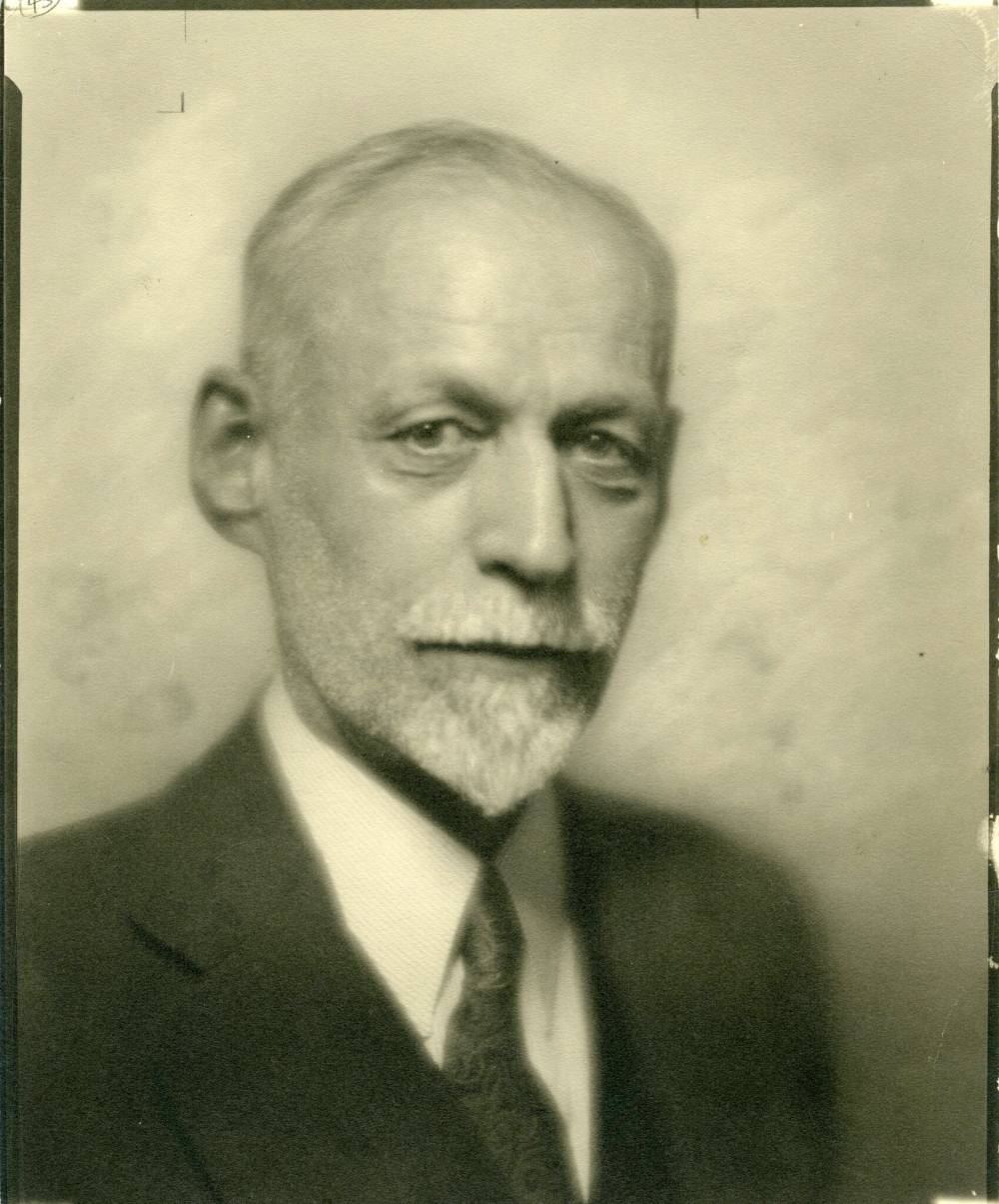
“One of the things I said was that inevitably the social gospel, and people like Wordsworth, in fact, played a major role in the secularizing of Canadian society,” says Mills from his home. “If you look at Woodsworth, his problem was that he came to a point roughly around 1905 when he’d already been ordained as a minister in the Methodist Church, but didn’t believe many of the foundational doctrines — the resurrection, virgin birth, this kind of stuff.”
By 1925, Woodsworth had left the ministry and was a sitting MP. That same year, Presbyterians, Methodists and Congregationalists in Canada came together to form the UCC.
Many leaders within these denominations were also resonant voices of the social gospel, though not every parish embraced the cause with the same fervour. Activist-minded ministers also often gravitated from the church for politics or academia, such as Wesley College.
Founded by Methodists in 1888 as a pastoral training school, and Woodsworth’s alma mater, Wesley’s emphasis by the 1920s on urban mission work in working-class neighbourhoods was morphing into the empirical study of urban conditions. Sermonizing became “sociologizing” in a reformist key, during an era when North America’s political left was paying close attention to the path-breaking sociological studies of poverty and labour by intellectual figures such as W.E.B. Du Bois and Robert Staughton Lynd.
Driven by church, union and financial pressures, Wesley College merged with the Presbyterian Manitoba College in 1938 to form United College. In 1967, it became the University of Winnipeg with its own charter, transitioning toward a public, secular university. But it still retains a reputation as the city’s most progressive campus and formal ties with the UCC, which appoints ten members to the university’s governing Board of Regents.
As for the United Church, its history between its origins and now is complex. But it’s not for nothing the UCC is still sometimes called, as Mills also jokingly puts it, the “NDP at prayer.”
This sensibility is felt not just in the revolving door that has historically existed between the two institutions, but also the UCC’s special emphasis today on “diversity, equity and inclusion” in its vision of Christian charity.
Westminster United Church, for its part, offers a variety of such progressively flavoured programs: education on economic justice, Indigenous reconciliation and LGBTTQ+ issues, refugee sponsorship, and a particularly energetic focus on food and clothing drives and disaster relief.
This isn’t surprising given that its last reverend, Sherri McConnell, was openly gay, while its current interim reverend Doug Martindale — who once played Woodsworth in a commemorative event for the 1919 General Strike — served as an NDP MLA from 1990-2011.
Still, Martindale’s religious training makes him somewhat unique among contemporary NDP politicians. As father Raymond Joseph de Souza observed in a 2022 eulogy in the National Post for Bill Blaikie (who held the record for Ottawa’s longest-sitting MP), today there are sparingly few figures within the party formed through the seminaries and sermons of the United Church.
“He was the last giant of a tradition that a healthy public life needs, and the last torchbearer of the social-gospel tradition in progressive politics,” writes the broadly conservative de Souza, before provocatively suggesting the federal NDP’s current malaise owes something to its shift from Prairie-rooted social-gospel tradition to urban-flavoured identity politics.
There’s diversity, then there’s hodgepodge. Knox United’s most recent Christmas pageant, as Rev. Lesley Harrison says with amusement, had plenty of both.
Organized by a Filipino church member, the nativity retelling featured Indigenous, African and European-Canadian congregants, and was woven from many cultural influences.
Ironically, the most incongruent element may have come from the very Scottish traditions that flow through the United Church’s Presbyterian currents.
“They did not appreciate the bagpipes much,” says Harrison with a laugh. Mother Mary doing a highland dance was also a bit of a head-scratcher for some members.
JOHN WOODS / FREE PRESS Knox United Rev. Lesley Harrison says the church’s vast range of community services programming is a prime example of social gospel at work.
Harrison estimates that less than a quarter of her congregation is historically from the United Church. This likely has much to do with the church’s location.
Central Park, which concentrates Winnipeg’s most diverse community into a mere 0.2 square-kilometres, has a few social anchors: the soccer pitch, the Islamic Manitoba Dawah Centre and Knox United.
Few, if any, churches in the city are as busy on the days between Sundays with outreach — hot meals and takeaway food, and household supplies, job matching, after-school activities, interfaith meetings, English language classes and more, which Knox often delivers in collaboration with other non-profits. They’re also a key intermediary between settlement services and local newcomers, helping them to navigate the government’s bureaucratic mazes.
Most who access Knox’s resources aren’t familiar with United Church catechisms. Many aren’t Christian. But the church’s services, like its boisterous Christmas pageant, has other enticements.
“One of the little boys — I thought he’d been to church a few times, but I don’t think he’s ever been on Christmas,” says Harrison. “And, so I asked him, ‘Would you like to be a shepherd?’ And he said, ‘Oh, yes!’ And then there was a pause, and he said, ‘What’s a shepherd?’”
As immigration from non-European countries has reshaped Winnipeg — where the visible-minority population nearly tripled from 13 per cent in 2001 to 35 per cent in 2021 — the share of mainline Protestants has declined, while Catholic, Muslim and Sikh communities have grown.
Harrison is blunt regarding her church’s enduring need for significant structural and technical upgrades. “When have we not needed them?” she says.
Yet, Knox United has never seemed as big and bustling. It appears buoyed, not overwhelmed, by immigration; emboldened, not weakened, by its social-gospel mission.
Still, skeptics might ask what any of this — food banks, dance classes and art programs secular enough to qualify for government grants — has to do with spreading the gospel.
“This was a natural extension of where the gospel was coming from,” Harrison says. She points to Mary’s Magnificat in the Gospel of Luke — the biblical hymn in which God “has brought down the powerful from their thrones and lifted up the lowly.” “You cannot tell me that that isn’t exactly at the heart of the social gospel,’” she says.
MIKAELA MACKENZIE / FREE PRESS FILES Elaine Dukuly (left) and Raymond Ngarboui distribute food outside of Knox United in 2024. The food distribution network is one of many social outreach programs run through the church.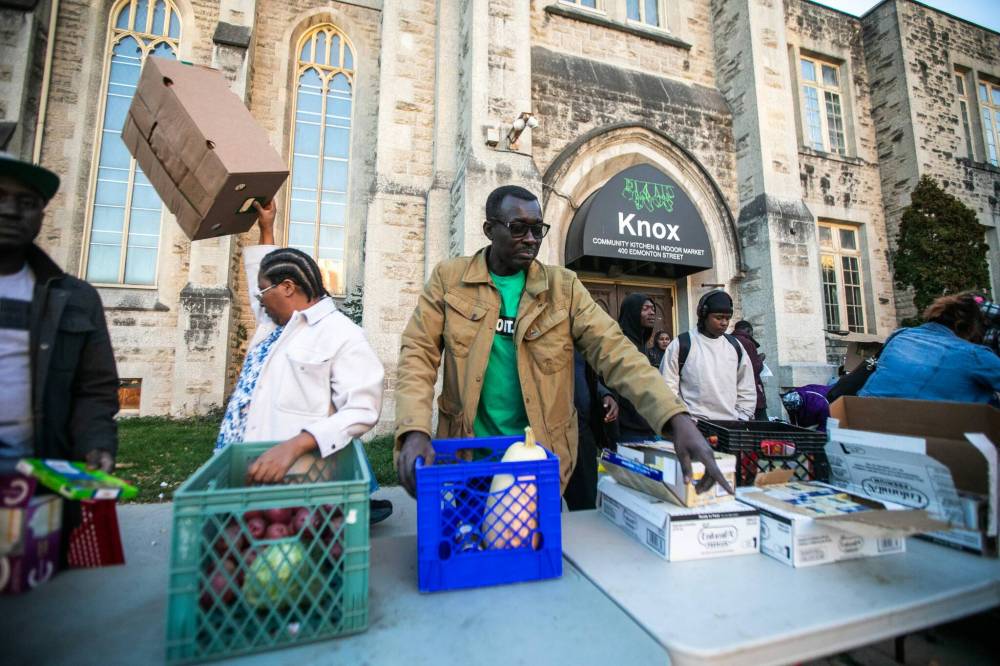
Harrison pushes against the idea that the social gospel’s liberalism simply drove secularization, seeing things as more complex. However, she notes that some parishioners’ intense faith also fuels their social conservatism, often at odds with United Church culture.
“People who live in very marginalized conditions … because their lives are already so ambiguous, they do not want any more (theological) ambiguity to add into that mix. And you probably already know this as well, that the United Church foundation is ambiguity,” she says.
Knox’s community isn’t without its quiet tensions. Harrison recalls a tearful newcomer seeking her counsel, afraid God couldn’t love her adult child for marrying someone of the same sex.
“From then on, we had more conversations about why God would not only love her and her adult child, but would celebrate that relationship as the heart of what the gospel is about,” says Harrison.
At the same time, she says colleagues of hers in the UCC — which, in 1988, became the first church in Canada to openly ordain homosexual clergy — have challenged her for being too open to people, like socially conservative newcomers, who harbour such attitudes.
For Harrison, the answer is a balancing act between “inclusivity” and “safe spaces,” which aren’t necessarily the same principles, when accommodating different marginalized groups.
“If we do not have proximity to the people we might be fundamentally at odds with, in terms of our way of thinking and our theological beliefs,” she says, “then how is the conversation ever going to happen?”
It’s become an oddly common sight: tents, bicycles and the rudimentary makings of homes on the front lawn of Canada’s churches. More often than not it’s been Anglican churches that are reported as embracing, or at least tolerating, homeless encampments.
When the City of Toronto finally unleashed “the Claw” on the homes of 10 souls living in front of the Anglican Church of Saint Stephen-in-the-Fields in October, dragging their tarps and tents into a trash compactor, no one protested more loudly than its rector Maggie Helwig.
MIKE DEAL / FREE PRESS FILES All Saints Anglican Church at Broadway and Osborne where a tent village sprung up in 2018.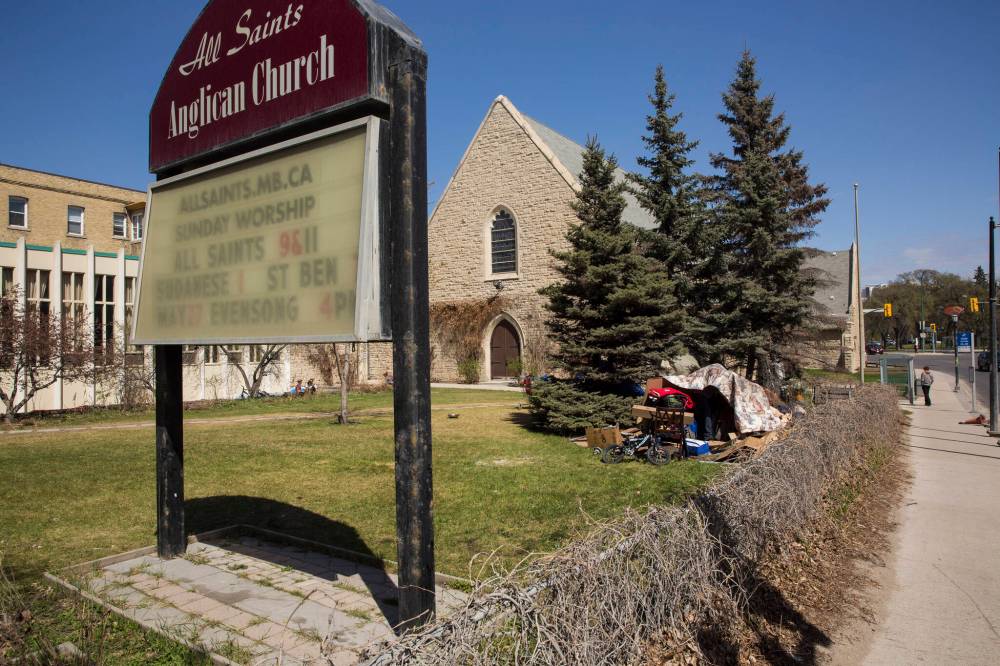
Things came to an end less dramatically for the encampment at All Saints Anglican Church in Winnipeg in 2018. Initially, the church furnished the site with port-a-potties and opened their doors to campers for coffee and church services. But vandalism and theft became an ongoing concern and tensions arose within the congregation over what to do in the long run.
When the church’s vestry ultimately asked the 40 or so people living on All Saints’ property to leave, they complied peacefully, no police called.
The incident didn’t spark physical protests as in Toronto, though it helped fuel legislative debates about Winnipeg’s lack of low-income housing. “It’s very hard for the people who are up in the legislature to look back here and say, ‘We don’t see a problem,’” Brent Neumann, then All Saints’ Reverend, quipped at the time. “Have you looked out the back door recently?”
MIKAELA MACKENZIE / FREE PRESS All Saints strives to practise what it preaches with its steady stream of meal programs, clothing drives, refugee supports and the like, many of which place homelessness near the core of its mission.
More than six years later — and after significant government investments, most notably $25.6 million from Ottawa — 12 stories of resident units stand about where the encampment was. More than half of them are affordable housing.
Known as West Broadway Commons, the complex’s majority owner is All Saints, while it is managed by the University of Winnipeg Community Renewal Corporation, the other major owner.
Make no mistake: the apartments are money-makers, keeping the lights on for All Saints modestly sized congregation and staff. But a typical service evokes what goes on at the church between Sunday mornings. Where conservative American churches may emphasize Romans and Ephesians on submitting to authority and hierarchy, Luke and Matthew’s lessons on caring for the poor and manger-less resonate more in the sermons of Canada’s mainline Protestant churches.
All Saints strives to practise what it preaches with its steady stream of meal programs, clothing drives, refugee supports and the like, many of which place homelessness near the core of its mission.
“Because of that experience with the encampment (the church) said, ‘Well, maybe housing might be the best option,’” says All Saints new reverend Robert Schoeck. “Accommodating vulnerable communities — it’s one of the core aspects of who we are as both as an Anglican church and a downtown Anglican Church.”
“Accommodating vulnerable communities – it’s one of the core aspects of who we are as both as an Anglican church and a downtown Anglican Church.”
For Schoeck, this isn’t just a matter of do-gooderism or idealism, but of institutional inheritance. He refers not to the social-gospel tradition, but the Anglican Church’s 19th century Oxford Movement.
Before its left turn roughly a century ago, Canada’s Anglican Church was more closely associated with Canadian Toryism. That tradition combined social conservatism, deference to the Church of England and loyalty to the crown, and belief in “the public good.” While that tradition is more uneasy about state-sponsored social welfare, this is partially because many Tories claimed charity was the moral responsibility of civil society and the church.
The Oxford Movement captured some of this dynamic, with its legions of urban priests more alert to the working poor’s lot and carried by a belief in their divine authority tracing back to the Apostles.
MIKAELA MACKENZIE / FREE PRESS Rector Rob Schoeck at All Saints Anglican Church, where providing housing for the vulnerable has become one of its core priorities.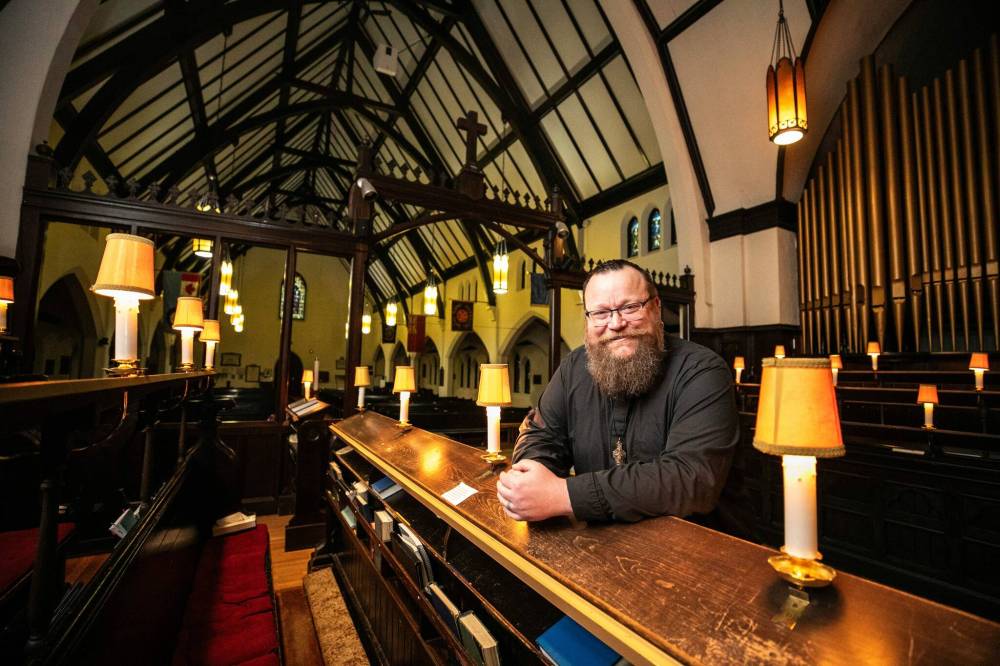
“The (movement’s) idea of beautiful worship, arts and community going hand in hand with a commitment to serving the least among us is a tradition that we hold on to and adhere to, to this day,” says Schoeck.
Still, Schoeck isn’t naïve about the secular thrust pushing local Anglican churches toward concert rentals, housing and mixed uses. Another neighbourhood housing project, West End Commons, is a converted church that has shed any religious affiliation to offer affordable housing.
Then there are cases like St. Phillips in St. Boniface. The decommissioned Anglican church risked being demolished, but was rescued by Hazel and Stephen Borys and converted into six private rental apartments.
The couple, a city planner and an art historian by profession, respectively, have elegantly woven modern flourishes and amenities into the church’s late-Gothic Revival-style, which has also been painstakingly restored. The sanctuary now serves as their home, but with a civic aspect: accommodating gatherings and concerts that often make use of the church’s organ.
Some local Anglican churches strike a middle-ground between art and worship — like St. Michael and All Angels Church, where parishioners might encounter local celebrities the Bros. Landreth, who now operate their record label from the church.
Others have desacralized to fully become venues.
This was the fate of the more than century-year-old church structure at the corner of Ellice Avenue and Sherbrook Street. It was eventually bought by local lefties and folk impresarios Mitch Podolak and Ava Kobrinsky to become the closest thing here to Greenwich Village’s Gaslight Café, namely the West End Cultural Centre.
“We’re all experiencing this sort of redefinition of who we are.”
But its recent financial hurdles — the WECC announced in late fall it needed to raise $50,000 by the new year to keep the lights on, a goal it met through community donations — remind us that desacralization and mixed-uses are hardly a silver bullet for preserving a vital part of the city’s physical heritage.
In so many ways, the WECC’s struggles stand in for those of the local arts and cultural community in general. In recent years, a rash of theatres, music ensembles and arts groups have either gone under or grappled with deep deficits and diminished audiences. With many of these collectives also performing or rehearsing out of churches, it undermines this key revenue source for the city’s struggling places of worship.
“My congregation is slowly growing over these last three, four years since the pandemic and I think it still reinforces (the fact) we are communal people,” says Schoeck.
“(But) the pandemic threw everything into disarray, disrupting completely our ability and our patterns and rhythms of gathering… it’s not just the Anglicans, it’s not just the churches. We’re all experiencing this sort of redefinition of who we are.”
winnipegfreepress.com/conradsweatman
The Free Press is committed to covering faith in Manitoba through our Religion in the News project. This reporting continues because readers like you step forward to fund it.
Donate now to support our reporting on religion.
Your donation is eligible for a charitable tax receipt.
BECOME A FAITH JOURNALISM SUPPORTER

Conrad Sweatman is an arts reporter and feature writer. Before joining the Free Press full-time in 2024, he worked in the U.K. and Canadian cultural sectors and freelanced for outlets including The Walrus, VICE and Prairie Fire. Read more about Conrad.
Our newsroom depends on a growing audience of readers to power our journalism. If you are not a paid reader, please consider becoming a subscriber.
Our newsroom depends on its audience of readers to power our journalism. Thank you for your support.
History
Updated on Friday, January 16, 2026 9:20 AM CST: Corrects reference to Sherri McConnell
Updated on Friday, January 16, 2026 10:38 AM CST: Clarifies details of University of Winnipeg's history
Updated on Saturday, January 17, 2026 3:37 PM CST: Minor copy edits throughout
The Free Press acknowledges the financial support it receives from members of the city’s faith community, which makes our coverage of religion possible.