The green economic machine Nature is a big part of the Canadian economy — but how big? We crunched the numbers.
Read this article for free:
or
Already have an account? Log in here »
To continue reading, please subscribe:

Digital Subscription
One year of digital access for only $205*
- Enjoy unlimited reading on winnipegfreepress.com
- Read the E-Edition, our digital replica newspaper
- Access News Break, our award-winning app
- Play interactive puzzles
*First annual payment billed as $205.00 + GST for one year. This annual subscription will automatically renew at $233.00 + GST every 52 weeks (10% off the regular annual price of $259.35). Offer available to new and qualified returning subscribers only. Cancel any time.
To continue reading, please subscribe:
Add Free Press access to your Brandon Sun subscription for only an additional
$1 for the first 4 weeks*
- Enjoy unlimited reading on winnipegfreepress.com
- Read the E-Edition, our digital replica newspaper
- Access News Break, our award-winning app
- Play interactive puzzles
*Your next Brandon Sun subscription payment will increase by $1.00 and you will be charged $17.95 plus GST for four weeks. After four weeks, your payment will increase to $24.95 plus GST every four weeks.
Read unlimited articles for free today:
or
Already have an account? Log in here »
Canada’s vast landscape, which boasts 20 per cent of the world’s freshwater, a quarter of global wetlands and 28 per cent of its boreal forests, is critical to its economy. Natural resource industries — forests, farms, fisheries, mining and oil and gas — together make up approximately seven per cent of Canada’s gross domestic product.
Tension exists between expanding these industrialized sectors and protecting the ecosystems on which they depend.
In Manitoba, some worry protecting the Seal River Watershed, which spans more than 50,000 square kilometres in the province’s north, will hinder opportunities in mineral resources and hydro; to the east, critical mineral mining ambitions in Ontario’s Ring of Fire clash with the protection of the Hudson and James Bay Lowlands, the second-largest carbon sink on earth; and in B.C., Coastal First Nations have protested that lifting the large tanker ban through their waters will endanger the protected Great Bear Rainforest.
These tensions make it easy to frame nature as the antithesis of economic activity, if it’s always put in opposition to projects that are described as growing Canada’s wealth, sovereignty and security.
But a growing chorus of economic and policy leaders, alongside conservation groups, are making the case for nature to be seen as a critical financial asset — not a barrier, but another opportunity for economic growth.
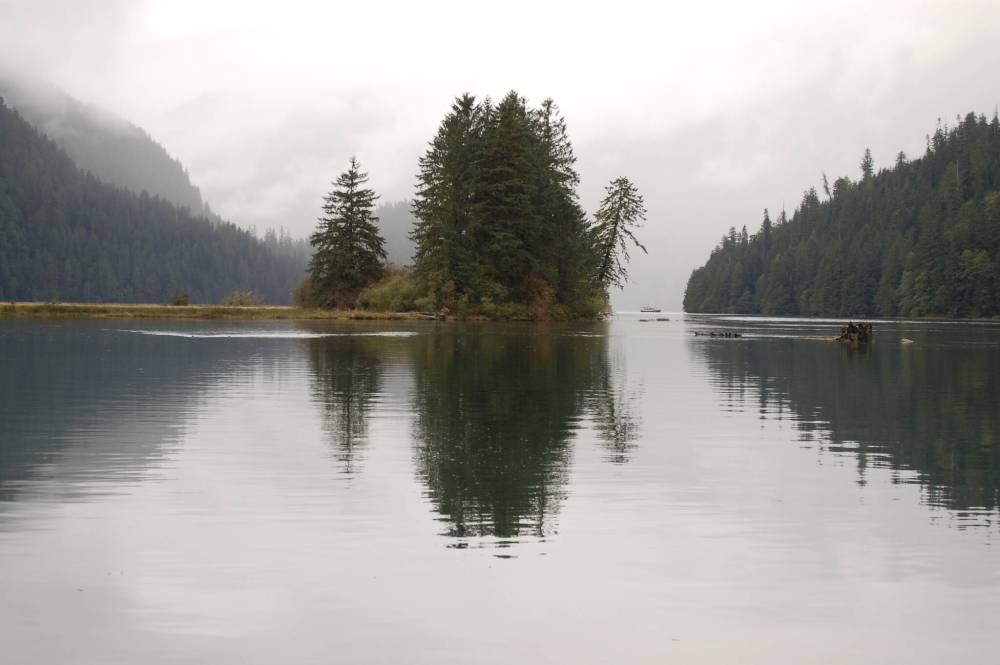
The federal government’s vision for conservation, laid out in its 2026 nature strategy, is of a nation that “protects, restores, and values nature as a foundation of our economy, sovereignty, and well-being.”
How are the industries defined?
Statistics Canada tracks economic activity indicators for a wide range of sectors using the North American Industry Classification System, which assigns a code to specific activities and sectors. Industries and government agencies tally these statistics in different ways to determine overall sector impacts.
This analysis uses Statistics Canada’s data, and defines each industry as follows…
Statistics Canada tracks economic activity indicators for a wide range of sectors using the North American Industry Classification System, which assigns a code to specific activities and sectors. Industries and government agencies tally these statistics in different ways to determine overall sector impacts.
This analysis uses Statistics Canada’s data, and defines each industry as follows:
Agriculture: Crop and animal production (farming), related support activities and food manufacturing, including mills, bakeries, meat and dairy production.
Fisheries: Aquaculture, fishing, hunting and trapping, and seafood product preparation.
Forestry: Forestry and logging, related support activities, wood and paper product manufacturing.
Mining: Mineral mining (ore, non-metals, potash) and quarrying activities, including related support. Also includes mineral product manufacturing and metal manufacturing.
Oil and gas: Oil and gas extraction and related support activities, petroleum and coal product manufacturing, natural gas distribution and pipelines.
Transportation: Air, rail, water, truck and transit and ground transportation (including public transit and taxis).
Utilities: Electric power generation, transmission and distribution and water and sewage systems.
One of the pillars to achieving that vision is “valuing nature and mobilizing capital,” according to the strategy. It estimated the value of “ecosystem services” — the direct and indirect contributions of nature to well-being and quality of life — to be $3.6 trillion dollars, or “more than double our 2018 GDP.” (Seal River, alone, is worth $187 billion in carbon credits.)
In other words, the government is looking to spur more private sector investment in conservation by showing businesses how valuable nature is to their bottom lines.
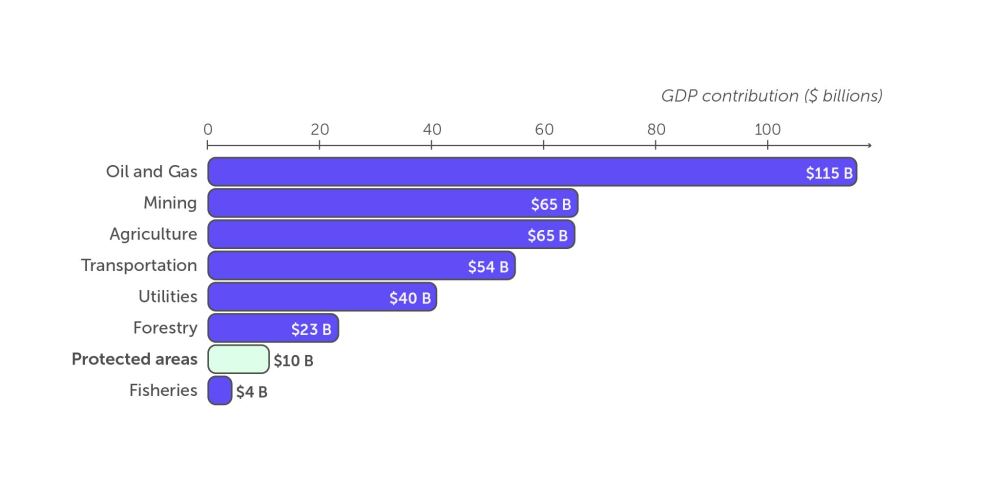
The numbers show conservation is comparable with many of Canada’s major industries. While it may not produce the same scale of economic value as major resource extraction sectors like oil and gas — which does not approach the value of sectors like health care or education — it is a significant contributor to Canada’s economy.
And the return on investment is high: a recent analysis by the Canadian Parks and Wilderness Society (CPAWS) found every dollar spent on protected areas generated more than $3.50 in visitor spending, helping fuel local economies and generate government revenues.
Like the oil and gas sector, Canada can choose to invest in the potential of conservation and champion it as a cornerstone of our country’s economic future.
And as Canadians grapple with the increasingly severe impacts of the climate crisis, the role of intact ecosystems becomes even more valuable.
These nine charts capture some of the value of Canada’s natural environments, and the economic potential of conservation.
Economic contributions from protected areas — by province
Graphics by Julia-Simone Rutgers. Source: Canadian Parks and Wilderness Society (CPAWS)
Source: Canadian Parks and Wilderness Society (CPAWS)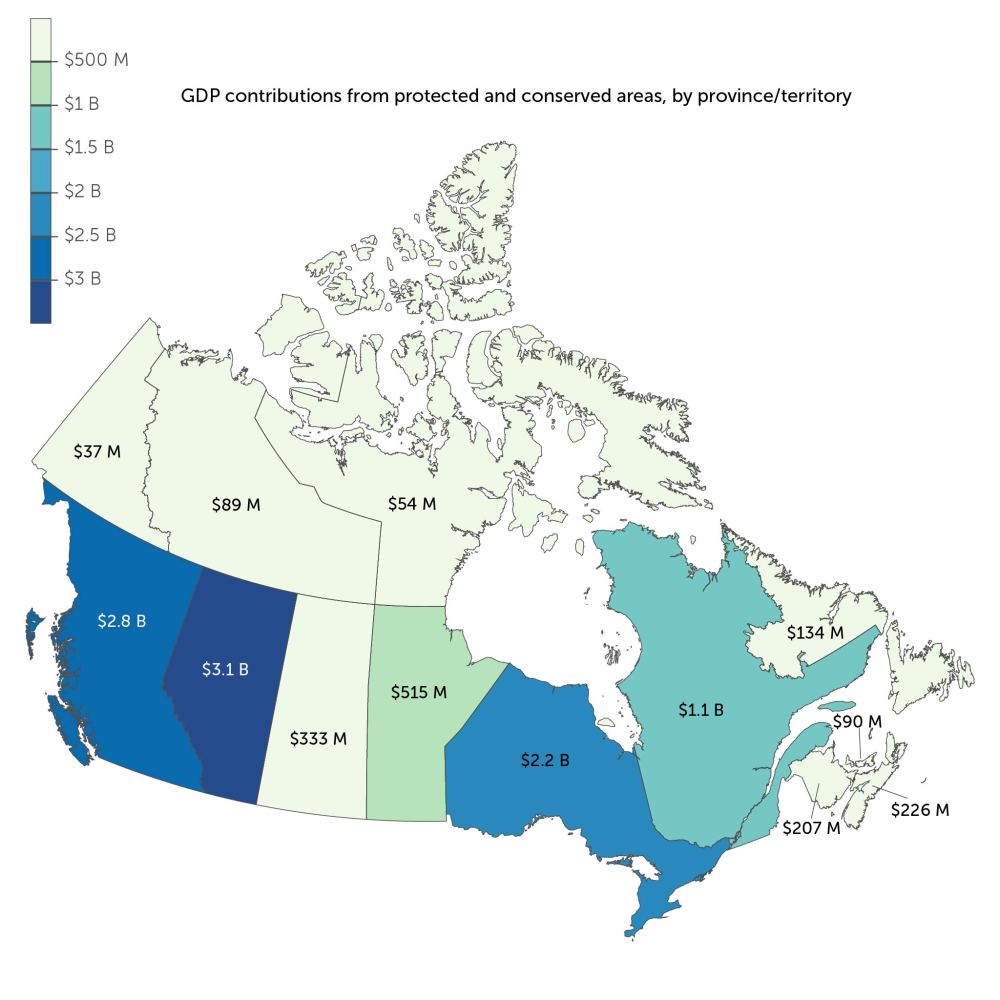
Gross domestic product contributions of Canadian industries
Jobs
More than 150,000 people work in protected and conserved areas — not far behind the oil and gas and forestry sectors.
As CPAWS points out, many of these jobs are in Indigenous, rural and remote communities, where unemployment rates are high compared to urban areas.
In parts of Canada where other economic opportunities are scarce, protected and conserved areas offer the opportunity to create long-term stable employment.
Total jobs across selected Canadian industries
Sources: CPAWS, Statistics Canada. For Statistics Canada figures, the estimate of the total number of jobs covers two main categories: paid workers jobs and self-employed jobs in 2024.
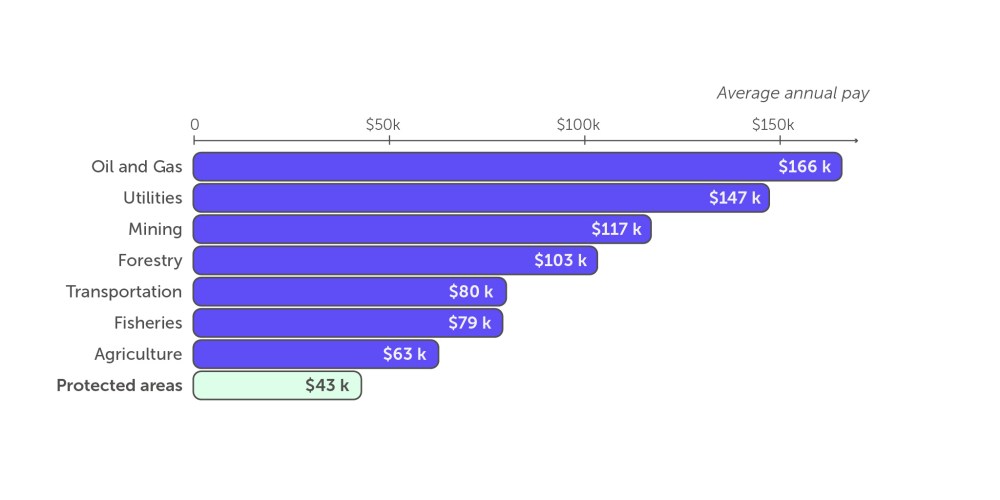
Average annual compensation
Conservation provides value, but how are conservation workers valued?
Compensation for the approximately 150,000 Canadians who work in protected areas is low, compared to other sectors; on average, an oil and gas worker makes nearly four times as much annually.
Tax revenues
Governments collected more than $1.4 billion in tax revenues from parks and protected areas in 2024, most of which stemmed from visitor spending, according to CPAWS’s analysis. That’s comparable to government tax revenues from the forestry industry, at $1.2 billion.
Major resource industries like forestry and oil and gas also create government revenue through royalties and other fees.
But for many of these industries, government revenues can be offset by tax breaks, grants and other subsidies.

Subsidies
Governments invested $2.3 billion in parks and protected spaces in 2024, generating $0.62 in revenue for every dollar invested.
By comparison, the OECD estimates the federal government spent $4.34 billion on fossil fuel subsidies — approximately $1.3 billion more than the United States spent on subsidies, despite their industry’s far greater output.
That number is likely an underestimate, as a lack of clear data and complex incentive structures makes it difficult to track how much governments give out to industry.
Environmental Defence, which releases an annual report tracking Canadian fossil fuel subsidies, estimates the government doled out more than $30 billion in subsidies and financing to fossil fuel companies in 2024. Most of that funding came in the form of a $20-billion loan for the Trans Mountain Expansion project.
Source: OECD, CPAWS, Economic Development Canada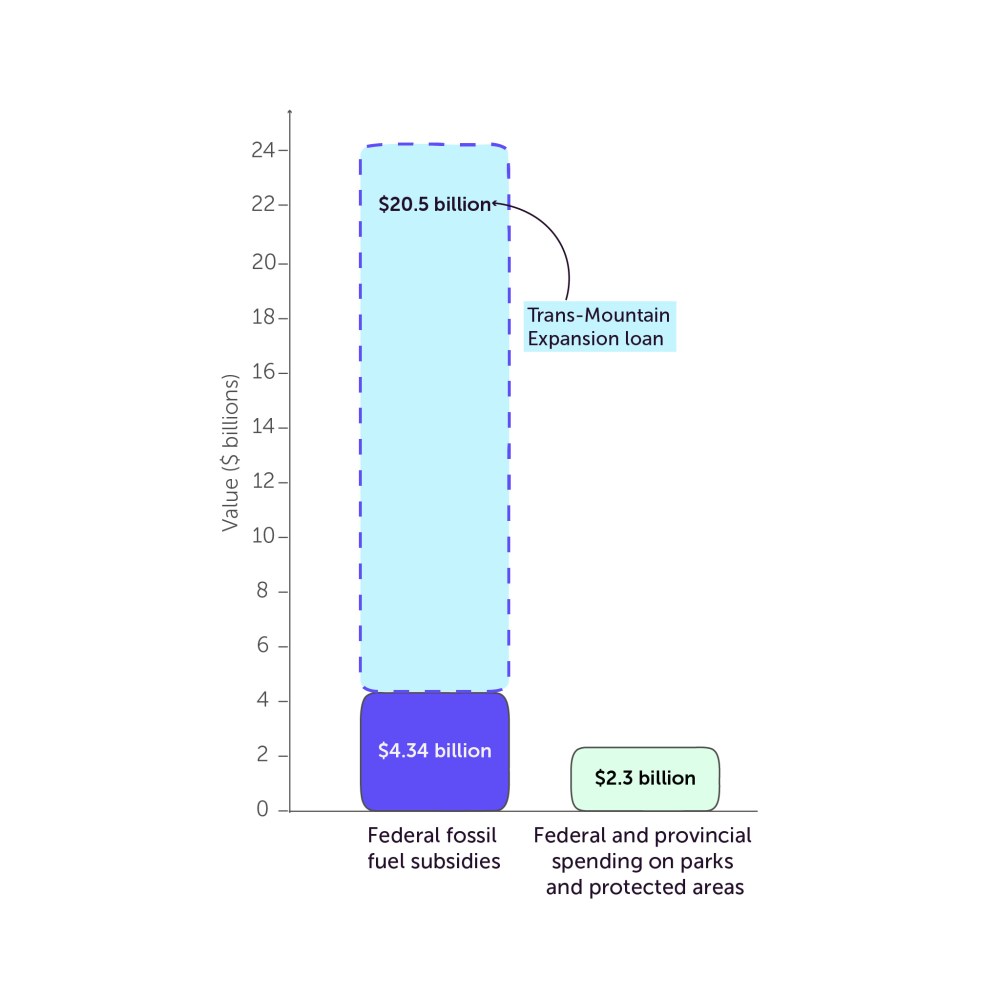
Carbon storage
CPAWS estimated the carbon stocks stored in Canada’s existing protected areas by comparing protected area boundaries to data showing the carbon concentration in soil, vegetated areas, and seabed sediments.
It found a total 51.4 gigatons of carbon stored in the country’s protected forests, peatlands, wetlands, soil and seabeds.
If this carbon was all emitted as carbon dioxide, CPAWS estimates, it would equate to 188.4 gigatons of emissions.
By protecting these regions from industrial disturbances like mining, logging or draining, that carbon stays in the ground. If released, that carbon comes at a cost.
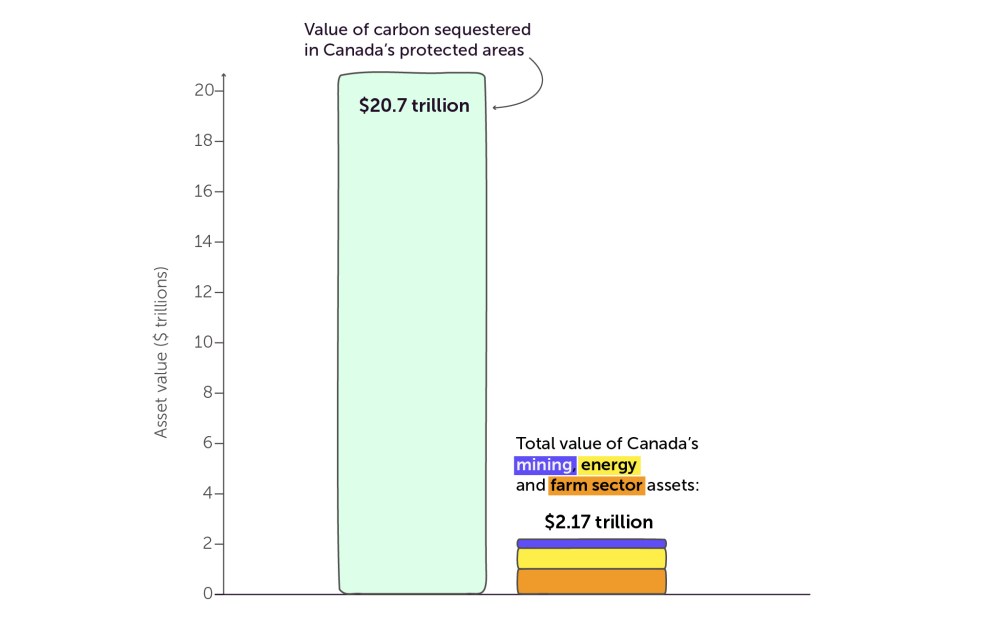
Canada’s industrial carbon price, which charges businesses for emissions that exceed a predetermined limit, is $110 per tonne as of 2026. A carbon credit — doled out for activities that remove or avoid carbon emissions — is worth the same.
At that price, the carbon stored in Canada’s protected areas is worth $20.7 trillion.
That’s about ten times the value of Canada’s global mining assets ($352.6 billion), global energy assets ($827 billion), and domestic farm sector assets ($992.4 billion) combined.
Source: Parks Canada Carbon Atlas Series: Carbon Dynamics in the Forests of National Parks in Canada (2023), SaskPower, Government of Alberta, Entropy Inc.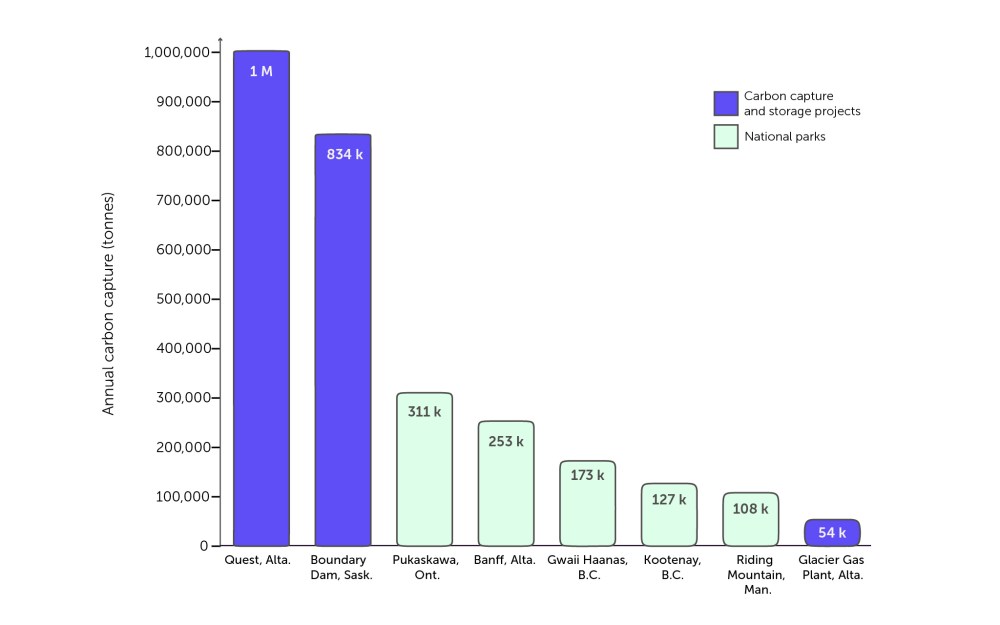
Annual carbon capture
Protected and conserved areas remove greenhouse gases from the atmosphere, a process known as “carbon capture.”
Manitoba’s Riding Mountain National Park, for example, removed an average of 108,328 tonnes of carbon dioxide per year from the atmosphere between 1990 and 2020. This is significantly less than Shell’s Quest carbon capture and storage project, but it’s also just one of thousands of parks and protected areas across Canada.
Most parks, like the ones included in this chart, are sequestering carbon each year. However, when parks or protected areas are hit by wildfires, they can become carbon emitters.

Julia-Simone Rutgers is an investigative reporter who joined the Free Press in 2020. Read more about Julia-Simone.
Every piece of reporting Julia-Simone produces is reviewed by an editing team before it is posted online or published in print — part of the Free Press‘s tradition, since 1872, of producing reliable independent journalism. Read more about Free Press’s history and mandate, and learn how our newsroom operates.
Our newsroom depends on a growing audience of readers to power our journalism. If you are not a paid reader, please consider becoming a subscriber.
Our newsroom depends on its audience of readers to power our journalism. Thank you for your support.
Related Articles
Kinew’s Churchill goals, climate concerns in conflict, environmental groups say