Titan submersible torn apart by catastrophic implosion, killing all five aboard

A catastrophic implosion ripped apart the Titan submersible, killing all five people aboard as it was descending to the bottom of the North Atlantic during an expedition to the wreck of the Titanic, a U.S. Coast Guard official said Thursday.

Read this article for free:


or

Already have an account? Log in here »

To continue reading, please subscribe:

Subscribe and receive a limited-edition Free Press branded hat or tote.

Digital Subscription

One year of digital access for only $205*

  • Enjoy unlimited reading on winnipegfreepress.com
  • Read the E-Edition, our digital replica newspaper
  • Access News Break, our award-winning app
  • Play interactive puzzles

*First annual payment billed as $205.00 + GST for one year. This annual subscription will automatically renew at $233.00 + GST every 52 weeks (10% off the regular annual price of $259.35). Offer available to new and qualified returning subscribers only. Cancel any time.

To continue reading, please subscribe:

Add Free Press access to your Brandon Sun subscription for only an additional

$1 for the first 4 weeks*

  • Enjoy unlimited reading on winnipegfreepress.com
  • Read the E-Edition, our digital replica newspaper
  • Access News Break, our award-winning app
  • Play interactive puzzles
Start now

*Your next Brandon Sun subscription payment will increase by $1.00 and you will be charged $17.95 plus GST for four weeks. After four weeks, your payment will increase to $24.95 plus GST every four weeks.

Hey there, time traveller!
This article was published 22/06/2023 (1206 days ago), so information in it may no longer be current.

A catastrophic implosion ripped apart the Titan submersible, killing all five people aboard as it was descending to the bottom of the North Atlantic during an expedition to the wreck of the Titanic, a U.S. Coast Guard official said Thursday.

Several pieces of the minivan-size craft, including parts of its carbon-fibre hull, were found in a debris field on an otherwise clear section of the ocean floor, about 500 metres from the bow of the sunken luxury liner, Rear Admiral John Mauger, commander of First Coast Guard District in Boston, told reporters.

“The debris is consistent with the catastrophic loss of the pressure chamber,” Mauger said at a briefing in Boston. “Upon this determination, we immediately notified the families.”

Those killed include the vessel’s pilot, OceanGate Expeditions CEO Stockton Rush, British billionaire Hamish Harding, French explorer and Titanic expert Paul-Henry Nargeolet and Pakistani businessman Shahzada Dawood and his 19-year-old son, Suleman.

“On behalf of the United States Coast Guard … I offer my deepest condolences to the families,” Mauger said. “I can only imagine what this has been like for them, and I hope that this discovery provides some solace during this difficult time.”

OceanGate Inc. issued a statement saying the men who died were “true explorers who shared a distinct spirit of adventure.”

“Our hearts are with these five souls and every member of their families during this tragic time,” said company spokesman Andrew Von Kerens. “We grieve the loss of life and joy they brought to everyone they knew.”

The bleak discovery of Titan’s distinctive tail cone and other parts were made Thursday morning by a crew guiding a remotely operated vehicle (ROV) that was launched from the MV Horizon Arctic, a large Canadian tug and supply ship.

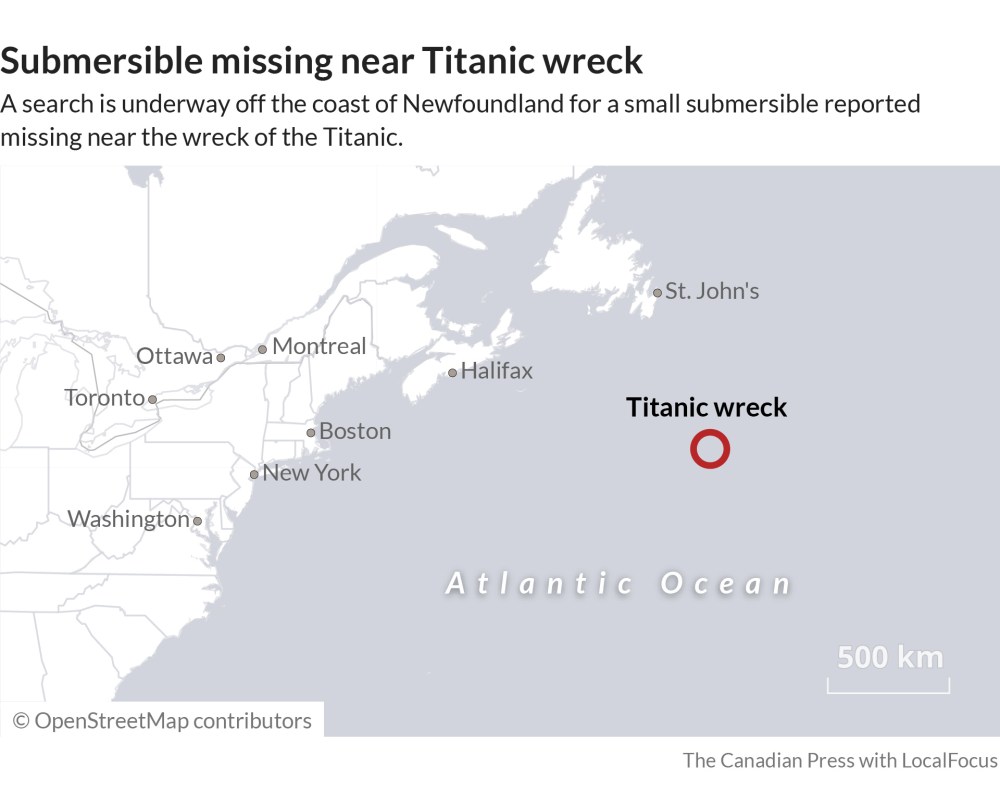
The Titan submersible, operated by Rush’s U.S.-based company, lost contact with surface vessels on Sunday morning as it was nearing the Titanic wreckage during a 3,800-metre dive that typically takes about two hours to complete. The remote site is about 700 kilometres southeast of eastern Newfoundland.
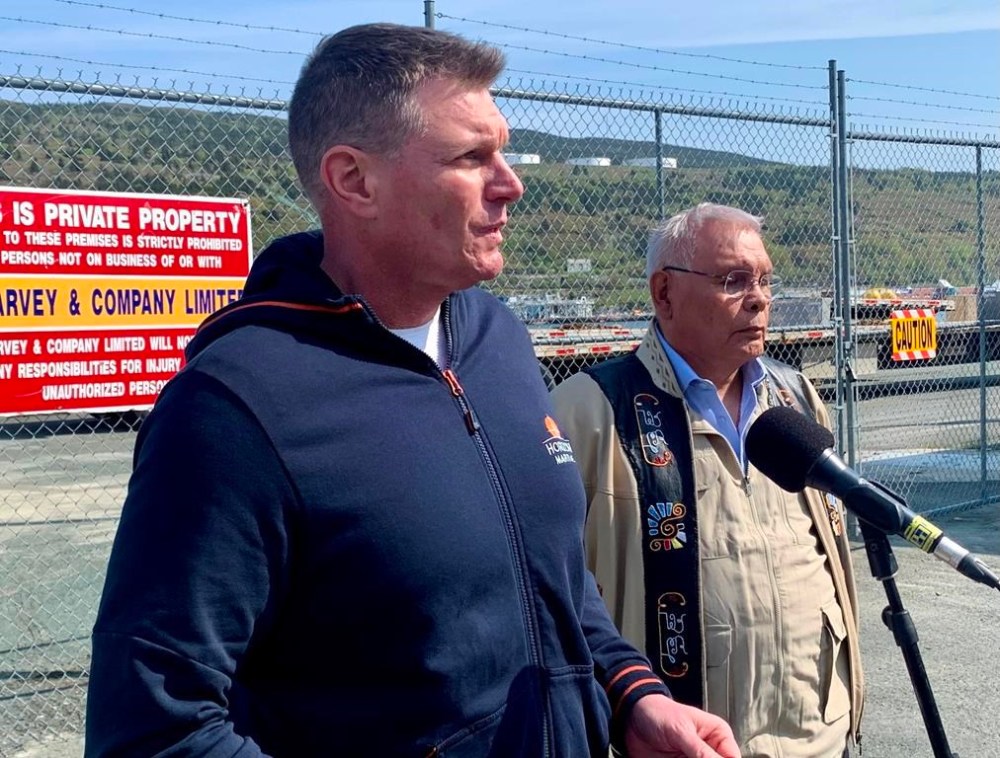
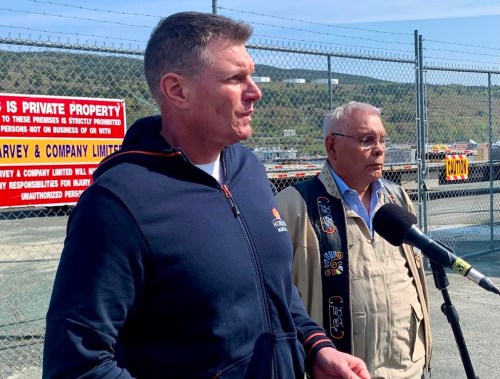
Sean Leet, left, chairman of Horizon Maritime Services, stands with Chief Mi'sel Joe of the Miawpukek First Nation, at a news conference at the harbour in St. John's, Wednesday, June 21, 2023. Underwater noises described as “banging” have been heard in an area of the Atlantic where a submersible disappeared three days ago near the wreck of the Titanic, search officials confirmed Wednesday. THE CANADIAN PRESS/Sarah Smellie

It remains unclear exactly what happened to Titan, but coast guard experts said the expanse of its debris field indicated that it came apart in the water column above the doomed steamship, which sank on April 15, 1912.

In all, five large pieces of the submersible were spotted. A coast guard expert said their location was consistent with where the vessel was expected to be when it lost contact with surface ships on Sunday morning.

As well, Mauger confirmed that the implosion did not happen while the search operation was underway because aircraft dropping sonar-equipped buoys would have recorded that sound.

“We had listening devices in the water throughout and did not hear any signs of catastrophic failure,” he said, adding that the ROVs on the ocean floor would continue to gather evidence of what happened.

When asked if there was any possibility of recovering the victims’ bodies, Mauger said: “This is an incredibly unforgiving environment down there on the sea floor …. We’ll continue to work and search the area, but I don’t have an answer at this time.”

On Wednesday, the U.S. Coast Guard, which led the search for the privately owned Titan, confirmed that sonobuoys dropped in the ocean by a Royal Canadian Air Force CP-140 Aurora patrol aircraft had picked up “banging sounds” earlier that day and on Tuesday, but Mauger said those unidentified noises had no connection to the grim finds on Thursday.
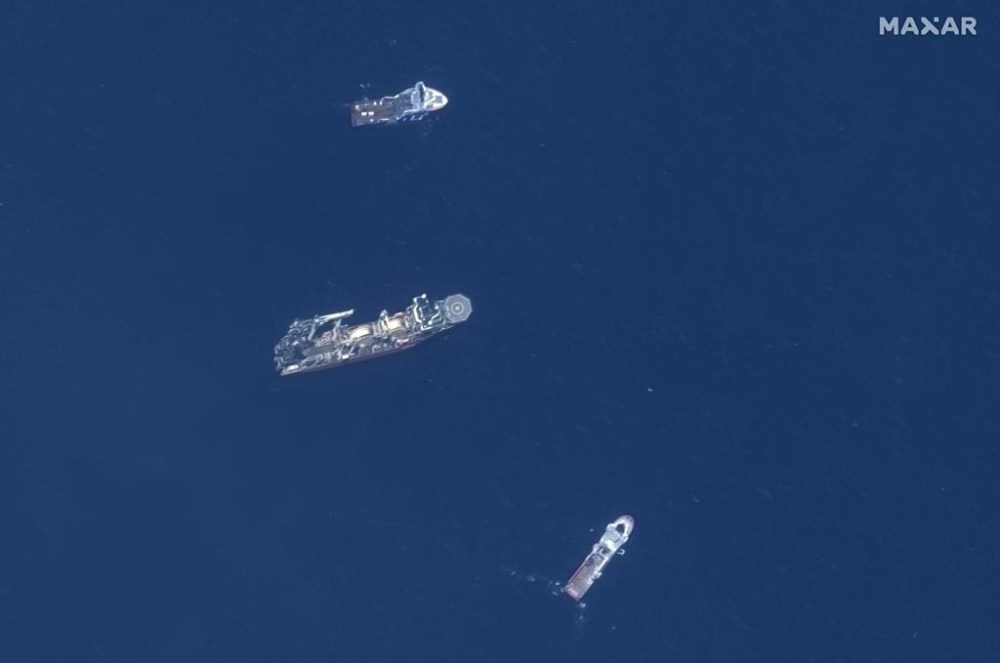
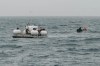
In this satellite image provided by Maxar Technologies, from top to bottom, the vessels Horizon Arctic, Deep Energy and Skandi Vinland search for the missing submersible Titan, Thursday, June 22, 2023 in the Atlantic Ocean. (Satellite image ©2023 Maxar Technologies via AP)

Some experts had suggested the noises could have come from sea creatures or from other vessels in the area.

There was speculation that the massive search effort, which included five vessels on Thursday, had reached a critical stage that day because OceanGate had said Titan’s 96-hour air supply could be running low. But that warning assumed the submersible was still intact.

Jamie Pringle, a professor in forensic geosciences at Keele University, in the United Kingdom, said the first 24 hours are the “golden hours” for a below-surface search, and after that the chances for success decline sharply.

“That’s when most people are found in water searches, and after that time chances of survival reduce massively,” he said in an interview Thursday, citing low temperatures, declining oxygen and rising levels of fatigue.

Paul Johnston, curator of maritime history at the Smithsonian, in Washington, D.C., said OceanGate’s brand of “frontier tourism” is a risky business. Asked about the debris field discovery, Johnston said the find raises questions about making the Titanic off limits to tourists.

“I believe that the current accident will probably diminish interest in Titanic tourism and maybe ‘risk tourism’ in general,” he said in an interview Thursday. He rejected the notion that these undersea tours are a form of exploration.
“(These are) people who are going down to look at an underwater graveyard,” he said. “Who cares how much iron there is in the water column around the ship, or how quickly the rusticles (on the Titanic) grow. To me, that’s of no scientific interest whatsoever …. I think it’s a plaything for wealthy people — a checkbox on a bucket list.”

Meanwhile, some marine engineering experts have come forward to raise concerns about Titan, which was never “classed” or certified by an independent third party to ensure it met certain safety standards.

William Kohnen, president and CEO of the California-based engineering firm Hydrospace Group, has said about 95 per cent of all submersibles are certified. Titan, he said, “is very much an outlier.”

Kohnen was part of a group of engineers and industry professionals who wrote to Rush in 2018 to express their concern. Their letter, first obtained by the New York Times, warned that the company’s “experimental” approach to Titan could have “catastrophic” consequences.

In a 2019 blog post, OceanGate explained that Titan — made from carbon fibre and titanium — was not classed because the process could inhibit innovation and did not address pilot error, which it said is the cause of most marine accidents.

In previous interviews, Rush showed off Titan’s many off-the-shelf features, including a steering control made from a video game controller, and cabin lights purchased from a camping store.
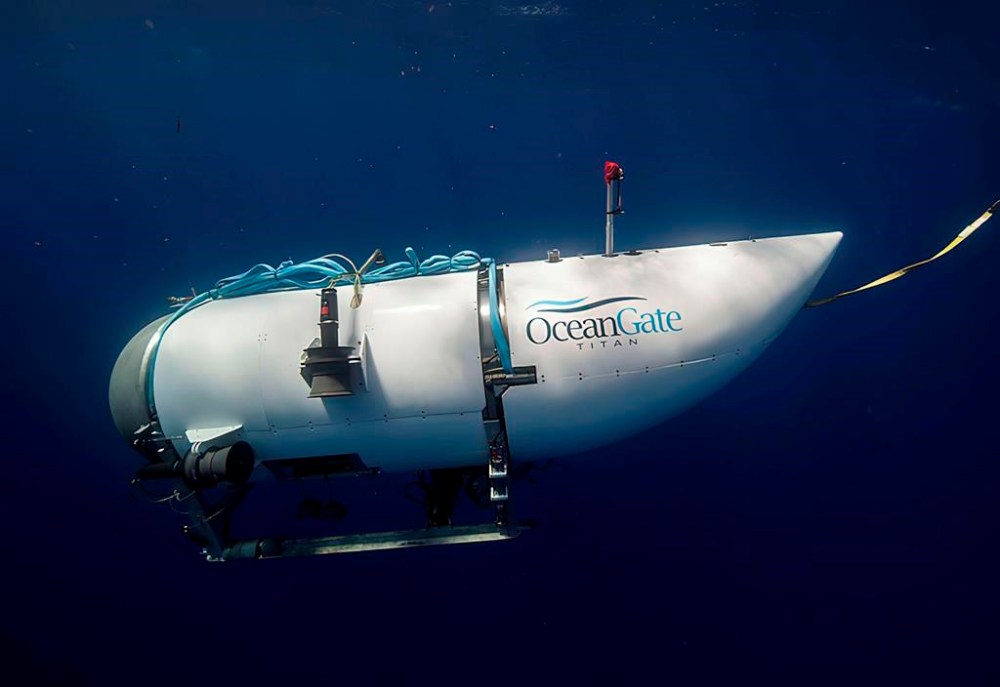
This photo provided by OceanGate Expeditions shows a submersible vessel named Titan used to visit the wreckage site of the Titanic south of Newfoundland. THE CANADIAN PRESS/AP-OceanGate Expeditions via AP

This report by The Canadian Press was first published June 22, 2023.

— With files from Sarah Smellie in St. John’s, Michael Tutton in Halifax, and The Associated Press.

This report by The Canadian Press was first published June 22, 2023.

Report Error Submit a Tip

More Stories

Titan submersible imploded: U.S. Coast Guard

Michael MacDonald, The Canadian Press 7 minute read Preview

Titan submersible imploded: U.S. Coast Guard

Michael MacDonald, The Canadian Press 7 minute read Thursday, Jun. 22, 2023

A catastrophic implosion ripped apart the Titan submersible, killing all five people aboard as it was descending to the bottom of the North Atlantic during an expedition to the wreck of the Titanic, a U.S. Coast Guard official said Thursday.

Several pieces of the minivan-size craft, including parts of its carbon-fibre hull, were found in a debris field on an otherwise clear section of the ocean floor, about 500 metres from the bow of the sunken luxury liner, Rear Admiral John Mauger, commander of First Coast Guard District in Boston, told reporters.

"The debris is consistent with the catastrophic loss of the pressure chamber," Mauger said at a briefing in Boston. "Upon this determination, we immediately notified the families."

Those killed include the vessel's pilot, OceanGate Expeditions CEO Stockton Rush, British billionaire Hamish Harding, French explorer and Titanic expert Paul-Henry Nargeolet and Pakistani businessman Shahzada Dawood and his 19-year-old son, Suleman.

Read
Thursday, Jun. 22, 2023

Yielding attraction

Joel Schlesinger 6 minute read Preview

Yielding attraction

Joel Schlesinger 6 minute read 2:01 AM CDT

Yield is a Rorschach test for investors. Where one see opportunity in high payouts from an investment, another sees high risk.

Consider bonds: yields are moving higher, which implies higher risk in the market, but to an investor considering buying a bond, higher yields represent higher income.

For most of the past 18 years, bond yields have been near historical lows and investors have sought alternatives.

“Canada’s population is aging, with a growing number of investors approaching or entering retirement and looking for more income,” says Pat Sommerville, co-chief executive officer of Hamilton ETFs in Toronto.

Read
2:01 AM CDT

Towing company hands stolen car back, but not to owner

By Matthew Frank 4 minute read Preview

Towing company hands stolen car back, but not to owner

By Matthew Frank 4 minute read Yesterday at 4:29 PM CDT

A Manitoba man says he is dumbfounded after his car was stolen, impounded by a Winnipeg towing company and given back — to someone that wasn’t him.

Cody Lamb lives in the western Manitoba community of Douglas, about 18 kilometres east of Brandon, but spends weeks away from home working on oil rigs in Alberta.

The 24-year-old says on Sept. 11, while away for work, he heard from his girlfriend who told him his car wasn’t in their driveway. Lamb reported the car stolen to Brandon RCMP the same day.

After filing the report, he heard from Steinbach RCMP on Oct. 1 that his car was recovered that day in the community of Mitchell, roughly five km west of Steinbach.

Read
Yesterday at 4:29 PM CDT

Nature doesn’t waste its time

Russell Wangersky 7 minute read Preview

Nature doesn’t waste its time

Russell Wangersky 7 minute read 2:01 AM CDT

Sixteen months in and the black burn from a forest fire somehow transitions from the foreground to the background. I’m not sure if it actually softens, if it really changes, or if is just that your eyes, now used to the background, start seeing less of it.

One thing’s for certain: nature doesn’t waste any time taking its opportunities. In the sheltered ground behind where the shed over our Newfoundland root cellar used to be, a forest of sorrel has arisen, its dark-green leaves with their distinctive double horns at their base crowding in tight amongst each other.

It’s no surprise: sorrel is new beginnings, often the first plant I see recultivating abandoned gardens or disturbed ground and I’m happy to have it around always. Its distinctive lemony bite is a fine addition to salads, though we’re not likely to choose it from that particular root cellar patch. Not with the way the asphalt roof shingles burned right around there. I shovelled up the heavy pats of congealed black tar last spring, right after the fire, bringing them up from inside the cellar in big plastic buckets to send to safe disposal. But there’s probably plenty of tar still in the ground and out of sight — hardly an appetizing thought.

From other areas, maybe we will eventually sample sorrel: it depends on how close they were to the house or shed or anything else that burned. And so very much burned. The province has said gardens are safe from contamination by fire-retardant chemicals as nothing has shown up in tests. But we know what way the wind was blowing — what burned, and where, is always part of the equation. It’s a strange calculation to make: I’m just glad our house wasn’t heated with fuel oil, was too old to contain asbestos, and didn’t have indoor plumbing for decades.

Read
2:01 AM CDT

Police looking into robbery of children captured on video

Morgan Modjeski 3 minute read Preview

Police looking into robbery of children captured on video

Morgan Modjeski 3 minute read Yesterday at 3:08 PM CDT

The Winnipeg Police Service said it is aware of a video circulating online that appears to show two children robbed while walking home from the library.

The mother of the siblings said the Sept. 26 incident, which happened in the area of Andrews Street and Magnus Avenue at around 7:30 p.m., has left her children afraid and her feeling guilty.

“I should have been there with them. I felt horrible,” said Brittany Beaudet. “I would have been out the door if I knew any sooner to help them out.”

In the 40-second video, the two children, 14-year-old Mason and nine-year-old Kenzie, are approached by a man wearing a black shirt, black pants and white shoes.

Read
Yesterday at 3:08 PM CDT

Puppies, stocks — ‘zoomies’ abound

Andrew Froese 4 minute read 2:01 AM CDT

This spring, I adopted a three-month-old rescued German Shepherd mix. To say she is easily excitable is an understatement.

It is not really her fault. A puppy’s frontal cortex, the part of the brain that helps with decision-making and impulse control, is still developing. When an older dog, or a human, gets tired, we generally understand we should rest. Puppies have not quite figured that out. They often interpret tiredness as a signal something is wrong, which makes them more alert, more reactive and harder to settle.

That creates a feedback loop. The puppy gets tired, which makes her frantic, which makes her more tired, which makes her even more frantic. Eventually, this becomes what people call the “zoomies”: frantic sprinting, biting, jumping and general chaos.

From the outside, it looks like the puppy has too much energy. In reality, the opposite is true. The zoomies are not a sign of excess energy. They are a sign the puppy is overtired and does not know it yet.