The largest digital camera ever built has released its first shots of the universe

NEW YORK (AP) — The largest digital camera ever built released its first shots of the universe Monday — including colorful nebulas, stars and galaxies.

Read this article for free:


or

Already have an account? Log in here »

To continue reading, please subscribe:

Subscribe and receive a limited-edition Free Press branded hat or tote.

Digital Subscription

One year of digital access for only $205*

  • Enjoy unlimited reading on winnipegfreepress.com
  • Read the E-Edition, our digital replica newspaper
  • Access News Break, our award-winning app
  • Play interactive puzzles

*First annual payment billed as $205.00 + GST for one year. This annual subscription will automatically renew at $233.00 + GST every 52 weeks (10% off the regular annual price of $259.35). Offer available to new and qualified returning subscribers only. Cancel any time.

To continue reading, please subscribe:

Add Free Press access to your Brandon Sun subscription for only an additional

$1 for the first 4 weeks*

  • Enjoy unlimited reading on winnipegfreepress.com
  • Read the E-Edition, our digital replica newspaper
  • Access News Break, our award-winning app
  • Play interactive puzzles
Start now

*Your next Brandon Sun subscription payment will increase by $1.00 and you will be charged $17.95 plus GST for four weeks. After four weeks, your payment will increase to $24.95 plus GST every four weeks.

Hey there, time traveller!
This article was published 23/06/2025 (440 days ago), so information in it may no longer be current.

NEW YORK (AP) — The largest digital camera ever built released its first shots of the universe Monday — including colorful nebulas, stars and galaxies.

The LSST Camera being loaded onto a transport cart before installation on the Simonyi Survey Telescope at NSF–DOE Vera C. Rubin Observatory  (RubinObs/NOIRLab/SLAC/NSF/DOE/AURA/T. Lange)
The LSST Camera being loaded onto a transport cart before installation on the Simonyi Survey Telescope at NSF–DOE Vera C. Rubin Observatory (RubinObs/NOIRLab/SLAC/NSF/DOE/AURA/T. Lange)

The Vera C. Rubin Observatory, located on a mountaintop in Chile, was built to take a deeper look at the night sky, covering hidden corners.

Funded by the U.S. National Science Foundation and U.S. Department of Energy, it will survey the southern sky for the next 10 years.

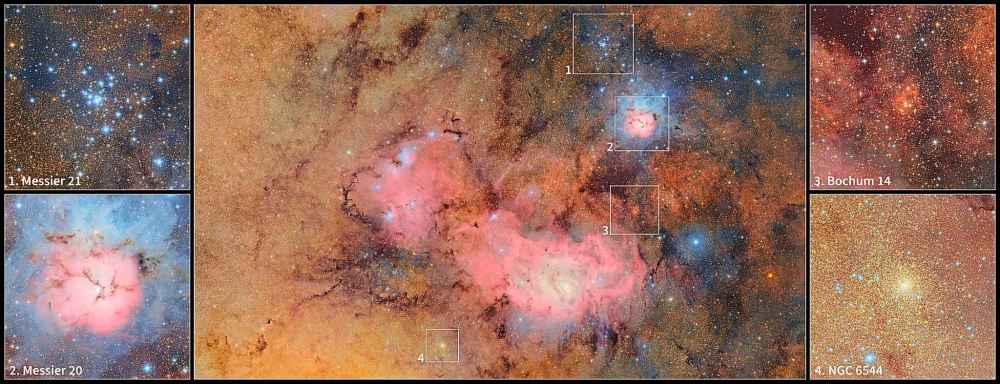
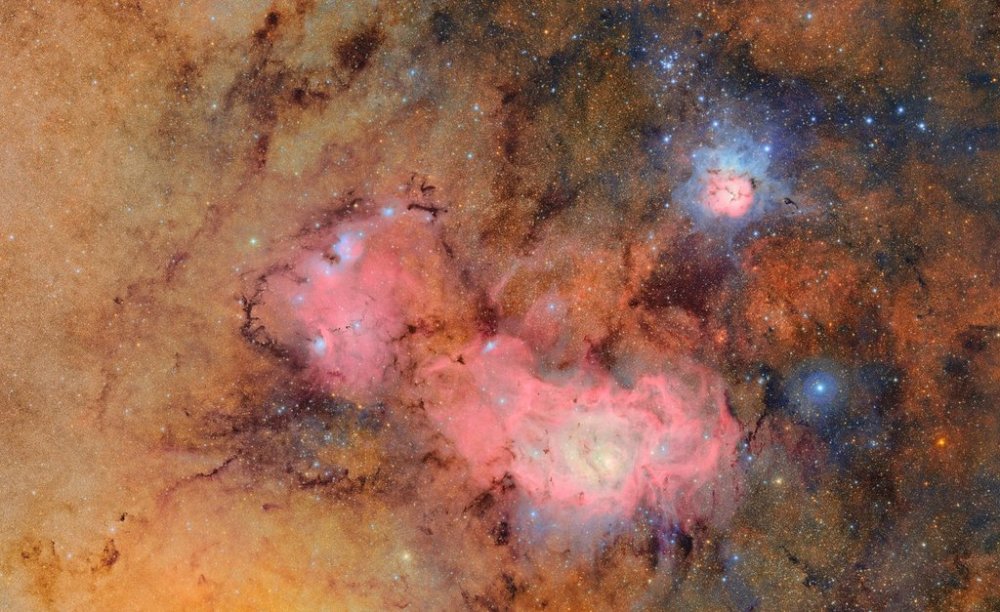
The observatory’s first look features the vibrant Trifid and Lagoon nebulas located thousands of light-years from Earth.

A light-year is nearly 6 trillion miles. A gaggle of galaxies known as the Virgo Cluster were also captured, including two bright blue spirals.
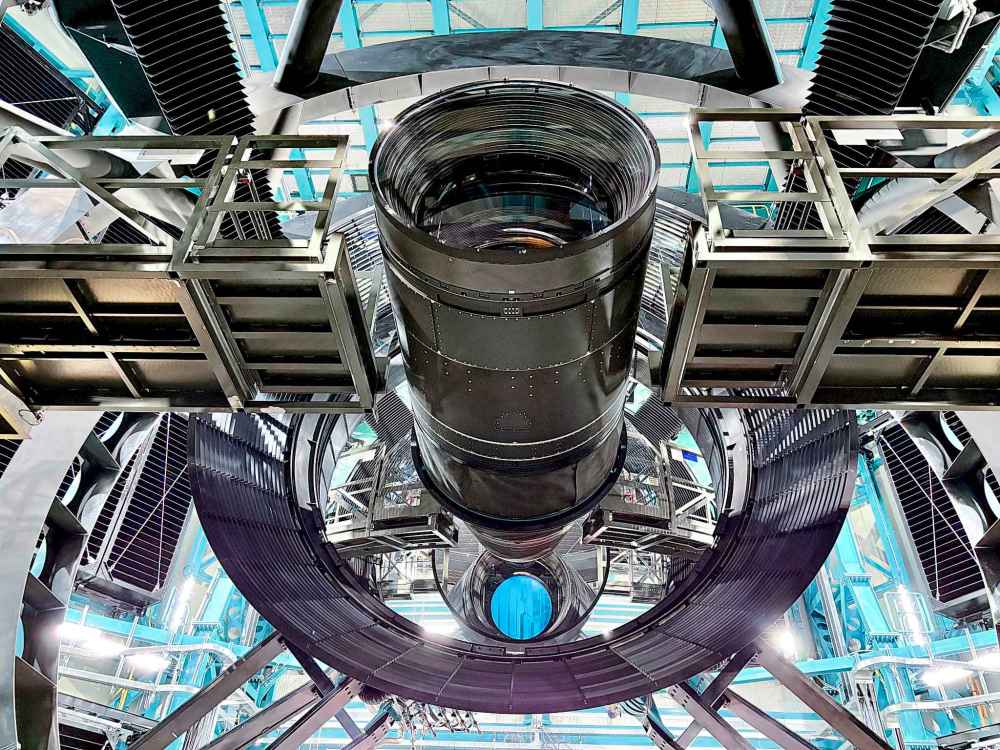
The LSST Camera is installed in the Simonyi Survey telescope.  (RubinObs/NSF/DOE/NOIRLab/SLAC/AURA/T. Lange)
The LSST Camera is installed in the Simonyi Survey telescope. (RubinObs/NSF/DOE/NOIRLab/SLAC/AURA/T. Lange)

The observatory hopes to image 20 billion galaxies and discover new asteroids and other celestial objects.

The effort is named after astronomer Vera Rubin, who offered the first tantalizing evidence that a mysterious force called dark matter might be lurking in the universe.

Researchers hope the observatory’s discerning camera may yield clues about this elusive entity along with another called dark energy.
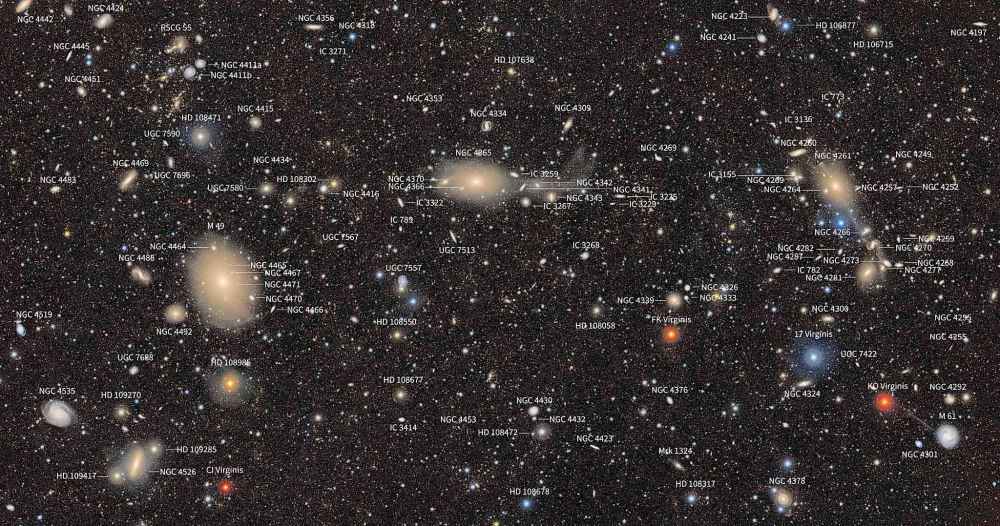
This annotated First Look image of the Virgo Cluster was captured by NSF–DOE Vera C. Rubin Observatory.

This image provided by the NSF-DOE Vera C. Rubin Observatory shows 678 separate images taken by the observatory in just over seven hours of observing time. Combining many images in this way clearly reveals otherwise faint or invisible details, such as the clouds of gas and dust that comprise the Trifid nebula (top right) and the Lagoon nebula, which are several thousand light-years away from Earth. (NSF-DOE Vera C. Rubin Observatory via AP)

This image offers a closer look at the region surrounding the Lagoon Nebula, as seen in this First Look image captured by NSF–DOE Vera C. Rubin Observatory. The Lagoon Nebula is the central pink, kidney bean-shaped area that spans much of the image. At the upper-right is the open star cluster Messier 21. Beneath that is the star-forming Trifid Nebula, known as Messier 20. Further down is the open cluster Bochum 14. Finally, to the bottom-left of the Lagoon Nebula is the globular cluster NGC 6544.  (NSF–DOE Vera C. Rubin Observatory)
This image offers a closer look at the region surrounding the Lagoon Nebula, as seen in this First Look image captured by NSF–DOE Vera C. Rubin Observatory. The Lagoon Nebula is the central pink, kidney bean-shaped area that spans much of the image. At the upper-right is the open star cluster Messier 21. Beneath that is the star-forming Trifid Nebula, known as Messier 20. Further down is the open cluster Bochum 14. Finally, to the bottom-left of the Lagoon Nebula is the globular cluster NGC 6544. (NSF–DOE Vera C. Rubin Observatory)

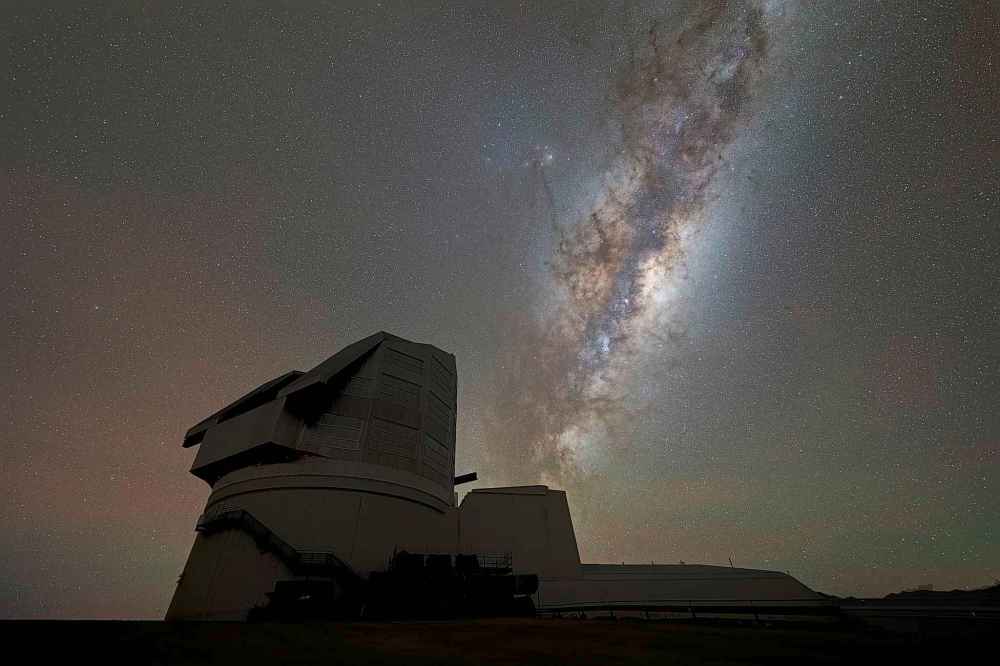
The night sky dazzles over Rubin Observatory.  (RubinObs/NOIRLab/SLAC/DOE/NSF/AURA/H. Stockebrand)
The night sky dazzles over Rubin Observatory. (RubinObs/NOIRLab/SLAC/DOE/NSF/AURA/H. Stockebrand)


The Associated Press Health and Science Department receives support from the Howard Hughes Medical Institute’s Department of Science Education and the Robert Wood Johnson Foundation. The AP is solely responsible for all content.

Report Error Submit a Tip

More Stories

Puzzles Palace

1 minute read Monday, Jul. 27, 2026

To solve our puzzles, please subscribe with this special offer: |

Smith’s pretzel logic confuses

Editorial 4 minute read Preview

Smith’s pretzel logic confuses

Editorial 4 minute read Yesterday at 2:01 AM CDT

Alberta Premier Danielle Smith had both sides of her mouth working overtime on Aug. 30, when she spoke at an event in Calgary to commemorate Alberta Day, the annual celebration of the province’s entry into Confederation in 1905 (officially Sept. 1, it was celebrated on the weekend).

Smith’s comments — and the things she did not say — revealed a lot about the political tightrope the premier is trying to walk over the challenges currently faced by her province. At the top of that list of challenges is a persistent campaign to separate Alberta from the aforementioned Confederation. A campaign that Smith appears to both support and oppose, depending on which day of the week it is.

Her Alberta Day remarks were an excellent case in point.

Smith has decided that on Oct. 19, Albertans will vote on a series of non-binding propositions in a province referendum. One of those questions will ask Albertans whether they want to hold a referendum on separation, thus making this fall’s vote a “referendum on whether to hold a referendum,” as some observers have dubbed it.

Read
Yesterday at 2:01 AM CDT

‘Quite a journey’: dozens move into transitional housing downtown

Carol Sanders 4 minute read Preview

‘Quite a journey’: dozens move into transitional housing downtown

Carol Sanders 4 minute read Friday, Sep. 4, 2026

Dozens of residents have moved into transitional housing units in a former university building in downtown Winnipeg.

Housing, Addictions and Homelessness Minister Bernadette Smith said 42 residents have moved into suites on the third and fourth floors of a seven-storey building previously owned by Providence University College and Theological Seminary. There will be space for as many as 118 people who were in encampments or otherwise homeless.

The remaining units under renovation are expected to be ready and occupied in the coming weeks, Smith said.

“This has been two years in the making,” the minister said at a media event with residents, staff, neighbours and supporters. The building cost the province $24.4 million to purchase and renovate.

Read
Friday, Sep. 4, 2026

A life's story: translator, poet, radio host, actor loved life to the fullest

Tiago Resko 7 minute read Preview

A life's story: translator, poet, radio host, actor loved life to the fullest

Tiago Resko 7 minute read Yesterday at 3:00 AM CDT

Born with an innate sense of curiosity, Charles Leblanc always wanted to understand the world around him. To him, words and theatre weren’t just pastimes. They were means of understanding the human experience and helping others see different perspectives.

The poet, translator, actor and radio host dedicated his life to this practice, founding the Winnipeg International Writers’ Festival, establishing French community radio station Envol — where he hosted a show for 25 years — and acting as a core member of the Association of Translators, Terminologists and Interpreters of Manitoba.

Leblanc’s contributions and dedication to Manitoba’s arts and literary scenes made an impact that continues to be felt by the community.

He died June 26 at the age of 75.

Read
Yesterday at 3:00 AM CDT

Man who pleaded guilty to killing three cats dies before sentencing

Morgan Modjeski 3 minute read Preview

Man who pleaded guilty to killing three cats dies before sentencing

Morgan Modjeski 3 minute read Friday, Sep. 4, 2026

A Winnipeg man awaiting sentencing after admitting he strangled three cats to death and dumped two of their carcasses under a city bridge, has died, the Free Press has learned.

Randy Jensen, 25, pleaded guilty on May 13 to one count of wilfully causing injury or suffering to animals in connection to the 2024 killings.

He was scheduled to be sentenced in January.

“That’s not something that anybody wanted,” said Kristy Zamonsky, founder of Project Artemis Animal Advocates. “We were all hoping for justice through the courts.”

Read
Friday, Sep. 4, 2026

Letters, Sept. 5

7 minute read Yesterday at 2:01 AM CDT

Clearing the airRe: QDoc patients in middle of billing dispute (Sept. 4)

QDoc has been fortunate to have a genuine partner in the Manitoba government over the past several years. Premier Wab Kinew and Health Minister Uzoma Asagwara have been consistently clear that no Manitoban should go without care because of where they live, and that commitment is exactly why virtual care exists as a permanent, publicly available option today. We built MediNav, the province’s online appointment booking system, together with Manitoba Health, and that same collaborative spirit has helped make more than 350,000 patient visits possible through our platform — many of them evenings, overnights and weekends, reaching rural and underserviced communities that need it most.

We want to be direct with the people who rely on us: QDoc is not going anywhere. We continue to see patients today, and we will keep doing so tomorrow. The issue reported this week is a technical billing matter, not a service disruption, and we are actively working with the province to resolve it quickly, so we can keep growing our capacity to serve Manitobans rather than limiting it.

We also want to take responsibility for our part in the recent confusion. Our Aug. 24 message to a small subset of our patients was meant to keep our community informed, but its tone left some people more worried than they needed to be, and for that we apologize. That was never our intention.