
Cache-ing in Thrill is in the hunt for geocachers who search far and wide for hidden treasures
Read this article for free:
or
Already have an account? Log in here »
To continue reading, please subscribe:
Digital Subscription
One year of digital access for only $1.44 a week*
- Enjoy unlimited reading on winnipegfreepress.com
- Read the E-Edition, our digital replica newspaper
- Access News Break, our award-winning app
- Play interactive puzzles
*Billed as $5.77 plus GST every four weeks. After 52 weeks, price increases to the regular rate of $19.95 plus GST every four weeks. Offer available to new and qualified returning subscribers only. Cancel any time.
To continue reading, please subscribe:
Add Free Press access to your Brandon Sun subscription for only an additional
$1 for the first 4 weeks*
- Enjoy unlimited reading on winnipegfreepress.com
- Read the E-Edition, our digital replica newspaper
- Access News Break, our award-winning app
- Play interactive puzzles
*Your next Brandon Sun subscription payment will increase by $1.00 and you will be charged $17.95 plus GST for four weeks. After four weeks, your payment will increase to $24.95 plus GST every four weeks.
Read unlimited articles for free today:
or
Already have an account? Log in here »
Hey there, time traveller!
This article was published 03/10/2020 (2080 days ago), so information in it may no longer be current.
Next time you wander through the sculpture garden at Assiniboine Park, watch out for the folks playing a version of hide-and-seek among the beautiful bronze figures.
Celebrating 15 years of caching in Manitoba
Check out the Manitoba Geocaching Association Tribute Trail, located near St. Malo on the Crow Wing Trail, consisting of 15 caches, one for every year of the association’s existence. Stretching out more than three kilometres, the trail commemorates the most found caches of the last 15 years in symbols and puzzles. Give yourself about two hours to complete the trail, which is only accessible by foot or bicycle.
Check out MBGA online or on Facebook.
“Some people come to the Leo Mol (Sculpture) Garden to look at sculptures and maybe get a cache while they’re here,” explains Jordan McPeek, treasurer of the Manitoba Geocaching Association. “We come for the caches and maybe look at the sculptures.”
A combination of adventure sport and puzzle solving, geocaching is officially two decades old this year, dating back to when selective availability of global positioning systems was lifted and locations could be detected more accurately. Enthusiasts in Manitoba are also celebrating 15 years of locating those tiny, hidden containers all over the province with the aid of a portable GPS device or a smartphone.
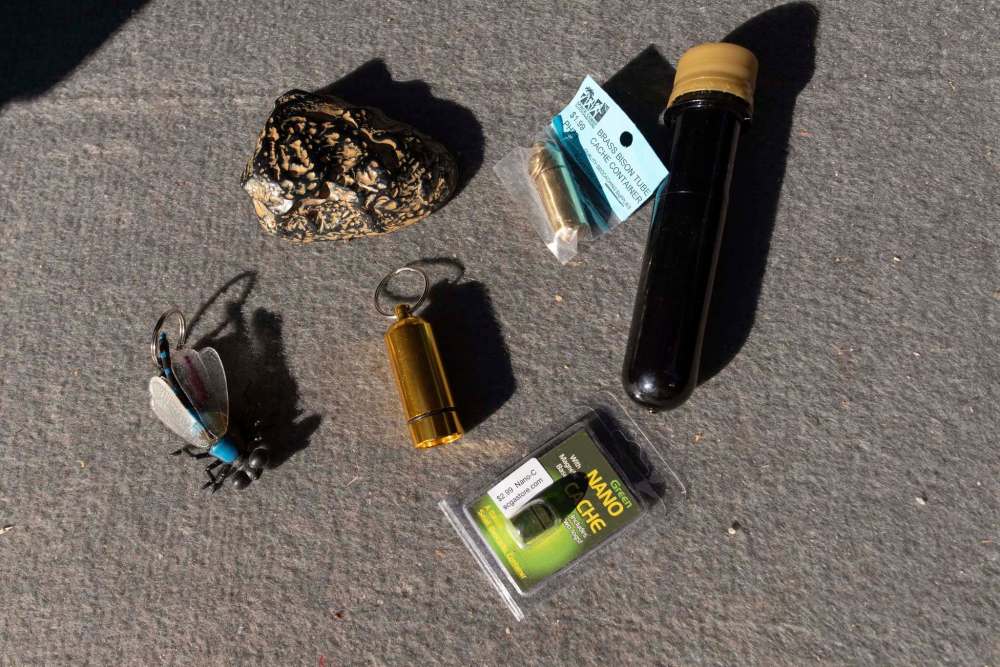
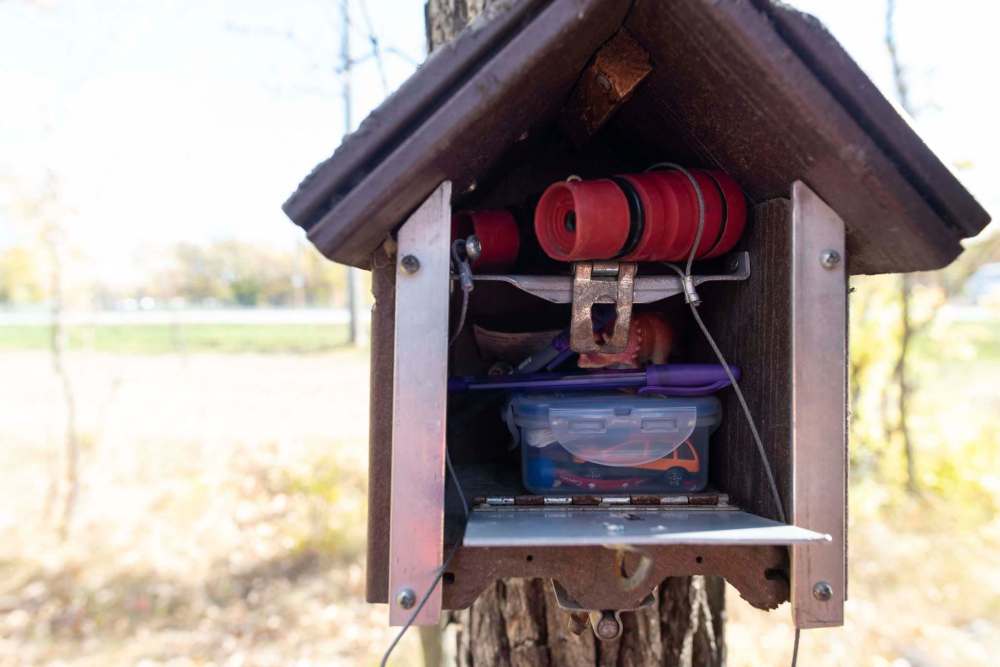
Using a geocaching app (www.geocaching.com), participants can search out outdoor waterproof caches, some just simple pill bottles with a small logbook inside, others more elaborate puzzles that require solving clues. Most are cleverly hidden in plain sight on poles, trees or buildings in parks, boulevards or ditches, explains McPeek.
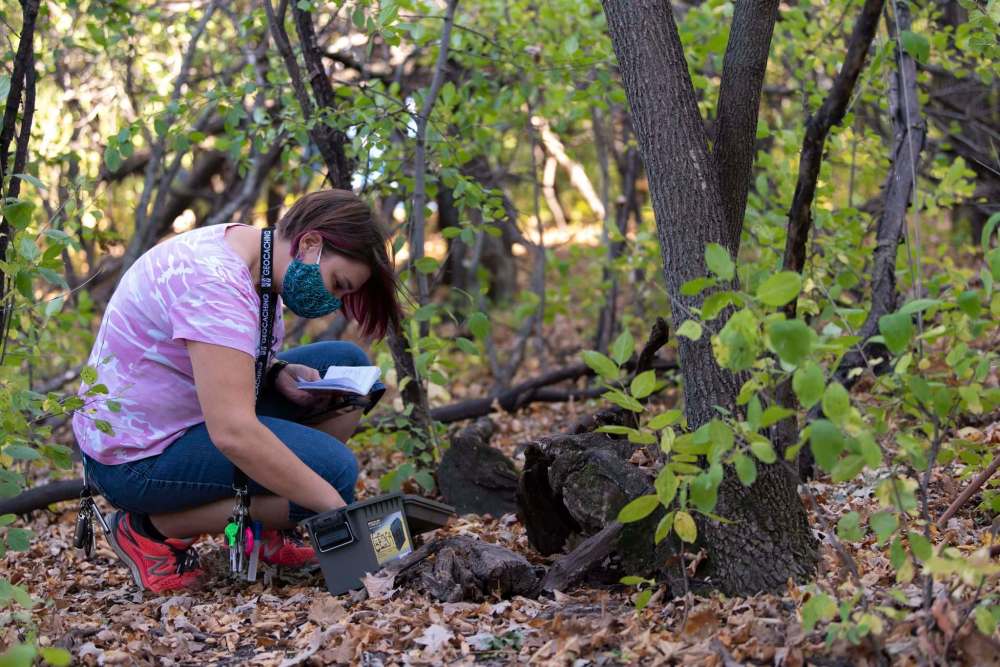
“Generally they’re hidden in a public spot where it’s accessible and its rather innocuous,” he says of the nearly 3,000 caches hidden in and around Winnipeg.
“It’s not harming anything or involving moving in a restricted area.”
Getting started
Find a cache near you by downloading the free geocaching app on your smartphone or going online to www.geocaching.com. Paying the premium fee of about $40 unlocks even more caches
Basic necessities include good walking shoes, a water bottle, a smartphone or handheld GPS or smartphone and a pen or pencil to mark the log
Find a cache near you by downloading the free geocaching app on your smartphone or going online to www.geocaching.com. Paying the premium fee of about $40 unlocks even more caches
Basic necessities include good walking shoes, a water bottle, a smartphone or handheld GPS or smartphone and a pen or pencil to mark the log
Regular geocachers invest in TOTT (tools of the trade) including tweezers, a pocket knife or multi-tool, a small flashlight, a whistle, a small self-inking stamp, expandable mirror and magnet for hard to reach caches, portable phone batteries, gloves and even a telescoping ladder to reach those high caches
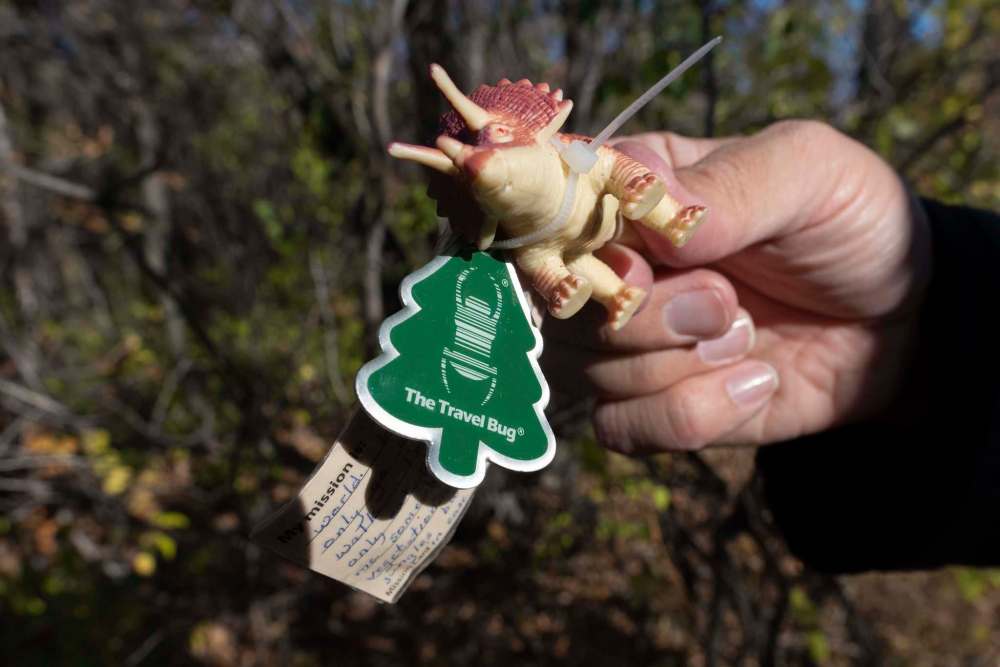
Some caches include trackables, a small token that geocachers move to another location in a quest to see how far the item can travel
The hunt is a huge part of the thrill, says longtime cacher and vlogger Kristin McCrindle, whose geocache handle is Hakliva.
(Most geocachers use a code name to sign the cache logbook and post their latest stats on online geocaching boards.)
“When you get within five metres, you put down your GPS and look at what doesn’t belong,” explains McCrindle during a recent search for caches in Assiniboine Park.
In this case, what didn’t belong was made of metal in a stand of bushes near a fence. McCrindle cautions against revealing more specifics about the cache description and location because knowing what you’re looking for takes the fun out of the search.
The caching code does allow phoning a friend for answers, adds fellow enthusiast Abe Wall of Winkler, who has travelled extensively across North America since he took up the hobby in 2014, logging about 17,000 caches so far, and hiding about 250 of his own.
“Generally they’re hidden in a public spot where it’s accessible and its rather innocuous.” – Jordan McPeek
“I’m driving to Winnipeg and I’m looking for something and it’s tricky,” Wall, 66, known as AWOL, says of when he asks for help.
Although the activity is often done alone or in pairs, McPeek says geocachers form a virtual community by following the stats posted monthly on the association’s website and Facebook page, and exchanging contact information so they can ask for help if they’re really stumped while searching for a cache
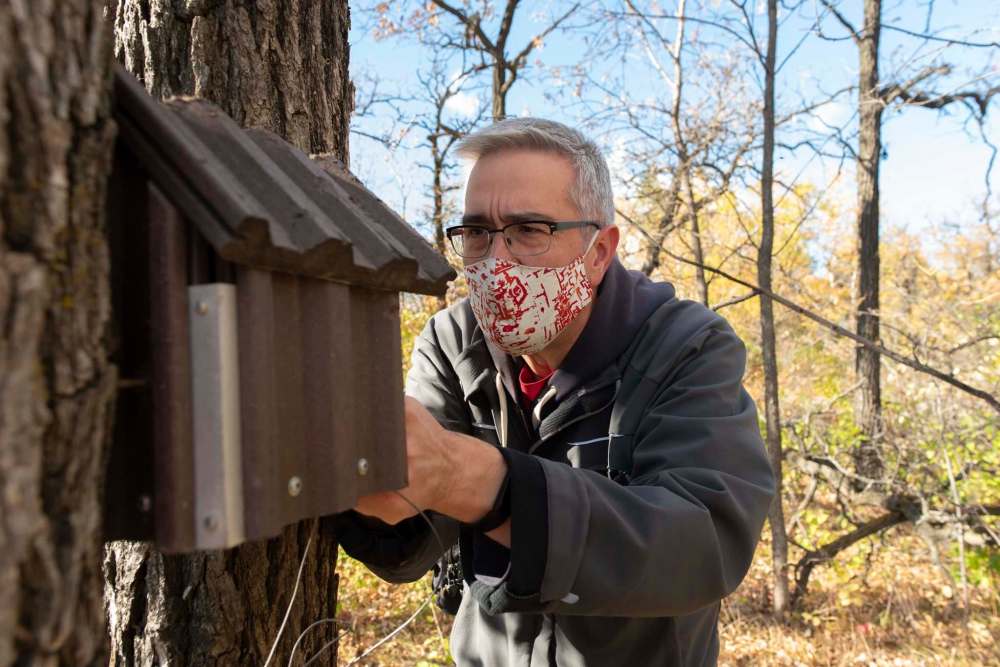
The app offers a few cryptic clues, and the name of the cache can also help narrow the search. If that fails, being prepared with the right tools can help. Along with standard equipment, such as a pen, tweezers (to pry out a tiny strip of paper that serves as a logbook) and a knife or multi-tool, McPeek carries an extendable mirror (like a big dental mirror) to run along the bottom of a bridge and other out-of-sight locations to seek out cleverly concealed caches.
Getting started in the hobby can be as easy as downloading the app and heading out with a good pair of walking shoes. North Kildonan resident Alyssa Hemminger took it up this summer while vacationing at the family cottage near Lac du Bonnet with her young niece and nephew.
“You find something and you track it with the app,” says Hemminger, 35, who has located about 100 caches in the last three months. “It pushes you to get as many as you can.”
Her new hobby has also encouraged Hemminger, to visit more parts of the city and the province, visiting St. Vital Park for the first time this summer as well as looking for caches on her regular Rollerblading trips through Bird’s Hill Park or walks along Chief Peguis Trail and Bunn’s Creek.
“It makes you think how many have I walked by and didn’t notice and how many people have I walked by who are geocachers and I didn’t notice,” she says.
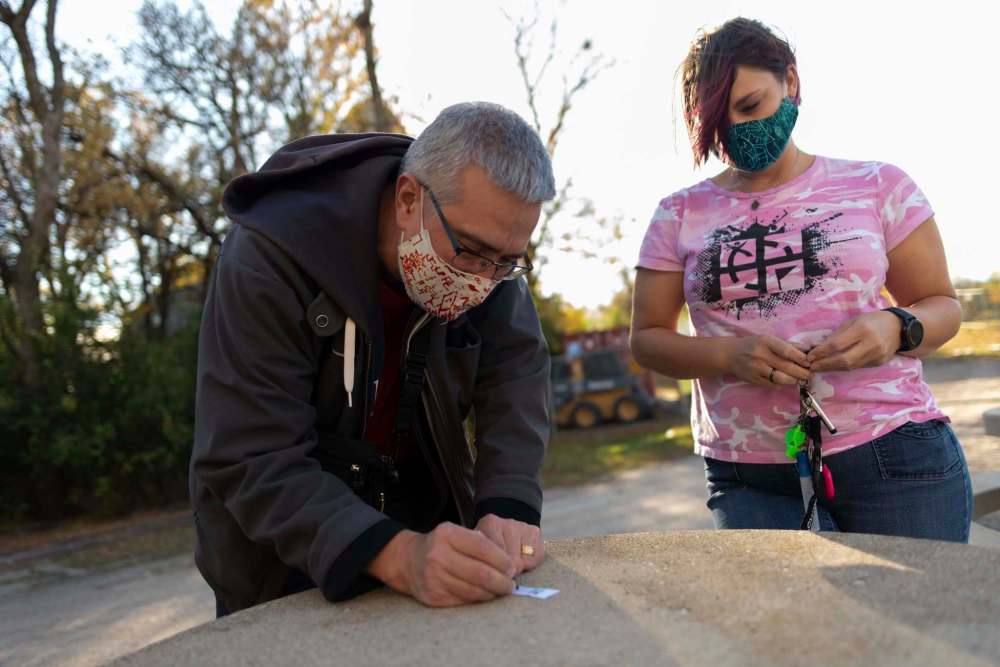
That new awareness is what separates geocachers from the Muggles, a term borrowed from the Harry Potter series of books to categorize people who are not part of the nearly invisible world of geocaching, says McPeek.
Enthusiasts see a walk in the park differently than Muggles, and are bonded by swapping stories, helping each other out, and their time together on short trips to explore new parts of the province.
“That’s part of what we enjoy about day trips,” says McPeek. “You’re going somewhere and you see something you didn’t know was there.”
They also plan group events that combine their passion with more pragmatic pursuits, such as picking up trash along cache routes.
“That’s part of what we enjoy about day trips. You’re going somewhere and you see something you didn’t know was there.” – Jordan McPeek
“Since cachers are out and about, looking off the beaten trail for the cache, there’s often trash there,” McPeek says about the cache in, trash out events, CITO for short.
Before the global pandemic hit, the association planned a huge meet-up to celebrate its 15th anniversary at the International Peace Garden, but opted instead to mark the milestone by creating a trail of 15 caches hidden along a three-kilometre stretch of the Crow Wing Trail near St. Malo.
Pandemic restrictions also forced McCrindle to change her summer plans from a caching trip with friends into the United States to exploring her home province on a solo road trip, heading north for two weeks and discovering about 100 caches en route.
“I went as far north as roads would take me, travelling around Lynn Lake, Fox Mine and Gillam,” explains the 35-year-old health-care worker of her 5,900-km road trip in search of geocaches.
“I have hip waders in my car and I have hiking boots.”
Not everyone needs that level of preparedness to enjoy the sport. Geocachers always welcome more participants to their favourite activity because more cachers searching and planting caches translates into more challenges for everyone, says Wall, who has helped rookies understand the sport in introductory sessions.
“These events help newbies understand the game and get them enthusiastic about placing caches,” says Wall.
“And it gives us something new to find.”
brenda@suderman.com

Brenda Suderman has been a columnist in the Saturday paper since 2000, first writing about family entertainment, and about faith and religion since 2006.
Our newsroom depends on a growing audience of readers to power our journalism. If you are not a paid reader, please consider becoming a subscriber.
Our newsroom depends on its audience of readers to power our journalism. Thank you for your support.