Real-time voting reports to be game-changer in Manitoba’s next election

Read this article for free:
or
Already have an account? Log in here »
To continue reading, please subscribe:
Digital Subscription
One year of digital access for only $1.44 a week*
- Enjoy unlimited reading on winnipegfreepress.com
- Read the E-Edition, our digital replica newspaper
- Access News Break, our award-winning app
- Play interactive puzzles
*Billed as $5.77 plus GST every four weeks. After 52 weeks, price increases to the regular rate of $19.95 plus GST every four weeks. Offer available to new and qualified returning subscribers only. Cancel any time.
To continue reading, please subscribe:
Add Free Press access to your Brandon Sun subscription for only an additional
$1 for the first 4 weeks*
- Enjoy unlimited reading on winnipegfreepress.com
- Read the E-Edition, our digital replica newspaper
- Access News Break, our award-winning app
- Play interactive puzzles
*Your next Brandon Sun subscription payment will increase by $1.00 and you will be charged $17.95 plus GST for four weeks. After four weeks, your payment will increase to $24.95 plus GST every four weeks.
Read unlimited articles for free today:
or
Already have an account? Log in here »
Hey there, time traveller!
This article was published 21/06/2023 (1224 days ago), so information in it may no longer be current.
Manitoba political parties and candidates fiercely jockeying for votes on election day will know almost instantly when someone casts a ballot on Oct. 3 owing to new technology being used by Elections Manitoba.
The independent electoral agency is mostly doing away with carbon-copy “bingo sheets” used to report voter records on election day and instead will send hourly, electronic updates on voters directly to political parties.
“Parties have always received a record of who has voted and they’ve always had the voters list for the (electoral divisions) where they’re running candidates,” explained Elections Manitoba director of communications Mike Ambrose.
THE CANADIAN PRESS FILES/John Woods Elections Manitoba is doing away with carbon-copy “bingo sheets” used to report voter records on election day and instead will send hourly, electronic updates on voters directly to political parties.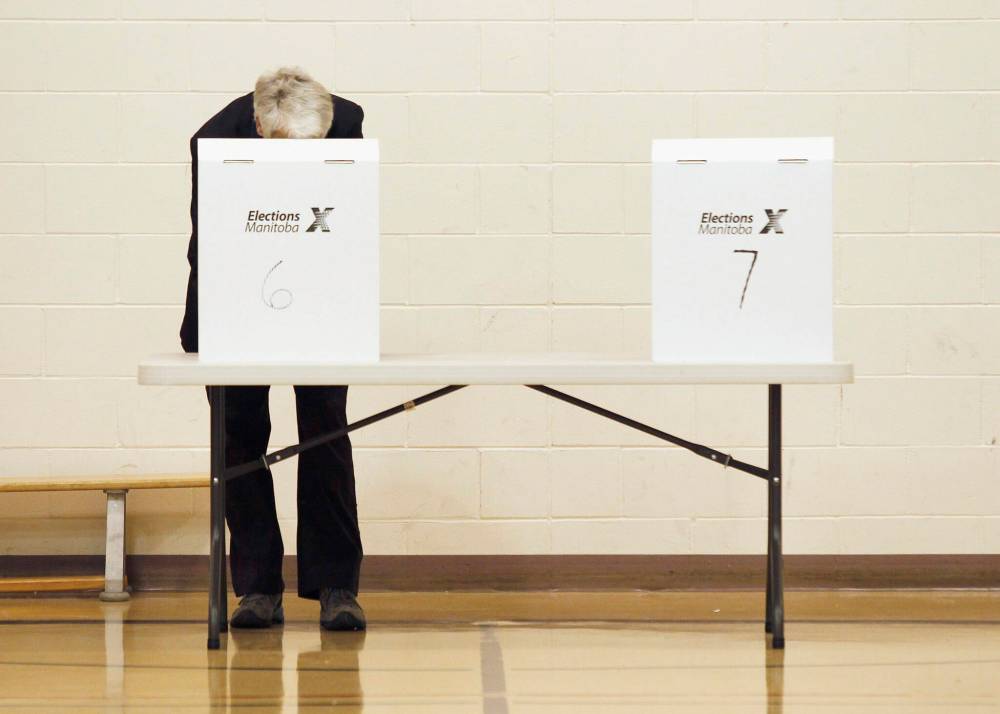
“Instead of sending people across the province to pick up paper forms, they can just log in to the portal to see that information.”
Elections Manitoba said registered political parties will be provided access to an online portal where they can search voters by name or address and can confirm whether or not they cast a ballot. The information will be updated hourly.
An extract of “real-time voting activity” that shows a voter’s unique identification number, their voting area, polling place, and, if a ballot has been cast, their voting method and time, will also be made available to parties and candidates.
Parties will only have access to data in electoral divisions where they run candidates, and candidates can only see information for their constituency.
“Instead of sending people across the province to pick up paper forms, they can just log in to the portal to see that information.”–Mike Ambrose, Elections Manitoba
Manitoba Liberal Leader Dougald Lamont said the near instantaneous access to voter data will change the game on election day.
“It’s the end of a paperwork nightmare,” Lamont said. “It takes a major annoyance out of campaigns.”
MIKAELA MACKENZIE / WINNIPEG FREE PRESS FILES
Liberal leader Dougald Lamont: “It’s the end of a paperwork nightmare."
In past elections, parties would station runners at polling stations — there were 2,130 such locations in 2019 — to regularly collect stacks of so-called bingo sheets indicating which voters have cast ballots.
The carbon-copies wold be rushed back to local campaign offices where the data would be cross-referenced against voter lists. Campaign volunteers would begin reaching out to supporters who had yet to vote to encourage them to get to the polls.
Elections Manitoba piloted its new electronic voter strike-off and the associated portal in the Fort Whyte byelection and refined and expanded the service in the Thompson and Kirkfield Park byelections.
The chief electoral officer’s office expects to have electronic voter strike-off to be used in most communities barring internet connectivity issues.
Lamont said the change will allow political parties to focus their energy on pulling the vote.
“It just makes election day itself and other polls that much easier to deal with.”–Manitoba Liberal Leader Dougald Lamont
“It is a change that makes things so much easier you can’t believe you used to have to do it the hard way,” the St. Boniface MLA said. “It just makes election day itself and other polls that much easier to deal with.”
Manitoba New Democratic Party provincial secretary Tim Johnson said his party and others advocated for improved access to voter data and supports Elections Manitoba’s efforts to modernize the process.
Compiling information about most registered voters in an online portal is expected to enhance the party’s election day ground game and free up volunteers to work the phones and get out the vote, Johnson said.
“It makes it easier for us, ultimately though, knowing who votes doesn’t matter if they’re not voting for you,” he said. “So, we need to make sure that we are identifying and talking to voters ahead of time, make sure that we are having the person-to-person conversations at the door step, and that’s all work, frankly, that happens before people cast their ballots.”

Both Johnson and Lamont said the change will also mean voters receive fewer calls on election day and won’t be pestered if they’ve already cast their ballot.
“Some voters could expect that this will make election day easier,” Johnson said.
Ambrose said the readily accessible voter data is on top of other changes at the polls, including electronic voters lists, voter-card scanning, on-demand ballot printing for advance voting, and vote-counting machines.
During advance voting, voters will be able to vote anywhere in the province; on election day, voters can vote anywhere in their electoral division.
“Because this is being powered by the electronic, real-time strike-off, voters should see a quicker experience when they’re at the polling place, it’ll be quicker and easier to find the voter’s name on the voters list, and the electronic strike-off also allows voters to cast their ballot at any polling place in their electoral division,” Ambrose said.
danielle.dasilva@freepress.mb.ca