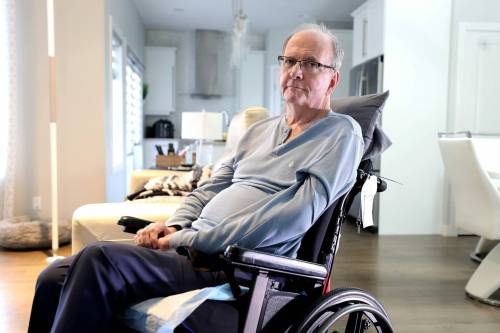
Return of motorized lift boosts home care recipient
Read this article for free:
or
Already have an account? Log in here »
To continue reading, please subscribe:

Digital Subscription
One year of digital access for only $205*
- Enjoy unlimited reading on winnipegfreepress.com
- Read the E-Edition, our digital replica newspaper
- Access News Break, our award-winning app
- Play interactive puzzles
*First annual payment billed as $205.00 + GST for one year. This annual subscription will automatically renew at $233.00 + GST every 52 weeks (10% off the regular annual price of $259.35). Offer available to new and qualified returning subscribers only. Cancel any time.
To continue reading, please subscribe:
Add Free Press access to your Brandon Sun subscription for only an additional
$1 for the first 4 weeks*
- Enjoy unlimited reading on winnipegfreepress.com
- Read the E-Edition, our digital replica newspaper
- Access News Break, our award-winning app
- Play interactive puzzles
*Your next Brandon Sun subscription payment will increase by $1.00 and you will be charged $17.95 plus GST for four weeks. After four weeks, your payment will increase to $24.95 plus GST every four weeks.
Read unlimited articles for free today:
or
Already have an account? Log in here »
Hey there, time traveller!
This article was published 25/10/2023 (1053 days ago), so information in it may no longer be current.
A Winnipeg wheelchair user is raising concerns about bureaucracy within Manitoba’s home care program, after an electric lift was approved for him, taken away over unexplained safety issues, and then reinstated after he publicly complained.
Jean Marcoux, 76, said a portable electric lift was removed from his Bridgwater home last week because officials expressed concerns he’d be stuck on his couch if a home care worker was not available or able to move him in a timely manner.
On Wednesday afternoon, after he contacted the Free Press and a reporter subsequently asked the Winnipeg Regional Health Authority about its handling of the case, Marcoux received a phone call from client relations advising him the lift will be returned to his home.
RUTH BONNEVILLE / WINNIPEG FREE PRESS Jean Marcoux and his wife, Gisele. Before the portable lift, Marcoux said he was stuck for 12 hours or more in his wheelchair or in his bed.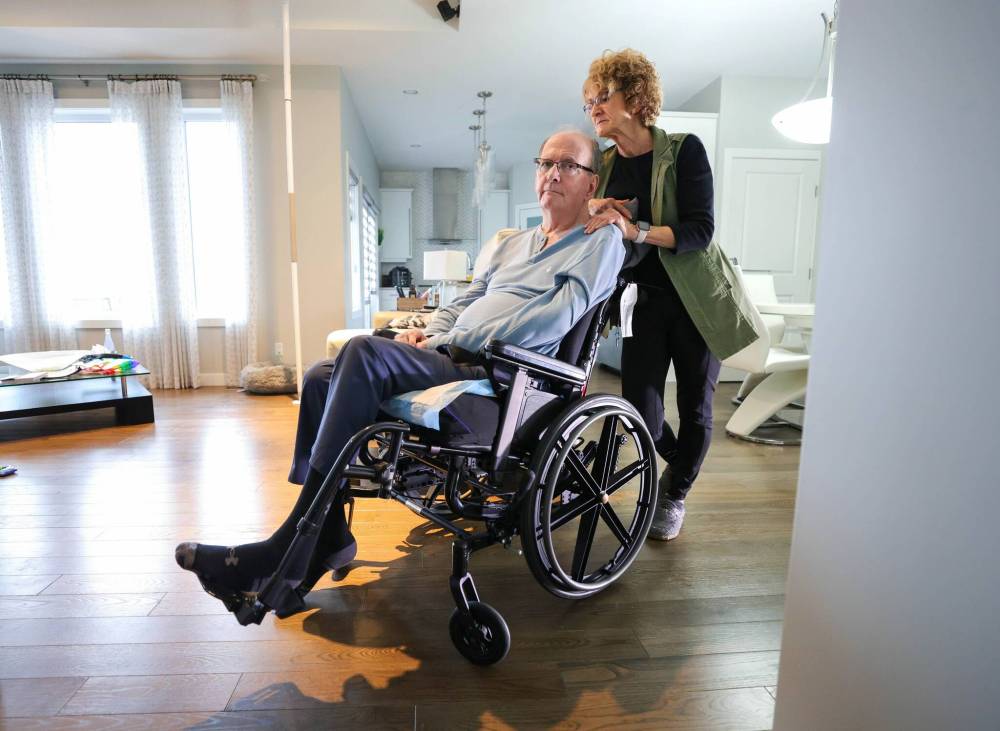
Only a few weeks earlier, an occupational therapist did a home visit and approved the assistive device, which meant Marcoux could finally sit on his reclining sofa. Previously, he could only be moved between his manual wheelchair and his bed via a permanent lift installed on the bedroom ceiling.
Being on the couch helps him avoid bed sores, he said.
“It’s much more comfortable,” said Marcoux, who began using a wheelchair after he had a stroke 17 years ago.
A recent seizure stole the little mobility he had left, and now Marcoux relies on home care visits four times a day.
The lift device was approved and provided by home care, but Marcoux said he was only able to use it for about 10 days.
“They were concerned I could be on the sofa and they wouldn’t be able to get me off the sofa. I told them I was prepared to accept that risk,” he said, also praising his home care worker and the consistent daytime care received.
“They were concerned I could be on the sofa and they wouldn’t be able to get me off the sofa. I told them I was prepared to accept that risk.”–Jean Marcoux
“But they told me they didn’t really care about that, they had to stick to their bureaucratic process — so they came and got the lift.”
Marcoux said he felt the reasoning was “bizarre at best.”
He was told the lift would be picked up so that someone else could use it, even though he’d already proven he needed it.
A WRHA spokeswoman said the agency couldn’t share specific details of the case because of privacy laws governing personal health information, but stated safety is the priority.
When asked if the home care program is changing its practices because of a lack of staff or whether it’s perceived as less of a risk to allow a client to remain in a wheelchair or a bed for hours rather than on a couch, the WRHA didn’t directly respond.
“All Manitobans should expect safe and high-quality care when they need home care services. We expect those services to be adaptable and work with clients and their families to find solutions that support them remaining in their homes. The Winnipeg Regional Health Authority will continue to work with this person and their family to find solutions,” the spokeswoman stated.
Marcoux said he was pleased to find out Wednesday home care officials had changed their minds and bring back the lift. The staff person who phoned told him and his wife the agency was trying to provide better customer service and would allow the portable lift — as long as he agreed to accept the risks of use.
RUTH BONNEVILLE / WINNIPEG FREE PRESS Jean Marcoux, 76, has been a wheelchair user for 17 years.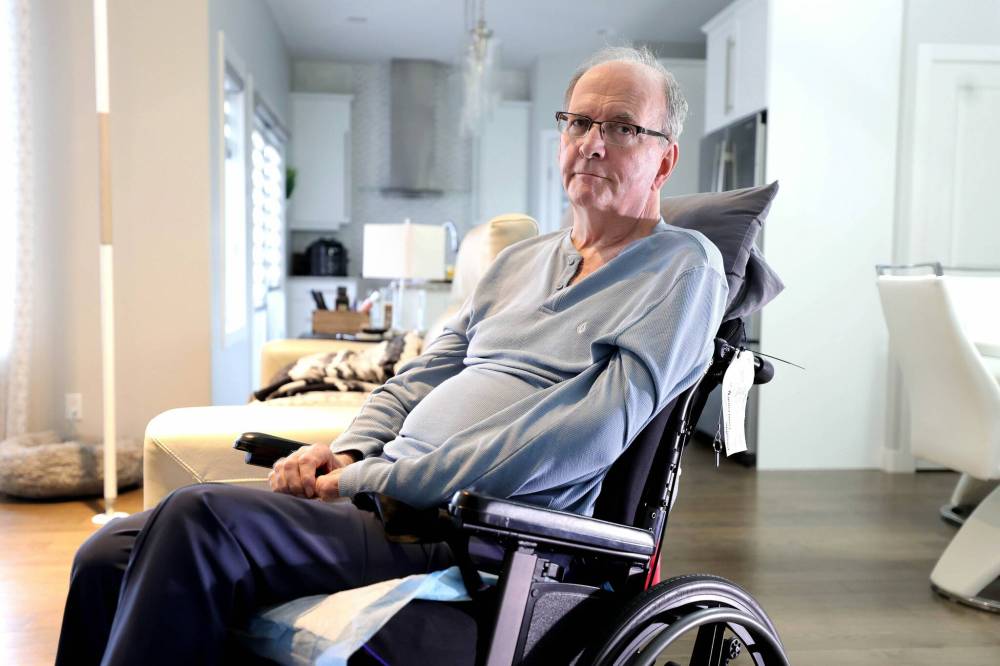
The portable power lift is on wheels. It has a sling that goes around the individual’s body and hooks onto the motorized lift, raising them out of a chair or bed. Marcoux needs a home care worker to operate the lift.
“It’s a fairly simple process but it requires a certain amount of strength to be able to do it safely,” Marcoux said, adding he was not made aware of any workers’ complaints.
Safety concerns sometimes come up if the wheels on the lift get stuck in carpet, for example, said CUPE Local 204 president Debbie Boissonneault, who represents home care workers. (Marcoux’s home doesn’t have carpet.)
However, without such a lift, staff can risk back injuries, she added.
“Without knowing the full situation of why they are not allowing (the lift), people have the right to refuse unsafe work in Manitoba, as per the act. If the person needs a (motorized lift) because they cannot bear weight, then the employer needs to do something about that or the WRHA should be looking at what they can do for this person.”
Before the portable lift, Marcoux said he was stuck for 12 hours or more in his wheelchair or in his bed.
“There’s many times where I’m scheduled to get home care for transfer… and nobody shows up. I’ve waited over 12 hours to get the transfer done, but that doesn’t seem to matter.”
katie.may@winnipegfreepress.com

Katie May is a multimedia producer for the Free Press.
Our newsroom depends on a growing audience of readers to power our journalism. If you are not a paid reader, please consider becoming a subscriber.
Our newsroom depends on its audience of readers to power our journalism. Thank you for your support.
Related Articles
Province urged to prioritize publicly funded wheelchair program Government failing disabled people