Anxiety attack Majority of Manitobans fear witnessing shoplifting, violence in stores: poll
Read this article for free:
or
Already have an account? Log in here »
To continue reading, please subscribe:
Digital Subscription
One year of digital access for only $1.44 a week*
- Enjoy unlimited reading on winnipegfreepress.com
- Read the E-Edition, our digital replica newspaper
- Access News Break, our award-winning app
- Play interactive puzzles
*Billed as $5.77 plus GST every four weeks. After 52 weeks, price increases to the regular rate of $19.95 plus GST every four weeks. Offer available to new and qualified returning subscribers only. Cancel any time.
To continue reading, please subscribe:
Add Free Press access to your Brandon Sun subscription for only an additional
$1 for the first 4 weeks*
- Enjoy unlimited reading on winnipegfreepress.com
- Read the E-Edition, our digital replica newspaper
- Access News Break, our award-winning app
- Play interactive puzzles
*Your next Brandon Sun subscription payment will increase by $1.00 and you will be charged $17.95 plus GST for four weeks. After four weeks, your payment will increase to $24.95 plus GST every four weeks.
Read unlimited articles for free today:
or
Already have an account? Log in here »
Hey there, time traveller!
This article was published 21/06/2024 (855 days ago), so information in it may no longer be current.
Elaine Lovatt will walk into any store — almost.
“Not if there’s going to be a band of these kids coming in and snatching, that terrifies me,” she said, laughing. “I’m a chicken.”
The pensioner has never witnessed a shoplifting incident. She believes people steal out of desperation and that maybe if security were more obvious — such as patrolling aisles, and so on — it might curb crime.
Lovatt is like a majority of Manitobans. Most of the population has anxiety about shoplifting and thinks efforts to prevent it should be stepped up, a poll commissioned by the Free Press has found.
“The level of concern people have, I guess it’s not totally surprising, but it really did stand out,” said Curtis Brown, a partner with Probe Research, which polled 1,000 Manitobans from the end of May to early June.
Six in 10 respondents said they are concerned about witnessing a shoplifting incident or seeing a violent encounter between a thief and retail staff, the results show.

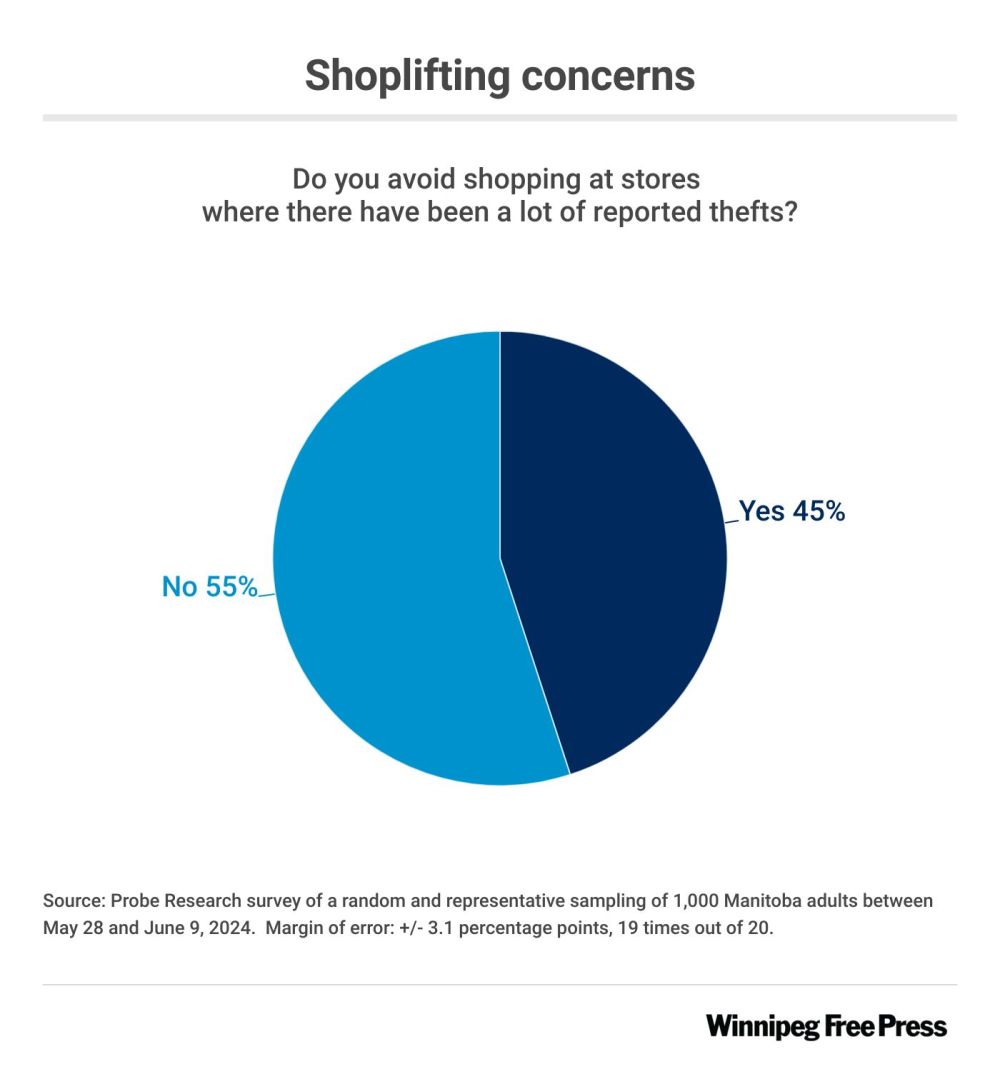
Forty-five per cent reported they avoid shopping at places they perceive as theft hot spots.
Kathryn Magarrell has sworn off a couple of dollar stores in Fort Rouge. She and her 16-year-old daughter witnessed people shoplifting a few times within the past year, Magarrell explained.
“I just don’t think I want my daughter to witness it (again),” said Magarrell, who was grocery shopping at a nearby Superstore.
There was no violence, no physical touching during the thefts. Staff members tried to act as a barricade and failed.
“I felt bad for the employees,” Magarrell recalled. “Surely they didn’t sign up for that when they started to work.”
At Food Fare, co-owner Munther Zeid said he has received more support from customers following media headlines about confrontations between staff and shoplifters. The grocery chain has confronted shoplifters and has been accused of being rough with them, including an April 28 incident in which a woman was allegedly punched at the outlet on Portage Avenue and Burnell Street.
“It’s almost like your home,” Zeid said about owning a shop. “You have the choice to let the thief leave or confront them and protect your stuff.
“You might let it happen once, twice, three times, but eventually you’re gonna say, ‘I’m not gonna let this happen to my home anymore.’”
He believes shoplifting will persist until it is addressed. Most people return stolen items when challenged, he said. Food Fare staff willingly group together to intimidate, but not touch, shoplifters once they hear a code word over the Portage Avenue shop’s system, Zeid continued.
“Customers really have nothing to fear when it comes to shoplifting,” he said, adding he can’t think of a case where a bystander was injured.
Forty-five per cent of poll respondents cited concern about being physically attacked by a shoplifter.
“For some people, fear of crime correlates with vulnerability, and for others, it doesn’t.”–Bronwyn Dobchuk-Land, criminal justice professor
“For some people, fear of crime correlates with vulnerability, and for others, it doesn’t,” noted Bronwyn Dobchuk-Land, a University of Winnipeg criminal justice professor.
The chances of getting hurt by a shoplifter are slim until someone intervenes, Dobchuk-Land explained. Often, the people most visibly pursued for theft — rightly or not — are also the ones most vulnerable to violence and crime, she said.
The Probe poll found that racialized respondents were most likely to express concern about being attacked by shoplifters and to avoid stores known to be plagued by shoplifting.
Lori Wilkinson, a University of Manitoba sociology and criminology professor who specializes in migration, describes it as “shopping while Black.”
Racialized and Indigenous people are likely tracked more by security, she said. They’re also commonly found working retail jobs, which exposes them to shoplifting and potential violence, she said.
Racialized people are less likely to find jobs that offer the same pay and benefits following university graduation than their non-racialized and non-Indigenous counterparts, Statistics Canada reported last year.
“It makes me uncomfortable, but mostly mad.”–Ainsley Wastesicoot
Ainsley Wastesicoot said she has noticed security guards follow her in some spaces, such as dollar stores.
“It makes me uncomfortable, but mostly mad,” said Wastesicoot, who’s Indigenous.
Her boyfriend used to be a security guard. He’s detailed how guards watch patrons; Wastesicoot said the information has boosted her awareness.
Still, she believes giving security guards more power to stop shoplifters would decrease the level of crime. Her boyfriend eventually quit his job because he was frustrated he couldn’t do much to stop it, she said.
In the Probe poll, 79 per cent of respondents agreed private security guards in retail stores should be given more power. Among Progressive Conservative voters, that number climbed to 90 per cent.

Racialized and Indigenous groups were slightly below the average, at 75 and 71 per cent, respectively.
Opponents such as Dobchuk-Land say boosting private security guards’ power would lead to the escalation of incidents and result in people being hurt in retail outlets.
Police have said guards have been stabbed, sprayed with bear repellent and physically assaulted, including in private businesses, over the past seven months.
Private security guards aren’t police, said Marie Buchan, secretary treasurer of UFCW Local 832, which represents such workers.
Guards are meant to “observe, report and deter.” If they touch a patron, they can be disciplined, Buchan clarified.
The union is lobbying to update the 40-hour training program to include relevant topics such as mental-health first aid and cultural sensitivity.
Danger pay
Wastesicoot, like 73 per cent of poll respondents, believes special training for front-line staff “wouldn’t hurt.”
Sixty-five per cent of respondents agreed retailers should pay employees higher wages, like a “danger pay.”
Support increased to 81 per cent and 78 per cent when looking at Indigenous and other racialized groups, respectively.
“They deserve more money if they’re going through it,” said Superstore shopper Bill Sumerlus. “But I don’t know that that would deter shoplifting.”
A part-time worker at a West End dollar store, who wanted to be identified as Joven, hedged at the thought of danger pay.
“I would rather not have a hazard pay (if) they will require us in exchange… to prevent those shoplifters,” Joven said. “I don’t think any money is worth your safety or your life.”
“I don’t think any money is worth your safety or your life.”–Dollar store employee
His manager has been grabbed by their necklace; shoplifters have brandished shovels and knives as they leave with pilfered goods, he said.
He hasn’t been hurt, but he also doesn’t stop thieves. Food items are the most commonly stolen goods, he said.
He sympathizes with shoplifters — “it’s kind of forgivable, in a way… if they’re hungry” — but questions why they’re stealing if they get government financial support.
The increasing cost to businesses, whether from higher payroll or increased security, would likely be passed to consumers, reminded Chuck Davidson, president of the Manitoba Chambers of Commerce.
“I think there’s a whole raft of areas… we need to look at and really start tracking to ensure we’re making some momentum,” Davidson said, noting shoplifting is prevalent across Manitoba.
“I think there’s a whole raft of areas… we need to look at and really start tracking to ensure we’re making some momentum.”–Chuck Davidson
The last thing the private sector wants is consumers being afraid to go to brick-and-mortar stores when they can buy online, Davidson said, adding long-term solutions are required to curb shoplifting and the violence that comes with it.
Concentrating on security guards and shifting the responsibility to workers, who are often paid low wages, misses the “bigger picture,” Dobchuk-Land stated. It’s unfair to them, she added.
She highlighted a Food Banks Canada report released this week; it said one in four Canadians has a poverty-level standard of living. Across Canada, food bank usage increased 78.5 per cent from March 2019 to March 2023.
People steal because they need food and money, and there’s a market for stolen goods “because other people can’t afford grocery prices,” Dobchuk-Land maintained.
Forty-five per cent of poll respondents agreed retail theft stems both from people not being able to afford items and stealing to re-sell them.
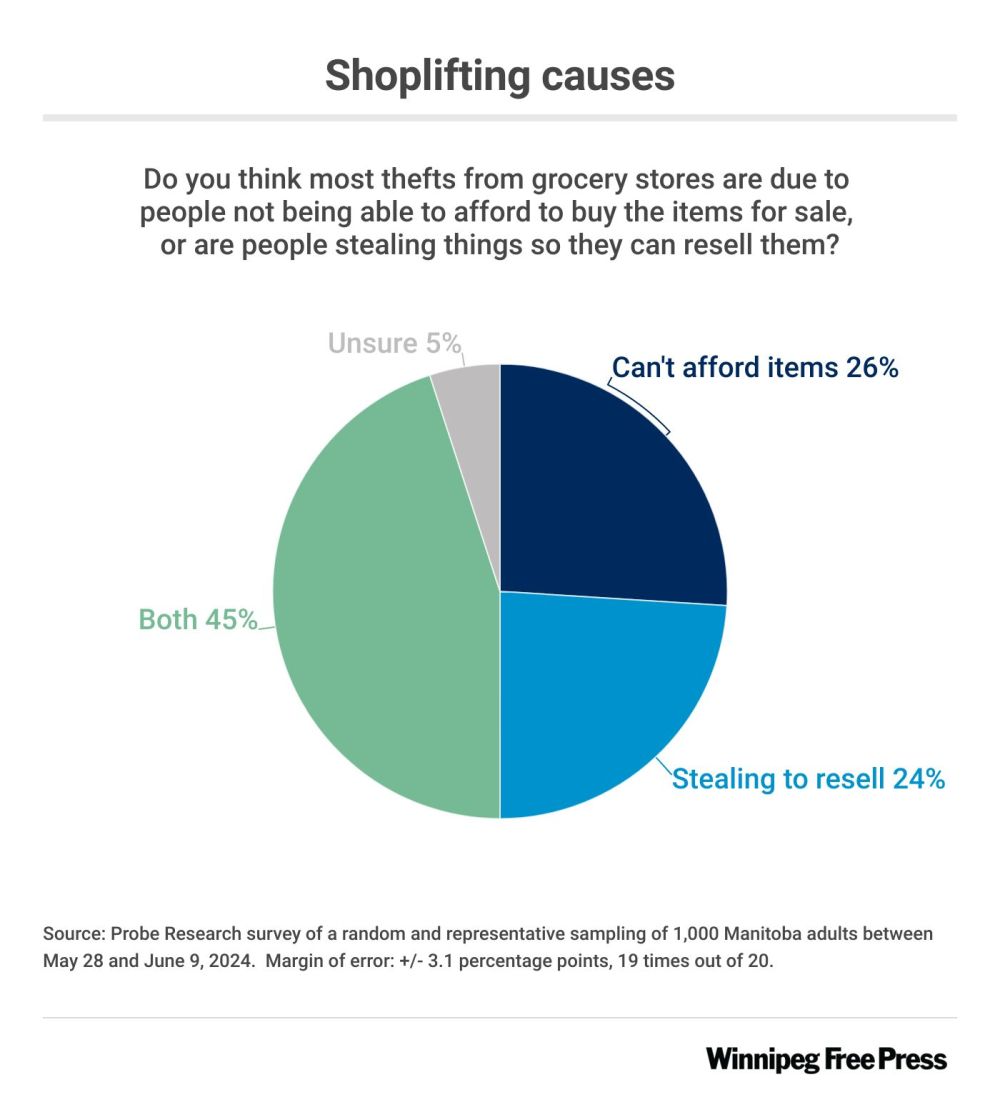
Twenty-six per cent blamed the affordability crisis while 24 per cent said it’s due just to reselling goods for cash.
“We’re living in an economy… and a social system where people are not being taken care of,” Dobchuk-Land said.
Shoplifting happens everywhere, noted Zeid. Winnipeg is a “hub” in a professional shoplifting industry, the Retail Council of Canada told the Free Press last month.
Reports of shoplifting increased 45.4 per cent from 2022 to 2023, the Winnipeg Police Service’s most recent annual report shows. The number — 6,040 incidents for shoplifting $5,000 or under — is almost double that of 2021.
Police are engaged in a crackdown on retail crime that includes increasing patrols in target areas. Meanwhile, provincial legislators have pushed through amendments to the Police Services Act.
Results from the Probe poll have a 95 per cent certainty of being within 3.1 percentage points if the entire Manitoba population were surveyed.
gabrielle.piche@winnipegfreepress.com

Gabrielle Piché reports on business for the Free Press. She interned at the Free Press and worked for its sister outlet, Canstar Community News, before entering the business beat in 2021. Read more about Gabrielle.
Every piece of reporting Gabrielle produces is reviewed by an editing team before it is posted online or published in print — part of the Free Press‘s tradition, since 1872, of producing reliable independent journalism. Read more about Free Press’s history and mandate, and learn how our newsroom operates.
Our newsroom depends on a growing audience of readers to power our journalism. If you are not a paid reader, please consider becoming a subscriber.
Our newsroom depends on its audience of readers to power our journalism. Thank you for your support.
Related Articles
Guards attacked during retail robbery Sharp rise in violent crime in 2023, stats show