Miller brings the boom Physics as much a factor as size and strength when Jets blue-liner unleashes cannonading slapshot
Read this article for free:
or
Already have an account? Log in here »
To continue reading, please subscribe:

Digital Subscription
One year of digital access for only $205*
- Enjoy unlimited reading on winnipegfreepress.com
- Read the E-Edition, our digital replica newspaper
- Access News Break, our award-winning app
- Play interactive puzzles
*First annual payment billed as $205.00 + GST for one year. This annual subscription will automatically renew at $233.00 + GST every 52 weeks (10% off the regular annual price of $259.35). Offer available to new and qualified returning subscribers only. Cancel any time.
To continue reading, please subscribe:
Add Free Press access to your Brandon Sun subscription for only an additional
$1 for the first 4 weeks*
- Enjoy unlimited reading on winnipegfreepress.com
- Read the E-Edition, our digital replica newspaper
- Access News Break, our award-winning app
- Play interactive puzzles
*Your next Brandon Sun subscription payment will increase by $1.00 and you will be charged $17.95 plus GST for four weeks. After four weeks, your payment will increase to $24.95 plus GST every four weeks.
Read unlimited articles for free today:
or
Already have an account? Log in here »
Hey there, time traveller!
This article was published 10/10/2024 (705 days ago), so information in it may no longer be current.
Grip it and rip it? Not quite.
There were 924 players who appeared in at least one NHL game last season. Nobody fired a puck harder than Colin Miller’s 102.59 mph (165 km/h) howitzer during a game in January between his then-New Jersey Devils and the Dallas Stars. In fact, that’s the fastest recorded slap shot in three years of data tracking by the league.
The now Winnipeg Jets defenceman is hardly the biggest or strongest player, standing 6-1 and weighing 200 pounds. He’s not some young phenom or can’t-miss prospect, either, as the 31-year-old was a fifth-round draft pick now skating for his sixth team over the past decade.
How, then, is this journeyman player able to blast the biscuit better than any of his peers? Miller’s top shot last year was more than 12 mph (19 km/h) faster than the average high for all NHL players. So, too, was his overall average shot speed. He had eight shots measuring more than 100 mph (160 km/h) in a league where the average is zero.
Fred Greenslade / THE CANADIAN PRESS FILES Winnipeg Jets defenceman Colin Miller is not the biggest or strongest player on the team, standing 6-1 and weighing 200 pounds.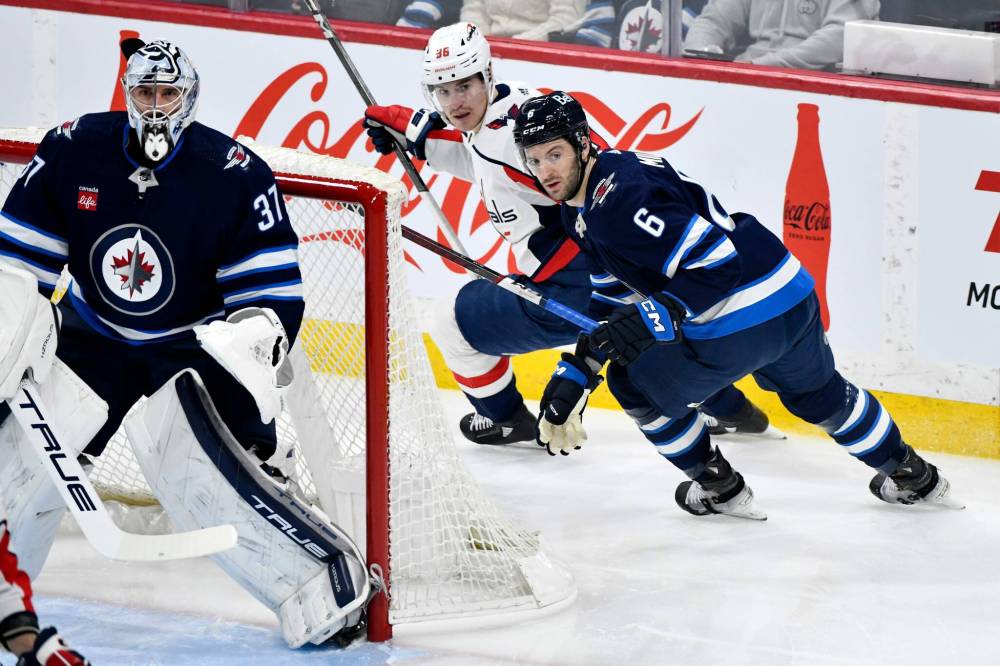
“I really don’t know,” Miller told the Free Press with a chuckle during a chat this week. “The physics, maybe? I don’t know. That would be interesting to see.”
It certainly would be, which is why we went digging. Especially after Miller’s terrific preseason in which he scored three goals on blue-line blasts. Acquired at the trade deadline last year from the New Jersey Devils, Miller figures to bring the boom as a fixture on Winnipeg’s back-end.
Turns out Miller was on the right track — there really is a science to it, even if he can’t fully explain how he’s created his not-so-secret weapon.
That’s where someone such as Alain Haché comes in. The 54-year-old is an experimental physicist who teaches at the University of Moncton. He’s also a huge hockey fan and a longtime beer league goaltender who is the author of The Physics of Hockey and Slap Shot Science.
“It’s how you perfect the mechanics of the slap shot.”–Alain Haché
“Certainly size will help. Zdeno Chara, for example, had the advantage of size (6-9, 250 pounds),” Haché explained of the now-retired Boston Bruins defenceman who could shoot with the best of them. More wingspan and more muscle means more rotation in the windup, which can cause the puck to move quicker.
“But if you look at (Miller’s) size, he would be average height and size. Maybe for a defenceman even on the lower side. So, size is not on his side.”
That’s where technique plays such a vital role.
“It’s how you perfect the mechanics of the slap shot” said Haché. Timing is everything, with the trick being finding the sweet spot between the blade and the puck.
“You’ll notice they never have a direct hit on the puck, a direct collision. That’s just fundamental physics. If you have a direct hit between the blade and the puck, the puck would never be able to go faster than twice the speed of the blade, and that would put a serious limit on how fast it can go,” said Haché.
Sean Kilpatrick / THE CANADIAN PRESS FILES At 6-9 and 250 pounds, former Boston Bruins defenceman Zdeno Chara, certainly had the advantage of size on his side.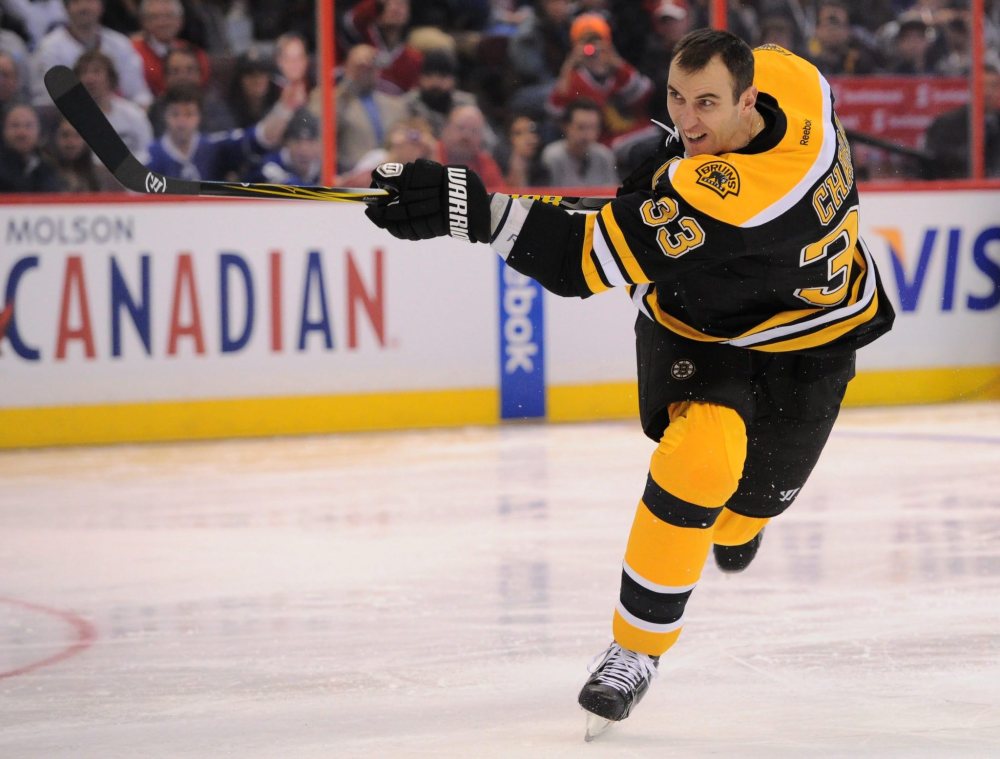
Watch any pro player up close and you’ll see they usually strike the ice first, ideally about a foot behind the puck. A few inches in either direction can make a world of difference.
“That stores what we call elastic energy or potential energy, and then the limit becomes not twice the speed of the blade (as with a direct impact), but the amount of energy that the player has. So that depends on his speed and his mass. And the speed can be much higher,” he said.
Other factors such as the length of stick and the flex of stick play a role.
“He’s a CCM guy!” Jets defenceman Neal Pionk is quick to chime in when asked how Miller does it. “He swings hard and gets good contact on it too. He uses the flex of his stick really well. You all see it, he’s got a really good shot and hopefully he’s able to use it a lot this year.”
Miller has been shooting pucks pretty much since he could walk, growing up in the hockey crazed community of Sault Ste. Marie, Ont.
“He (Miller) swings hard and gets good contact on it too. He uses the flex of his stick really well.”–Winnipeg Jets defenceman Neal Pionk
“We used to go to a tennis court. We had a little set-up there, me and my friends. We’d shoot pucks in the summer. That’s probably where it kind of came together,” he said.
“We just had different drills we would do, screwing around. I think it was more that. I don’t know if I can really explain it. Obviously with maturity, getting older, things change so maybe that helped, too.”
You’d think Miller would be lighting the lamp with regularity, yet he’s only scored 39 times over 513 career NHL games. Stars goalie Scott Wedgewood stopped his hardest shot last year, for example. That speaks to how difficult it in today’s game to beat a goalie clean from the blue line, which is something Jets head coach Scott Arniel can attest to.
Long gone are the days when a player such as Dave Babych, a former teammate of Arniel’s with Jets 1.0, could hit double-digits with his eyes closed. Goaltenders are bigger and better than ever and shot blocking has also become an art form.
Steve Roberts / USA TODAY files Last season, as a member of the New Jersey Devils, Jets defenceman Colin Miller recorded the hardest slapshot of the season at 102.59 mph.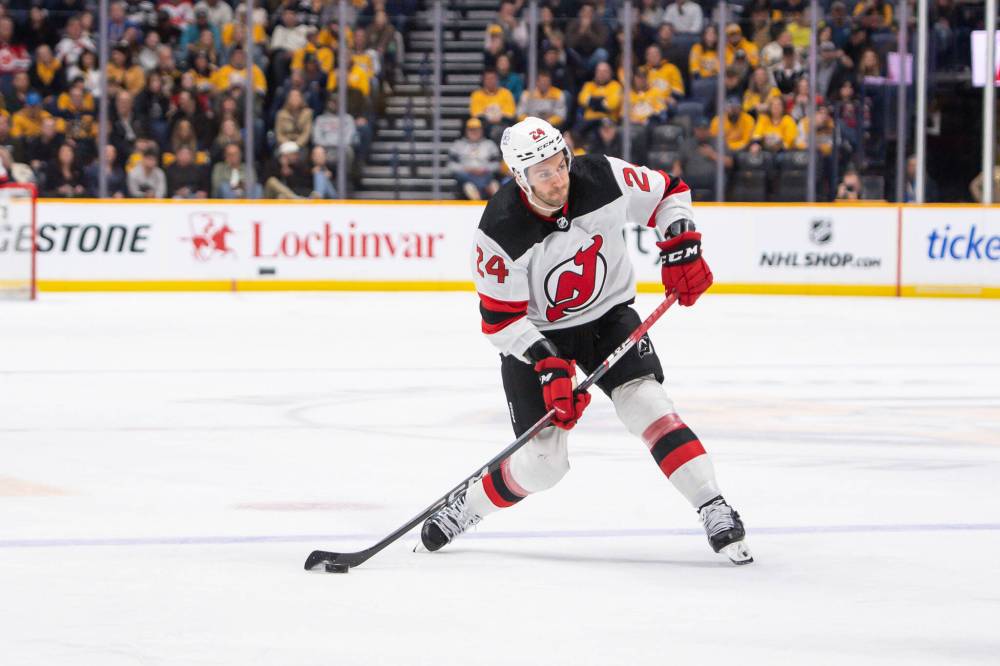
“There’s a lot more teams defending with five layers. You gotta get it by people. Forwards are going to get in lanes, or the D in the net front,” said Arniel.
However, fear can be a powerful thing, so someone like Miller can be a valuable asset.
“When you have a cannon like that, there’s a tendency to maybe not quite get in that lane, maybe take little steps to the side,” said Arniel.
“If you have some kind of trait that’s really good, and that shot being one of them, try to get it off as much as possible. That’s what we’ve talked about since he came last year and certainly all of camp. If you have a chance to get a lane, get an alley, pound that puck, because it’s not just the shot going in, it’s the rebound, it’s the craziness that happens after that shot, if there’s a rebound, the puck spits out, then we can kind of track that as well. He’s got to use it as much as he can.”

Haché said another key to slap shot success is what is known as the “bounce effect.” In simple terms, the faster something is coming at you — whether it’s a hockey puck or a baseball — the easier it can be to hit it harder. A one-timer, for example, can typically do more damage than a stationary shot in the same way a batter who barrels up a 100 mph pitch can go much deeper than hitting a ball off a tee.
“The energy of it coming towards you is actually helping you,” said Haché. “So if a defenceman is receiving a pass and does a one-timer, it should theoretically be a faster shot.”
Miller’s current defence partner, Haydn Fleury, has said he’s going to try to feed him as much as possible, which seems like a sound strategy.
“You know players don’t think about physics at all. They don’t read physics papers. It’s just all practice.”–Alain Haché
“You can count on one hand the number of times you see a big slapshot in a game. It’s not really that many,” said Miller, who might just challenge the career-best 10 goals he scored in the 2017-18 season with regular playing time this year.
He’s going to keep firing away and hoping for the best, even if he can’t fully explain how he is to shooting a puck what Connor McDavid is to skating.
“You know players don’t think about physics at all. They don’t read physics papers. It’s just all practice,” said Haché.
“They discover what is the best thing just by trial and error. Some players just pick it up better than others. It’s not all about size or weight or strength, but you certainly have to develop a very good technique.”
mike.mcintyre@freepress.mb.ca
X: @mikemcintyrewpg

Mike McIntyre is a sports reporter whose primary role is covering the Winnipeg Jets. After graduating from the Creative Communications program at Red River College in 1995, he spent two years gaining experience at the Winnipeg Sun before joining the Free Press in 1997, where he served on the crime and justice beat until 2016. Read more about Mike.
Every piece of reporting Mike produces is reviewed by an editing team before it is posted online or published in print — part of the Free Press‘s tradition, since 1872, of producing reliable independent journalism. Read more about Free Press’s history and mandate, and learn how our newsroom operates.
Our newsroom depends on a growing audience of readers to power our journalism. If you are not a paid reader, please consider becoming a subscriber.
Our newsroom depends on its audience of readers to power our journalism. Thank you for your support.