U of M unique Métis fiddling course strikes a chord
Read this article for free:
or
Already have an account? Log in here »
To continue reading, please subscribe:

Digital Subscription
One year of digital access for only $205*
- Enjoy unlimited reading on winnipegfreepress.com
- Read the E-Edition, our digital replica newspaper
- Access News Break, our award-winning app
- Play interactive puzzles
*First annual payment billed as $205.00 + GST for one year. This annual subscription will automatically renew at $233.00 + GST every 52 weeks (10% off the regular annual price of $259.35). Offer available to new and qualified returning subscribers only. Cancel any time.
To continue reading, please subscribe:
Add Free Press access to your Brandon Sun subscription for only an additional
$1 for the first 4 weeks*
- Enjoy unlimited reading on winnipegfreepress.com
- Read the E-Edition, our digital replica newspaper
- Access News Break, our award-winning app
- Play interactive puzzles
*Your next Brandon Sun subscription payment will increase by $1.00 and you will be charged $17.95 plus GST for four weeks. After four weeks, your payment will increase to $24.95 plus GST every four weeks.
Read unlimited articles for free today:
or
Already have an account? Log in here »
Hey there, time traveller!
This article was published 26/11/2024 (650 days ago), so information in it may no longer be current.
When Krysta Alexson first picked up a fiddle in September, she hoped she would be able to play a tune by the end of the semester.
As she has progressed in the first-of-a-kind Métis fiddling class at the University of Manitoba school of music, she’s found the tunes are helping to carry her.
Alexson, a graduate student in Indigenous studies, said Tuesday that when she’s stuck writing her thesis on the inherent leadership systems of the Plains Cree, or feeling “a little off” after researching colonial records, she grabs her bow and draws it across the strings.

MIKAELA MACKENZIE / FREE PRESS
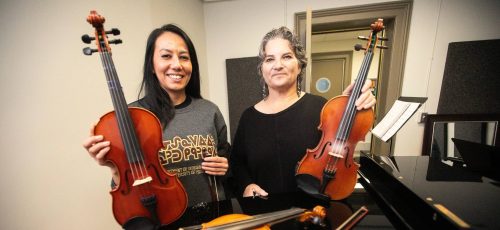
Metis fiddling instructor Patti Kusturok (left) and Indigenous Studies grad student Krysta Alexson at the University of Manitoba.
“It’s not pretty, but I start playing it, and it gets the juices flowing,” she said. “It gets that thought process going.”
The class, which involves a one-on-one lesson once a week, is headed by North American Fiddlers’ Hall of Fame member Patti Kusturok, a member of the Manitoba Métis Federation.
In January, Kusturok was hired to do a university gig with Garry Lapine, a legendary Métis fiddler from Portage la Prairie, when she was approached by a staff member who offered her a chance to teach a class.
She jumped at the chance.
“They have funding for 10 students, and I have three this semester and there are six or seven for next semester already,” Kusturok said.
She encourages her students to join a jam session she hosts on Monday nights.
“Fiddling is a community thing,” she said. “It’s good to play with other people. I’m trying to foster that as well.”
Although played on a violin, fiddling is different from violin music because of how it is played. Classical violinists adhere to written music while fiddling is more free-flowing.
“To me, Métis fiddling is a style of playing, more of a feel of playing,” Kusturok said. “We play a lot for dancers, square dancing and jigging. It’s all about the beat and making people want to dance. It’s not a particular repertoire, although there are tunes that are considered Métis tunes. A lot of the adopted Métis tunes are Scottish in origin, but it’s the style you play with a real percussive feel to it.”
“Fiddling is a community thing … It’s good to play with other people. I’m trying to foster that as well.”–Patti Kusturok
Reconciliation inspired the program, and students have access to the fiddles for free, thanks to a grant to the school of music.
Savannah Newans had played classical violin from eight years of age until she took a break in high school.
The fourth-year arts student was taking a sociology course when she heard about Kusturok and the class.
“I just decided to pick it back up again; it’s been a lot of fun,” she said. “The muscle memory really kicks in. I was really rusty to start, but I’m feeling like I’m enjoying it again.”
Newans’ learning started with the Suzuki method before she switched to the Royal Conservatory of Music.
“There’s just a little bit of a different pace with the bowing (when fiddling),” Newans said. “It’s more fun, I feel like, because you can just be more free with your playing.”
Alexson, meanwhile, hopes to nail down Jingle Bells before the semester ends.
“While it’s only a semester-long, I’m definitely going to carry on with this,” she said. “I’ve already started talking about adding a layer of music into my thesis as I’m writing.”
A member of Kahkewistahaw First Nation in Saskatchewan, a big part of Alexson’s thesis research is done in the community, in ceremony and on the land.
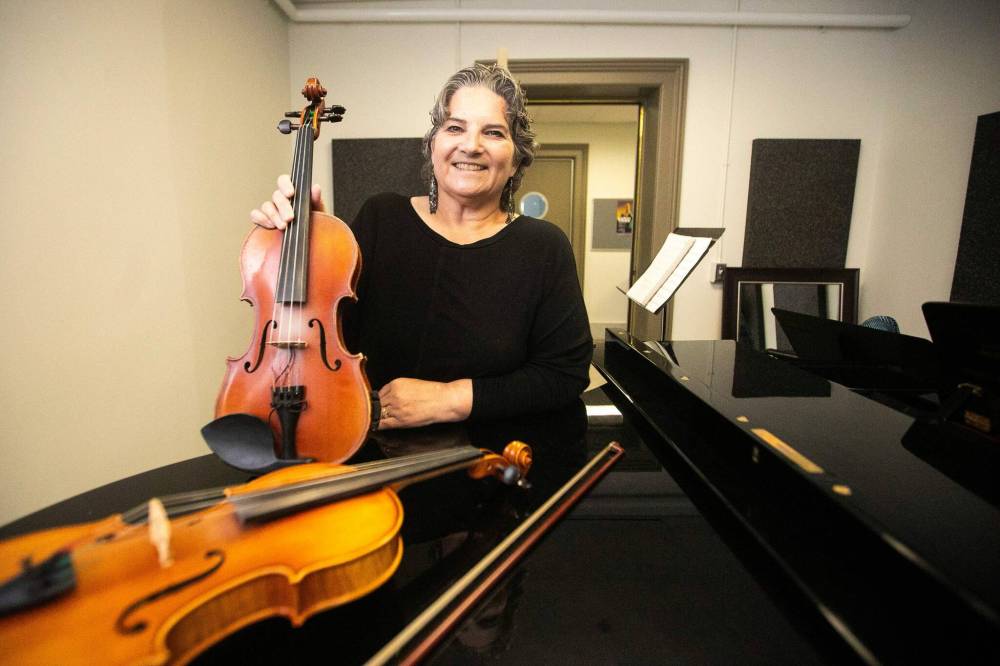
MIKAELA MACKENZIE / FREE PRESS
Instructor Patti Kusturok at the University of Manitoba which offers a new class inspired by reconciliation which is the first of its kind in Canada.
“I always sort of thought that would be done with my jingle dress dancing and with ceremonies,” she said. “Now, I’m hoping to jump in with people with my fiddle this summer and create those different relationships and open different conversations.”
Alexson has found the fiddle to be empowering.
“Part of my process is also wearing my traditional wear all year, really normalizing women’s skirts and just different aspects that is normal within my culture,” she said. “Travelling with my fiddle has almost been an extension of me. It’s part of my toolkit… and it’s certainly opened a lot of conversations with my peers.”
scott.billeck@freepress.mb.ca


Scott Billeck is a general assignment reporter for the Free Press. A Creative Communications graduate from Red River College, Scott has more than a decade’s worth of experience covering hockey, football and global pandemics. He joined the Free Press in 2024. Read more about Scott.
Every piece of reporting Scott produces is reviewed by an editing team before it is posted online or published in print — part of the Free Press‘s tradition, since 1872, of producing reliable independent journalism. Read more about Free Press’s history and mandate, and learn how our newsroom operates.
Our newsroom depends on a growing audience of readers to power our journalism. If you are not a paid reader, please consider becoming a subscriber.
Our newsroom depends on its audience of readers to power our journalism. Thank you for your support.