Smashing expectations Wheelchair rugby a game changer for athletes with disabilities
Read this article for free:
or
Already have an account? Log in here »
To continue reading, please subscribe:

Digital Subscription
One year of digital access for only $205*
- Enjoy unlimited reading on winnipegfreepress.com
- Read the E-Edition, our digital replica newspaper
- Access News Break, our award-winning app
- Play interactive puzzles
*First annual payment billed as $205.00 + GST for one year. This annual subscription will automatically renew at $233.00 + GST every 52 weeks (10% off the regular annual price of $259.35). Offer available to new and qualified returning subscribers only. Cancel any time.
To continue reading, please subscribe:
Add Free Press access to your Brandon Sun subscription for only an additional
$1 for the first 4 weeks*
- Enjoy unlimited reading on winnipegfreepress.com
- Read the E-Edition, our digital replica newspaper
- Access News Break, our award-winning app
- Play interactive puzzles
*Your next Brandon Sun subscription payment will increase by $1.00 and you will be charged $17.95 plus GST for four weeks. After four weeks, your payment will increase to $24.95 plus GST every four weeks.
Read unlimited articles for free today:
or
Already have an account? Log in here »
Hey there, time traveller!
This article was published 29/11/2024 (647 days ago), so information in it may no longer be current.
In 1977, a team of quadriplegic wheelchair basketball athletes in Winnipeg created an alternative sport to accommodate people with reduced function in their arms and hands. They called it murderball.
Almost 50 years later, the game, now officially known as wheelchair rugby, has become one of the most popular gateways for those with a disability who want to remain in sport.
An example is Reese Ketler, a 24-year-old member of Team Canada’s wheelchair rugby team.
“It (wheelchair rugby) gives me something to look forward to,” Ketler said this week during a practice at the Canada Games Sport For Life Centre. “I’m really lucky to have this outlet — I wouldn’t be the same without it.”
BROOK JONES/FREE PRESS Reese Ketler (left), 24, and his brother Mitch Ketler race towards the ball.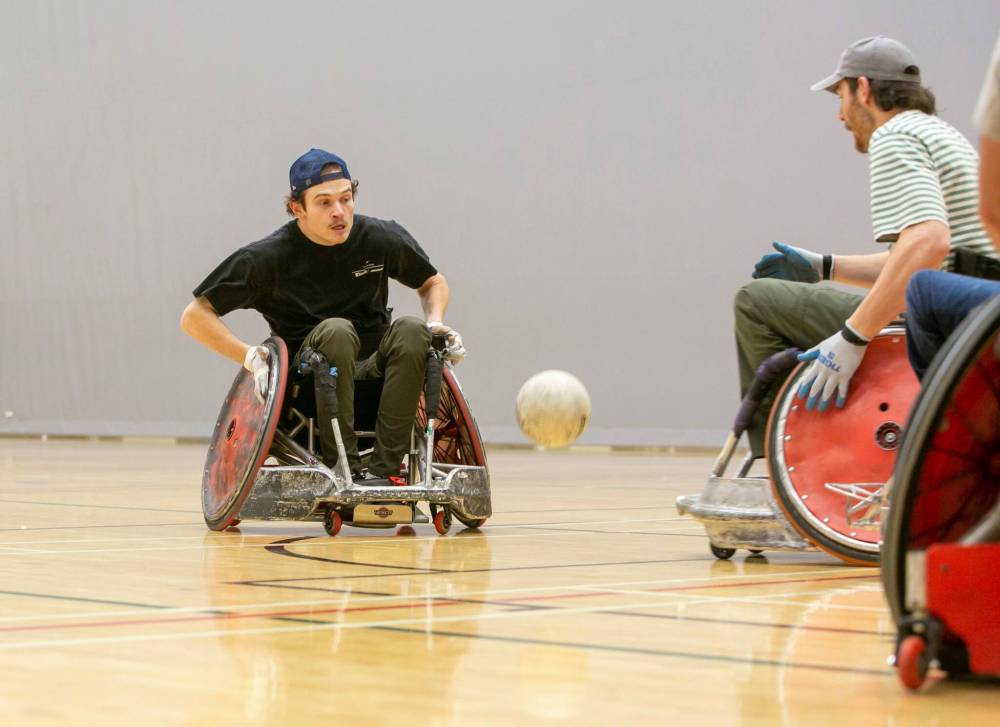
It’s been nearly five years since Ketler was paralyzed from a major spinal cord injury that he suffered during a Manitoba Major Junior Hockey League game.
The former player for the St. Vital Victorias was taken heavily into the boards after driving to the net, causing permanent damage to his lower body and temporary numbness to the upper body.
Ketler, who was hospitalized for four months, said the first year after the injury was the hardest.
“Everything was taken away from me that year,” he said. “You basically learn everything from scratch — everything from how to pick up a glass to opening a jar lid.”
Although Ketler’s world was turned upside down, it was also how he discovered a new sporting outlet.
“I remember Jared visited me in the hospital, and he told me if I wanted to get back into sport, I should give it a shot,” Ketler said. “Less than six weeks later, I sat in the rugby wheelchair and haven’t looked back since.”
Rules of the game
Thinking of giving wheelchair rugby a shot? Here are some rules to help familiarize yourself with the sport.
Playing time: Wheelchair rugby is played in four eight-minute quarters, while traditional rugby is played in two 40-minute halves.
Players/location: Wheelchair rugby features teams of four playing on a basketball court, while traditional rugby has 15 players a side playing on a field.
Ball: Wheelchair rugby is played using a volleyball because it’s easier for people with varying disabilities to hold, while traditional rugby is played using a larger variation of a football.
Ball Movement: In wheelchair rugby, players can’t kick the ball, so they move it forward by carrying the ball in their lap. In traditional rugby, the only way to move a ball forward is to either kick or by running with it.
Defence: Wheelchair rugby’s defence relies on contacting the opponent’s wheelchair, while players in traditional rugby tackle each other.
Scoring: A goal in wheelchair rugby is scored when the wheelchair of the person in possession of the ball crosses the goal line.
Classification: All wheelchair rugby players have a classification according to their functional physical ability, which ranges from 0.5 (the lowest) to 3.5 (the highest). The total point value of all players on the court can not exceed 8.0 per team.
Possession: The team in possession of the ball has 40 seconds to score a goal, and a player who has possession of the ball must dribble or pass at least once every 10 seconds. Failure to do so results the ball being turned over to the opposing team.
Stoppage: A throw‐in is used to begin play after a goal is scored or a ball goes out of bounds. After the throw-in, the team in possession of the ball has 10 seconds to get past the centre line.
Jared is Jared Funk, Ketler’s wheelchair rugby coach and teammate. Funk, 50, was paralyzed in a car accident at age 21. Ever since, he has been recruiting people like Ketler to give the sport a try.
“I saw he (Reese) had a great opportunity to make something of his bad circumstance, and he did,” Funk said.
“When you’re first injured, you’re probably at the lowest point of your life, but you look at Reese now, and he is a Team Canada member — it’s pretty cool to see that growth.”
Funk, who’s been involved in the sport for more than 30 years, played for Canada in three Paralympic Games — in Athens (2004), Beijing (2008) and London (2012).
His goal has always been to help as many people stay active post-injury, whether that be in wheelchair rugby or another sport.
“If I can help just one guy, that’s a check mark right there,” Funk said.
BROOK JONES / FREE PRESS Wheelchair rugby has become one of the most popular gateways for those with a disability who want to remain in sport.
In May, Funk and Ketler played in the Wheelchair Rugby National Championships in Calgary, when they captured gold in Division 2 as part of a combined Saskatchewan-Manitoba team.
As a member of Team Canada, Ketler also gets to travel four to five times a year.
“Traveling is one of the best parts,” he said. “We get to go to cool places, and it’s nice the national team makes it accessible for everyone, no matter their financial situation or physical limitations.”
Ketler was in Birmingham, Ala., two weeks ago for an invitational tournament and is set to return in January, where he will be competing against teams from Australia, Japan and the United States.
A proud member of Team Canada, his next big goal is to compete at the Paralympic Games.
His father, Trevor Ketler, knows it’s a tough task but believes it’s a possibility.
“I have all my confidence in Reese,” said Trevor. “He’s a very hard worker, and he’s going to do whatever it takes.”
BROOK JONES/FREE PRESS Nick Vandale (left) passes the ball to a teammate as Reese Ketler gives chase.
During Reese’s twice-weekly training sessions at Sport For Life Centre, Trevor works as a support volunteer, helping transfer players in and out of their chairs and fixing flat tires.
Having volunteered for more than three years, it was only natural the elder Ketler wanted to take a wheelchair for a spin and give the sport a try.
“It truly is a humbling experience,” said Trevor, a fixture on the local cycling scene. “It gave me a better understanding of all the limitations there are with wheeling around in a chair.”
Meanwhile, Funk said the physical nature of wheelchair rugby is his favourite part when introducing people to the sport.
“When you think of people with disabilities or people in wheelchairs, you think of them as fragile or weak, but the first time you watch wheelchair rugby, you see guys smash into each other and go flying,” said Funk.
“At the beginning people ask, ‘Oh my gosh, are they OK?’ and by the end they’re all cheering,” Funk said. “It defies all logic regarding how others think about people with disabilities.”
Five years ago, Funk visited Reese Ketler at HSC to help him find a new purpose in sport. Today, he is often accompanied by Ketler in reaching out to other newly injured athletes, urging them to give wheelchair rugby a try.
Ten minutes of pain
As soon as I dropped my 6-foot-2 body into the small-framed wheelchair, I felt immediately restricted. My legs had no room, my arms felt locked, and I had no momentum from my core.
It was like I was tightly pressed up against the corner of a wall and couldn’t do anything to escape.
I was extremely slow once I started playing — pushing the wheel back and forth was more physically exerting than I anticipated.
By the end of the 10-minute session, my shoulders and back muscles were aching and my chest felt like overly inflated balloon ready to pop.
It was a type of fatigue I had never felt before, and it gave me a greater appreciation for the athletes who play the sport.
The most surprising aspect was the full-on contact. Every time I had the ball, I got hit hard, and although it didn’t hurt, it felt as if the noise echoed throughout the entire gym floor.
— Massimo De Luca-Taronno
History
Updated on Tuesday, December 3, 2024 9:24 AM CST: Fixes typo