Code orange for NDP Soaring Liberal support has put Canada’s third party on Manitoba’s endangered-species list

Read this article for free:
or
Already have an account? Log in here »
To continue reading, please subscribe:

Digital Subscription
One year of digital access for only $205*
- Enjoy unlimited reading on winnipegfreepress.com
- Read the E-Edition, our digital replica newspaper
- Access News Break, our award-winning app
- Play interactive puzzles
*First annual payment billed as $205.00 + GST for one year. This annual subscription will automatically renew at $233.00 + GST every 52 weeks (10% off the regular annual price of $259.35). Offer available to new and qualified returning subscribers only. Cancel any time.
To continue reading, please subscribe:
Add Free Press access to your Brandon Sun subscription for only an additional
$1 for the first 4 weeks*
- Enjoy unlimited reading on winnipegfreepress.com
- Read the E-Edition, our digital replica newspaper
- Access News Break, our award-winning app
- Play interactive puzzles
*Your next Brandon Sun subscription payment will increase by $1.00 and you will be charged $17.95 plus GST for four weeks. After four weeks, your payment will increase to $24.95 plus GST every four weeks.
Read unlimited articles for free today:
or
Already have an account? Log in here »
Hey there, time traveller!
This article was published 04/04/2025 (560 days ago), so information in it may no longer be current.
It has never happened before in the party’s history, but the New Democratic Party could be shut out of Manitoba in the upcoming federal election if public opinion polls hold.
Voter intention continues to show the NDP at single-digit support across the country, including in Manitoba — well below where the party was polling at the beginning of the year.
The party’s popularity has fallen so sharply over the past few weeks it’s now at risk of not winning a single seat in Manitoba.
“It’s possible,” said Mary Agnes Welch, a partner with Probe Research, which tracks voter intentions in Manitoba at the provincial and federal levels.
The reason? Voters in many parts of Canada, including in Manitoba, are migrating to the Liberal party as U.S. President Donald Trump imposes tariffs on Canadian imports and continues to muse about making Canada a 51st state.
“I think it’s still a little bit hard to imagine,” said Welch. “But as the days wear on and that Liberal vote increases and the NDP vote nationally continues to decline and soften, more and more I think those voting patterns, where the NDP are flocking to the Liberals… are becoming more entrenched.”
“At this stage of the game, I would say everything is in play, especially those Winnipeg ridings.”–BU political science prof Kelly Saunders
The party has always had a Manitoba voice in Parliament since forming in 1961, with the merger of the Co-Operative Commonwealth Federation and organized labour. The closest the province came to having no NDP representation in Ottawa was in 1993 when the Liberals nearly swept Manitoba, winning 12 of the province’s 14 ridings.
The late MP Bill Blaikie was the sole Manitoba winner from his party in that election after being re-elected in what was then called Winnipeg Transcona.
The NDP has fared better since then, usually winning two to four federal seats in Manitoba. In 1980, the party won an impressive seven ridings, the largest number it has ever attained.
There are three NDP incumbents in Manitoba in this campaign who are vying for re-election — two in Winnipeg and one in the northern Manitoba. However, their prospects are dwindling as party support continues to sink across the country.
“At this stage of the game, I would say everything is in play, especially those Winnipeg ridings,” said Brandon University political science professor Kelly Saunders. “There’s just so much in flux right now and so much volatility…I wouldn’t say any of those Winnipeg seats are really safe at this point (for the NDP).”
A Free Press-Probe Research poll released March 20 showed that only nine per cent of Manitobans would vote for the NDP in a federal election. That’s a stunning drop from the 22 per cent the party enjoyed in Manitoba just a month earlier and the 28 per cent support it had in the 2021 federal election.
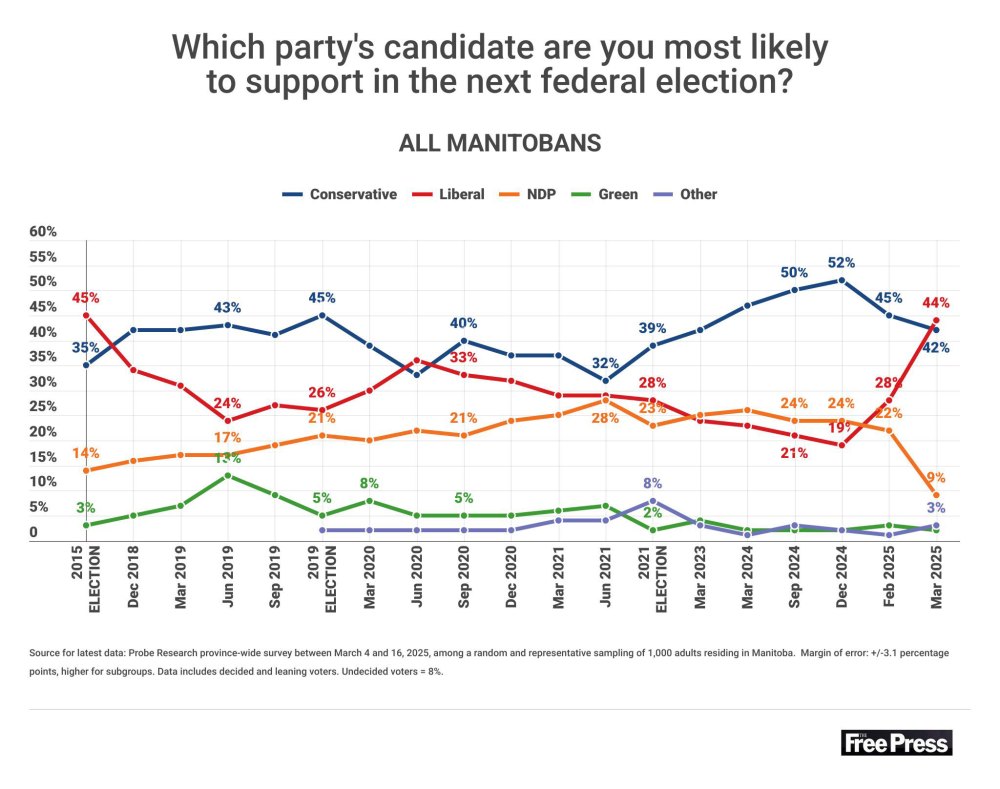
National polls this week from across the country show the NDP garnering between six and nine per cent support. If those numbers hold, some observers have said the party could lose official party status in the House of Commons.
Saunders says there are a few reasons why NDP support has fallen so dramatically in Canada, including in Manitoba.
In crisis situations, such as the one Canada is now facing with the U.S., voters often prefer to stick with incumbent governments, she said. That shift in support has come almost exclusively at the expense of the NDP, whose left-of-centre and centrist supporters more naturally gravitate to the Liberals than the Conservatives.
But there’s another factor at play that’s driving votes away from the NDP and to the Liberals, said Saunders. Since Trump was sworn in as president in January, many Canadian voters are taking an “anyone but Conservative” approach, including in Manitoba.
Conservative Leader Pierre Poilievre has had trouble distancing himself from the Trump-like style of politics he employed for most of the past two years. That approach — including attacking institutions such as the Bank of Canada and using terms like “woke” and the “radical left” — served the Conservative leader well until Trump was re-elected.
Brandon University poli-sci Prof. Kelly Saunders says voters like an incumbent government in times of trouble.
But it’s now turning some voters off, and many are thinking about strategic voting to prevent the Conservatives from winning government, said Saunders.
“(Poilievre) still to this day cannot seem to pivot,” she said. “He keeps sticking to old messaging.”
Former provincial NDP cabinet minister Gord Mackintosh agrees that many people who traditionally vote NDP are thinking about voting Liberal to keep the Conservatives out of power.
“I don’t think the NDP did anything wrong,” said Mackintosh, now a senior adviser with the consulting firm Counsel Public Affairs. “They punched above their weight in Parliament.”
Indeed, the party pushed the Liberals to implement national dental and pharmacare programs under a supply and confidence agreement it signed with the minority government in 2022. However, the party has struggled to get credit for those programs, and they have not translated into higher voter support for the NDP.
In fact, the opposite has happened under Canada’s rapidly changing political landscape. Few will remember the role the NDP played in getting those programs off the ground as Canadians focus on Trump and the threats coming from south of the border, said Mackintosh.
“I think Canadians are craving stability right now,” he said. “That favours incumbent governments… Trump’s attack on Canadian sovereignty makes us intuitively defensive of the status quo.”
“Trump’s attack on Canadian sovereignty makes us intuitively defensive of the status quo.”–Gord Macintosh
Mackintosh, who has campaigned for the NDP at both the provincial and federal levels, said it’s not unusual for people to vote for different parties in provincial and federal elections. The provincial NDP under Premier Wab Kinew continues to surge in popularity nearly a year and a half after the October 2023 provincial election. But that magic has not worn off on federal NDP candidates.
“I think that Manitobans clearly understand the difference between provincial and federal elections,” he said. “Manitobans know that the federal election is a different channel than a provincial election.”
Mackintosh said he doesn’t think the NDP will be shut out of Manitoba in the federal election, slated for April 28. But the party is facing an uphill battle to retain the seats it has and will likely focus on the few winnable seats it has across the country.
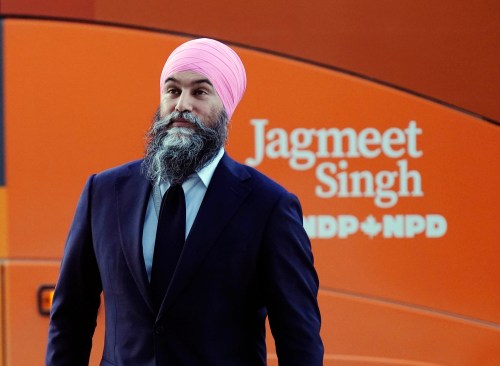
Welch said part of the NDP’s problem, including in Manitoba, is leader Jagmeet Singh, who hasn’t been able to connect with voters in a meaningful way since he became head of the party in 2017.
“For all of his time in national politics there is very little personal fondness for Jagmeet Singh,” said Welch. “So that vote is so quick to erode. Those voters are so quick to move.”
Saunders said Singh is struggling at a time when Canadians are looking for a strong, stable leader in the face of Trump’s threats.
“I don’t think at this moment that people are seeing him as a serious enough leader to be able to manage through the greatest threat that Canada has faced in its modern history,” she said. “Whether that’s a fair assessment of Mr. Singh or not, I think that’s the perception.”
Jagmeet Singh, who has led the NDP since 2017, has had trouble connecting with voters even though the party was successful in getting the Liberals to bring in national dental care and pharmacare programs.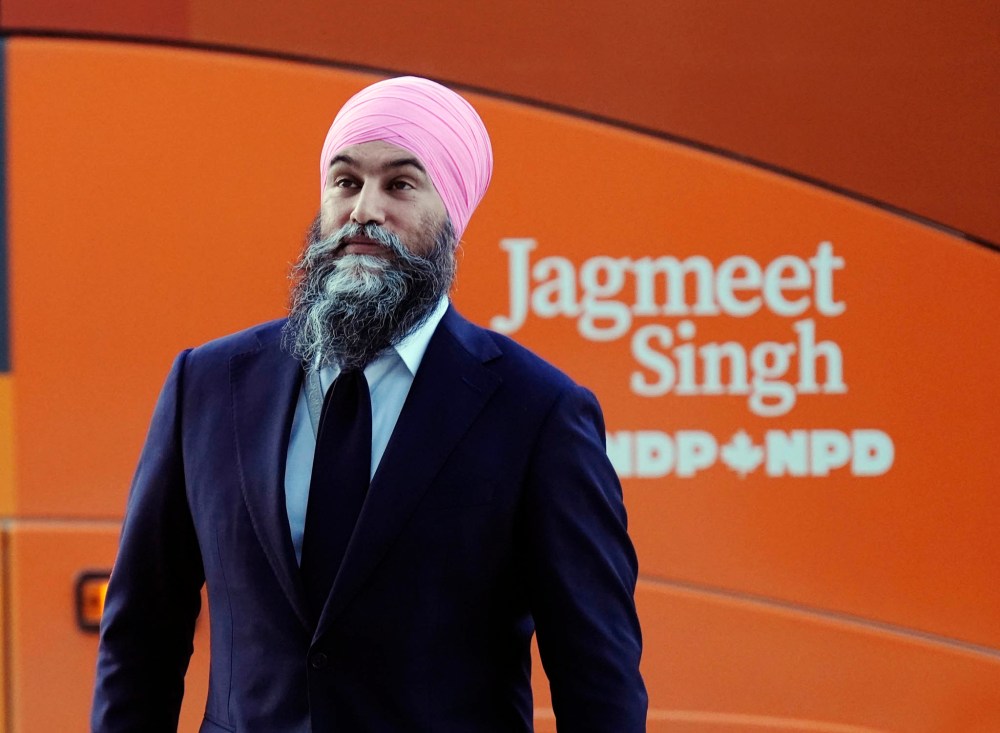
However, NDP incumbent Niki Ashton, who is seeking re-election in the northern Manitoba riding of Churchill—Keewatinook Aski, said it’s too early to count out the NDP in Manitoba.
“Polling does shift throughout campaigns,” said Ashton. “There’s a lot of campaign left… I don’t think we’re at a point where we can say this is what’s going to happen on election day.”
Besides, the kind of strategic voting some people are talking about to keep the Conservatives out of government doesn’t always work, she said.
In ridings with strong NDP support, a push to elect a Liberal can split the vote and allow a Conservative candidate to come up the middle and win, she said.
“Strategic voting often doesn’t get the result that people think they’re going to get,” she said. “In the case of ridings where the NDP is pushed out, a Conservative has won despite people wanting otherwise.”
Ashton said it’s also telling that at a time when Canadians are trying to fend off attacks from the U.S. that some people are trying to turn this election into a U.S.-style, two-party race.
“The great irony is here we are talking about standing firm against the Trump administration,” said Ashton. “Yet pushing Canada towards a two-party system will only make us more like the U.S.”
“… Pushing Canada towards a two-party system will only make us more like the U.S.”–NDP incumbent Niki Ashton
And that has not been Canada’s history, she said. The NDP has been instrumental in pushing for social programs such as medicare, protecting worker and Indigenous rights and fighting for diversity, something she said is not part of the American political culture.
“A clear message has to be that Canada without the NDP would be like Donald Trump’s America,” said Ashton. “I don’t think any Canadian would want that end result.”
Ashton agreed Trump is a major problem facing Canada right now, but it’s not the only challenge the country has, she said. Poverty, Indigenous issues, housing and protecting Canada’s universal health-care system are all issues that are important to Canadians in this election, she said.
“We all agree there’s a lot at stake,” she said. “But having a Parliament without NDP voices, without a party with a track record that we have would be turning the clock back on progress within our own country.”
tom.brodbeck@freepress.mb.ca

Tom Brodbeck is an award-winning author and columnist with over 30 years experience in print media. He joined the Free Press in 2019. Born and raised in Montreal, Tom graduated from the University of Manitoba in 1993 with a Bachelor of Arts degree in economics and commerce. Read more about Tom.
Tom provides commentary and analysis on political and related issues at the municipal, provincial and federal level. His columns are built on research and coverage of local events. The Free Press’s editing team reviews Tom’s columns before they are posted online or published in print – part of the Free Press’s tradition, since 1872, of producing reliable independent journalism. Read more about Free Press’s history and mandate, and learn how our newsroom operates.
Our newsroom depends on a growing audience of readers to power our journalism. If you are not a paid reader, please consider becoming a subscriber.
Our newsroom depends on its audience of readers to power our journalism. Thank you for your support.
Related Articles
Liberals win 4th mandate as NDP vote collapses and Singh announces he will resign