The Jets’ team at 35,000 feet A peek behind the charter curtain with the club’s dedicated flight crew
Read this article for free:
or
Already have an account? Log in here »
To continue reading, please subscribe:
Monthly Digital Subscription
$0 for the first 4 weeks*
- Enjoy unlimited reading on winnipegfreepress.com
- Read the E-Edition, our digital replica newspaper
- Access News Break, our award-winning app
- Play interactive puzzles
*No charge for 4 weeks then price increases to the regular rate of $19.00 plus GST every four weeks. Offer available to new and qualified returning subscribers only. Cancel any time.
Monthly Digital Subscription
$4.75/week*
- Enjoy unlimited reading on winnipegfreepress.com
- Read the E-Edition, our digital replica newspaper
- Access News Break, our award-winning app
- Play interactive puzzles
*Billed as $19 plus GST every four weeks. Cancel any time.
To continue reading, please subscribe:
Add Free Press access to your Brandon Sun subscription for only an additional
$1 for the first 4 weeks*
*Your next subscription payment will increase by $1.00 and you will be charged $16.99 plus GST for four weeks. After four weeks, your payment will increase to $23.99 plus GST every four weeks.
Read unlimited articles for free today:
or
Already have an account? Log in here »
MONTREAL — The Winnipeg Jets have hit plenty of rough air lately, nose-diving in the NHL standings after a turbulent month that’s produced just four wins in their past 13 games.
Most of that stretch has been spent far from home — with stops in 11 cities across four time zones — the Jets have landed in Montreal, where their latest lengthy road trip wraps up Wednesday night.
As bumpy as their play has been, one thing has remained constant as they criss-cross the continent: they’re in good hands thanks to a small but mighty team tasked with keeping their travel running smoothly and efficiently.

MIKE MCINTYRE / FREE PRESS
Joanne Prescott and David and Sandy Herfst are the cabin crew this season for the Winnipeg Jets, while Kevin Polonuk ensure’s the entire operation runs smoothly, doing the literal heavy lifting of packing the club’s equipment before every flight. From left: (front row) Joanne Prescott, Kevin Polonuk, (back row) Sandy Herfst, David Herfst.
The Free Press sat down with the organization’s dedicated flight crew this week for a unique peek behind the curtain — talking tricks of the trade, the chaotic post-game race from rink to airport, loading 2,500 kilograms of hockey gear in the blink of an eye, charter cuisine, card games at 35,000 feet, and the family atmosphere that develops over time.
The plane can be a place of raucous celebration. Or of quiet reflection. Truth be told, there’s been far more of the latter this season given what’s happened on the ice.
Regardless of the result, the aircraft often becomes a sanctuary for a pro athlete — a space to bond with teammates, binge a Netflix series, or escape a scoring slump for a few hours.
“You talk about safe places where you can kind of hang out and be yourself. The dressing room is one, but the plane is another,” said Jets captain Adam Lowry.
“You talk about safe places where you can kind of hang out and be yourself. The dressing room is one, but the plane is another.”
That’s where Air Canada and its JETZ program — a coincidence in name, given it launched a decade before the Jets 2.0 were born — comes in.
All seven Canadian teams use the service, as do four American clubs: Buffalo, Colorado, Dallas and Seattle. They share four modified A320s that have had all economy seating removed, leaving just 70 business-class seats, and even a pair of card tables at the very back.
The aircraft are shuffled around North America like puzzle pieces, lining up with each team’s schedule. Occasionally, planes from the main fleet are pulled into emergency service to lighten the load, such as a wild day last week when all 11 client teams were on the road simultaneously.
The pilots change constantly. The cabin crew does not. Three Air Canada flight attendants who undergo a rigorous screening and qualification process are assigned to each hockey team for the entire season.
In that sense, they become an extension of the team, spending 90 to 120 days together from September through April — and potentially into May or June if they can get hot at playoff time. Many come back every second year as part of a contracted rotation to avoid burnout.
“To be able to build a relationship with the staff on the plane and to have them every trip, it’s great,” said Lowry.
“They do such a good job of taking care of us. Just making sure you’re comfortable and making sure you have everything you need. They’ve always got big smiles on their face. There’s a lot of things that go on behind the scenes that make an NHL operation. I think they’re one of the pieces that goes unnoticed or unrecognized.”
It was love at first flight for David and Sandy Herfst. The married couple met in 1998 while working for a now-defunct airline and have been travelling the world together ever since.
David joined JETZ when it launched in 2001, first working with the Toronto Maple Leafs and then the Montreal Canadiens. But when the NHL returned to Winnipeg in 2011, the hometown boy jumped at the chance to watch the new team spread its wings.
Sandy joined him in 2013, and they’ve now spent every second season ensuring Jets players, coaches, management, broadcasters and support staff are buckled in and aware of the emergency exits.
In reality, their role entails far more than safety demonstrations.
They arrive at the plane three hours before departure, preparing roughly 70 meals — they always order extras for the travelling party of about 50. They often pick up the food themselves, though some restaurants deliver.
They have three or four reliable spots in all 32 NHL cities, usually consulting with the Jets ahead of time
“In general they want a beef, a chicken and a fish option. And a salad,” said Sandy.
They have a set budget, which means lobster and caviar is not on the menu. But the food is high-quality, with extra-large protein portions to reflect the needs of athletes.
Getting the food right requires finesse.
“There’s a lot of tricks we employ when we’re ordering food,” said David. Under-cooking pasta so it can be finished in the galley. Blanching vegetables. Getting steaks cooked only rare, then bringing them up to medium using the convection oven.
“We’ve had restaurants flat-out say we’re not interested, and that’s simply because we’re taking their product and moving it off-site, so now they have no quality control,” he added.
Food poisoning is the worst fear. Montreal went through it once — not on a JETZ flight — and now everything is plastic-wrapped, checked, double-checked.

JOHN WOODS / THE CANADIAN PRESS FILES
Winnipeg Jets captain Adam Lowry said the crew takes such good care of the team, and out of all the things that go on behind the scenes in an NHL operation, ‘they’re one of the pieces that goes unnoticed or unrecognized.’
Forget bags of tiny pretzels — dessert often includes fresh-baked cookies and ice cream, and every player’s birthday is marked with a cupcake waiting at their seat.
Despite their unique vantage point, the couple were never huge hockey fans.
“But I have learned to appreciate what it takes to become an NHL player,” said Sandy. “The sacrifices they make for their career. And what goes into it. It’s special. Those guys are all special.”
Their relationships extend beyond players to their families, especially during the annual mom and dad trips. They felt the loss last spring when Mark Scheifele’s dad, Brad, passed away from cancer.
“He was a beautiful man,” said Sandy.
She’s enjoyed watching players like Lowry and Scheifele grow from fresh-faced kids into grizzled veterans, particularly on a Jets team that’s kept so much of its core intact.
One of their favourite memories involves Dustin Byfuglien, who thought he’d cracked a mystery years ago. They hadn’t advertised their relationship but were clearly giving off subtle signs.
One day, Byfuglien confronted them, revealing a theory the players had developed.
“They all thought we were having an affair,” Sandy said, laughing. “They knew we were married — just not to each other.”
A career highlight remains the night the Jets beat Nashville in Game 7 of the 2018 second round — a dramatic road win that led to quite the flight home.
“That was incredible. It was so much fun,” she said.
Still, boundaries matter. No photos. No videos.
“I respect their privacy and their quiet time. And, of course, we want them to feel comfortable around us,” said Sandy.
According to Lowry, they pass with flying colours.
“I’ve had Dave and Sandy now, I think this is my sixth time out of 12 years. You get to know them and you’re always excited to see them,” he said.
“We’re super lucky to have both crews. I still talk to the crew we had last year. You develop those relationships, those jokes and that banter. They become part of the team.”
Joanne Prescott jokingly refers to herself as Dave and Sandy’s daughter — even though she’s close to the same age. Given how close they work together, they truly have become family.
A 30-year Air Canada employee, the Winnipegger is now in her third tour with the Jets. She admits she’s a lifelong sports nut, watching Jets 1.0 games as a kid and playing ringette growing up.
Does she ever get starstruck?
“It’s a cool experience. But a professional line is drawn,” she said. “Even though you get to see behind-the-scenes, my role and responsibility is as a crew member. And what happens on the plane stays there. It has to stay there.”
With her kids now in university, she has more flexibility to embrace the chaotic lifestyle. She estimates she spent just four nights in her own bed in November.
“It’s been a bit like Groundhog Day,” she said of the relentless schedule.
One of the perks is getting a bit of downtime on the road to play tourist in cities they might not otherwise visit, especially on off days when there’s no flight to prepare for. Whether it’s going to a Madonna concert in Pittsburgh or a Dodgers game in Los Angeles, Prescott is always up for an adventure.
“We chose this life, and you have to have fun doing it,” she said.
MIKE MCINTYRE / FREE PRESS
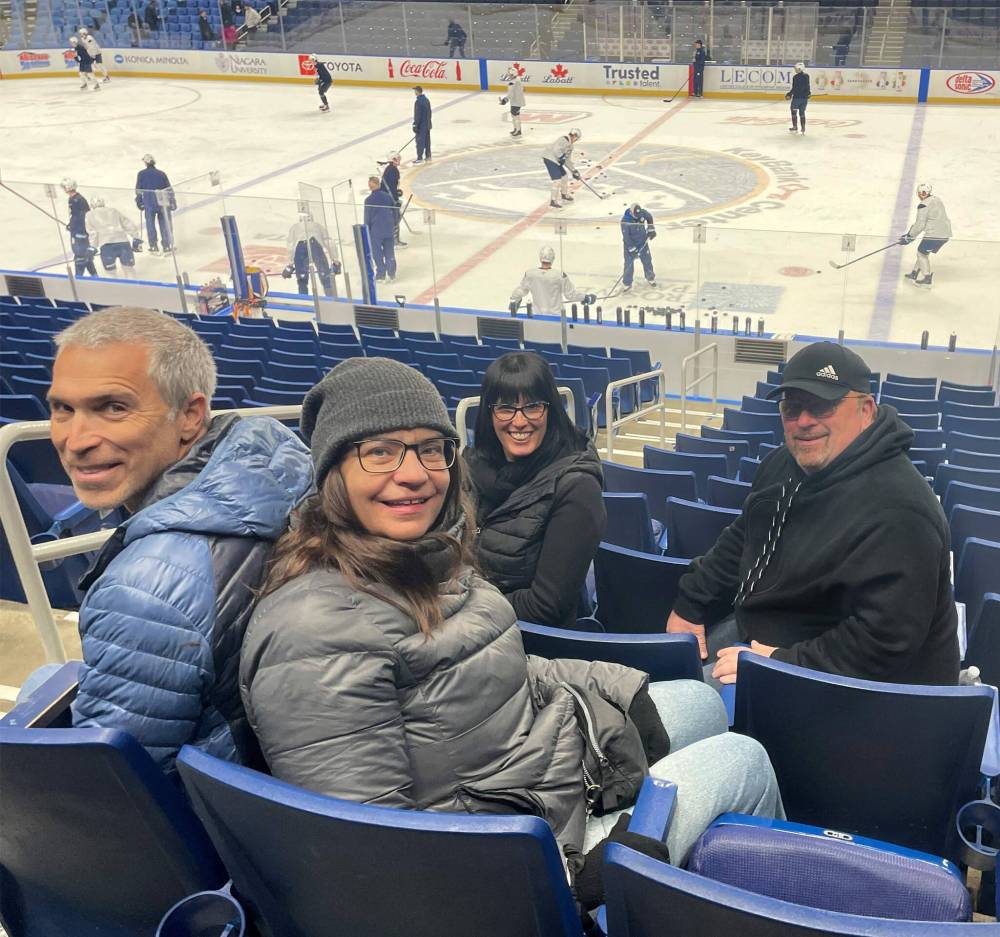
The Winnipeg Jets’ dedicated flight crew. From left: David Herfst, Sandy Herfst, Joanne Prescott, Kevin Polonuk.
“We chose this life, and you have to have fun doing it.”
Prescott said she gets a kick out of how superstitious some players are. Whether it’s eating the same type of food or wearing the same clothing when things are going well, she’s seen it all.
There’s a usual pecking order when it comes to the seating chart: Coaches and management sit at the front. Broadcasters behind them. Trainers in the middle. Younger players further back. Veterans in their familiar perches at the rear.
Some wear the result of a particular game on their faces, while others show no visible signs.
“You can never look at a game the same way once you get to know the players,” said Prescott.
The crew can’t do anything about what happens between the whistles, but they’d like to think they play at least a tiny role.
And when they can beat the clock and land ahead of schedule — as they did this past Friday night going from Raleigh to Nashville — they can jokingly take credit when good things happen such as the Jets win over the Predators in Music City.
“We did it!” said Prescott. “It’s because we got them there 10 minutes early!”
Last — but far from least — is Kevin Polonuk.
He is the operations rep for the Jets–JETZ partnership and an Air Canada aircraft maintenance engineer since 1993. Unlike the flight attendants, he doesn’t rotate out, and this is now his seventh season with his hometown team.
Polonuk ensures the entire operation runs smoothly, working closely with Jets director of team operations Chris Kreviazuk to map out every detail.
What nights are they flying out immediately after a game? When do they stay over — such as Wednesday in Montreal, with the Jets choosing to maximize rest during a stretch of six games in nine nights?
What hotels are booked? How does equipment move from A to B? And what happens when an emergency hits, such as earlier this month in Los Angeles, when the Jets took off for San Jose, reached the Pacific Ocean, and had to turn back due to a mechanical issue? Polonuk scrambled to secure another aircraft and transfer everything over.
Polonuk also does the literal heavy lifting, stacking 2,500 kilograms of team equipment into the belly of the plane before every flight with help from a handful of airport employees and Jets equipment personnel. Personal bags and staff luggage get loaded into the forward cargo.
“On a good day, we can get it all loaded in 12 minutes. Maybe 10.”
“It’s kind of like Tetris. If you don’t get it right, it won’t all fit,” said Polonuk. “So we’ve got an order everything goes in. On a good day, we can get it all loaded in 12 minutes. Maybe 10.”

The Jets always aim to be wheels up exactly four hours after puck drop, which is quite remarkable given all that is involved. That leaves a window of about 90 minutes from final buzzer at the rink to rolling down the runway at the airport with everything — and everyone — on board.
Every second matters, especially when dealing with creatures-of-habit such as pro athletes.
Polonuk is a huge fan of the Jets and hockey in general. He is doing what he loves — and loves what he’s doing.
“Not many people have an opportunity to do something like this for a living,” he said. “We are very, very fortunate.”
winnipegfreepress.com/mikemcintyre

Mike McIntyre is a sports reporter whose primary role is covering the Winnipeg Jets. After graduating from the Creative Communications program at Red River College in 1995, he spent two years gaining experience at the Winnipeg Sun before joining the Free Press in 1997, where he served on the crime and justice beat until 2016. Read more about Mike.
Every piece of reporting Mike produces is reviewed by an editing team before it is posted online or published in print — part of the Free Press‘s tradition, since 1872, of producing reliable independent journalism. Read more about Free Press’s history and mandate, and learn how our newsroom operates.
Our newsroom depends on a growing audience of readers to power our journalism. If you are not a paid reader, please consider becoming a subscriber.
Our newsroom depends on its audience of readers to power our journalism. Thank you for your support.