Magic buzz Hive time with honeybees a sweet summer adventure
Read this article for free:
or
Already have an account? Log in here »
To continue reading, please subscribe:

Digital Subscription
One year of digital access for only $205*
- Enjoy unlimited reading on winnipegfreepress.com
- Read the E-Edition, our digital replica newspaper
- Access News Break, our award-winning app
- Play interactive puzzles
*First annual payment billed as $205.00 + GST for one year. This annual subscription will automatically renew at $233.00 + GST every 52 weeks (10% off the regular annual price of $259.35). Offer available to new and qualified returning subscribers only. Cancel any time.
To continue reading, please subscribe:
Add Free Press access to your Brandon Sun subscription for only an additional
$1 for the first 4 weeks*
- Enjoy unlimited reading on winnipegfreepress.com
- Read the E-Edition, our digital replica newspaper
- Access News Break, our award-winning app
- Play interactive puzzles
*Your next Brandon Sun subscription payment will increase by $1.00 and you will be charged $17.95 plus GST for four weeks. After four weeks, your payment will increase to $24.95 plus GST every four weeks.
Read unlimited articles for free today:
or
Already have an account? Log in here »
Hey there, time traveller!
This article was published 09/01/2026 (253 days ago), so information in it may no longer be current.
I’ve spent 18 years documenting Prairie life in western Manitoba, mostly photographing the people who make up the region’s small towns, farms, Hutterite colonies and First Nations.
As photojournalists, we are constantly in and out of people’s lives, which is an amazing privilege — but it can also be exhausting.
This year, I decided to spend my time with bees.
A honeybee casts a shadow on the petals of a poppy while collecting pollen on an early July morning in Deerboine hutterite colonies communal garden. The colony has it’s own apiary.
My friends Andrew and Hiltje Vander Velde, owners of Red House Ranch Apiaries, happily agreed to allow me to come and go from their hives, letting myself in and out through the electric fence meant to deter bears looking for honey.
I spent hours at a time in the early morning and late evening watching the honeybees work, collecting pollen from near and far and bringing it back to the hives. I got to see the different colours of the pollen up close.
Photographer and author Tim Smith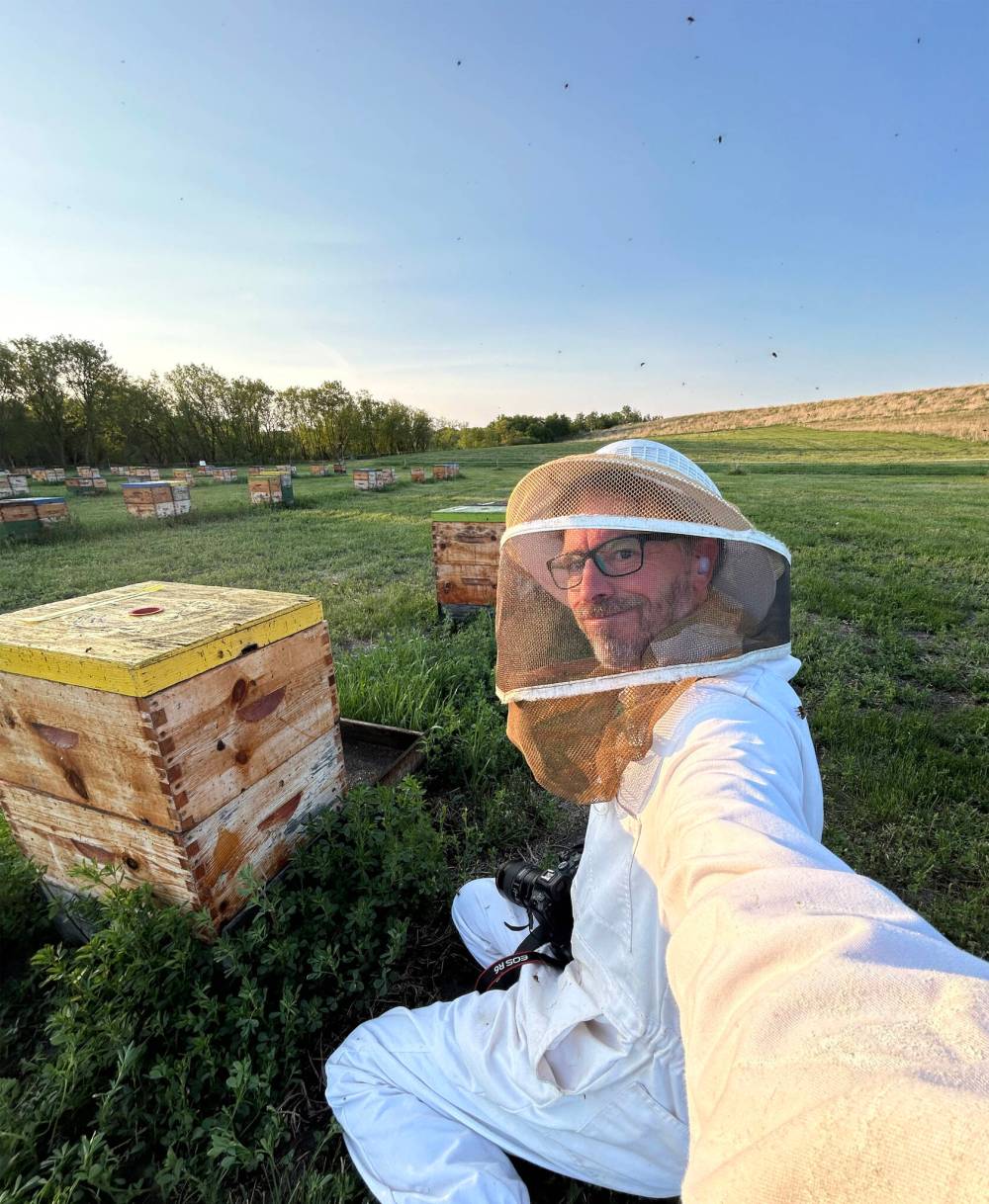
I wanted to capture the lives of bees, including through macro-lens portraits. This was not an easy task. Macro lenses have narrow depths of field — and flying bees move quickly and erratically, usually coming in and out of my focal plane faster than I or the camera could register.
I wanted photos that felt like portraits, so I set up backdrops, relying on crafting or scrapbooking items I had purchased. I’d pick a colourful piece of cardboard paper, line it up vertically against the side of a hive and focus my camera on the action just outside the entrance so I could get bees returning to their home or heading out on their missions.
It might sound simple — but it required taking thousands of photos at each sitting to get a few that were in focus.
I sat in the grass, my face and camera lens positioned inches from the upper entrance to the hive, my neck and shoulders contorted uncomfortably. And I photographed while enveloped in the droning sound of thousands of bees at work.
Sometimes I listened to podcasts, other times I listened to the birdsong of the western meadowlarks, bobolinks and least flycatchers.
Honeybees congregate on drone comb next to a hive to collect pollen and nectar at sunset in an apiary west of Brandon, Manitoba in late May, 2025.
Sometimes I’d wear the full beekeeper suit that Andrew and Hiltje lent me, other times just a T-shirt and shorts. Aside from one poor bumblebee that inadvertently got pinched in my elbow crease, the only times I got stung — fewer than a half-dozen times in total — were when I was wearing my beekeeper suit. Most were just one sting at a time, on an exposed bit of wrist or ankle.
Once I had a group of angry bees following me back to my car. I’m not sure how I inadvertently caused them stress that day, but I could register their agitation in the change of pitch in their buzzing — the wing vibrations they use to communicate.
The mesh head covering, which hung off a hard, rimmed hat, was a pain to photograph through so I’d often ditch it, especially in the evenings when the bees were calmer.
Over the years, I’ve learned to follow beekeepers’ leads. My friends at Deerboine Hutterite Colony rarely wear any protective covering, so if I’m around them, I also don’t wear anything.
A honeybee returns to its hive with collected pollen at an apiary west of Brandon, Manitoba in late May, 2025.
When I came across apiarist Mike Clark, director of the Manitoba Beekeepers’ Association, pulling honey boxes from hives amid a strong late summer wind, he also wasn’t wearing any protective gear.
Meanwhile, thousands of honeybees, blown out from the frames of honeycomb with a leaf blower, filled the Prairie air with chaos. “Shallow breaths,” Clark told me. “They’re attracted to carbon dioxide.”
That day was magical. Dozens — if not hundreds — of bees explored and rested on my arms, legs and torso while I photographed their hives shortly after their honeycomb was collected. I didn’t get stung once; I gently brushed them off my body as I changed positions.
The backdrop to all of this, of course, is that bees are under threat. Canada is home to more than 800 species of wild bees, many of which are rare. The threats to them are many: pesticides, invasive species, climate change and more.
Honeybees are also under threat. Mites and the viruses they spread led to 30 per cent of honeybees dying in Canada last winter, according to the Canadian Honey Bee Council, though not all apiarists experienced this level of loss.
Honeybees fill the air at an apiary west of Brandon, Manitoba in June, 2025.
However, the conversations around the threats are nuanced and complicated. Beekeepers tout the importance of honeybees in pollination and how they can benefit wild bees and wildflowers, but the harms versus benefits are situational, based on competition for pollen and other factors.
But this project wasn’t about the big picture. It was about looking closely, and enjoying the moments with a tiny insect many of us never turn our full attention to. It was a case study in zooming in and slowing down.
Summer evenings at the hives were especially beautiful as the low sun backlit the bees still active in the airspace above their hives, with trees in shade lining the west side of the apiary providing a dark backdrop to the glowing bees.
There’s something beautiful about getting to know a subject beyond the surface level. I spent hours watching bees take evening naps on plants just outside their hives, or casting shadows on and through the delicate petals of poppies in the garden at Deerboine Colony.
A bumblebee leaps from one flower to another in Souris in the search for pollen.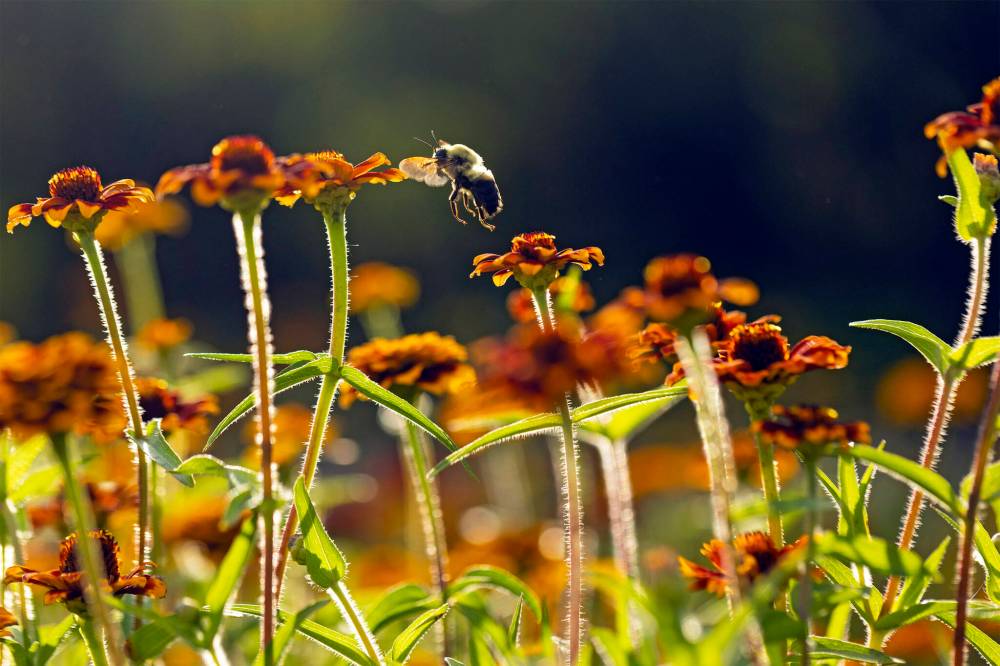
The beauty was in the details: Leafcutter bees store their collected pollen on the bottom of their abdomens using specialized hairs called scopa to grasp the powdery plant fertilizer. When leafcutters plunge themselves headfirst into flowers, their pollen-covered back ends stick out.
Bumblebees, of which Manitoba has several species, sometimes climb out of flowers looking like they fell into a vat of pollen, with it clinging to every part of their fuzzy, barrel-shaped bodies. Patches of goldenrod and fireweed were the bee equivalent of a Manitoba social.
A leafcutter bee collects and stores pollen on its scopa, a patch of hair on its abdomen.
Some evenings at the hives, shortly after the sun had set, coyotes filled the air with their cries from every direction.
Activity slowed as bees entered their hive for the night, congregating on discarded honeycomb or in repose on plants in the field. The occasional firefly would glow alongside the bees still moving across the dusk-blue sky.
I sat and watched the activity slowing — and felt lucky to be there in that moment.
tsmith@brandonsun.com

A honeybee zeros in on the entrance to a hive at Hiltje and Andrew Vander Velde’s apiary northwest of Alexander.

A female worker bee carries collected pollen back to its hive in Hiltje and Andrew Vander Velde’s apiary northwest of Alexander, Manitoba in late May, 2025. Honey bees pack collected pollen into the corbiculae, special pollen baskets on their hind legs. Pollen colour varies from flower to flower.
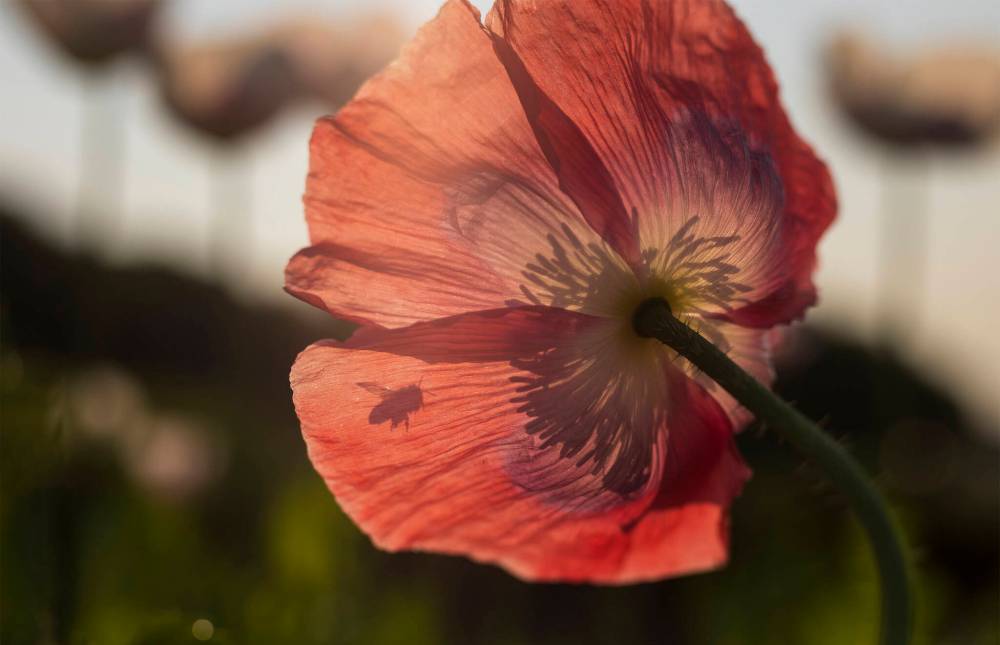
A honeybee casts a shadow through the petals of a poppy at Deerboine Hutterite Colony.

A portrait of a honeybee mid flight outside a hive at an apiary west of Brandon, Manitoba in early June, 2025.

Honeybees, backlit by the late evening sun, fill the air around their hives in an apiary west of Brandon, Manitoba in late May, 2025. Each hive can contain up to 60,000 bees at its summer peak.

A portrait of a honeybee mid flight outside a hive at an apiary west of Brandon, Manitoba in early June, 2025.

A bumblebee collects pollen and nectar from goldenrod in Riding Mountain National Park in late July. New queen bumblebees hibernate through the cold winter months while the rest of the colony dies off.

A bumblebee delicately climbs from one purple salvia flower to another at a unban flower garden in Souris, Manitoba while searching for pollen in early August.

A bumblebee crams into a flower head-first to collect pollen at a unban flower garden in Souris, Manitoba in early August.

Thousands of honeybees fill the sky after apiarist Mike Clark collected honeycomb frames from the hives in late August.