A rift in the neighbourhood Debate over Toronto supervised consumption site serves as cautionary tale as Manitoba government pursues its own harm-reduction facility
Read this article for free:
or
Already have an account? Log in here »
To continue reading, please subscribe:

Digital Subscription
One year of digital access for only $205*
- Enjoy unlimited reading on winnipegfreepress.com
- Read the E-Edition, our digital replica newspaper
- Access News Break, our award-winning app
- Play interactive puzzles
*First annual payment billed as $205.00 + GST for one year. This annual subscription will automatically renew at $233.00 + GST every 52 weeks (10% off the regular annual price of $259.35). Offer available to new and qualified returning subscribers only. Cancel any time.
To continue reading, please subscribe:
Add Free Press access to your Brandon Sun subscription for only an additional
$1 for the first 4 weeks*
- Enjoy unlimited reading on winnipegfreepress.com
- Read the E-Edition, our digital replica newspaper
- Access News Break, our award-winning app
- Play interactive puzzles
*Your next Brandon Sun subscription payment will increase by $1.00 and you will be charged $17.95 plus GST for four weeks. After four weeks, your payment will increase to $24.95 plus GST every four weeks.
Read unlimited articles for free today:
or
Already have an account? Log in here »
Hey there, time traveller!
This article was published 30/01/2026 (230 days ago), so information in it may no longer be current.
TORONTO — There’s a life-and-death struggle unfolding on Augusta Avenue, although you’d hardly know it from the sleepy morning calm that lingers, waiting for the impending buzz of the morning commute.
The coffee houses south of College Street, a nearby cross street, are starting to fill up with students, commuters grabbing one to go and work-from-home contractors escaping their home offices for a whiff of crisp January air. But apart from that, the front windows of trendy shops, restaurants and pubs are dark, patios vacant, still hours away from joining the day.
The one exception to the quiet is 260 Augusta Ave., where about two dozen people have gathered outside The Neighbourhood Group Community Services (TNGCS), a multi-headed hydra of social and health services.
The building hosts a mash-up of a half-dozen or so agencies that provide everything from supportive housing to a food bank, child care, primary health care and a broad array of support for the homeless, addicted and those suffering from mental illness.
On the sidewalk in front of the building, clusters of three or four homeless people enjoy muffled laughs and joshing. Others sit on benches enjoying a quiet smoke. A few people are digging through knapsacks and large shopping bags for garbage, which is being stuffed in a large black wheely-bin.
Around 9 a.m., people start making their way inside. It’s quiet, orderly, a familiar trek like factory workers going in for their morning shifts.
Before the day is out, roughly 300 people will come in to use the washing machines, showers, grab a hot meal or just enjoy a warm respite from the creeping January cold outside. Depending on the day of the week, visitors can also be tested for sexually transmitted infections, get advice on how to access social assistance or find a pathway to employment or housing.
And then there’s KMOPS.
The Kensington Market Overdose Prevention Site occupies a 400-square-foot office on the first floor of TNGCS. On a daily basis, roughly two dozen people will visit. Most are there to test their drugs for fatal additives. Others come in for clean needles.
Desks where people can use pre-obtained substances in a safe space at the Kensington Market Overdose Prevention Site (KMOPS) in Toronto. (Marta Iwanek / Free Press)
About one-in-four visits involve a client who will use drugs in a supervised setting to ensure they do not overdose or suffer other adverse reactions.
KMOPS is, by the most important metrics, a success; in the six years it has operated, there has not been a single overdose death. However, despite its record of success and the fact that KMOPS is only one tiny part of the broad spectrum of services offered by The Neighbourhood Group on Augusta Avenue, KMOPS has become the focus of a divisive community debate in Kensington Market as it has across Canada.
From from Vancouver to the Maritimes, critics express concerns facilities that provide environments for safer consumption of illicit drugs promote increased, open drug use and serve as a catalyst for crime of all types.
Manitoba’s NDP government is getting a first-hand view of the challenges of establishing such a centre.
After the government backtracked on its first proposed site, near the Disraeli Bridge, amid strong opposition over concerns of its close proximity to a daycare and high school, its second proposed site, this time west of Main Street on Henry Avenue, is also facing pushback.
Area residents and businesses have expressed concerns over safety, increases in crime and limited consultation. Regardless, those who champion harm reduction as part of the spectrum of responses to addiction in Winnipeg are undeterred.
Related Articles
City looking at options for ‘managed encampment’ with basic services for homeless people


















And despite the challenges in Winnipeg, nowhere has the debate been more intense than Ontario.
In August 2024, Ontario Premier Doug Ford passed legislation designed to push existing harm-reduction sites — five in Toronto and stand-alone centres in Guelph, Hamilton, Thunder Bay, Waterloo and Ottawa — to close.
The law contained new restrictions, including a requirement that the sites be at least 200 metres away from schools and child-care centres. The new law not only prohibited existing sites from relocating away from schools and daycares, it also prevented municipalities from applying for licences from the federal government for establishing new harm-reduction sites.
The Ford government dangled money — in most instances, four times the funding they were getting to do supervised consumption — to entice the harm-reduction sites to transition into Homelessness, Addiction and Recovery Treatment (HART) Hubs that would be banned from offering any form of supervised consumption or harm reduction.
The law was successful at achieving its goal. By last spring, nine of Ontario’s 10 harm-reduction sites either closed down or transitioned to HART Hubs. Kensington Market’s site was the lone outlier, deciding it would rather fight than run from the Ford government’s new laws.
Augusta Avenue in the heart of Kensington Market has become the centre of the debate surrounding supervised consumption sites in Toronto. (Marta Iwanek / Free Press)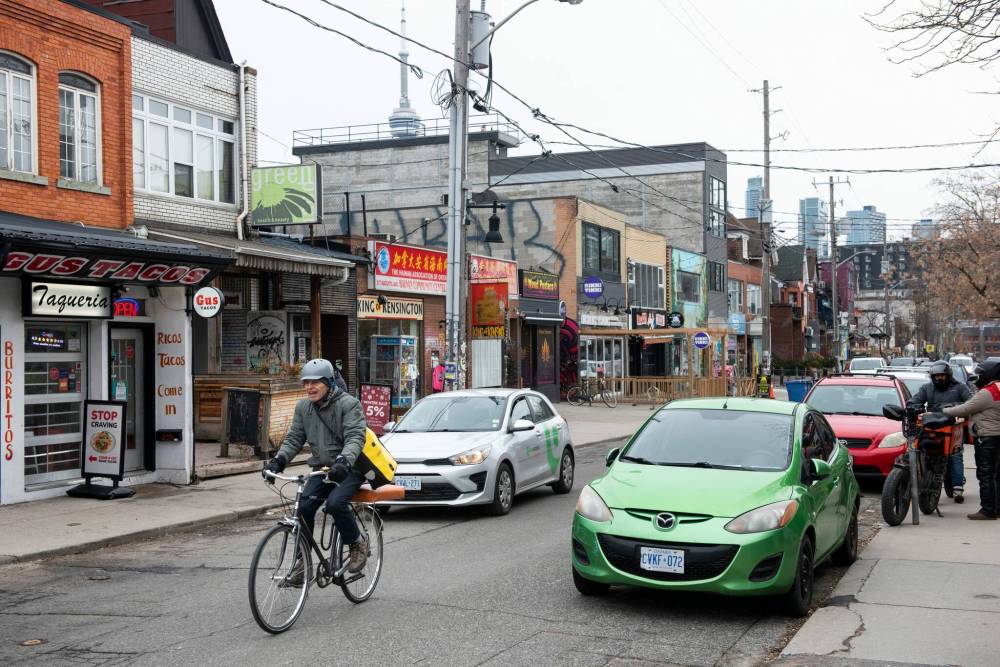
Kensington Market is a densely populated, multiculturally diverse downtown Toronto neighbourhood, one that’s familiar to a certain generation of Canadians who grew up watching the 1970s CBC series King of Kensington.
Given the neighbourhood’s density, it was no surprise KMOPS was declared to be in contravention of the new restrictions, notably for its close proximity to a daycare operated by TNGCS and located in a building connected by an alley. TNGCS argued there had been no complaints from families using the daycare, or incidents where anyone was accosted or otherwise affected by the people using the harm reduction suite.
Last March, TNGCS and two other agencies took the Ford government to court arguing the law was violating the Charter of Rights and Freedoms by denying homeless and addicted the rights of life, liberty and security of the person. It was a legal long-shot but one that ultimately paid off.
In March 2025, an Ontario Superior Court judge issued an injunction allowing all of Ontario’s safe-consumption sites to continue operating until he can issue a ruling on the broader Charter rights argument. KMOPS was the only site to hold its ground. That verdict is expected sometime this year.
Bill Sinclair, the president and CEO of TNGCS, said the publicity surrounding the court challenge has unearthed decades of emotions and assumptions about homelessness and addiction. Although there are many supporters of what his organization is doing on Augusta Avenue, there is also a lot of opposition. And that creates a lot of uncertainty.

Sinclair said so much of the recent opposition has focused on the supervised consumption site but the offerings at TNGCS are much more than that.
“We’ve been offering homeless services in this neighbourhood and on the street at this site since 2001,” Sinclair said.
“Of course, homeless services, it’s sometimes messy, it’s unsightly, and people don’t want that. I know (opponents) would rather they weren’t looking across the street at a homeless drop-in centre every day but it gets all mixed up where they think that somehow, if we stop doing the supervised consumption site, the homeless people are going to go away. They’re not going away. They’re just going to die more.”
Lord knows, David and Wanda Beaver have tried to be good neighbours.
As owners of Wanda’s Pie in the Sky on Augusta Avenue, their business sits directly across the street from The Neighbourhood Group building.
Wanda’s is an overwhelmingly welcoming place: the bricks on the outside painted Lego-yellow, and the inside full of warm and tasty baked goods that do have that “just-like-my-grandmother-used-to-make” appeal.
Over the years, the Beavers said they’ve had many conversations with the TNGCS staff, have tried to understand their selfless mission and even took a stab at helping out.
“When we first moved here, our hearts went out to these people,” David said.
“OK, let’s see if we can figure out a way to help. So I contacted them. They had an outreach person come see us, and … we offered to give some of them jobs. You know, give dishwashing jobs to start, especially if they have any skills, we’ll teach them. So we did about five or six attempts to get people over to work here. They would work for, on average, one or one and a half hours and then quit. Want to get paid cash right away so they can go get their injection. The longest anyone of them worked was four hours. Get very belligerent if you didn’t pay them in cash.”
David and Wanda Beaver, owners of Wanda’s Pie in the Sky, said a supervised consumption site only adds to the struggling neighbourhood’s problems. (Marta Iwanek / Free Press)
Now, with the lingering effects of the pandemic still eating into business margins, the Beavers said their patience is wearing out.
The burgeoning homeless population in Kensington Market has made Augusta Avenue less inviting, more threatening. David said they had to start locking their unisex bathroom because people were shooting up inside. If a homeless person does enter the bakery, Wanda said they always try to offer them a coffee or a sandwich.
The Beavers acknowledged TNGCS was trying to do its best to maintain order on Augusta Avenue.
Staff are stationed outside during business hours to keep an eye on anyone congregating in front of the building. And TNGCS pays some of the homeless people to clean up the sidewalks in front and, in fact, around the entire block. Every hour, one or two people set out with brooms and dustpans and black garbage bags to remove trash and any stray drug paraphernalia.
However, despite these gestures, the sheer number of homeless people living in and around Kensington Market seems to be out of control, Wanda said. That has made things like the supervised consumption site seem like a bad fit for a neighbourhood that’s already struggling.
“I’m sure the statistics show that it maybe saves lives in the immediate, but not over time,” said Wanda.
“I don’t think it does necessarily save lives because you get more people addicted. It seems easier. It doesn’t seem to have logic to it. I understand it’s being humanitarian, but I don’t think that it’s really doing any good.”
“I understand it’s being humanitarian, but I don’t think that it’s really doing any good.”
It is that perspective, that supervised consumption can only make things worse, that drives opposition from many of the business owners in Kensington Market. Even if most people didn’t even know it was among the services being provided.
Sinclair said one of the real ironies of the fight over supervised consumption was that many people in the neighbourhood were generally unaware KMOPS existed until the Ford government tried to shut it down.
In September 2024, several hundred supporters rallied on Augusta Avenue in front of TNGCS in support of the harm-reduction site.
As Sinclair mingled in the crowd and talked with local residents and business owners, it became apparent that many were unaware harm reduction was one of the services being offered in a facility well known for serving the homeless population. “I think generally, people forgot we were doing it, yeah, until, until, you know, we had to tell people that we were now having to stop doing it.”
Sinclair said he completely empathizes with concerns about the homeless population growing to unmanageable levels. Homelessness — and the constant companions of substance abuse and mental illness — is on the rise across Canada. And given TNGCS is a one-stop shop for many support services, the number of people seeking help has only grown.
Even so, Sinclair was quick to note that clients using KMOPS are among the quietest and least problematic people who come into TNGCS’s building. Many addicts actually do not like using drugs out in the open; that is only an option of last resort if they have nowhere else to go. The people who cause the most trouble on Augusta Avenue are typically those with severe mental illnesses, or those using volatile drugs like meth, who never come into contact with KMOPS.
“I think generally, people forgot we were doing it, yeah, until, until, you know, we had to tell people that we were now having to stop doing it.”
However, as bad as things are getting, Sinclair strongly objected to the notion that providing less support will make the problem better. Although TNGCS is a lightning rod for community anger, not having places to support the homeless would not reduce the number of homeless.
That’s a message Sinclair said he hopes the government of Manitoba can emphasize as it attempts to set up its first harm-reduction facility.
“We’d be certainly happy to explain to any group that was starting up what we think are best practices,” Sinclair said.
“Having staff standing in front, having staff intervening, talking to all our neighbours, picking up the needles and picking up trash in the area, having a little bit of a slush fund that if somebody breaks a window that you know, we can offer to fix it. Try to just be a good neighbour at all times, but not back down. We can’t be (a good neighbour) by not helping our neighbours.”
As conciliatory as TNGCS’s tone has been, it has started to fall on deaf ears largely because so many people in this dense, eclectic and impoverished area of Toronto can only see the problem getting worse.
“This is a neighbourhood we’ve worked to keep independent in a good way,” said Mike Shepherd, owner of the Trinity Commons pub right across from TNGCS, and chair of the Kensington Market Business Improvement Association.
“But since COVID, the social problems and the rent increases and the homeless factor and the drug addiction, its all just a spiral, right?”
Shepherd said, for the most part, TNGCS is not creating the problems of homelessness and addiction. A lack of government investment in mental-health services and affordable housing has combined to lay the groundwork for the crisis on Augusta Avenue.
Trinity Common owner Mike Shepherd stores Naloxone behind the bar. Despite TNGCS’s best intentions, he says homelessness has not lessened. (Marta Iwanek / Free Press)
Even so, his front-window view of what’s happening suggests that whatever TNGCS is doing, it’s not working.
“Drugs are getting cheaper and more dangerous and there aren’t enough spaces for detox, I get that,” Shepherd said.
“But what I see now is (TNGCS) is fostering more drug use and more open-air dealing and it’s endangering the people around it…. We need to look at it like almost as a wartime effort. We need to look at it as such a dilemma now that we need a lot of focus from our government to get things done quick.”
The brick-and-stone façade of St. Stephen-in-the-Fields Anglican church has been marked with splashes of graffiti and stained by swirls of black and grey created by 168 years of pollution and weather, giving the looming house of worship an air of defiance.
One assumes its rector, the Rev. Canon Maggie Helwig, would have it no other way.
Helwig is well known to the citizens of Kensington Market as one of its fiercest defenders and activists.
Last October, Helwig stood defiantly on the front steps of St. Stephen as city workers used heavy equipment to clear a small homeless encampment that had occupied two patches of grass near one corner of the church. The encampment had been in place for four years, and had become a source of concern for some area residents.
Helwig and community activists lobbied long and hard to have the encampment remain.
Unsuccessful, the city ordered it cleared and then later erected two-metre-high metal fencing and filled up the two patches of what had been grass with two dozen enormous concrete blocks.
Poet, novelist and Reverend of Church of Saint Stephen-in-the-Fields, Maggie Helwig stands among the fences and concrete blocks that the city of Toronto put in place after it cleared an encampment. (Marta Iwanek / Free Press)
The fencing and the blocks will remain in front of the church for the foreseeable future, a deterrent to anyone looking to pitch a tent and a reminder of the city’s heavy-handed posture towards homelessness.
Helwig said she understands why some of the businesses and residents of Kensington Market wanted the encampment gone. And why some of those same people are railing against the harm-reduction site located a block away.
However, she said what critics do not seem to understand is that the problems they are most concerned about are not caused by encampments or supervised consumption sites.
“People are scared. People are confused. The social contract is being shredded. All kinds of things are going down the tube. All kinds of conditions are getting worse and worse, and I’m not arguing about any of that,” Helwig said.
“But people want one simple thing they can blame. And for a while, the encampment was that one simple thing to blame, and now it’s a safe consumption site.”
One of the biggest misconceptions taking root is that KMOPS or homeless encampments have brought a drug and street-crime problem to Kensington Market, Helwig said.
“…For a while, the encampment was that one simple thing to blame, and now it’s a safe consumption site.”
History will show that, as one of the poorest neighbourhoods in the city, drugs and the corresponding street crime that go in lock-step have always been a prevalent concern in this part of Toronto.
And Helwig said there is now incontrovertible data from the Metropolitan Toronto Police, buttressed by social-science research, that has shown crime rates have not skyrocketed in the areas surrounding supervised consumption sites. In fact, crime has gone down in some of the neighbourhoods that host harm-reduction services, she added.
“I think what they want is a Kensington Market that has never existed,” Helwig said. “They want a Kensington Market where there is no drug trade, where there are not drug deals being made in the park, where there aren’t homeless people in the streets, where everything is kind of clean. And that’s never actually been Kensington Market.
“I lived here during the crack wars in the ’80s. This neighbourhood has had a drug problem as long as there have been illicit drugs flowing around the country. And if you want to get rid of all that, you have to go much, much deeper into the causes of the whole drug and homelessness crisis. You can’t just shut things down.”
dan.lett@winnipegfreepress.com


Dan Lett is a columnist for the Free Press, providing opinion and commentary on politics in Winnipeg and beyond. Born and raised in Toronto, Dan joined the Free Press in 1986. Read more about Dan.
Dan’s columns are built on facts and reactions, but offer his personal views through arguments and analysis. The Free Press’ editing team reviews Dan’s columns before they are posted online or published in print — part of the our tradition, since 1872, of producing reliable independent journalism. Read more about Free Press’s history and mandate, and learn how our newsroom operates.
Our newsroom depends on a growing audience of readers to power our journalism. If you are not a paid reader, please consider becoming a subscriber.
Our newsroom depends on its audience of readers to power our journalism. Thank you for your support.
History
Updated on Friday, January 30, 2026 10:20 AM CST: Removes reference to Point Douglas Residents Committee