Paid plasma donors fear province will stop cash flow after deaths
Read this article for free:
or
Already have an account? Log in here »
To continue reading, please subscribe:

Digital Subscription
One year of digital access for only $205*
- Enjoy unlimited reading on winnipegfreepress.com
- Read the E-Edition, our digital replica newspaper
- Access News Break, our award-winning app
- Play interactive puzzles
*First annual payment billed as $205.00 + GST for one year. This annual subscription will automatically renew at $233.00 + GST every 52 weeks (10% off the regular annual price of $259.35). Offer available to new and qualified returning subscribers only. Cancel any time.
To continue reading, please subscribe:
Add Free Press access to your Brandon Sun subscription for only an additional
$1 for the first 4 weeks*
- Enjoy unlimited reading on winnipegfreepress.com
- Read the E-Edition, our digital replica newspaper
- Access News Break, our award-winning app
- Play interactive puzzles
*Your next Brandon Sun subscription payment will increase by $1.00 and you will be charged $17.95 plus GST for four weeks. After four weeks, your payment will increase to $24.95 plus GST every four weeks.
Read unlimited articles for free today:
or
Already have an account? Log in here »
Hey there, time traveller!
This article was published 12/03/2026 (202 days ago), so information in it may no longer be current.
As the provincial government mulls banning the practice of collecting plasma for pay, donors say the system has become a crucial lifeline in tough times.
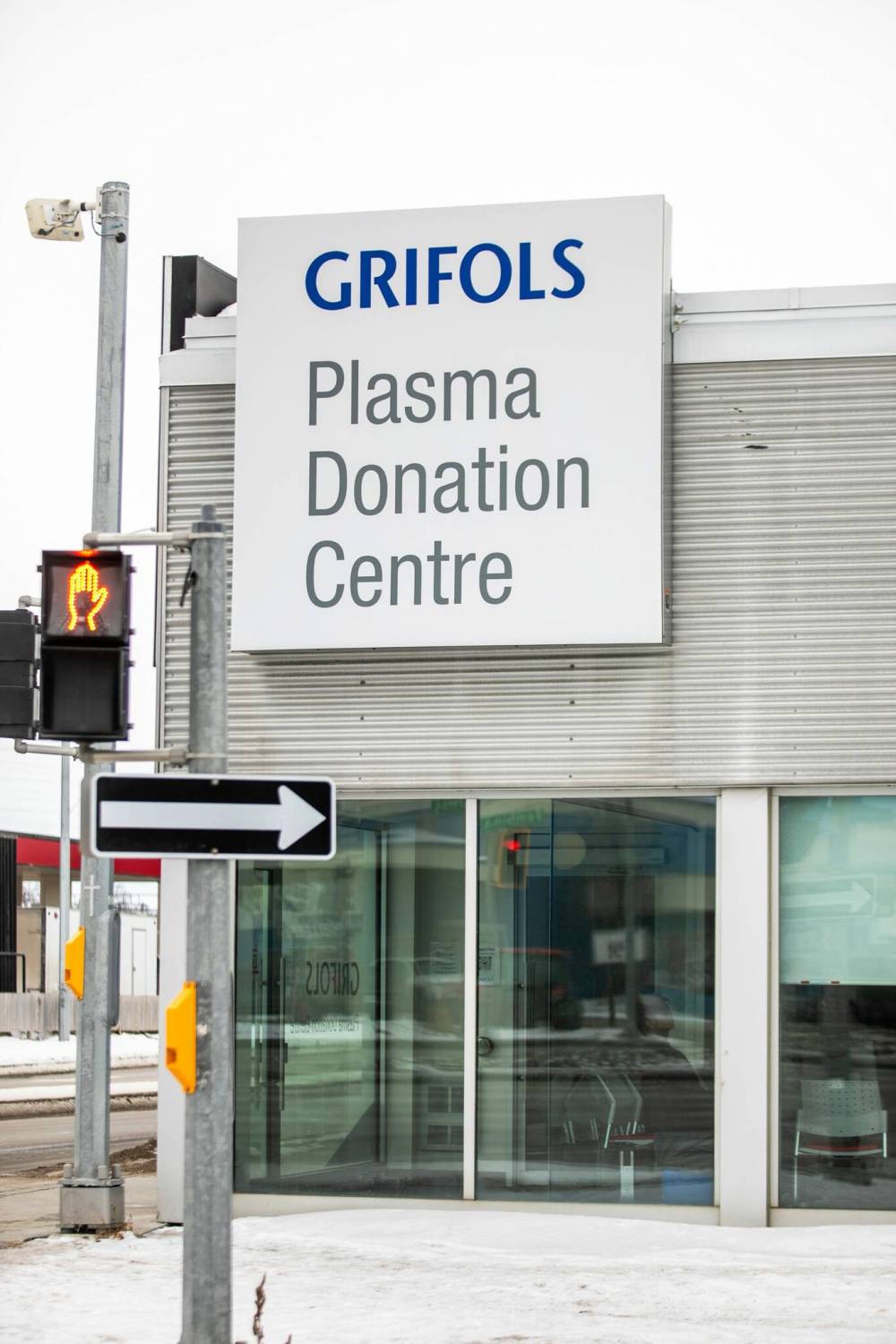
Health Canada is investigating the deaths of two donors in October and January. Both had plasma drawn at Winnipeg’s two private collection centres, both run by Grifols, a Spain-based company licensed to run Canada’s for-profit paid plasma centres.
One of the deaths, as reported by CBC this week, was 22-year-old Rodiyat Alabede, whose heart stopped while giving plasma Oct. 25.
MIKAELA MACKENZIE / FREE PRESS
Health Canada is investigating the deaths of two donors who had plasma drawn at Winnipeg's private collection centres run by Grifols.Health Canada has said no link has been established yet between plasma donation and the deaths, the second of which occurred on Jan. 30, but Health Minister Uzoma Asagwara said the province is considering a ban on the practice in Manitoba, but will wait for investigation results before making a decision.
“We’re keeping all options on the table,” Asagwara said Thursday. “We want to make sure that first and foremost, public safety is the top priority.”
Nearly every waiting-room seat was filled at the Taylor Avenue Grifols Plasma Donation Centre Thursday afternoon.
Jeff, 51, said he has been driving in from Steinbach to donate plasma twice a week since he was laid off from his job hauling gravel just before Christmas. He makes about $140 a week.
“I’ll be straight, that’s my primary source of income,” he said, declining to provide his last name. “I’ll sit here for an hour-and-a-half, two hours, and I make some money.”
Grifols, which also has a donation centre on Innovation Drive on the University of Manitoba campus, currently pays $100 per session for the first three appointments, and $60 to $70 for most subsequent appointments, depending on the amount of plasma collected. There is also a bonus for every 10 donations made within six weeks, according to the company’s website.
Jeff said he had heard about the two deaths earlier Thursday, but the news didn’t deter him from showing up for his appointment.
“We want to make sure that first and foremost, public safety is the top priority.”
He said other than running a mild fever after one donation, he’s never experienced any side-effects, and he needs the money — most of what he gets goes to servicing the loan on his truck, which he’s hoping to keep while he waits for construction work to pick up again.
He said it sounded like the province is “jumping the gun” on a crucial source of income for many.
“Me, personally, I would not say it’s a good idea to ban it, because of the way it would affect quite a few people,” he said.
Others selling their plasma Thursday said they were surprised and disappointed to hear the province was considering a ban.
“That’s my gas money,” one man said while walking in. “I’d be screwed.”
Most said they would not donate plasma without the financial incentive.
The Manitoba Health Coalition wants to see the practice of paid plasma collection banned entirely, regardless of the results from Health Canada’s investigation.
What is plasma?
Plasma is the liquid component left when red and white cells and platelets are removed from blood, and makes up about 55 per cent of blood’s total volume.
It is a vital component of treatments for a range of conditions such as liver failure, serious infections, autoimmune disorders and fluid loss in burn patients.
In 2022, Canadian Blood Services announced it would partner with Grifols to “address the ongoing global shortage” of plasma that was exacerbated by the COVID-19 pandemic. It was controversial at the time because Grifols pays people who donate plasma, while the publicly funded CBS operates on a typical compensation-free donor framework.
Plasma is the liquid component left when red and white cells and platelets are removed from blood, and makes up about 55 per cent of blood’s total volume.
It is a vital component of treatments for a range of conditions such as liver failure, serious infections, autoimmune disorders and fluid loss in burn patients.
In 2022, Canadian Blood Services announced it would partner with Grifols to “address the ongoing global shortage” of plasma that was exacerbated by the COVID-19 pandemic. It was controversial at the time because Grifols pays people who donate plasma, while the publicly funded CBS operates on a typical compensation-free donor framework.
Grifols operates its own donation centres, and takes the excess byproducts from manufacturing immunoglobulins to make albumin, a protein in plasma, which it sells to other countries. It is used to treat blood loss.
Canadian Blood Services’ agreement with Grifols requires it to comply with provincial legislation as a “control” on the growth of for-profit collection, a post on its website from 2024 says.
“We are not giving away our responsibility to Grifols. We are not against paid donation, or against the commercial plasma industry from which we have procured safe products for Canadians for decades,” the post reads.
“Rather, we are protecting the national blood supply system by putting important controls in place that cap where and how much commercial plasma is collected in the country, bringing commercial collection in Canada into alignment with the national system.”
“It just targets or (preys) on more vulnerable populations, who are then more likely to have adverse reactions… unfortunately, we need kind of a blunt instrument to try to prevent more harm,” said executive director Noah Schulz.
British Columbia, Ontario and Quebec have already banned paid plasma donation, but Ontario has an exemption in place for Grifols through Canadian Blood Services.
According to the Government of Canada’s website, a Grifols plasma centre in Regina was inspected and deemed “non-compliant” with federal regulations as recently as January.
“Building more profit motive into health-care delivery is never something, I think, that ends well for patients,” Schulz said.
A statement from Grifols’ corporate communications said the company strives “to operate under strict operational procedures at the highest standard.”
The statement said the deaths were reported because of Health Canada policy that requires a report if a donor experiences a “serious adverse reaction” or dies within 72 hours of giving plasma.
Asagwara said the provincial government was not informed about the deaths until a few weeks ago, and called it concerning.
A Health Canada spokesperson said it was on site “immediately” at both locations after receiving reports of the deaths to ensure they were compliant with the federal regulations.
Schulz suggested the investigation puts Health Canada in a conflict of interest because it licenses Grifols locations across the country.
The province should move quickly, he said.
A GoFundMe campaign launched in October identifies Alabede as an international student who was enrolled at the University of Winnipeg.
It describes her a a compassionate, kind student who was devoted to her faith as a Muslim and her dream of being a social worker.

The fundraiser, which will go to funeral and burial expenses, passed its $15,000 goal Thursday.
Schulz noted many of the people getting paid to donate plasma are doing so under financial duress.
“I think that’s a pretty sad reflection of our society,” he said.
— With files from Gabrielle Piché
malak.abas@freepress.mb.ca

Malak Abas is a city reporter at the Free Press. Born and raised in Winnipeg’s North End, she led the campus paper at the University of Manitoba before joining the Free Press in 2020. Read more about Malak.
Every piece of reporting Malak produces is reviewed by an editing team before it is posted online or published in print — part of the Free Press‘s tradition, since 1872, of producing reliable independent journalism. Read more about Free Press’s history and mandate, and learn how our newsroom operates.
Our newsroom depends on a growing audience of readers to power our journalism. If you are not a paid reader, please consider becoming a subscriber.
Our newsroom depends on its audience of readers to power our journalism. Thank you for your support.
Related Articles
Canadian Blood Services says it needs 1 million new blood donors over next 5 years