Overland oil What’s old is new again, from a looming energy crisis sparked by war in the Middle East, to strategies to mitigate it, such as an Arctic pipeline
Read this article for free:
or
Already have an account? Log in here »
To continue reading, please subscribe:
Digital Subscription
One year of digital access for only $1.44 a week*
- Enjoy unlimited reading on winnipegfreepress.com
- Read the E-Edition, our digital replica newspaper
- Access News Break, our award-winning app
- Play interactive puzzles
*Billed as $5.77 plus GST every four weeks. After 52 weeks, price increases to the regular rate of $19.95 plus GST every four weeks. Offer available to new and qualified returning subscribers only. Cancel any time.
To continue reading, please subscribe:
Add Free Press access to your Brandon Sun subscription for only an additional
$1 for the first 4 weeks*
- Enjoy unlimited reading on winnipegfreepress.com
- Read the E-Edition, our digital replica newspaper
- Access News Break, our award-winning app
- Play interactive puzzles
*Your next Brandon Sun subscription payment will increase by $1.00 and you will be charged $17.95 plus GST for four weeks. After four weeks, your payment will increase to $24.95 plus GST every four weeks.
Read unlimited articles for free today:
or
Already have an account? Log in here »
‘This is no picnic,” warned a somewhat-cryptic job poster on the wall of an Edmonton pipeline construction firm in summer 1942.
“Men hired for this job will be required to work and live under the most extreme conditions imaginable.… Men will have to fight swamps, rivers, ice and cold. Mosquitos, flies and gnats will not only be annoying but will cause bodily harm. If you are not prepared to work under these and similar conditions — do not apply.”
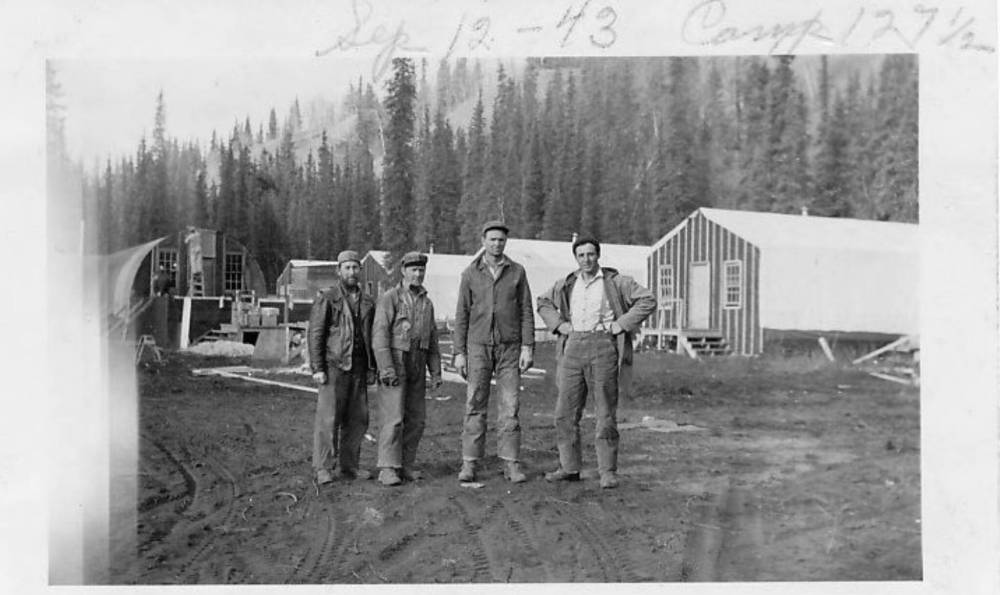
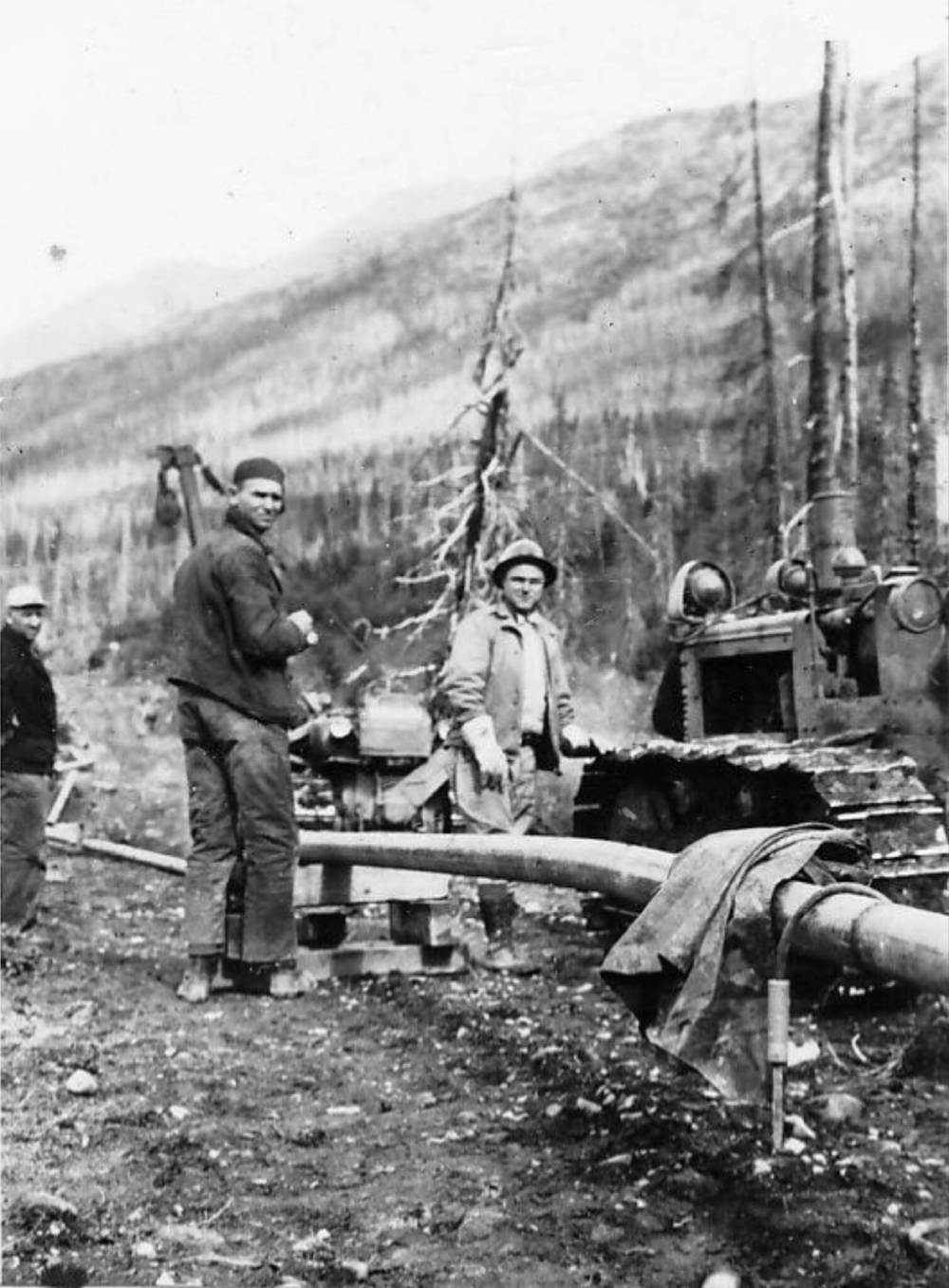
The job was a secretive government project in the wilderness of the Canadian North. In less than two years, a team of 30,000 would enlist to lay a four-inch-wide steel pipe from a recently discovered oilfield near Norman Wells, N.W.T., to Whitehorse, Yukon.
The “stupendous” and “unusual” construction project, as it would be called in the years after its completion, was the first attempt to build a pipeline in the North American Arctic.
It would ultimately lay the foundation for many decades of oil exploration in the North.
Today, a fragmented trade relationship with the United States and an oil crisis driven by a new conflict in the Middle East has bolstered Canadian politicians’ calls for new oil and gas infrastructure.

As investors hesitate to back the east-west pipeline proposals that face opposition from Indigenous communities and environmental advocates, a decades-old idea to build a link to the Port of Churchill on the shores of Hudson Bay has picked up steam.
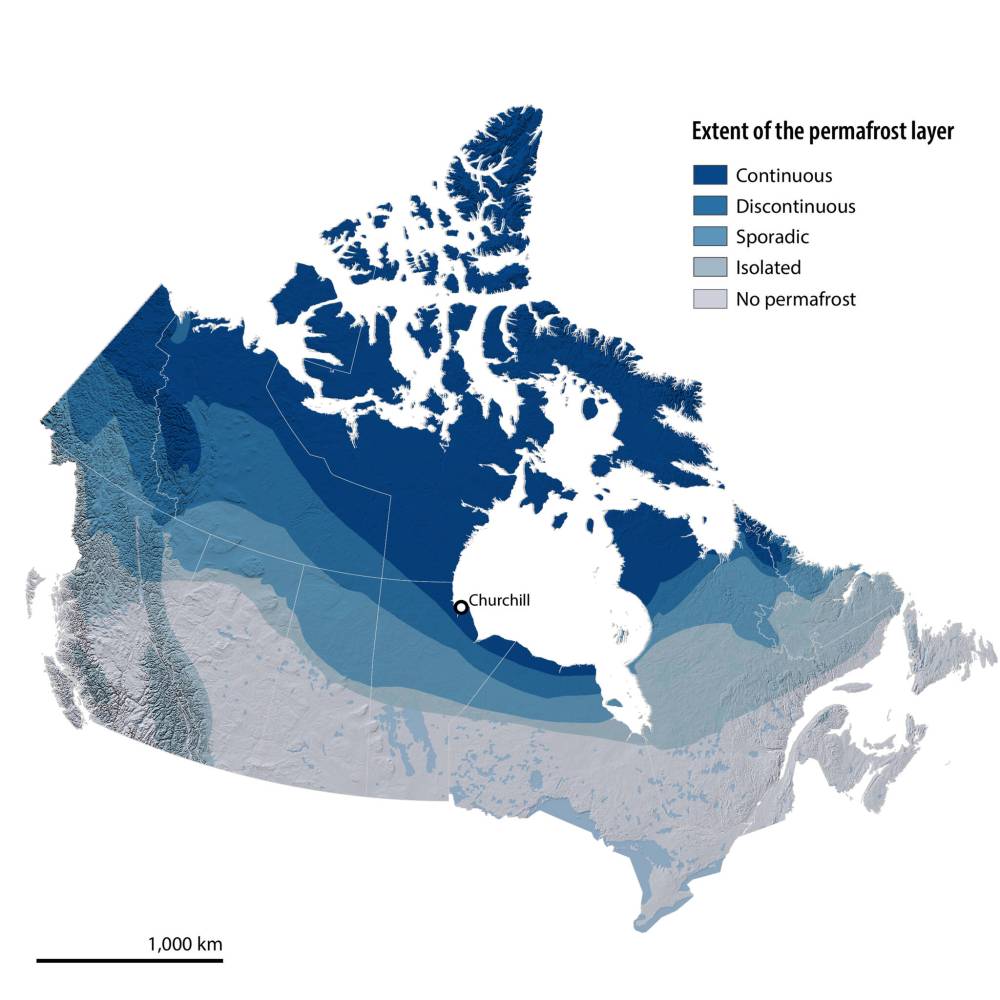
While not all of northern Manitoba is as ice-laden as the Northwest Territories or Alaska, any pipeline from Alberta’s oilfields to Manitoba’s northern coast would need to cross the Canadian Shield, the tundra and permafrost. These ecosystems are changing rapidly as the planet warms; more than half of existing infrastructure in the Arctic is projected to incur damage by mid-century as a result of climate change.
If the province of Manitoba, the federal government and industry players are serious in their pursuit of pumping oil and gas through the Port of Churchill, they will need to build on the legacies — and lessons — of northern pipelines that have come before it.
Step 1: Begin in a time of crisis
The first time a pipeline was strung across the hard, icy wilderness of the North American Arctic, the world was at war.
It was the spring of 1942, just months after the attack on Pearl Harbor, and the U.S. War Department (as it was called then, too) was concerned its Arctic bases were exposed to attacks by Japanese forces.
Behind closed doors, the U.S. government devised a plan to shore up its Arctic security with two daring infrastructure projects: a highway slicing through the ice from Dawson Creek, B.C., to Delta Junction, Alaska, and a pipeline feeding crude from the untapped Norman Wells oilfield in the Northwest Territories across the Mackenzie Mountains and on to a refinery in Whitehorse.
This secret wartime pipeline, built by the Imperial Oil Company, would be called Canol — short for Canadian oil.
“It was imperative that an overland route to Alaska be opened up and given an assured fuel supply…. All that was done, and with amazing speed.”
“At the time Canol was begun, our situation was not a happy one.… The sea lanes to Alaska might be blocked, and with a shortage of freighters and tankers it was imperative that an overland route to Alaska be opened up and given an assured fuel supply,” Richard Finnie, a historian and filmmaker who produced a documentary about the pipeline, said in a 1947 article in the Canadian Geographical Journal.
“All that was done, and with amazing speed.”
It took just 22 months to lay the 1,000-kilometre pipeline; it would take just nine months to abandon it. By 1947 the war was over and the oil link was no longer needed. Canol was dismantled, its steel repurposed.
But its short-lived presence made a permanent mark on the North.
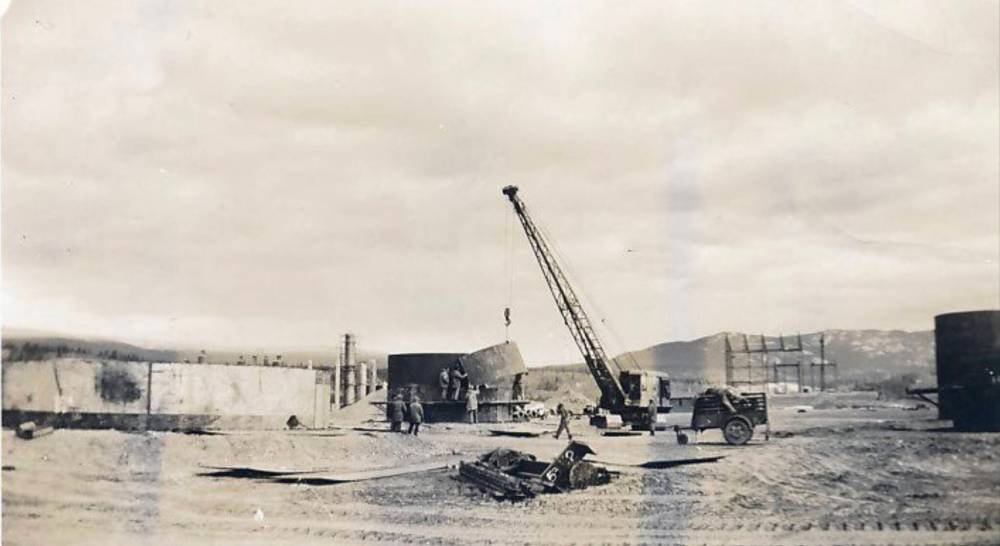
Before Canol, Finnie said, there were no airports, no roads longer than 15 kilometres and certainly no oil infrastructure. The project proved to governments, business and engineers that the harsh northern terrain, with its unyielding granite and ice, could be tamped down with concrete and steel.
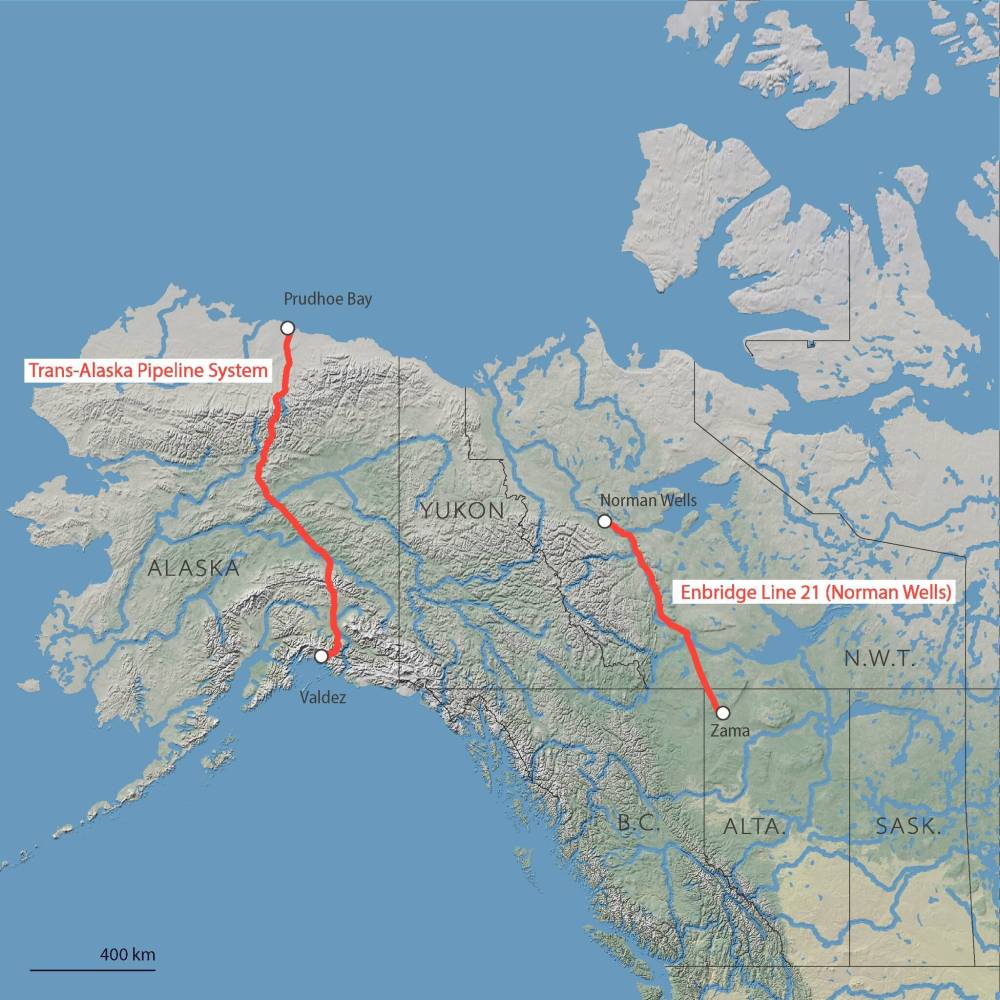
In the decades since, two more major pipelines have been built in the northern reaches of the continent: Enbridge’s Line 21, from Norman Wells to northwest Alberta, and the Trans-Alaska Pipeline System that cuts the length of the northernmost American state.
The Trans-Alaska pipeline, a four-foot-wide, 1,200-kilometre-long pipe that zigzags through Alaska’s mountain valleys from an oilfield at Prudhoe Bay to a marine terminal at Valdez, was also built in just two years. It had previously been stalled for several years due to legal and environmental challenges, but was ultimately approved when the 1973 Arab-Israeli war thrust America into an oil crisis.
Now, a new oil crisis is renewing old interests.
Amid what the International Energy Agency called “the largest supply disruption in history,” Canada has agreed to contribute 23 million barrels to global emergency oil supply. Despite being the world’s fifth-largest producer of both crude oil and natural gas, pundits and politicians argue a lack of pipelines is stymieing the country’s export capacity.
“We must build new pipelines west, east, north and south — without delay and without hesitation — to supply Asian, European and American markets with safe, reliable and responsibly produced energy products,” Alberta Premier Danielle Smith wrote in an op-ed for the Financial Post this month.
Manitoba’s Port of Churchill is now being heralded as a potential trade hub allowing the country’s resources more rapid access to eastern markets. Momentum is building in support of an energy corridor that could carry oil, natural gas, potash or hydrogen from the Prairies to Hudson Bay.
In January, Premier Wab Kinew announced multiple energy companies are interested in backing the proposal, while a November agreement with the federal government pledges to simplify regulatory approvals for a port expansion.
In the 2026 budget, the NDP announced a further $10 million to “keep building the momentum on this project and attract even more private sector interest in a potential energy corridor.”
“There’s just an idea that we don’t do enough in the Arctic.”
Under these political conditions — and with significant investments from either the private or public sector — pipelines can be built quickly.
“There’s just an idea that we don’t do enough in the Arctic,” Heather Exner-Pirot, director of energy, natural resources and environment at the Macdonald-Laurier Institute, said in a late-February interview. Canadians periodically worry the country does not have enough presence in the Arctic, or is underutilizing its resources, she added.
Those fears are “based on a very superficial understanding” of the Arctic, she said. But coupled with a desire to diversify exports and opposition to an east-west pipeline through B.C. to the Pacific Ocean, they have made the prospect of a new northern pipeline more enticing.
But in reality, she said, building in the North — over Manitoba’s muskeg and permafrost — is an expensive and dangerous logistical challenge.
Step 2: Assume ‘the ground is going to move’
When Canol was first proposed, scientists knew so little about building infrastructure in the Arctic, they had yet to come up with a term for its characteristic, perennially frozen ground. It was Stanford University professor Siemon Muller who first coined the term permafrost after being sent to investigate where the Alaska Highway and Canol pipeline would be built.
In simplest terms, permafrost is a term for ground that remains frozen year-round, though it is formally defined as “earth materials that remain below 0 C for two or more consecutive years.”
Permafrost is typically described as either continuous (appearing over more than 80 per cent of the ground), discontinuous (covering between 30 and 80 per cent) or sporadic (less than 30 per cent). Almost half of Canada’s land area is underlain with permafrost, predominantly across the northern territories.
While the top layer of soil, called the active layer, thaws briefly in the summer, the permafrost below remains at a relatively stable freezing temperature. Gravelly, rocky soil is often considered “ice-poor,” and is able to maintain its stability even when the ice thaws. Finer soil tends to create “ice-rich” permafrost, where frozen moisture is necessary to the structural integrity of the surface.
Understanding these nuances is a prerequisite to designing any pipeline infrastructure in the North, University of Alaska Fairbanks geophysicist Vladimir Romanovsky said in an interview.
“If it’s present, the second very important question is: how much ice is in that permafrost?”
Romanovsky has been working with permafrost since the mid-1970s — right around the time the Trans-Alaska pipeline was built. Understanding of permafrost was still limited then, but would grow as engineers planned a route across the Arctic.
In January 1969, representatives from some of North America’s largest oil and gas producers and mining operations met at the University of Calgary for the third Canadian conference on permafrost, where a session was dedicated to discussing the challenges of building pipelines over the frozen ground.
By this point, scientists understood permafrost “is in a very delicate state of thermal equilibrium with its environment, and any disturbance will cause thawing and degradation,” T. A. Harwood, chairman of the National Research Council’s permafrost subcommittee, said in a presentation. This is further complicated by the discontinuous nature of much of Canada’s permafrost layer, he added, which makes the ice “patchy and unpredictable.”
Understanding the ice content helps engineers assess how the permafrost will change under the temperature stresses created by a pipeline, Romanovsky said. Oil pipelines are usually transporting a heated product, while gas pipelines are often chilled.
“The heated oil pipeline will thaw permafrost if it’s placed into the ground; the chilled gas may actually create new permafrost.”
“Both of them impact the environment in terms of permafrost. The heated oil pipeline will thaw permafrost if it’s placed into the ground; the chilled gas may actually create new permafrost,” he said.
When permafrost thaws, a layer of water forms under the ice, which can cause the ground to shift — a phenomenon called subsidence. The problem is exacerbated on slopes, where the soil can become oversaturated and form landslides. Newly frozen areas can swell or heave, posing other infrastructure risks.
“Permafrost, generally, is not just frozen dirt. It’s a highly sensitive, temperature-dependent foundation,” Alireza Bayat, professor of civil engineering and director of the Canadian Underground Infrastructure Innovation Centre at the University of Alberta, said in an interview.
As the active layer thaws and freezes, the changing ground can cause pipes to either sink into the soil or be pushed up out of the dirt, Bayat said.
“Essentially you’re assuming the ground is going to move. How can we build or design a pipe that’s able to handle that?”
To make a pipeline work in the discontinuous permafrost seen in northern Manitoba, Romanovsky said scientists and engineers will need to consider the extent of the ice layer and calculate the degree of cooling needed to keep the frost stable through the pipeline’s lifespan. Extra margin should be built in to account for climate change, he said, which is rapidly warming the Arctic.
Step 3: Prepare to build above-ground — or chill the oil
After finding a major oilfield at Prudhoe Bay, Alaska, in the 1960s, oil and gas executives were consumed with “the problem of deciding on the best means of transporting this oil to market.”
In his presentation, Harwood suggested a couple possible routes: either straight across the permafrost to Alaska’s south shore, or through the Mackenzie River Valley. The latter seemed the more sensible option to Harwood, given the pipe could either link up with existing infrastructure in Alberta or be carried on to the Port of Churchill — which was being used for seasonal grain shipments at the time — where “it appears reasonably certain that it would be possible to ship oil … to any continental port throughout the year.”
The decision would ultimately be made to run the pipeline across Alaska, allowing easier access to western markets and posing fewer regulatory challenges.
But the question of how to lay a pipeline carrying either hot liquid oil or pressurized cold gas was still unanswered.
At that point “no one (had) actually constructed a pipeline in the North and operated it,” Harwood said.
He proposed three solutions: building a road with a large crown — effectively a peak in the centre — along which a pipeline could be nestled in insulating materials, laying the pipe in a trench dug into the active layer of the permafrost or suspending the pipeline above ground.
The original design for the Trans-Alaska pipeline was drawn up by a Texas company that planned to use the same methods it had for its southern lines, Romanovsky said: “Dig a trench, put the pipe in, cover it and everything will be good.”
“That would be a disaster if that would have happened,” he said.
The design was reviewed by Arthur Lachenbruch, a permafrost scientist at the United States Geological Survey, who determined the proposal to bury a four-foot wide pipe the length of the state would likely thaw the surrounding permafrost.
“Where the ice content of permafrost is not high, and other conditions are favorable, thawing by the buried pipe might cause no special problems. Under adverse local conditions, however, this thawing could have significant effects on the environment, and possibly upon the security of the pipeline,” Lachenbruch wrote in a 1970 report.
Lachenbruch’s report changed everything, Romanovsky said.
The pipeline was already facing pushback in the courts from both environmental organizations and Indigenous Alaskans. It was the first major test of the newly passed National Environmental Policy Act, and led to lengthy environmental impact assessment hearings, where critics used Lachenbruch’s report to support their case.
Construction stalled while the pipeline owner, now called the Alyeska Pipeline Service Company, was forced back to the drawing board.
Instead of burying the line, engineers decided to suspend more than half of the 1,200-kilometre link on H-shaped support beams, a novel construction method for the time.
The 78,000 beams were each fitted with an innovative technology, called thermosyphons, designed to regulate the temperature of the permafrost.
“It’s a very smart engineering design.”
“It’s a very smart engineering design,” Romanovsky said.
The thermosyphons (also called thermopiles) don’t require any energy. Instead, the space-age technology consists of sealed tubes inserted several metres into the permafrost that contain a small amount of pressurized gas.
In the summer months, when the permafrost is colder than the air, the thermosyphons don’t have much work to do. But in the winter, when the temperature below ground is warmer than the atmospheric temperature, the gas condenses into a liquid and drips to the bottom of the tube. Below ground, the liquid absorbs heat from the surrounding ice and evaporates, drawing the heat up and out to the surrounding air.
“This convection goes on all winter long, taking heat from the ground, bringing it to the atmosphere and releasing it,” Romanovsky said.
Years after the Trans-Alaska pipeline came online, Canadian oil companies returned to the idea of laying a pipe through the Mackenzie Valley, this time connecting the oilfield at Norman Wells, N.W.T., to existing infrastructure in Zama, Alta.
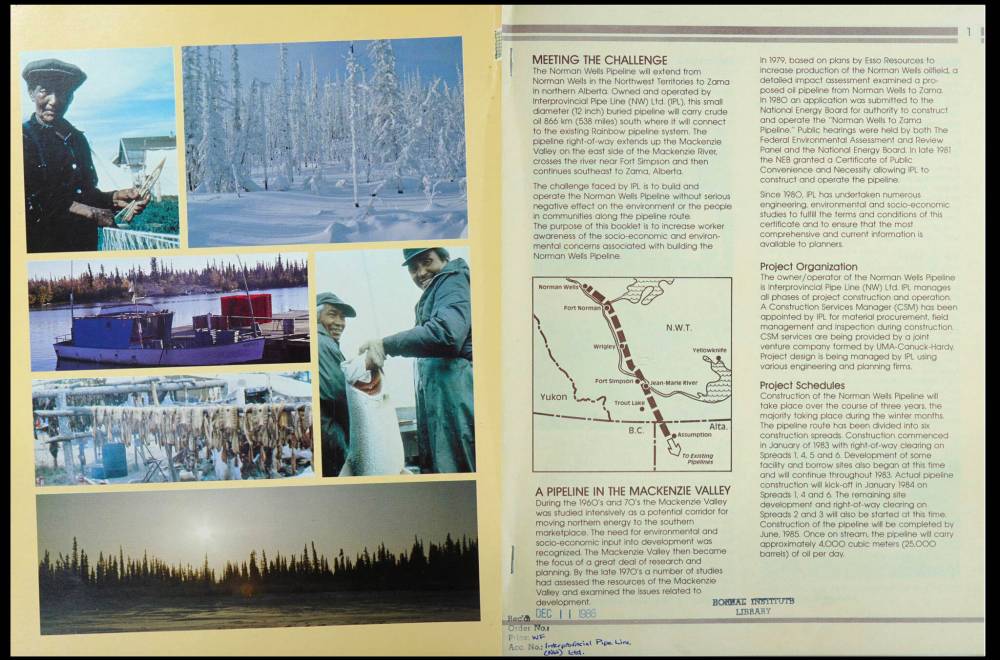
Unlike the Trans-Alaska line, Enbridge’s 869-kilometre Line 21, which came online in 1985, is the first Canadian Arctic pipeline to be buried in the permafrost.
To mitigate the risk of subsidence, the Norman Wells pipeline runs cold. The oil is chilled before entering the line to mirror the average ground temperature throughout the year, averaging between 0 C and -1 C. (Oil in the Trans-Alaska line is kept between 38 C and 63 C).
Because clearing the ground for a pipeline right-of-way removes some of the natural insulation atop the permafrost, several thaw-sensitive slopes along the route were insulated with woodchips to prevent melting. Monitoring technology was installed in strategic locations to measure ground temperature, check for pipe movement and estimate thaw depths.
The pipeline has not been without incident.
In 2011, 1,500 barrels of oil spilled after the pipe failed. Two years later, the federal pipeline regulator found 77 buried lines in the region were at risk of failure; the town of Norman Wells ranked as the community with the highest number of federally regulated pipeline incidents in 2013. In 2016, the pipe was shut down for nearly two years due to risks posed by a shifting permafrost slope.
Imperial Oil plans to “wind down” operations at the Norman Wells oilfield this fall, citing declining production.
Step 4: Expect cost overruns, especially as the climate changes
Regardless of whether the pipe is to be built above or below ground, designing and constructing infrastructure able to withstand shifting permafrost is, above all, “very expensive,” Romanovsky says.
At the earliest stages, a feasibility study estimated the Trans-Alaska pipeline would cost between US$863 million and $1.05 billion, depending on its capacity. By 1975, after re-working the design to factor in the permafrost, the budget was $6.4 billion.
In the end, it cost more than US$8 billion — 10 times the original estimate.
Similarly, Canol came with an initial estimate of $500 million (in 2025 CAD) but in the end cost $3.2 billion. After the Second World War, U.S. cabinet members criticized the project as “useless and a waste of public funds.”
These ballooning costs are often attributed to the limited permafrost expertise during the initial design process; they do not account for the additional costs of maintenance and repair.
Bayat, at the University of Alberta, said Arctic pipelines require specialized materials, design characteristics and construction methods to withstand the forces caused by shifting permafrost while mitigating the pipe’s risk to the environment — all of which can be costly.
The remote location can also add to the cost, as it leaves operators reliant on winter roads and other temporary infrastructure when building and maintaining the pipeline.
“You will spend some money to keep it in good shape,” Romanovsky said of Arctic pipelines. For example, a company will try to survey the pipeline by helicopter every day, weather permitting.
When the Alaska project was being designed in the mid-’70s, Romanovsky said, engineers and geophysicists were concerned about how the pipeline could impact the permafrost, but few were aware of the long-term risks a warming climate could pose to the pipe itself.
In 2020, several supports holding the pipeline aloft began to bend as the permafrost slope they were attached to began to thaw and shift, threatening the integrity of the pipe and forcing the ownership group to replace the beams and re-freeze the slope using thermosyphon technology. The same year, flood damage cost the operators US$10 million to repair the pipeline, while preventative maintenance to safeguard sections against further flooding was expected to cost a further $10-15 million.
These expenses are expected to climb as warming accelerates permafrost thaw.
A scientific review of research from the last 20 years estimates as much as 50 per cent of Arctic infrastructure — including the Trans-Alaska pipeline, and some Canadian highways — are at high risk of damage by 2050. Maintenance costs, the review estimates, could increase by more than $15 billion in that period, while unavoidable damages could cost upwards of $21 billion.
Manitoba has already felt the impacts of shifting permafrost on infrastructure.
The Hudson Bay Railway, which runs more than 800 kilometres between The Pas and Churchill, was among the first major transportation projects built over Canadian permafrost. Since its construction in the late 1920s, it has required regular maintenance as the weight and heat of train traffic thaws the ice-rich permafrost over which it was built. The railway was out of service for 18 months after being washed out by floods in 2017.
Federal and provincial governments have spent upwards of $500 million to purchase, repair, maintain and upgrade the railway since 2018.
Step 5: Monitor in perpetuity. Adapt to a warming climate
As part of the environmental agreement that greenlit the Norman Wells pipeline, Enbridge and the Canadian government collaborate on research and monitoring, which provides long-term data about the impact of pipeline infrastructure on the permafrost.
That data makes up one of the longest permafrost monitoring records in the country. The long view of the ice helps form a picture of how permafrost is changing alongside the global climate — and trends show the ice is warming quickly, Romanovsky said.
“In places where the permafrost was warmer, it’s already started to thaw from the top down,” he said “In the future, with further warming, it will be happening in more and more regions, and be happening faster and faster.”
A 2024 report from the Arctic Monitoring and Assessment Programme found permafrost has warmed by two to three degrees Celsius since the 1970s, as ground temperatures reach record highs. The thawing has substantial impacts on the landscape, causing erosion, slumping and pooling of water. That melting permafrost in turn releases trapped carbon dioxide, further fuelling the warming effect.
The Arctic Research Consortium of the United States warns the standard 30-year climate data engineers typically use when planning infrastructure projects has become “insufficient,” as climate change speeds up.
“In the past, pipe design was kind of static … they were based on the fact we know how the weather is or how the ground is,” Bayat said. “Those assumptions are now more dynamic and they are changing with the climate.”
These warming trends could render existing mitigation technologies like thermosyphons ineffective, Romanovsky said.
During an engineering conference in Portugal in 2008, Edmonton-based Duane DeGeer presented on the unique considerations for Arctic pipelines, reporting that the success of both the Norman Wells pipeline and the buried segments of the Trans-Alaska line had “prompted pipeline designers to consider burying Arctic pipelines wherever possible.”
To mitigate heaving and sinking, the report referred to research on thicker, stronger, better-insulated pipes, as well as controlling the temperature of materials inside, varying burial depth and soil cover and, above all, conducting long-term monitoring of soil temperatures and pipeline integrity.
“These foundations are rapidly changing.”
According to Bayat, more resilient materials, better temperature-control methods, as well as more advanced monitoring technology, have become more accessible over time.
Engineers now use a “strain-based design” philosophy that accounts for the inevitable ground movement caused by permafrost, and plans for pipes that can withstand those forces, he said. Construction practices have also evolved, with directional drilling (an underground tunnelling technique) replacing the traditional open trench methods.
Major strides have been made in monitoring technology, he added, with fibre-optic sensors, digital inspections and predictive analytics that “allow us to have more eyes on those pipes and be more proactive than reactive.”
Ultimately, Bayat said, building a new pipeline in the North will come with many unknowns.
“This is not the area (where) we go and build pipes every day. … When it comes to the North, yes, we have examples, but only a few, and they’re from the past,” he said.
“These foundations are rapidly changing. What will the pace of that change be? How much further is it going to change? Those are the things that need to be taken into account.”
julia-simone.rutgers@freepress.mb.ca

Julia-Simone Rutgers is the Manitoba environment reporter for the Free Press and The Narwhal. She joined the Free Press in 2020, after completing a journalism degree at the University of King’s College in Halifax, and took on the environment beat in 2022. Read more about Julia-Simone.
Julia-Simone’s role is part of a partnership with The Narwhal, funded by the Winnipeg Foundation. Every piece of reporting Julia-Simone produces is reviewed by an editing team before it is posted online or published in print — part of the Free Press‘s tradition, since 1872, of producing reliable independent journalism. Read more about Free Press’s history and mandate, and learn how our newsroom operates.
Our newsroom depends on a growing audience of readers to power our journalism. If you are not a paid reader, please consider becoming a subscriber.
Our newsroom depends on its audience of readers to power our journalism. Thank you for your support.