No more trashing paper coffee cups Empties can be thrown into blue box
Read this article for free:
or
Already have an account? Log in here »
To continue reading, please subscribe:

Digital Subscription
One year of digital access for only $205*
- Enjoy unlimited reading on winnipegfreepress.com
- Read the E-Edition, our digital replica newspaper
- Access News Break, our award-winning app
- Play interactive puzzles
*First annual payment billed as $205.00 + GST for one year. This annual subscription will automatically renew at $233.00 + GST every 52 weeks (10% off the regular annual price of $259.35). Offer available to new and qualified returning subscribers only. Cancel any time.
To continue reading, please subscribe:
Add Free Press access to your Brandon Sun subscription for only an additional
$1 for the first 4 weeks*
- Enjoy unlimited reading on winnipegfreepress.com
- Read the E-Edition, our digital replica newspaper
- Access News Break, our award-winning app
- Play interactive puzzles
*Your next Brandon Sun subscription payment will increase by $1.00 and you will be charged $17.95 plus GST for four weeks. After four weeks, your payment will increase to $24.95 plus GST every four weeks.
Read unlimited articles for free today:
or
Already have an account? Log in here »
Mahalia Lepage and Joshua Bassman know their way around a recycling bin.
They try to take reusable cups when they go to their local coffee shop, and even volunteered with Folk Fest’s “enviro crew” last weekend. A large part of that job, they said, was informing guests about which items were recyclable.
The one item that stood out was paper coffee cups.
Can you blue bin it?
It can be tough to remember what goes in the blue bin and what doesn’t. If you’ve ever found yourself pondering the fate of an empty Chinese food container or Slurpee cup, here’s a brief list:
Recyclable:
- Paper cups, including coffee cups, soda cups and paper Slurpee cups
- Cardboard packaging, including cereal boxes, take-out drink trays, ice cream tubs, milk and cream cartons, frozen food boxes and paper towel and toilet paper tubes
- Most plastic take-out containers, plastic disposable cups and plastic cup lids
- Metal food cans
- Some printed paper and paper packaging (excepting paper with grease, food residue, paint or glitter)
- Gift bags and greeting cards, but only if they are 100 per cent paper. Handles must be removed. Craft wrapping paper is recyclable, but dyed paper is not
- Glass bottles, empty and without metal lids. Beer bottles should be returned to beer vendors
- Juice boxes
- Magazines, mail, flyers and calendars
- Pizza boxes without too much grease
It can be tough to remember what goes in the blue bin and what doesn’t. If you’ve ever found yourself pondering the fate of an empty Chinese food container or Slurpee cup, here’s a brief list:
Recyclable:
- Paper cups, including coffee cups, soda cups and paper Slurpee cups
- Cardboard packaging, including cereal boxes, take-out drink trays, ice cream tubs, milk and cream cartons, frozen food boxes and paper towel and toilet paper tubes
- Most plastic take-out containers, plastic disposable cups and plastic cup lids
- Metal food cans
- Some printed paper and paper packaging (excepting paper with grease, food residue, paint or glitter)
- Gift bags and greeting cards, but only if they are 100 per cent paper. Handles must be removed. Craft wrapping paper is recyclable, but dyed paper is not
- Glass bottles, empty and without metal lids. Beer bottles should be returned to beer vendors
- Juice boxes
- Magazines, mail, flyers and calendars
- Pizza boxes without too much grease
Not recyclable:
- Aluminum foil containers and wraps
- Compostable cups
- Plastic rings from beverage cans
- Napkins, tissues and paper towels, even if clean
- Paper straws
- Greasy or food-soiled paper, including paper take-out containers
- Food and drink pouches
- Bread bags and bread tags
- Straws and stir sticks
- Parchment paper
- Pet food bags
- Tea bags
- Keurig, Nespresso and other coffee pods
If you’re not sure if you can recycle your garbage, consult the City of Winnipeg’s “Recyclepedia” database at winnipeg.ca.
They weren’t considered recyclable until Wednesday — when Winnipeg recycling organizations announced paper cups can be thrown into blue bins around the province, effective immediately.
The pair, who were headed to Bonnie Day coffee shop in Wolseley Wednesday morning, called the announcement “good news” for their fellow avid recyclers. They hope the move convinces people to get into the habit.
“If I was out and wanted a coffee and didn’t have my reusable cup, then I’d be more likely to get one,” Lepage said.
“It seems like people already have that intuition,” Bassman added.
“So that’s why I think it’s a good thing … if they’re already thinking coffee cups (go) to recycling.”
Cups that are now recyclable include paper coffee cups and sleeves, fountain drink cups and other hot and cold beverage cups. Lids and straws, which are still not recyclable, should be removed before thrown into a blue bin. In addition, compostable cups are still not recyclable.
Paper cups are considered challenging to recycle and weren’t included in Manitoba’s recyclable material list until Wednesday because they have a liquid-resistant coating and some are dyed.
Recent shifts in the paper market, including reductions on how much paper is being printed and thrown away, have made integrating the cups into the provincial recycling program possible, said Christa Rust, executive director of Multi-Material Stewardship Manitoba, the non-profit organization leading the project.
“It’s a big change, something folks who’ve been working in this industry have probably talked about up to about 20 years, in terms of a challenge,” Rust said.
Paper cups can be included in mixed paper recycling, which is sent to re-processing facilities and made into new material, including tissue paper and paper bags.
Manitoba joins several other provinces, including British Columbia and Ontario, by blue-binning paper cups.
It was a common misconception that paper cups could be recycled, leading to them being thrown into blue bins and contaminating the contents, Rust said.
Staff who sort recyclable material would remove items such as paper cups, but if there are too many non-recyclable items in a bin, it reduces the chance of its contents being sent to a recycling facility.
“There is now an evolving market because mixed paper is changing so dynamically … and we’ve done the math to ensure that you know opening up paper cups as an accepted material is not going to flood things out,” Rust said.
She couldn’t estimate the number of coffee cups that will be recycled annually, but called it “substantial.”
MIKAELA MACKENZIE / FREE PRESS The owner of Harrisons Coffee Co. is happy their paper cups can now be recycled.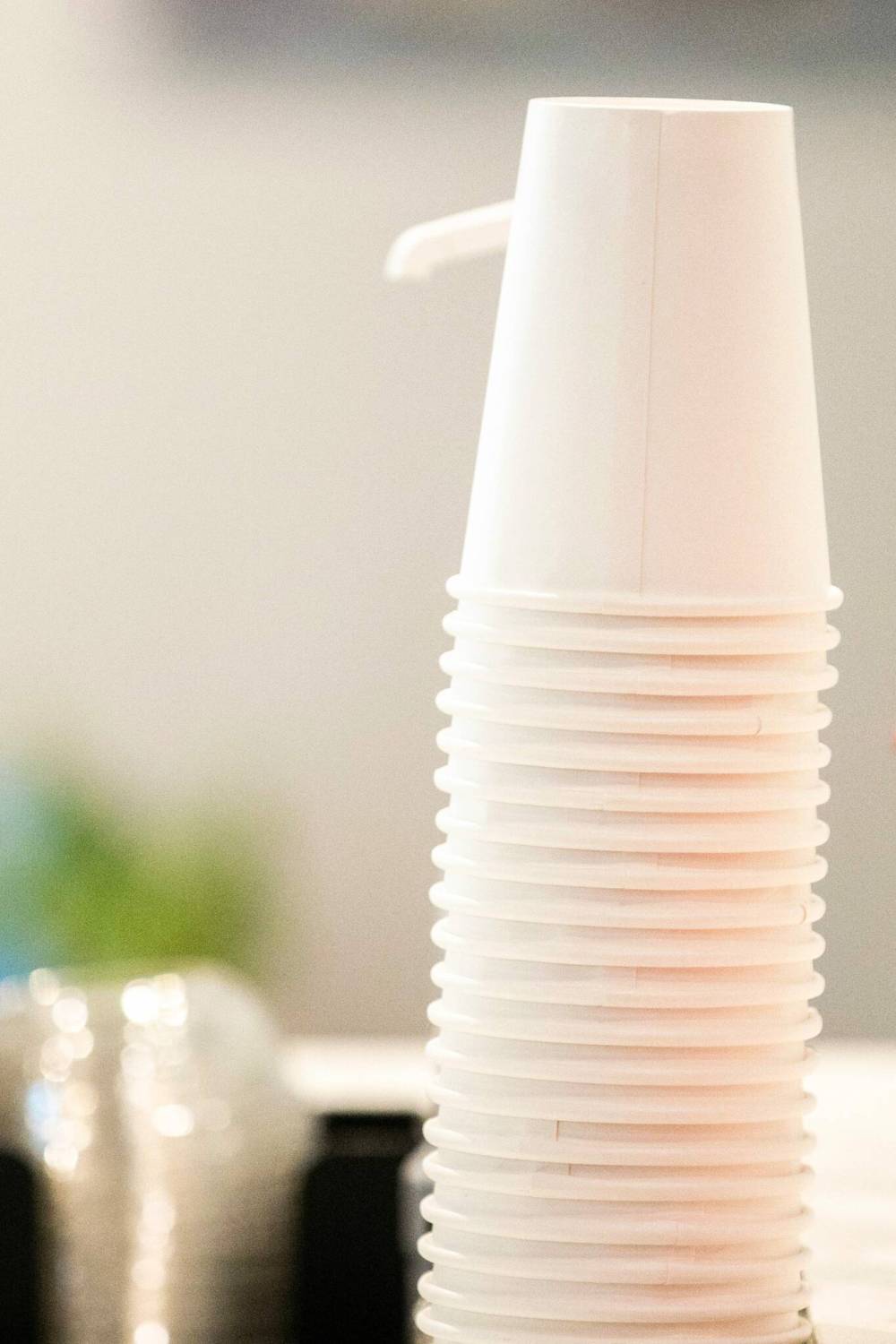
At Harrisons Coffee Co.’s two city locations, customers toss out from 800 to 1,500 coffee cups a month while in the café — a small percentage compared to how many take them to-go, said owner Al Dawson.
“I think it’s cool that the city is looking to make a difference,” he said.
“I think we have to progress or perish, and that definitely shows that they’re in the spirit of progression, so I support it.”
Multi-Material Stewardship Manitoba has reached out to recycling groups and municipalities to get the word out.
“For those who already thought it was accepted, no change for you, you’re good. But for those folks who had been told they’re not accepted, it will take some time to adjust, and we understand that,” Rust said. “Signage and information may have to change, so it will be an evolving process.”
The City of Winnipeg’s website was updated Wednesday to include coffee cups and other paper cups in its Recyclepedia, a database that lists recyclable and non-recyclable garbage.
Mayor Scott Gillingham applauded the change.
“Any time we can recycle more materials, it’s good news for everybody,” he said.
“It’s good news for our planet. It’s good news that we can reduce household waste and divert material that goes to landfill.”
malak.abas@freepress.mb.ca


Malak Abas is a city reporter at the Free Press. Born and raised in Winnipeg’s North End, she led the campus paper at the University of Manitoba before joining the Free Press in 2020. Read more about Malak.
Every piece of reporting Malak produces is reviewed by an editing team before it is posted online or published in print — part of the Free Press‘s tradition, since 1872, of producing reliable independent journalism. Read more about Free Press’s history and mandate, and learn how our newsroom operates.
Our newsroom depends on a growing audience of readers to power our journalism. If you are not a paid reader, please consider becoming a subscriber.
Our newsroom depends on its audience of readers to power our journalism. Thank you for your support.