Researchers tracking Manitoba monarchs migrating to Mexico
Read this article for free:
or
Already have an account? Log in here »
To continue reading, please subscribe:

Digital Subscription
One year of digital access for only $205*
- Enjoy unlimited reading on winnipegfreepress.com
- Read the E-Edition, our digital replica newspaper
- Access News Break, our award-winning app
- Play interactive puzzles
*First annual payment billed as $205.00 + GST for one year. This annual subscription will automatically renew at $233.00 + GST every 52 weeks (10% off the regular annual price of $259.35). Offer available to new and qualified returning subscribers only. Cancel any time.
To continue reading, please subscribe:
Add Free Press access to your Brandon Sun subscription for only an additional
$1 for the first 4 weeks*
- Enjoy unlimited reading on winnipegfreepress.com
- Read the E-Edition, our digital replica newspaper
- Access News Break, our award-winning app
- Play interactive puzzles
*Your next Brandon Sun subscription payment will increase by $1.00 and you will be charged $17.95 plus GST for four weeks. After four weeks, your payment will increase to $24.95 plus GST every four weeks.
Read unlimited articles for free today:
or
Already have an account? Log in here »
After applying eyelash glue on a tiny tracker, Laura Burns carefully places it on a monarch butterfly named Eddie.
The technology will allow Burns to follow Eddie, who was named after his tracker code of a similar spelling, as he migrates to Mexico and collect data on any dangerous obstacles he may face.
Eddie was one of 30 monarchs outfitted with trackers at the Living Prairie Museum this week as part of a national effort to help preserve the endangered species.
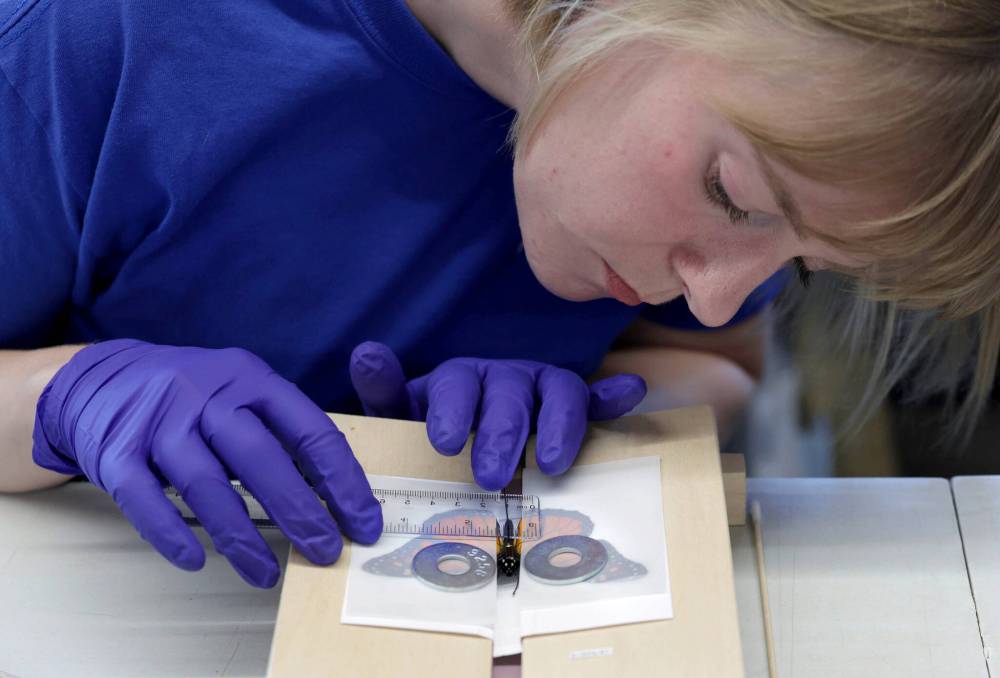
Ruth Bonneville / Free Press
Kirstyn Eckhardt, conservation research specialist at Assiniboine Park Zoo, examines Eddie, a monarch butterfly captured in the area near the museum.
This is the first time the new technology has been used in Manitoba, and the data collected will go to researchers in Ottawa who will use it to better understand the monarchs’ life cycle.
Burns, who is the conservation manager at Assiniboine Park Conservancy, said the technology has been used for only three years.
“We’re already learning amazing things that we didn’t know before about how far they go, how far they can fly in a day and what type of habitat they’re using,” she said.
Eddie was caught after recently emerging from his cocoon in the museum’s tall grass fields.

He was then examined for parasites and weighed to make sure he could handle the extra equipment.
After being chilled in a cooler to limit his movement, Eddie was carefully placed on a board, where his wings were weighed down by little washers so he wouldn’t hurt himself trying to move.
Burns and other conservation employees have extensive experience handling the butterflies in order to apply the trackers without hurting them.

Ruth Bonneville / Free Press
Eddie was one of 30 monarchs outfitted with trackers at the Living Prairie Museum this week as part of a national effort to help preserve the endangered species.
Once Eddie was released, the technology sent a Bluetooth signal from his pack to a free-to-download app called Project Monarch, where people can now search for him and track his migration.
“The reason we’re deploying so many tags across Canada is that we know not all of them are going to make that full migration, but everything we learn from them will tell us a story,” said Burns.
The monarch population has been in decline for the last 25 years and efforts to reverse it have been unsuccessful, said Marika Olynyk, curator of the Living Prairie Museum.
“Everything we learn from them will tell us a story.”
“Because they migrate, it can be difficult to know what’s going through their whole life cycle at the different habitats they use all across North America,” she said.
The technology will show scientists how the butterflies are moving, where they’re stopping and where they could protect existing habitat.
“All of this is a big effort that involves people from Mexico, the United States and Canada, so we’re just one little part of that, but all of that (data) is going to get put together,” she said.
Olynyk said a loss of habitat has been the biggest threat to the butterflies, and there hasn’t been enough milkweed for the monarchs to lay their eggs on.

Ruth Bonneville / Free Press
Laura Burns, conservation manager at Assiniboine Park Conservancy, releases Eddie, back into the wild after he was successfully tagged Wednesday.
She said traditionally, North America had tons of wildflowers and milkweed, making it the perfect breeding ground for monarchs. However, the continued loss of prairies, along with more mechanized farming, is killing their natural habitat.
Paulson Des Brisay, a species at risk biologist with Environment Canada, said scientists initially started the program in Ontario to help understand knowledge gaps in the life cycle of monarchs. They expanded the program to get a better sense of how the butterflies are moving from Western Canada to Mexico.
“It’s a technological advancement that we’re able to do this for a species like monarchs now, and plug this information into some of the conservation planning,” he said.
Of the 30 butterflies, Des Brisay said it’s likely just one will make it all the way to Mexico.
tiago.resko@freepress.mb.ca