Frequency of private plasma donations called into question Provinces, territories demanded answers after deaths of Winnipeg donors
Read this article for free:
or
Already have an account? Log in here »
To continue reading, please subscribe:
Digital Subscription
One year of digital access for only $1.44 a week*
- Enjoy unlimited reading on winnipegfreepress.com
- Read the E-Edition, our digital replica newspaper
- Access News Break, our award-winning app
- Play interactive puzzles
*Billed as $5.77 plus GST every four weeks. After 52 weeks, price increases to the regular rate of $19.95 plus GST every four weeks. Offer available to new and qualified returning subscribers only. Cancel any time.
To continue reading, please subscribe:
Add Free Press access to your Brandon Sun subscription for only an additional
$1 for the first 4 weeks*
- Enjoy unlimited reading on winnipegfreepress.com
- Read the E-Edition, our digital replica newspaper
- Access News Break, our award-winning app
- Play interactive puzzles
*Your next Brandon Sun subscription payment will increase by $1.00 and you will be charged $17.95 plus GST for four weeks. After four weeks, your payment will increase to $24.95 plus GST every four weeks.
Read unlimited articles for free today:
or
Already have an account? Log in here »
Two weeks after the death of a second plasma donor in Winnipeg following their donation at a privately run collection site, provincial and territorial health officials compiled a list of urgent questions for Health Canada.
A health department official in Nova Scotia, which leads the Provincial Territorial Blood Liaison Committee, wrote in mid-February to the federal regulator that their members had expressed “a great deal of curiosity tempered with concern” and forwarded two dozen questions, according to documents obtained by the Free Press.
Under a section titled “MANITOBA ESTABLISHMENT INCIDENTS,” the provinces wanted to know: “What requirements are in place to ensure Grifols is ensuring collections frequency (does) not exceed the limit under the Health Canada licence?” and “Is Health Canada able to identify whether Grifols Canada has a donor system across establishments? (e.g., can identify when a donor last donated and where, similar to their operations in the United States).”
“Does the situation of two high-severity incidents in one Province or at establishments run by a relatively new entity to Canada, within a short period of time, initiate any additional protocols?”
And, the provinces asked, why are the private collector Grifols and Canadian Blood Services licensed for different donation frequencies, with Grifols allowed to collect plasma twice per week from a donor, but the national blood authority only once. Unlike Grifols, CBS does not compensate donors.
MIKAELA MACKENZIE / FREE PRESS Grifols donors in Canada, the U.S. and Egypt can give plasma twice a week, every week, up to 104 times a year.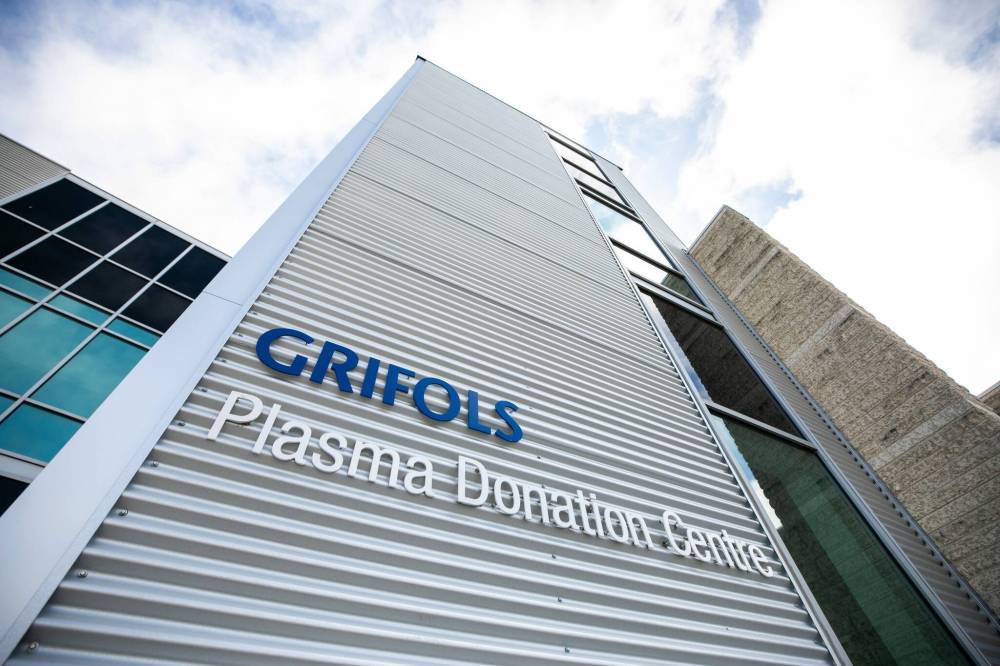
The two deaths occurred after people donated at separate Grifols sites in the city: 22-year-old Rodiyat Alabede on Oct. 25, 2025 at the company’s Taylor Avenue location and an unidentified individual on Jan. 30 at its Innovation Drive centre. Health Canada has said no linkage has been established between their deaths and plasma donation.
Also in Winnipeg, a third donor died in 2018 and a fourth individual is suing a plasma collection company, later acquired by Grifols, for a serious kidney injury he attributes to giving plasma, a claim the company denies.
Grifols donors in Canada, the U.S. and Egypt can give plasma twice a week, every week, up to 104 times a year.
It’s the highest number allowed anywhere in the world and roughly four times what’s permitted in many European countries, where researchers say there is insufficient scientific evidence to definitively prove such high frequencies are safe.
A 2023 survey of 17 countries found the most common annual limit was 26 donations. The SUPPLY Project, a European Union-backed research initiative working to increase the EU’s own supply of plasma, conducted the survey and has recommended a maximum of two donations a month.
The survey also found Canada allows the highest volume of plasma per donor annually, at 47 litres, while the most common limit was a third of that.
In a statement, Health Canada spokesperson Mark Johnson said the agency “continuously monitors emerging evidence and is aware that some Canadian and international organizations and expert groups have proposed more conservative donation frequencies.”
He said the U.S. has allowed two donations per week since 1973, which “means that this frequency of donation has been in use in the country with the largest annual plasma volume collection for almost 50 years without any donor safety signals being reported.”
In an unattributed statement, Grifols said that “donor safety and well-being are central to Grifols’ plasma collection operations and quality standards,” adding that each year, over 16 million donations take place safely at its centres worldwide.
Grifols also said they’ve put in place “internal cross-check systems” to ensure donors do not donate more frequently than is allowed.
Grifols has operated in Canada since 2022 and is now in six provinces. That came to a halt in mid-August, when the company opted to pause its collections in Canada, the same day Health Canada issued a formal notice of its non-compliance with federal blood regulations, as the Globe and Mail reported. Grifols has said its stoppage was a result of “unfounded attention.”
Grifols is a Spanish drug manufacturer that pioneered the practice of plasmapheresis in the 1950s. Plasma is a protein-rich component of blood, which when extracted, can be manufactured into medicines for rare disorders like hemophilia, as well as used in emergency rooms to treat severe burns.
MIKAELA MACKENZIE / FREE PRESS Grifols has operated in Canada since 2022 and recently annouced it would pause plasma collection at all donation centres in the country.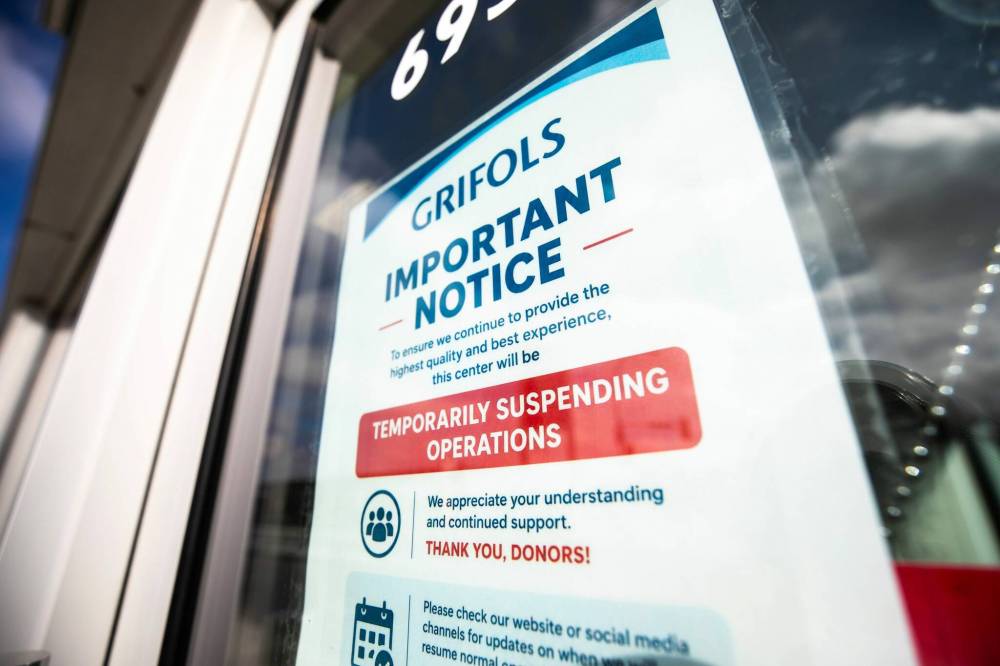
Prior to the shutdown, the Free Press spoke with two dozen Grifols donors in an effort to learn more about their experiences. Of the group, 19 said they donated twice a week.
Most said they’d had positive experiences, though several reported switching from the Taylor Avenue location to the Innovation Drive centre, citing long waits, high staff turnover and a perceived lack of staff professionalism at the former. (Grifols did not directly respond to a question about these comments.)
One donor also said that, after switching locations, he realized his initial medical screening was far more in-depth at the Innovation Drive centre near the University of Manitoba.
He also said, given that his eligibility had to be newly assessed upon switching, it did not appear the two collection centres share a records system. Health Canada’s spokesperson said all of Grifols’ locations in Canada share a records system, except the Innovation Drive location.
One Winnipeg donor said he had been able to donate more than twice that week without being stopped, completing his third donation just before speaking to a reporter. A handful said they’d tried to donate more than twice a week but were turned away by Grifols staff.
Several donors also said they’d been rejected periodically due to low protein or iron readings. One donor said he did not receive an email with a low protein warning — which included direction to stop donating for two weeks — until two weeks after the test. He’d continued to donate throughout that time period.
Grifols incentivizes donors to keep up a twice-weekly schedule. The first payment is $50 and the second is $70, which works out to $480 a month or $6,240 a year. Those payments are only for donors who visit twice weekly for five consecutive weeks, receiving “gold” status; those who visit less frequently are paid less.
There are additional financial rewards: every 10th donation within a six-week time period comes with a $50 bonus; there’s a $100 bonus for donating 100 times in one year; and there’s a bonus for donating near one’s birthday or the anniversary of their first visit.
Health Canada has identified a number of deficiencies at Grifols’ head office and collections centres around the country, including inadequate training at Winnipeg’s Taylor Avenue location, where staff could fail and re-take quizzes four times before followup was required.
In March, Health Canada issued a non-compliant rating to Grifols’ head office, citing “recurring, systemic deficiencies across several sites.”
The regulator also noted that the Taylor Avenue location had already failed to make required changes after a serious adverse reaction in 2023, saying “training of staff and method of training was not adequate as staff continue to repeat errors.”
With 22-year-old Alabede’s donation, the federal regulator found the plasmapheresis machine extracting her plasma had showed an alert that should have prompted staff to terminate the donation, which they failed to do.
These issues culminated in a non-compliant rating for the Taylor Avenue location in June.
Grifols secured a 15-year deal with Canadian Blood Services in 2022 to supply the national blood authority with plasma-derived immunoglobulin medicines, sourced from Canadian donations.
Earlier that year, it had acquired Prometic Plasma Resources Inc.’s collection centre on Innovation Drive. In late 2025, Grifols acquired 50.1 per cent of Canadian Plasma Resources Corporation, which owned the centre on Taylor Avenue, according to the company’s 2025 annual financial report.
In 2019, Canadian Plasma Resources was granted approval from Health Canada for donors to provide plasma twice a week, leading its CEO to tell a business magazine at the time that this “effectively removes the last regulatory advantage U.S. collectors had over CPR.”
In a federal committee hearing in March, Mary Hughes, the vice-president of sales and commercial operations of Grifols Canada, was asked why Health Canada allows Grifols to extract plasma from donors twice as often as Canadian Blood Services.
Hughes deflected the question, but when pressed by Manitoba Conservative MP Dan Mazier (Riding Mountain), she replied simply: “I cannot comment on CBS’s plasma operations.”
Hans Van Remoortel, who co-ordinates research for the Belgian Red Cross’s Centre for Evidence-Based Practice, told the Free Press there’s a lack of research examining the health consequences of high frequency plasma donation in the long term.
A recent systematic review by the centre informed the SUPPLY Project’s recommendation to limit donations to twice per month.
“That’s taking into account a precautionary principle, which states that in the absence of solid scientific evidence, we need a safety margin,” Van Remoortel said.
Van Remoortel, along with other Belgian colleagues, also worked on a randomized controlled trial to look at plasma donor frequency: they found that in the majority of twice-per-week donors, their immunoglobulin G (IgG) levels dropped below the lower limit of normal, referring to the proteins in blood that provide immune support.
“If you’re talking about a two times per week frequency, if your statement is ‘it’s safe,’ well my reaction would be, ‘show me the evidence.’”
“If you’re talking about a two times per week frequency, if your statement is ‘it’s safe,’ well my reaction would be, ‘show me the evidence.’”
A second randomized controlled trial, led by Norwegian researchers in 2025, found similar conclusions: that high-frequency donation “substantially reduces” both a donor’s total serum protein and IgG levels.
Morten Haugen, that study’s lead author, who is a medical doctor and PhD candidate studying donor health and plasma donation frequency at the University of Oslo, said while it’s clear high-frequency donation causes drops in protein levels, the effects on a person’s health are not yet known.
“We don’t actually know the consequences of having these low protein levels and the IgG levels, but they are so substantial that it’s hard to think that it won’t have any consequences over a long time,” Haugen told the Free Press.
Like Van Remoortel, he called for long-term research on donors’ clinical outcomes, such as risk of infection due to low immunoglobulins.
“It’s a really complex issue, because it’s politics and governmental systems and science and health issues — it’s so big because we also need medication for patients,” he said.
— With files from Malak Abas
marsha.mcleod@freepress.mb.ca

Marsha McLeod
Investigative reporter
Signal
Marsha McLeod is an investigative reporter at the Free Press. She joined the Free Press in 2023. Read more about Marsha.
Every piece of reporting Marsha produces is reviewed by an editing team before it is posted online or published in print — part of the Free Press‘s tradition, since 1872, of producing reliable independent journalism. Read more about Free Press’s history and mandate, and learn how our newsroom operates.
Our newsroom depends on a growing audience of readers to power our journalism. If you are not a paid reader, please consider becoming a subscriber.
Our newsroom depends on its audience of readers to power our journalism. Thank you for your support.
Related Articles
Plasma clinic pauses operations in Canada amid ‘unfounded attention’







History
Updated on Saturday, September 5, 2026 8:07 AM CDT: Adds donors in Egypt may give plasma twice a week.
Updated on Wednesday, September 9, 2026 3:56 PM CDT: Clarifies the plasma donor died after their donation, not at the clinic.