Bond with beastie besties beneficial for seniors Animal and aging experts alike say little companions play huge role in promoting better health and well-being as we age
Read this article for free:
or
Already have an account? Log in here »
To continue reading, please subscribe:

Digital Subscription
One year of digital access for only $205*
- Enjoy unlimited reading on winnipegfreepress.com
- Read the E-Edition, our digital replica newspaper
- Access News Break, our award-winning app
- Play interactive puzzles
*First annual payment billed as $205.00 + GST for one year. This annual subscription will automatically renew at $233.00 + GST every 52 weeks (10% off the regular annual price of $259.35). Offer available to new and qualified returning subscribers only. Cancel any time.
To continue reading, please subscribe:
Add Free Press access to your Brandon Sun subscription for only an additional
$1 for the first 4 weeks*
- Enjoy unlimited reading on winnipegfreepress.com
- Read the E-Edition, our digital replica newspaper
- Access News Break, our award-winning app
- Play interactive puzzles
*Your next Brandon Sun subscription payment will increase by $1.00 and you will be charged $17.95 plus GST for four weeks. After four weeks, your payment will increase to $24.95 plus GST every four weeks.
Read unlimited articles for free today:
or
Already have an account? Log in here »
My mother-in-law will turn 89 this year and she’s in love. In her rural home — where she’s lived for more than 60 years — her new roommate, a kitten named Pepper, has brought sheer joy to her world.
She regales my partner with play-by-plays of Pepper’s antics and activities. She repeatedly expresses how happy she is since Pepper moved in. She can’t imagine her world without him. They’re inseparable.
With the huge role tiny Pepper now plays in her life, calls to our home are less frequent, as she immerses herself in playing with Pepper, cleaning up after him and just delighting in his every move. Pepper has given her a renewed sense of happiness and purpose, keeping her mind on the present and free of worry.
And though a kitten is an unusual choice for a senior, experts agree that a pet of any age will benefit immensely from someone regularly being at home with them, the same way my mother-in-law’s quality of life has been enhanced by Pepper’s presence.
Dr. Jonas Watson has been practising veterinary medicine for 20 years. One of three partners responsible for creating Grant Park Animal Hospital, Watson has been widely recognized for his efforts to improve animal health and well-being.
“The relationship between older people and their pets is a very unique and special manifestation of the human/animal bond,” Watson says. “It’s a particularly special relationship that exists for older people who may not have as many outlets for the time they have.”
“Living with a dog or cat keeps people physically active and mentally stimulated. There is someone who depends on them.”
Watson points out there’s often a concern with seniors that the pet may outlive them, so it’s a good idea to have a transition plan in place with family members or friends. But that worry pales in comparison to the benefits for seniors sharing a home with an animal.
“For older people who may not have connections with other family members, whose children may not live nearby, a dog or cat or other animal becomes such a central part of their lives and is occasionally their whole reason for existence …,” Watson says.
“It can be very nice for older people to have that companionship. I can think of widows whose husbands have passed away, where the animal meant a lot to the late husband or to both, and the pet becomes a primary source of companionship and a meaningful reminder of the spouse. That bond strengthens that much more.
“You may have family or you may not have family — a lot of people may not have a lot of relationships. Living with a dog or cat keeps people physically active and mentally stimulated. There is someone who depends on them.”
And Watson points out there are all kinds of animals in need of homes and not all of them require a multi-decade commitment.
“Shelters are filled with middle-aged and senior animals. These can be the absolute perfect companion for an older person.”
Leota Ward has always had dogs in her life. She says there’s nothing better.
For eight months of the year, Ward lives in a pet-friendly condo in Crescentwood, while the rest of her time is spent at a cottage in Matlock, on the west side of Lake Winnipeg.
Ensuring her two homes offer everything her dog needs is top priority.
Clover, a spunky and playful pug, has been with her for two years and is her third pug. The eight-year-old holds a central place in Ward’s home and heart.
“I’ve had (multiple sclerosis) for 25 years. She’s keeping me out of the nursing home,” says the 70-year-old retired nurse.
“Without her I would probably be a very quiet person, and not have a lot to do. There’d be something missing. She’s my day, my night.”
Ruth Bonneville / Free Press Leota Ward enjoys a fall morning on Lake Winnipeg with her pug Clover.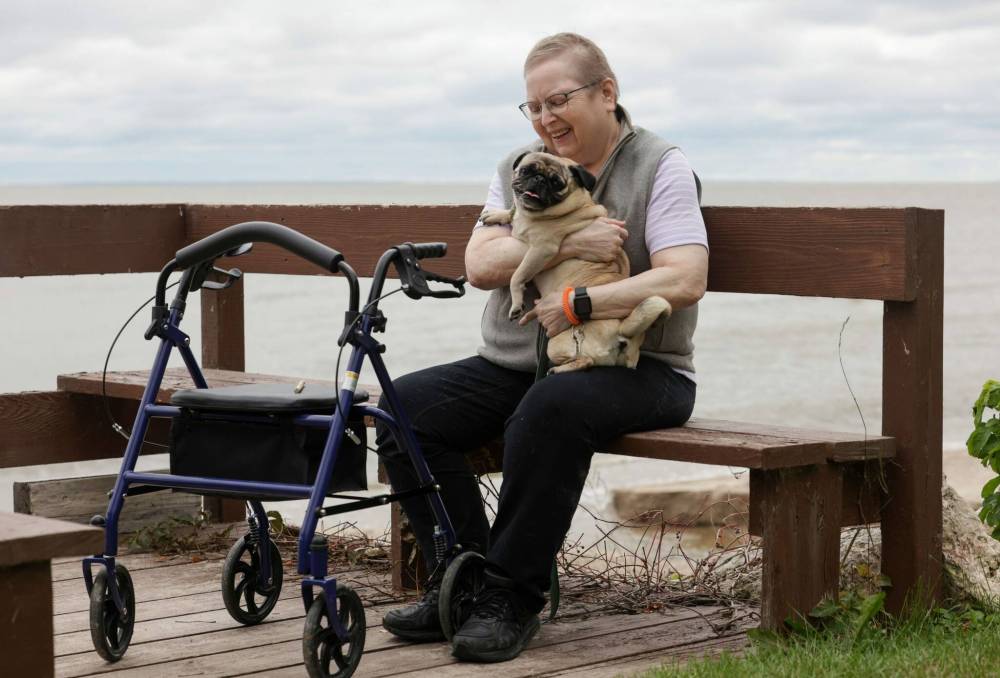
During the months at the cottage, Clover revels in time spent with Ward’s extended family members, neighbours and the neighbourhood dogs.
Ward delights in her twice-daily walks with Clover. In the wintertime, because of her health condition and to avoid falls, she gets help from a young man in her building who takes over dog-walking duties.
“It’s the best place. We take care of each other,” Ward says of her urban home, which houses numerous other residents and their pets, including lots of cats.
Clover loves them all.
“I’m twice divorced, living on my own and loving it. She gives me a reason to get up in the morning.”
Ward adopted Clover, then six, from a family who could no longer care for her. It took a while before the pug adjusted to her new home. Training helped and Clover — who is much calmer now — is living her best life with her new best friend.
“The first year was a challenge — now she’s just the sweetest thing, definitely Mommy’s girl,” Ward says.
“She gives me a reason to get up in the morning.”
When Ward began contemplating life changes that come with aging, she took a hard look at options and realized she had to do whatever was necessary to continue to have Clover by her side.
“I thought a lot about either going into assisted living, or redoing my condo for a handicapped person. Having the dog, I decided to redo my condo from floor to ceiling. Now it’s set up for the handicapped,” she says.
Ward understands the bond between humans and animals all too well. She recalled during her nursing career, when she ran dementia units, she’d see residents asking about their pet, and the sadness that came upon them when they realized their four-legged friend wasn’t with them anymore.
She also remembers the intense grief she felt when her last pug had to be euthanized. When she came upon a picture of Clover online, it was love at first sight.
“‘That’s my dog,’ I said. She’s my baby.”
Ward says Clover is always aware of how she is feeling and the two are grateful to have each other.
“She cuddles right up — she won’t leave. I used to think she wanted the body heat.
“It’s unconditional love. This morning it was cool in the cottage. She climbed under the blankets, like a hot water bottle. There’s no sweeter feeling. We slept for another couple of hours.”
Psychology professor Corey Mackenzie, who is also a research affiliate with the Centre on Aging at University of Manitoba, has done extensive reviews of the literature regarding the bond between seniors and companion animals.
“The evidence is pretty clear that having a companion animal is good for mental health across the lifespan,” Mackenzie says. “That’s true for older adults. Human beings are highly social. Moments of isolation are risks to mental health.
“You come home to a yellow Lab, you’re guaranteed to get this friendly, unconditional love. They don’t get crabby, you just get love and affection,” he says, adding that there are also obvious physical health benefits to the built-in dog walks.
The father of two notes that nothing will get him out of the house on a cold January night except Ginger, his nine-year-old labradoodle.
“She’s definitely a member of the family.”
Mackenzie says there are different risks to having a pet for older adults, with older individuals more likely to be hospitalized from a dog or cat bite or scratch when compared with other age groups, and that there is more likelihood of falls and injuries.
“You come home to a yellow Lab, you’re guaranteed to get this friendly, unconditional love. They don’t get crabby, you just get love and affection.”
“When you have a pet underfoot, or when taking the dog out for a walk, and it starts lunging at a squirrel, there can be physical risks, including bites or scratches.”
But despite those worries, Mackenzie says the benefits of the human-animal bond far outweigh the risks.
“When my uncle passed away from cancer, my aunt got a dog. I’m sure that dog was better than any grief counselling she could ever have.”
Another psychological risk associated with seniors living with a companion animal is the grief that arises when their pet dies.
As a clinical psychologist, Mackenize says, “It’s better to have loved and lost than never to have loved at all. The grief is equal to the love. It’s part of the picture,” he says, adding that relationships with pets tend to be less complicated and not as challenging as human ones.
“There’s also an interesting argument to be made. If you go to the humane society, there are animals that are in need of homes. If I were a kitten I would love to be adopted by seniors, older adults who have a lot of time.”
In a 2020 research article published in Clinical Gerontologist, out of 70 studies examined, 52 showed companion animals positively contributing to the mental and/or physical health of older adults.
With respect to mental health, involvement with a companion animal improved participants’ quality of life and effectively reduced symptoms of depression, anxiety, cognitive impairment, and the behavioral and psychiatric symptoms of dementia, the journal cites.
Regarding physical health, increases in physical activity and improvements in blood pressure and heart-rate variability were also observed.
Shannon McGunigal, 75, is a retired social worker who lives in her own home in Wolseley, with her daughter moving in from time to time. She has two cats of her own and currently lives with her daughter’s two cats: Annabelle, who is all black and tiny, and her brother Rhythm, who is a sweetheart of a tabby.
Ruth Bonneville / Free Press Shannon McGunigal says living with her feline family of four has made her life better.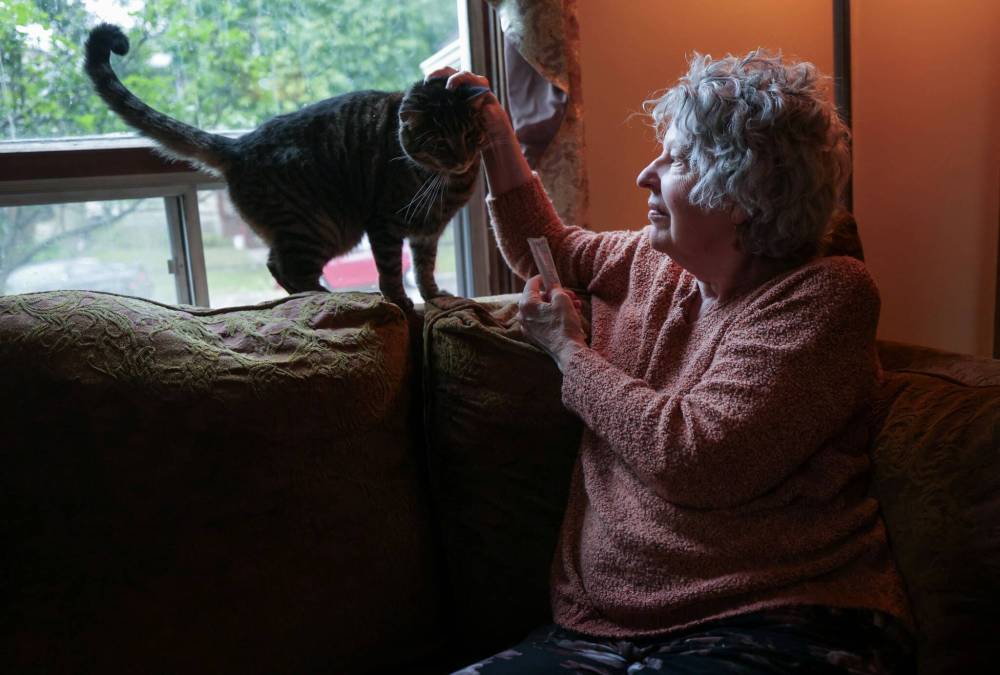
“I have Teddy, who is a black cat with a tiny white tip on the end of his tail — which is an important distinguishing feature from the other black cats,” McGunigal says. “I adopted Ted during COVID. Basil, who is all black, is a stray I adopted at about 18 months old three years ago. He has very green eyes and is one of the smartest cats I have had.
“I have had many cats, most from kittens, and they all have their own way of expressing their love and affection for their human,” McGunigal says.
“Mine have always been outdoor cats, and when they come in and have eaten, they will look for a lap cuddle or curl up in the same room. They are great company at bedtime especially; some spoon with me under the sheets all night, some come for a purr at my head and nod off, then go to the end of the bed for the night, whereas Basil will sleep somewhere on my bed and just have contact with my form with his foot or his back, just to reassure me — or him.”
Ruth Bonneville / Free Press McGunigal cuddles Rhythm, one of her four cats.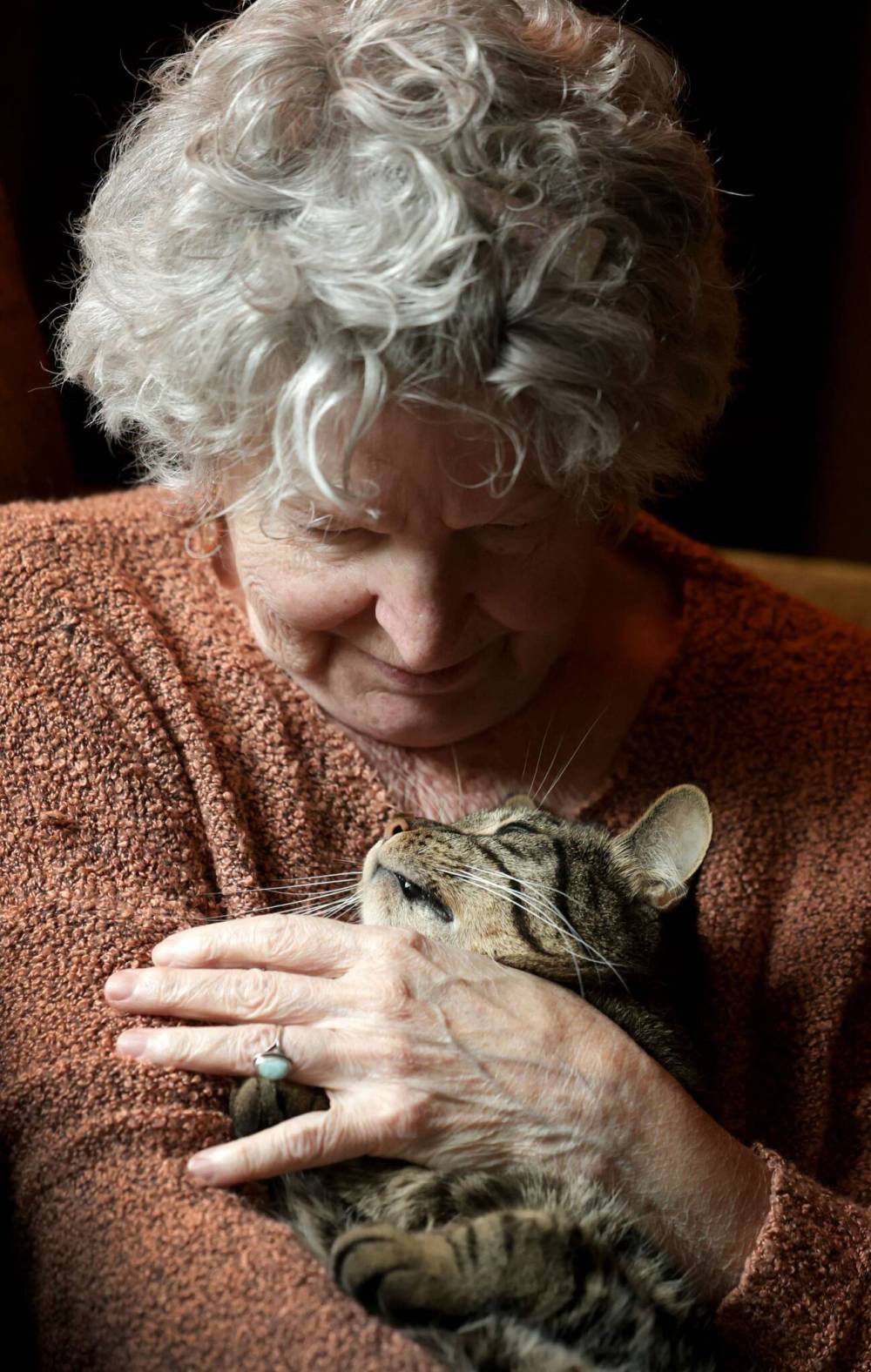
McGunigal has appreciated the benefits of living with her feline family. Through all the challenges and hardships that come with aging, her cats have made life better.
“Anytime I have been sick in bed, unable to get up except for the washroom, the cats stay with me, leaving only to use their litter or grab some dry food,” she explains. “They know when you are sick, and they stand by. They don’t meow or ask for anything, they just keep close.
“I have lived alone for many years, with cats for company, and I cannot imagine not having one: that soothing purr when I feel anxious — laughing at their antics when they are playing and being goofy.”
McGunigal has thought about what the future might bring and hopes that it will include her cats.
“When I do give up my house and have to move, hopefully it will be to an apartment or complex that allows cats — I know they are allowed far more often than dogs.
“Even in a care facility, I believe they should be able to accommodate pets as they are integral to a person’s emotional and mental health. Some countries are focusing on this but I know we are far from making this a priority. At the very least there could be a visiting room where kittens are brought for residents to go and visit and cuddle, something like cat cafés. I can imagine how comforting that would be for anyone who had to give up their own pet.”
From her earliest memories, Christina Von Schindler has always felt a profound kinship for all animals. Her early childhood was spent in the former Yugoslavia, mainly Montenegro, where children and street dogs played freely. As an adult, she’s been involved in animal advocacy and rescue her entire life.
“I often say that my dogs are the best and most uncomplicated love I’ve ever had,” says Von Schindler, who lives with her husband and four rescue dogs.
Much of her career was spent in health services, including NGOs and the public health system, while fulfilling her passion for animals in her off-work hours. That all changed last year when she accepted the role of CEO at the Winnipeg Humane Society.
“Animals have always held my heart,” Von Schindler says. “Having such a meaningful hands-on opportunity to help steer change and action for their welfare, whether individually or systemically, is profoundly meaningful to me.”
Von Schindler’s wish is that all seniors wanting to share their lives with companion animals have access to affordable, pet-friendly housing with supports in place.
MIKAELA MACKENZIE / FREE PRESS Winnipeg Humane Society CEO Christina Von Schindler, with Ernie, says more pet-friendly housing would be a mental and physical boost for seniors.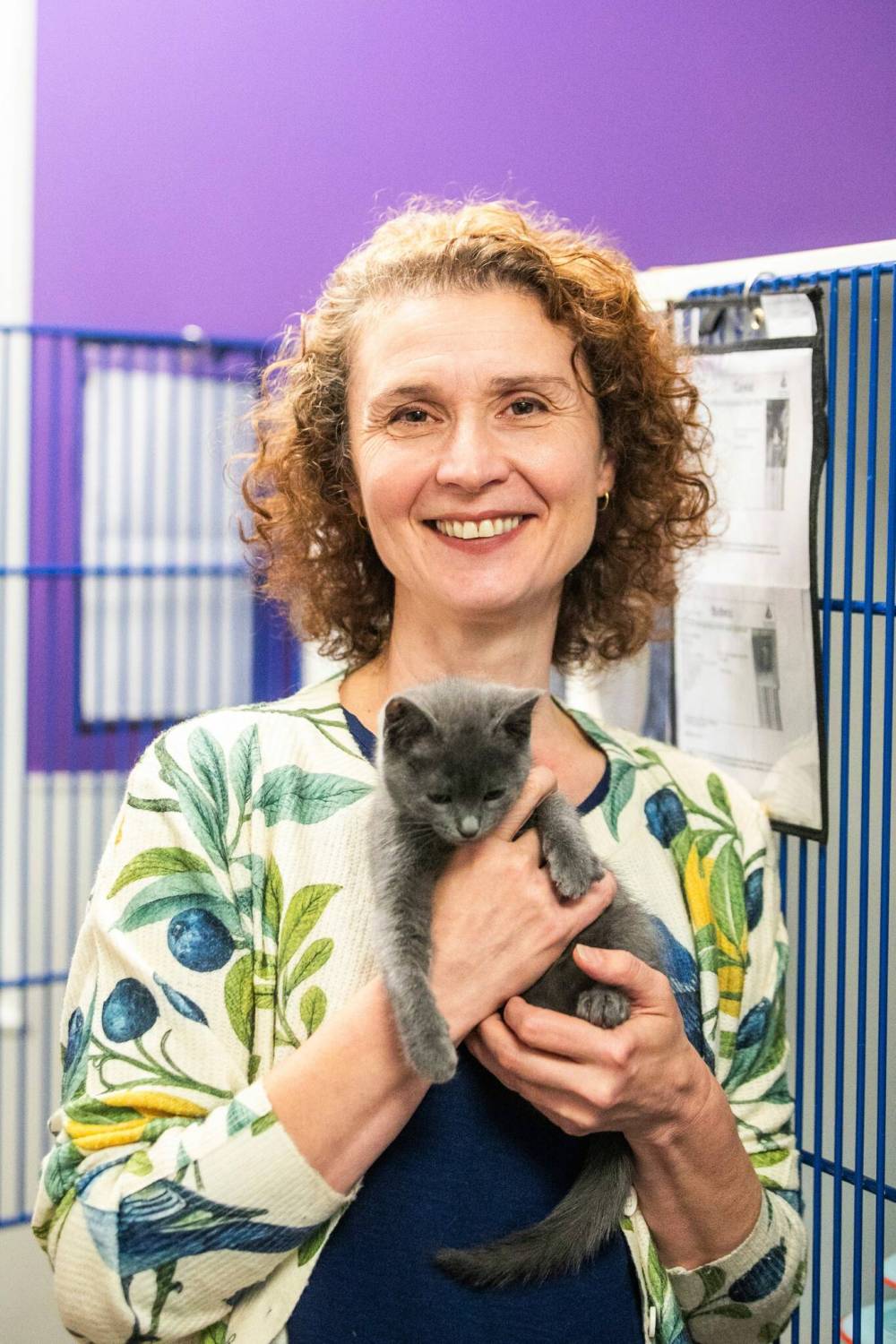
The humane society hosts a variety of initiatives, including the Safe Pet Program, which provides temporary hostelling services for pets when their owners are temporarily entering a health-care facility, treatment centre or shelter.
“A number of folks accessing the program are seniors receiving health care,” Von Schindler says. “We also know that a number of our annual surrenders are from heartbroken seniors going into assisted living and long-term care where they are unable to keep their companion animals. This is devastating for them as well as for their animals.
“Social isolation and loneliness are significant predictors of poor health outcomes for people generally — especially older adults — including declining physical and mental health, reduced resilience and a greater risk of hospitalization and loss of independence,” Von Schindler says.
“For many seniors, particularly those living alone or with limited mobility, an animal companion provides consistent purpose, affection, comfort and meaningful daily connection. This trusted relationship can ease loneliness, create a sense of purpose and belonging, and encourage routine, activity and social interaction, helping seniors remain healthier, more engaged, and independent for longer.”
Von Schindler would like to see Manitoba invest in more supportive living and personal care home spaces and supportive strategies to help people stay healthy and age in place longer.
Both of the strategies would benefit from companion-animal support policies, she says.
“The flipside of this consideration is that many seniors may avoid seeking out more supportive housing — even when they really do need a higher level of support — because doing so would mean having to surrender their companion animals. This in turn places them at greater risk of requiring prolonged hospitalization should they become sick or injured. Sadly, I know seniors are forced to give up their companions all too often for a number of preventable reasons.”
One of the concerns about pet-inclusive affordable housing, especially for seniors, is their potential inability to keep litter boxes clean and look after the animal adequately. The humane society has offered to partner with pet-friendly housing establishments to provide responsible companionship training.
She points out that while 60 per cent of Canadian households have pets, only 20-40 per cent of rental units in Manitoba accept them, highlighting a significant gap in pet-friendly housing in the province. And even if you can find a building that allows pets, it likely won’t be affordable, a disparity that disproportionately impacts vulnerable groups like seniors.
More pet-inclusive housing means less strain on the shelter system and more families staying together.
These days animal visits are popular among many residents at personal care homes. So far this year, the humane society has facilitated 39 therapy dog bookings at senior homes and facilities. The humane society currently has five recurring monthly visits with senior homes that book on a regular basis. Last year, staff facilitated a total of 73 therapy dog sessions at senior homes.
Debbie Wall is a retired veterinary assistant, a long-time animal rights activist, and a renter well acquainted with the challenges of finding affordable pet-friendly housing.
After being in the same house for several years, the landlord decided to hike her rent, leaving her no choice but to leave. Though it was challenge, she managed to find a place that was both affordable and pet-friendly. When she moved in nine years ago, she had two rescue goldfish, two cats and a dog.
When she retired in 2023, and after the loss of her dog and one cat, Wall — who’d always enjoyed the company of a multi-pet family — began contemplating whether she might get another puppy or a kitten, or possibly start fostering. That’s when she learned about the City of Winnipeg Animal Services Agency doggie dates program.
“You’re not committing to a certain number of hours,” said Wall, 67.

“You pay the adoption fee, which is returned when the dog is returned, establishing some trust. You take them for walks. You can take them for a week. It lessens the load for staff, and it’s great for the dogs. It lets the dog experience being a dog, and enhances the potential to be adopted. They wear ‘adopt me’ vests,” she continued, adding that she’s occasionally been stopped while on a doggie date walk by someone asking about the animal.
When it comes to all of her animal friends — Missy, her cat, her goldfish Bob and Russ, and the dogs she takes out on doggie dates — Wall says they’re family.
“As an activist who is exposed to the scale and scope of what our species brings to bear on our fellow earthlings, it’s therapeutic to be with happy animals and be reminded of what I’m fighting for. And after a day of dealing with people, either in-person or online, it’s refreshing to be in the company of those who are non-judgmental, live in the moment and appreciate the little things in life.”
It’s not hard to find stories of seniors and their pets living happily together and evidence of the benefits to those relationships. It’s considerably more challenging to find accommodations that will welcome both.
Von Schindler hopes Manitoba becomes a province that will model a way to demonstrate that.
“We know enough about the detrimental effects of loneliness and isolation to understand that animal companions play an invaluable role in supporting good health,” she says.
“It’s time we, as a society, act on that knowledge and help people stay healthy and connected to the beings they love.”
fpcity@freepress.mb.ca
History
Updated on Friday, September 18, 2026 4:48 PM CDT: Adds web headline