Fear factor Manitoba’s Raya Surinx was already a lethal hitter but her now-deadly jump spin serve is helping to change the way women’s volleyball is played
Read this article for free:
or
Already have an account? Log in here »
To continue reading, please subscribe:

Digital Subscription
One year of digital access for only $205*
- Enjoy unlimited reading on winnipegfreepress.com
- Read the E-Edition, our digital replica newspaper
- Access News Break, our award-winning app
- Play interactive puzzles
*First annual payment billed as $205.00 + GST for one year. This annual subscription will automatically renew at $233.00 + GST every 52 weeks (10% off the regular annual price of $259.35). Offer available to new and qualified returning subscribers only. Cancel any time.
To continue reading, please subscribe:
Add Free Press access to your Brandon Sun subscription for only an additional
$1 for the first 4 weeks*
- Enjoy unlimited reading on winnipegfreepress.com
- Read the E-Edition, our digital replica newspaper
- Access News Break, our award-winning app
- Play interactive puzzles
*Your next Brandon Sun subscription payment will increase by $1.00 and you will be charged $17.95 plus GST for four weeks. After four weeks, your payment will increase to $24.95 plus GST every four weeks.
Read unlimited articles for free today:
or
Already have an account? Log in here »
Hey there, time traveller!
This article was published 29/12/2023 (993 days ago), so information in it may no longer be current.
Raya Surinx starts her serve with a big one-handed toss, spinning the volleyball about six metres in the air with a forward rotation, and she takes three short steps before launching herself off her feet and toward the net.
At the apex of her leap, Surinx makes contact with her right hand and, with a snapping wrist action, adds rotation and speed to the ball as it begins its path to waiting opponents. With the volleyball travelling at speeds in excess of 90 km/h, it could be one of the most menacing moments in the sport.
Often, the ball either lands untouched with an emphatic thud on the opposite court, or, even if a defender manages to get a piece of it, is simply unreturnable.
“Well, after a few aces, you can tell it’s getting a little shaky on the other side of the net and then usually the coach will call a timeout and try to break her serve,” says Julia Arnold, Surinx’s University of Manitoba teammate. “That’s been the pattern we’ve noticed.”
BROOK JONES / WINNIPEG FREE PRESS Manitoba left side Raya Surinx’s jump spin serve is proving to be a big headache for Canada West opponents.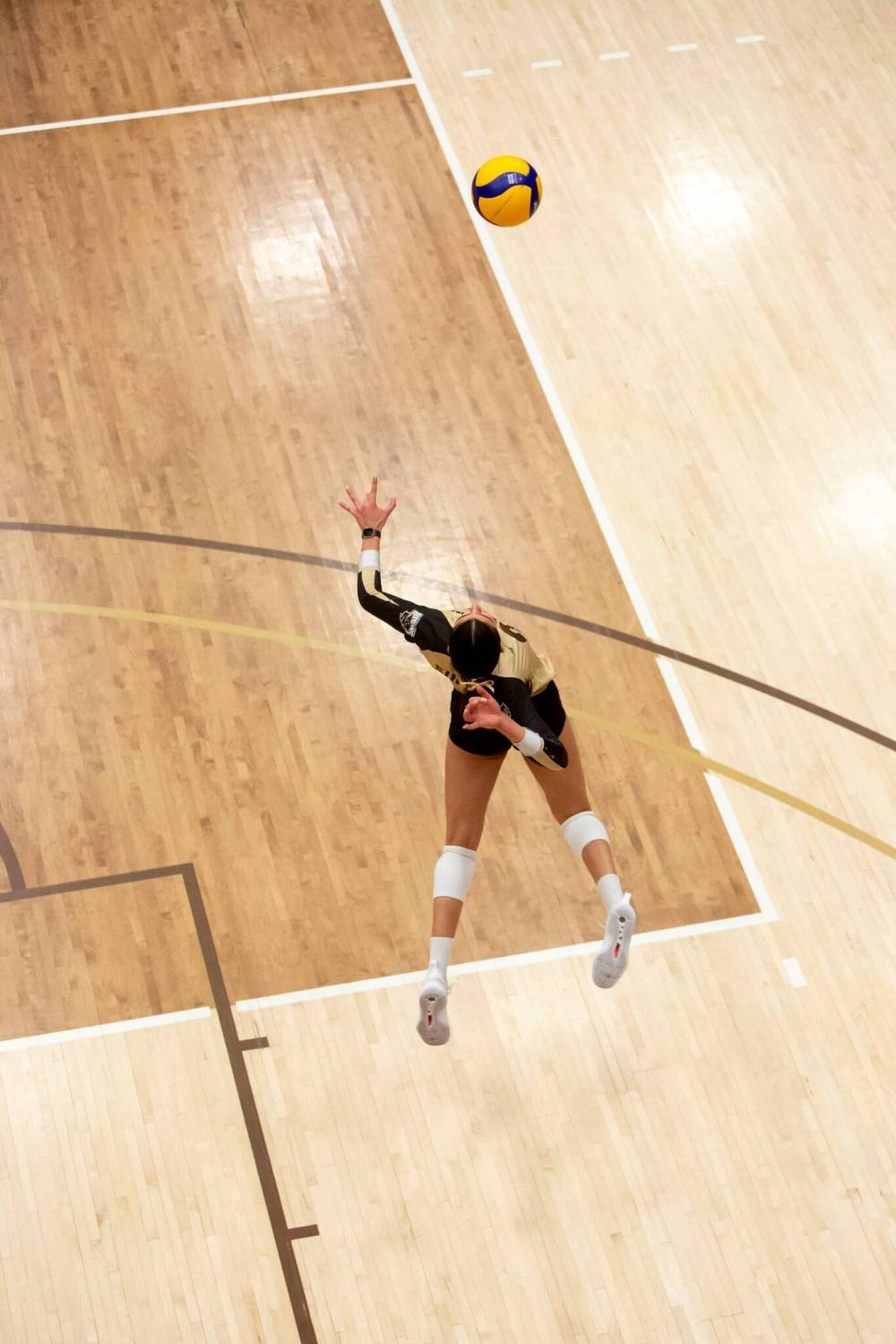
When Surinx’s serve is on, the best play might be to pray for a mistake.
“I mean, she goes up to serve and if she misses there’s a palpable sense of relief on the other side,” says Bisons head coach Ken Bentley. “Let’s face it, no one wants that smoke.”
Surinx, meanwhile, seems blissfully surprised by the impact she is having on the game.
As the U Sports national rookie of year during the 2022-23 season, a powerful right arm and freaky athleticism had already established her as one of the most dangerous attackers in the Canada West conference. But her play early in ‘23-24 has pushed her stardom to a new level.
A growing legion of young female fans comes to watch the Bisons, carrying signs riffing on a ‘Raya the Slaya’ theme.
“I think their ages range,” says Surinx, sounding amused by the attention her serving exploits are getting. “My target demographic right now is like 11 or 12. It gives them something to think about for when they’re older, because when I was younger, I never thought about serving like that.”
The humble star, it seems, is becoming a role model.
“A lot of little kids that come watch our games now are taking a big interest in Raya serving,” says Arnold.
“That’s the thing that they’re interested in most… They ask her, ‘How can I serve like you?’ It just wasn’t a thing even when I played high school and until Raya came around. I think it might influence a lot of girls to start spin serving.”
Surinx’s more conventional volleyball skills are firmly established.
BROOK JONES / WINNIPEG FREE PRESS Raya Surinx leads Canada West in kills (195) and kills per match (4.76 per set) but she also sits fifth in service aces (21) and first in service errors (38).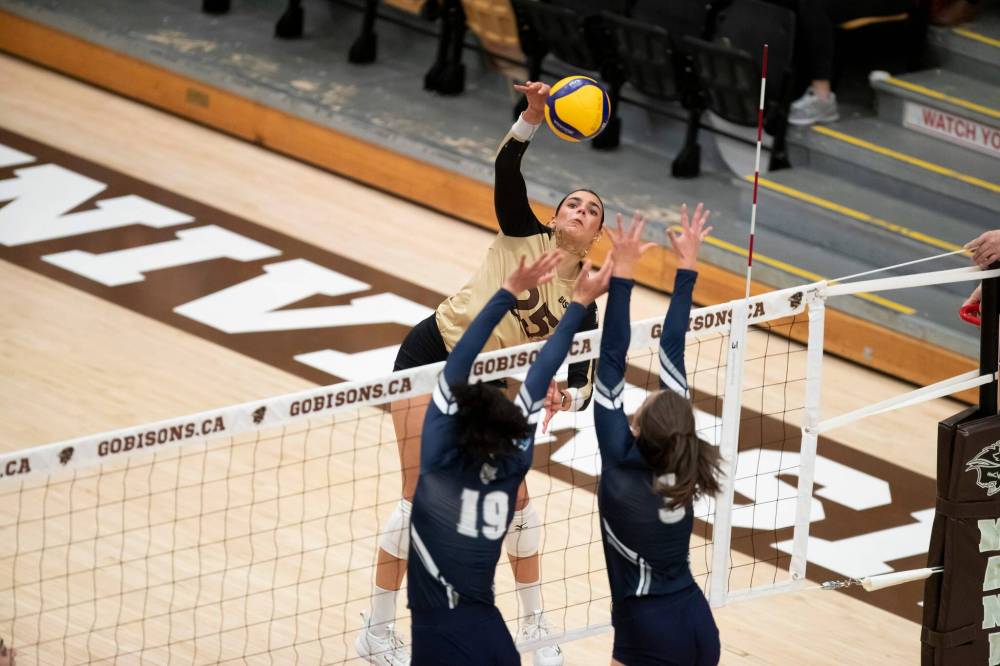
The six-foot left side leads the conference in kills (195) and kills per match (4.76 per set) but she also sits fifth in service aces (21) and first in service errors (38).
The jump spin serve has a high risk factor but her prowess is all the more remarkable when you consider she was not a jump spin server in high school and only took up the new skill while training with Manitoba’s Canada Games team in the summer of 2022 and then at Bentley’s urging when she started her university career.
Alix Krahn, who coached Manitoba to gold at the 2022 Games, remembers seeing Surinx jump spin serve in practice and wondered aloud why she hadn’t seen her do it in a game before.
“I want you to go back there and I want you to rip your best serve always and guess what, you’re young now — screw it up as much as possible,” recalls Krahn telling Surinx. “Hit it out the back… because one day this is going to be your thing and you’re going to be consistent at it. Now’s the time to make all the errors. If we don’t give our athletes permission to make errors and fail — we’re not really doing a good job as a coach.”
Jump spin serving, a fixture at the upper echelon of the men’s game for more than four decades, has fewer adherents on the women’s side.
BROOK JONES / WINNIPEG FREE PRESS Surinx, named the U Sports rookie of the year in 2022-23, was a member of Canada’s NextGen national team in the off-season.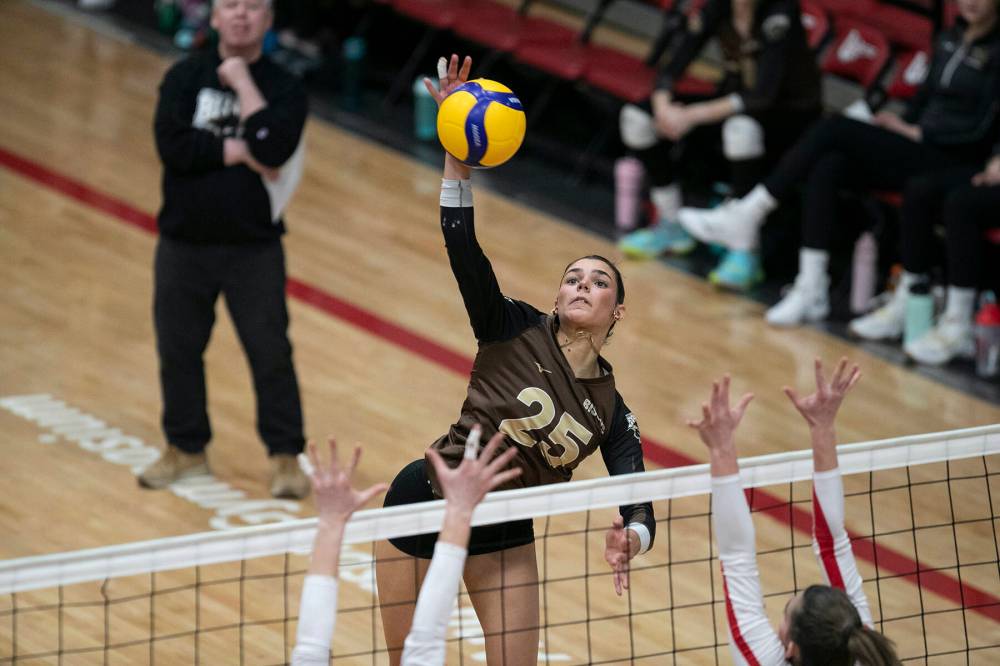
“I don’t really have a routine — most people do — but I just kind of go back there and hit it,” says Surinx. “Spin is very important because if I try to hit too hard, I’ll hit through the spin and then it’ll just float out, which I don’t want. So, my first serve (of a match), when we go around our rotation, I’ll try to make make sure that one’s in and then gradually progress from there.”
Surinx has laboured hard to improve her numbers and her fitness — part of a team objective during the off-season.
“You certainly have to have the capacity to hit the kind of spin that’s hard enough and have the mechanics to be able to do it. The other thing that I’ve imparted on Raya is it’s not just one or two serves,” says Bentley. “You’ve got to be able to hit 50 balls a match, and you got to be able to serve another 20. So, now fitness is really important. You’ve got to be fit. You can’t peter out in the fifth set and lose steam.”
Former Bisons great Loriann Ludwig, a jump spin server in the 1990s who still owns the program’s single season (135 in 1994-95) and career records (382) for aces, has already noticed a refinement of Surinx’s technique.
“I remember the first time I watched her play last year, I was like, ‘She’s got to lead it more,’” says Ludwig, the country’s player of the year in ’94-95. “She was still landing on the end line. She was still learning and she obviously will still keep on learning and improving. But just watching her this year, she’s leading herself more, she’s taking off closer to the end line and she’s landing in the court. She’s a special player that’s for sure and she’s fun to watch.”
“She’s a special player that’s for sure and she’s fun to watch.”–Loriann Ludwig
Third-year Bisons left side Andi Almonte, a standard float server when she began her U Sports career, has developed a spin serving technique that incorporates old and new.
“My spin serve is kind of like a hybrid,” says Almonte, a big leaper although she’s five inches shorter than Surinx. “I can turn it into a float off of the spin. I usually decide before I toss the ball but if I toss it badly then I can float it. The tosses are supposed to be the same if I’m floating or if I’m spinning, usually the (other team’s) passers won’t know until I hit the ball.”
Misdirection is also part of Surinx’s approach to serving. A rapidly spinning hard-hit ball has a wicked tendency to bottom out, leaving defenders flat-footed and helpless.
“She can hit the ball deep on her spin serve, which is hard to pass because usually it’s gonna fall in front of you but when it goes behind you, it’s hard to get behind it fast enough when it’s coming that quick,” says Arnold.
The University of Winnipeg’s Janis Kelly and Ludwig brought the jump spin serve to national prominence in the 1990s, but the technique never gained the widespread acceptance it has enjoyed in the men’s game.
“There’s a lot of cultural stereotyping and belief that women can’t serve as as hard so why would you do it, right?”–Alix Krahn
“There’s a lot of cultural stereotyping and belief that women can’t serve as as hard so why would you do it, right?” says Krahn, a former U of W player currently serving as an assistant coach at the University of Toronto. “I just don’t really agree with any of that. We’ve known for a long time that women can attack hard and can hit the ball hard…
“I’m sorry, I’ve been playing volleyball my whole life and I’ve never, ever thought that we couldn’t hit it or couldn’t do it. But when you have a culture that doesn’t encourage that and doesn’t support people in taking those risks, it just perpetuates the problem. So then, what is the issue? Is it the issue of physical strength or is the issue the fact that there hasn’t been a culture created that supports people doing it?”
Surinx is helping to introduce it to the next generation of female stars.
The superstar as innovator
It’s a story John Barrett loves to tell.
It was 1981 and Barrett, the brash 19-year-old star of Canada’s national men’s team, had a “lightbulb moment” as he watched warm-ups at a tournament in Shanghai. A member of the Chinese team, experimenting with an early version of a spin serve, leaped up before hitting the ball with top spin.
“I thought, ‘Wow, I bet that could be done with an approach,’” remembers Barrett. “So, I went to practice the next day and I started throwing it up from the baseline and (my approach) was because I was an outside hitter and I was a high ball hitter, I thought of it as just like setting yourself a high ball from the baseline.”
John Barrett (left) helped to revolutionize volleyball by inventing and bringing the jump spin serve to prominence in the 1980s.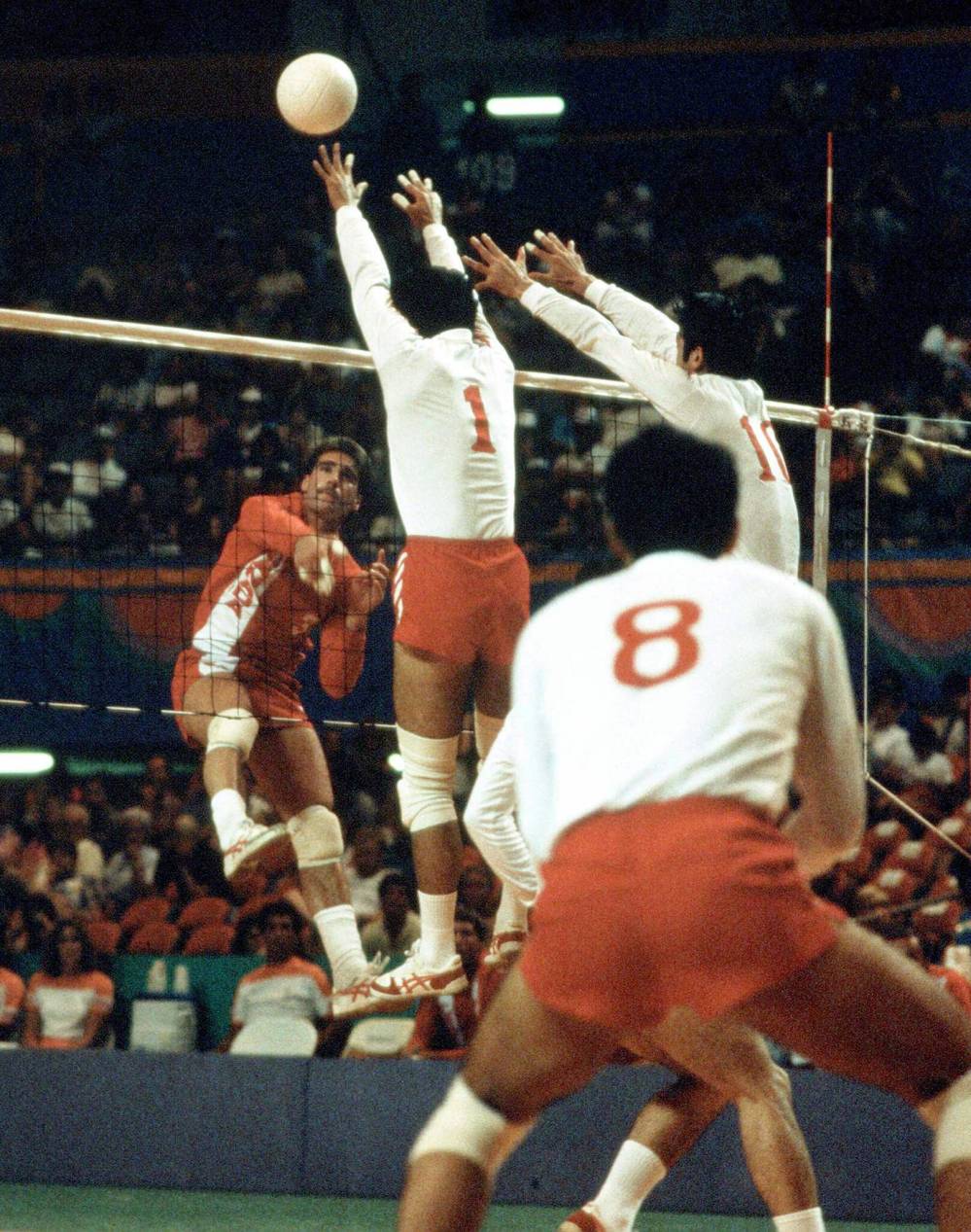
A day later, in his first attempt under game conditions, a Japanese blocker leaped up — blocking serves was permitted at the time — and slammed Barrett’s serve harmlessly to the floor.
“(Head coach) Ken (Maeda) looked over at me and he called a timeout and I thought, ‘Oh, wow, I’m gonna get it now,’” says Barrett. “He would speak in broken English and he said to me, ‘John, what is that?’ I said, ‘Ken, I think I can do it.’ And he kind of nods his head and goes, ‘OK, do it every time.’ If it wasn’t for Ken seeing something, I probably would’ve been told never to do it again.”
Maeda, who guided Barrett and the Canadians to a fourth-place finish at the 1984 Olympics, was accepting of the new tactics at a time when some of his teammates weren’t.
“I remember having a number of teammates who saw me do it and they’re like, ‘Why are you wasting your time? You’ll never be able to do that with any consistency,’ ” remembers Barrett, now 61 and the head coach of the University of Toronto men’s volleyball team. “But sometimes in your youth, your real strength is sort of your ignorance to what can be done and what can’t be done.”
Soon after, Barrett was lured to the University of Manitoba by his Olympic teammate, Bisons head coach Garth Pischke, and they combined to go 59-2, beat NCAA champion Pepperdine four times and captured the 1984-85 national championship. That year, Barrett set a single-season program mark of 162 aces, a record that still stands.
“I said, ‘Ken, I think I can do it.’ And he kind of nods his head and goes, ‘OK, do it every time.’”–John Barrett
“He would be very effective now, there’s no question,” says Pischke, who retired as coach of the Bisons following the 2019-20 season. “He had an absolutely perfect arm swing for it and it was extremely consistent. The funny thing about him getting 162 aces was at that time, you weren’t allowed to contact the net on your serve, so he might have had double the amount if you would have included the tricklers as we call them, where they the ball hits the top of the net and just trickles over.”
The net rule, changed in 2001, was predated in 1998 by another major rule change — the introduction of the libero position, an innovation intended to improve defensive play.
After his one season at the U of M, Barrett made the move to the professional ranks, joining Bologna of the Italian league. In their first meeting with Modena, coached by legendary Julio Velasco, Bologna triumphed 3-0 with Barrett ripping 12 direct aces.
“After that match, Velasco had everybody on his team jump serving and by the end of the season, every team in the league had at least two spike servers on the team,” says Barrett, who can rightfully claim to be the originator of the jumping spin serve.
“The evolution of the serve is interesting, but the purists, the guys who are most effective with it, are what I call bombers.”–John Barrett
But the jumping spin serve remains an elusive skill to this day.
“The evolution of the serve is interesting, but the purists, the guys who are most effective with it, are what I call bombers,” says Barrett. “They’re big strong guys and they can toss it high — my toss was more of a lower in-rhythm toss. I played around with a lot of different tosses but had to be able to hit it hard, and get a full jump. Obviously the guys who really bomb have to be really big, physical guys or girls.”
In the women’s game, Italy’s Paola Egonu and Serbia’s Tijana Boškovic are exceptionally good at the craft — bombing away with their own versions of the jumping spin serve. Might Manitoba’s Raya Surinx join that elite club one day?
“She has a very good arm strength, is very consistent and contacts the ball high and is quite powerful,” says Pischke. “She’s only going to get stronger as her career goes on but her technique is almost perfect for the spike serve and her timing is obviously very, very good as well. It’s certainly the best I’ve ever seen in the female game.”
mike.sawatzky@freepress.mb.ca