Crossing our heart, hoping to thrive Immortalized, romanticized, criticized and politicized — Portage and Main is, as the mayor said, ‘just an intersection’; but it represents much more to those who know its history and some who can envision its future
Read this article for free:
or
Already have an account? Log in here »
To continue reading, please subscribe:

Digital Subscription
One year of digital access for only $205*
- Enjoy unlimited reading on winnipegfreepress.com
- Read the E-Edition, our digital replica newspaper
- Access News Break, our award-winning app
- Play interactive puzzles
*First annual payment billed as $205.00 + GST for one year. This annual subscription will automatically renew at $233.00 + GST every 52 weeks (10% off the regular annual price of $259.35). Offer available to new and qualified returning subscribers only. Cancel any time.
To continue reading, please subscribe:
Add Free Press access to your Brandon Sun subscription for only an additional
$1 for the first 4 weeks*
- Enjoy unlimited reading on winnipegfreepress.com
- Read the E-Edition, our digital replica newspaper
- Access News Break, our award-winning app
- Play interactive puzzles
*Your next Brandon Sun subscription payment will increase by $1.00 and you will be charged $17.95 plus GST for four weeks. After four weeks, your payment will increase to $24.95 plus GST every four weeks.
Read unlimited articles for free today:
or
Already have an account? Log in here »
Hey there, time traveller!
This article was published 10/05/2024 (885 days ago), so information in it may no longer be current.
When Mayor Scott Gillingham announced in March he’d like to see Portage and Main finally open to pedestrians — which it famously has not been since 1979 — he made a comment that would become a front-page headline.
“It’s just an intersection.”
MIKE DEAL / FREE PRESS FILES Winnipeg Mayor Scott Gillingham: “It’s just an intersection.”
Gillingham correctly pointed out Portage and Main is not the busiest intersection in Winnipeg. It’s not even the busiest intersection downtown.
But with respect to the mayor, Portage and Main has never been “just an intersection.”
Although generations of Winnipeggers have never been able to walk through it, Portage and Main is deeply ingrained in our civic identity and mythology. It’s been the site of debate and discussion, of protest and celebration. It’s been a lightning rod, punchline and “hot-button” issue, and it’s been lauded as famous, iconic and important.
Winnipeggers are hyperbolic about Portage and Main in a way that could be interpreted as pride. It’s (allegedly) the “coldest and windiest intersection in Canada.” It’s the “crossroads of Canada,” owing to its longitudinal position on the map. Portage Avenue is the “longest street in the world,” an artery of both the Trans-Canada and Yellowhead highways.
Portage and Main has been featured on a stamp, is the answer to a Trivial Pursuit question and is a (Canadian) Monopoly property.
It’s been immortalized in song, perhaps most famously in Randy Bachman’s 1992 Prairie Town, featuring Neil Young — the refrain is “Portage and Main 50 below,” a temperature it has never been in Winnipeg, but again, we do love us some lore — and, perhaps less famously, in 1989’s Portage and Main by the British band Blurt.
Canadian folk legend Stompin’ Tom Connors also made the intersection the setting of his 1975 song Red River Jane, which is about a griftin’ city gal who burns a country boy:
Here I walk in the Winnipeg rain
Tryin’ to get a bus, tryin’ to get a train
Tryin’ to get back to my field of grain
Away from Portage Street and Main
There was a Vancouver-based band called Portage & Main. There’s also an Edmonton-based kids clothing brand named Portage and Main.
“To us, an intersection represents two important things coming together. For us those two things are modern and woodsy,” reads the company’s website copy. “The word ‘Portage’ evokes images of canoes, upper and lower Canada. Main Street is all about the downtown urban vibes.”
MIKE DEAL / FREE PRESS FILES A boarded-up entrance to the underground Portage and Main Concourse in March.
Obviously, the intersection has captured the imaginations of Winnipeggers and non-Winnipeggers alike. Why that is, however, is more difficult to parse. Because for such a supposedly famous, iconic and important intersection, there’s no “there,” there. The way Portage and Main is talked about is at almost comical odds with what it actually is. The only vibe is “hostility,” and as for its esthetic… well, let’s just say Urine & Bunker isn’t a nice name for a children’s clothing brand.
“And it makes sense that the reason we’re opening the intersection at all is that it’s the cheapest option.”–Sabrina Janke
Nothing about Portage and Main as it exists now conveys its cultural or economic significance to the city.
You can’t hang out there. You can’t walk there. You can be at Portage and Main only to celebrate the achievements of a local sports team, but no other time.
If Portage and Main is “just an intersection,” it’s because we’ve made it into just an intersection.
“That’s a very ‘Winnipeg’ mythology, too, in that it’s like, ‘this intersection is not only famous, it’s kind of bad,’” says Sabrina Janke, a Winnipeg historian and co-host of the One Great History podcast.
Portage and Main is, in many ways, a microcosm of the city, and our identity more broadly, she says.
“I feel like it’s a classic Winnipeg dilemma in that we’re both very nostalgic and also very resistant to change. Even if it’s like, ‘Oh, this change might be good for the city,’ it takes a lot of pushing to accept that.
“And it makes sense that the reason we’re opening the intersection at all is that it’s the cheapest option.”
The thing about famous intersections is that people occasionally want to visit them.
Monica Giesbrecht is a landscape architect and a principal at HTFC Planning & Design, located a short walk from the intersection in the Exchange District. She recently hosted friends visiting from the U.K. who, if you can believe it, were not exactly writing home about Portage and Main’s concrete barriers.
“They were like, ‘This represents Winnipeg in a really bad light. I don’t know why you would ever send people here. If you really want tourism and you want a vibrant space and you want to be a worldly city, then this intersection needs to be a people intersection.’ And that really hit home for me,” Giesbrecht says.
“I mean, (Portage and Main) has so many historical layers and claims to fame and even environmental conditions — like, it is super windy, which you could do something very fun with. It’s just strange to me.”
MIKAELA MACKENZIE / FREE PRESS Landscape architect Monica Giesbrecht at Portage and Main.
Having nothing at Portage and Main is like having nothing at The Forks, the historic site at the confluence of the Red and Assiniboine rivers.
And yet, in 2018, 65 per cent of voters said they wanted to keep Portage and Main closed to pedestrians in a now-infamous plebiscite that laid bare the tensions between downtown denizens who live near the intersection and suburbanites who drive through it, as evinced in a now much-memed map.
“I think it really comes down to whether or not you’re wanting to experience the place, or whether you’re looking at it as a vehicle conveyance mechanism,” Giesbrecht says.
‘If you really want tourism and you want a vibrant space and you want to be a worldly city, then this intersection needs to be a people intersection.’–Monica Giesbrecht
“I think what we disagree about is how it’s used, not about whether it’s important.”
But maybe sometimes we forget that it’s important. And maybe understanding how it was used in the past could be constructive in imagining how it could be used in the future.
Because Portage and Main has always worn people’s visions for it — good, bad and ugly.
Let’s go back to 1862, when a man named Henry McKenney bought land at what is now the intersection and decided to build a general store.
Fellow settlers reportedly thought this guy was out of his tree. The land McKenney had his eye on was too far from everything, including the river. To their minds, it was too swampy, scrubby and low.
But the joke was on those naysaying nellies. Those roads — long used by Indigenous and Métis people — were eventually graded. Other businesses cropped up around McKenney’s store. Winnipeg was incorporated. And by the turn of the last century, Portage and Main was the bustling commercial centre of a growing city, with its own Bankers Row.
ARCHIVES OF MANITOBA Main Street circa. 1905, looking north from Portage Avenue. By the turn of the century, Portage and Main was the bustling commercial centre of a growing city.
“There’s a 1913 article in the Winnipeg Telegram that talks about how it’s the heart of the city in a major way because it’s these two major old roads — but it’s really only the heart of the city if you’re rich,” Janke, the historian, says.
“So there would have been law offices. I think maybe one or two stores, some solicitors, some real estate offices, and then both railways had their offices there selling tickets. I think it shows the vision of the city that they had early on, the Chicago of the North.”
What Portage and Main wasn’t, at least back then, was a gathering site — that was Market Square. But that all changed with the Winnipeg General Strike of 1919.
“There is obviously Bloody Saturday (June 21), the one everyone knows about, but there was an earlier riot on June 10,” Janke says. “Special Police are sworn in, they marched to Portage and Main, and there’s a group of protesters there basically protesting the new police force. And it breaks into a fight, the police are, I think, hosing people away. There are pictures of it.
“But I think it’s interesting that the first time we really start gathering at Portage and Main is because of this sort of class conflict.”
WINNIPEG FREE PRESS ARCHIVES Intersection of Portage Avenue and Main Street during the 1919 General Strike.
In subsequent years, Portage and Main could be held up as the beating heart of a thriving downtown.
“The old pictures of it show a lot of pedestrians, a lot of streetcars. It’s a very different sort of city that we have now,” Janke says.
But after the Second World War, cars became a more dominant mode of transportation in North America.
“The old pictures of it show a lot of pedestrians, a lot of streetcars. It’s a very different sort of city that we have now.”–Sabrina Janke
“And this idea of new urbanism and renewal meant, in a lot of cases at the time, erasing older things,” Giesbrecht, the landscape architect, says. “Demolishing swaths of downtowns was not unheard of, putting freeways in was not unheard of. The car was king.”
So, we turned away from making Portage and Main a place, and instead focused on making it a thoroughfare. The streetcar tracks were ripped out in the 1950s. And then, in 1979, pedestrians were driven underground by a new vision for Portage and Main promised by the Trizec Corporation that mostly failed to materialize.
SUPPLIED A crowded Main Street between 1908 and 1911, looking north from Portage Avenue with streetcars, horse drawn wagons, cyclists and many pedestrians. 
And while some people don’t want Portage and Main to reopen, not everyone wanted it to close in the first place. In 1979, former city councillor Joe Zuken famously led a jaywalking protest march across the then-newly closed intersection, joined by disability activists who said (and, it’s worth noting, still say) a closed Portage and Main is discriminatory.
“When you have to throw up walls to manipulate people, then you have a problem,” a landscape architect is quoted as saying in a 1980 Winnipeg Tribune article, in which the descriptors “antiseptic,” “neutralized” and “the Berlin Wall” were also used.
In 1976, three years before pedestrians lost access, the Tribune ran an editorial cartoon opposing the intersection’s closure, depicting it as heavily militarized and surveilled. “Checkpoint gulag, motor vehicles only, no walking” reads a poster on a wall, as armed cops mill about. Pedestrians, meanwhile, are being funneled down into the “Taypayers Memorial Concourse.” Above them is a picture of a clown.
Portage and Main is an intersection. But it’s our intersection. Shouldn’t it say something about who we are as a city?
Of course, it already does say something about who we are as a city. But is this really the image — closed-off, car-centric, “kind of bad” — we want to put out into the world? Is this really how we want to perceive ourselves?
Places like this, if they are done right, instil a sense of uniqueness, Giesbrecht says.
“That’s why none of these intersections around the world in famous cities where you can think of them are the same. They are place specific. It’s not going to look like Times Square in New York or Champs-Élysées in Paris. It’s gonna look like what Winnipeg’s version of an iconic public street or intersection looks like.”
MIKAELA MACKENZIE / FREE PRESS FILES The former Bank of Montreal building at Portage and Main.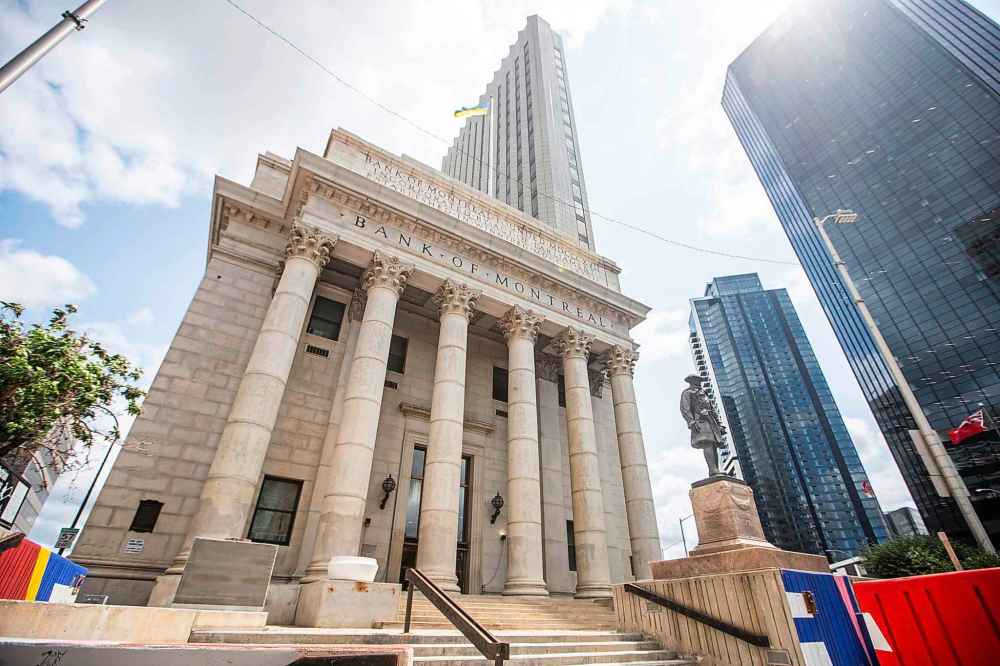
The Manitoba Métis Federation is helping to build that sense of place, transforming the iconic Bank of Montreal building at the southeast corner of Portage and Main into the Red River Métis National Heritage Centre.
David Chartrand, president of MMF, points out the intersection has particular cultural significance to the Métis people, who founded this province and were a major economic engine.
“You stand at the Bank of Montreal and you look, and where does it point? Exactly northwest, to our homeland,” he says.
“And so for us, the Heritage Centre to be where it’s located, right in the centre of the passageway to the west, I think, sends a powerful message that the Métis are still here. We may have faded away for a while for a few generations. But we’re back. This is where we want to be. We want to help our city, we can help our province, we want to help our country. And one of the ways we do that is investing downtown.”
“I think it would be really lovely for Portage and Main to be animated in a manner that you can come down and experience the best of the food and culture of downtown Winnipeg on that corner,” Giesbrecht says. “We’ve done many projects where we propose things like a restaurant at grade that spills out. Or even the bunker on the Richardson side that’s the stairwell access to the underground, we did a scheme where we extended that into this massive glass box right on the corner where you could just go for a drink.
“For us, the Heritage Centre to be where it’s located, right in the centre of the passageway to the west, I think, sends a powerful message that the Métis are still here. We may have faded away for a while for a few generations. But we’re back. This is where we want to be.”–David Chartrand
“Basically you need to activate it so people are going there to do something.”
Janke agrees. “It’s tough as a historian, because part of me is like, ‘Oooh yeah, a bunch of plaques and memorials,’” she says with a laugh. “But I think, more importantly, we should just have people there first and then we can think about what monuments we want to put up.
“Because what’s the point of putting up a new statue if no one’s there to look at it?”
Opening Portage and Main isn’t a magic bullet when it comes to curing all that ails downtown, Giesbrecht says.
“But I think the more people you get downtown — and it’s going to be a progressively changing thing — the safer and the better it will feel.”
And the stakes, to Chartrand’s mind, are high. Portage and Main, he says, is worth protecting.
“We let that history diminish on us, we let Portage and Main just become a ghost town and see the tumbleweeds roll down Portage Avenue, then we have no more economic pride or strength (that) we can broadcast to the world or the country,” he says. “I think it’d be shameful for our beautiful city.”
jen.zoratti@winnipegfreepress.com

Jen Zoratti is a columnist and feature writer working in the Arts & Life department, as well as the author of the weekly newsletter NEXT. A National Newspaper Award finalist for arts and entertainment writing, Jen is a graduate of the Creative Communications program at RRC Polytech and was a music writer before joining the Free Press in 2013. Read more about Jen.
Every piece of reporting Jen produces is reviewed by an editing team before it is posted online or published in print – part of the Free Press‘s tradition, since 1872, of producing reliable independent journalism. Read more about Free Press’s history and mandate, and learn how our newsroom operates.
Our newsroom depends on a growing audience of readers to power our journalism. If you are not a paid reader, please consider becoming a subscriber.
Our newsroom depends on its audience of readers to power our journalism. Thank you for your support.
Related Articles
Council votes to reopen Portage and Main to pedestrians, close underground concourse






History
Updated on Friday, May 10, 2024 5:00 PM CDT: Adds fresh photo