In it fur better or worse Tell-tail dedication, instinct for compassion drive staff at the Winnipeg Humane Society
Read this article for free:
or
Already have an account? Log in here »
To continue reading, please subscribe:
Digital Subscription
One year of digital access for only $1.44 a week*
- Enjoy unlimited reading on winnipegfreepress.com
- Read the E-Edition, our digital replica newspaper
- Access News Break, our award-winning app
- Play interactive puzzles
*Billed as $5.77 plus GST every four weeks. After 52 weeks, price increases to the regular rate of $19.95 plus GST every four weeks. Offer available to new and qualified returning subscribers only. Cancel any time.
To continue reading, please subscribe:
Add Free Press access to your Brandon Sun subscription for only an additional
$1 for the first 4 weeks*
- Enjoy unlimited reading on winnipegfreepress.com
- Read the E-Edition, our digital replica newspaper
- Access News Break, our award-winning app
- Play interactive puzzles
*Your next Brandon Sun subscription payment will increase by $1.00 and you will be charged $17.95 plus GST for four weeks. After four weeks, your payment will increase to $24.95 plus GST every four weeks.
Read unlimited articles for free today:
or
Already have an account? Log in here »
Hey there, time traveller!
This article was published 06/02/2026 (257 days ago), so information in it may no longer be current.
Our new One Day feature is just as it sounds: Each month, we will spend one day documenting the everyday work that helps keep our communities going.
If you know an organization, program or person you think readers would be fascinated to follow, drop writer Melissa Martin a line.
10:30 a.m.
It’s mid-morning, and already the Winnipeg Humane Society’s veterinary clinic is deep in its daily routine. In the crowded prep room, veterinary technicians and assistants zip to and fro, carrying sedated cats wrapped in blankets, clipping claws and checking charts to see which patient is up next.
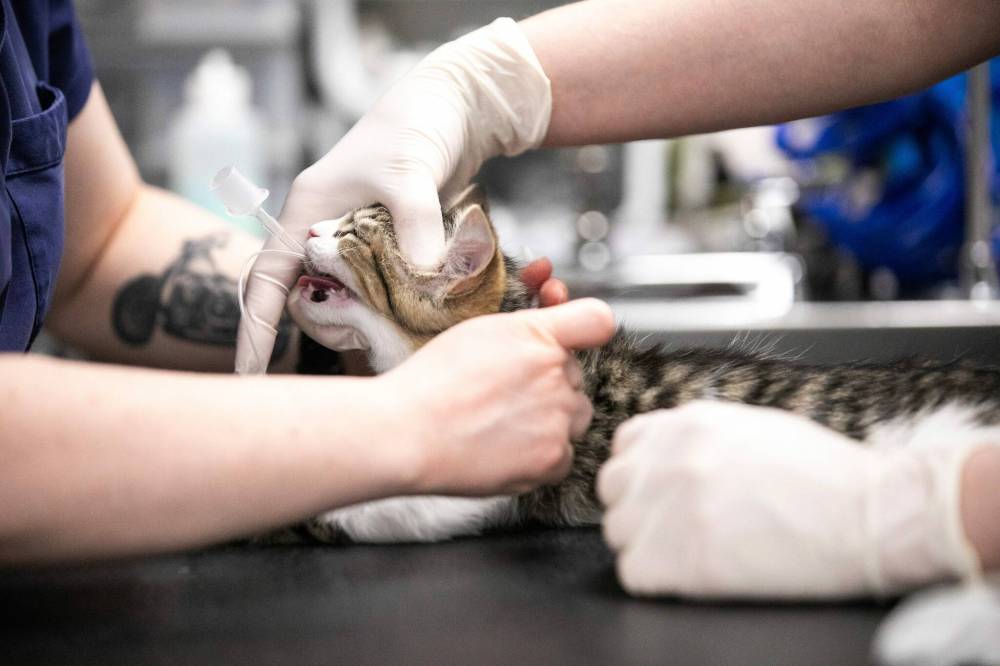
MIKAELA MACKENZIE / FREE PRESS
Starfish gets prepped for surgery at the Winnipeg Humane Society veterinary clinic.
In the middle of the room, a 12-week-old tabby named Starfish sits hunched on a metal table, curiously reaching her paws towards a handful of medical gadgets lying nearby. Distracted by the bustling surroundings, she doesn’t seem to notice as Crystal Evans slips a needle into her back leg.
Exactly three seconds later, the kitten’s eyelids fall heavy. She makes one confused lurch forward; then her head slumps to the table and her tiny pink tongue slips out of her mouth.
“Yay, good drugs,” Evans says cheerfully, patting the baby stray’s back.
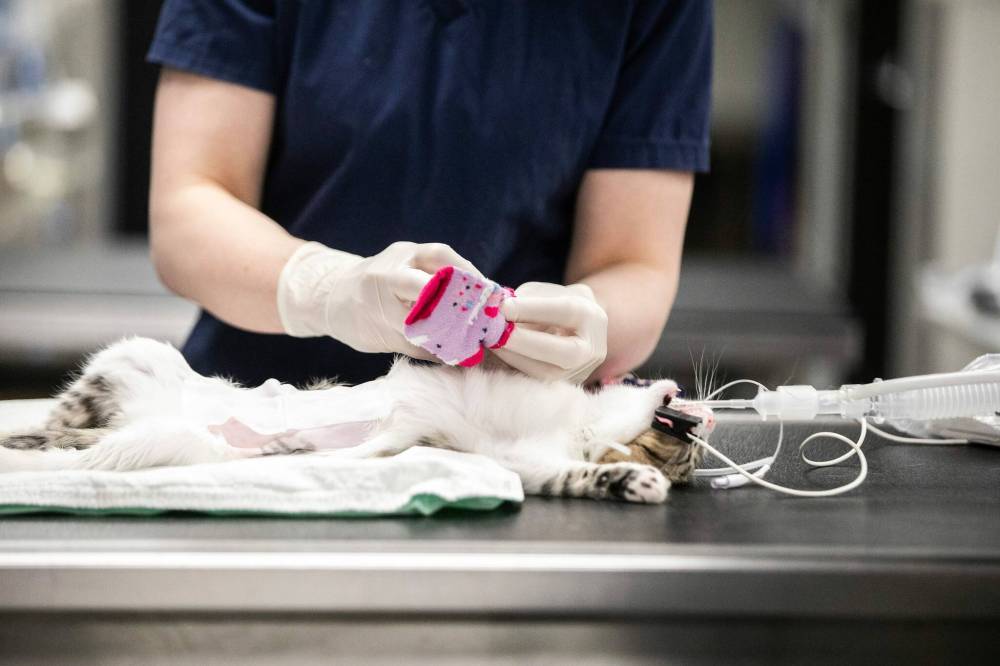
With Starfish now off in dreamland, the techs swing into action, hands dancing over the kitten in quick, practised motions. They slip a breathing tube down her throat; shave her belly; press down on her bladder, squeezing its contents into a metal pan.
They pop mismatched baby socks on to her paws to help keep her warm during surgery.
Finally, the techs splay Starfish on her back, ready for her turn in a nearby surgical suite where she will be relieved of her ovaries. She’s cute, but thousands of cats just like her pass through the shelter each year; no need for any of them to make more of themselves.
Today is a relatively slow day for the clinic; some of the staff are away, so the pace is a bit milder. On an average day, they do about 40 procedures. Today, they’ve scheduled 28: one dog spay, 10 cat spays, 11 cat neuters, one rabbit neuter, three dental cleanings, one wound repair and a tail amputation.
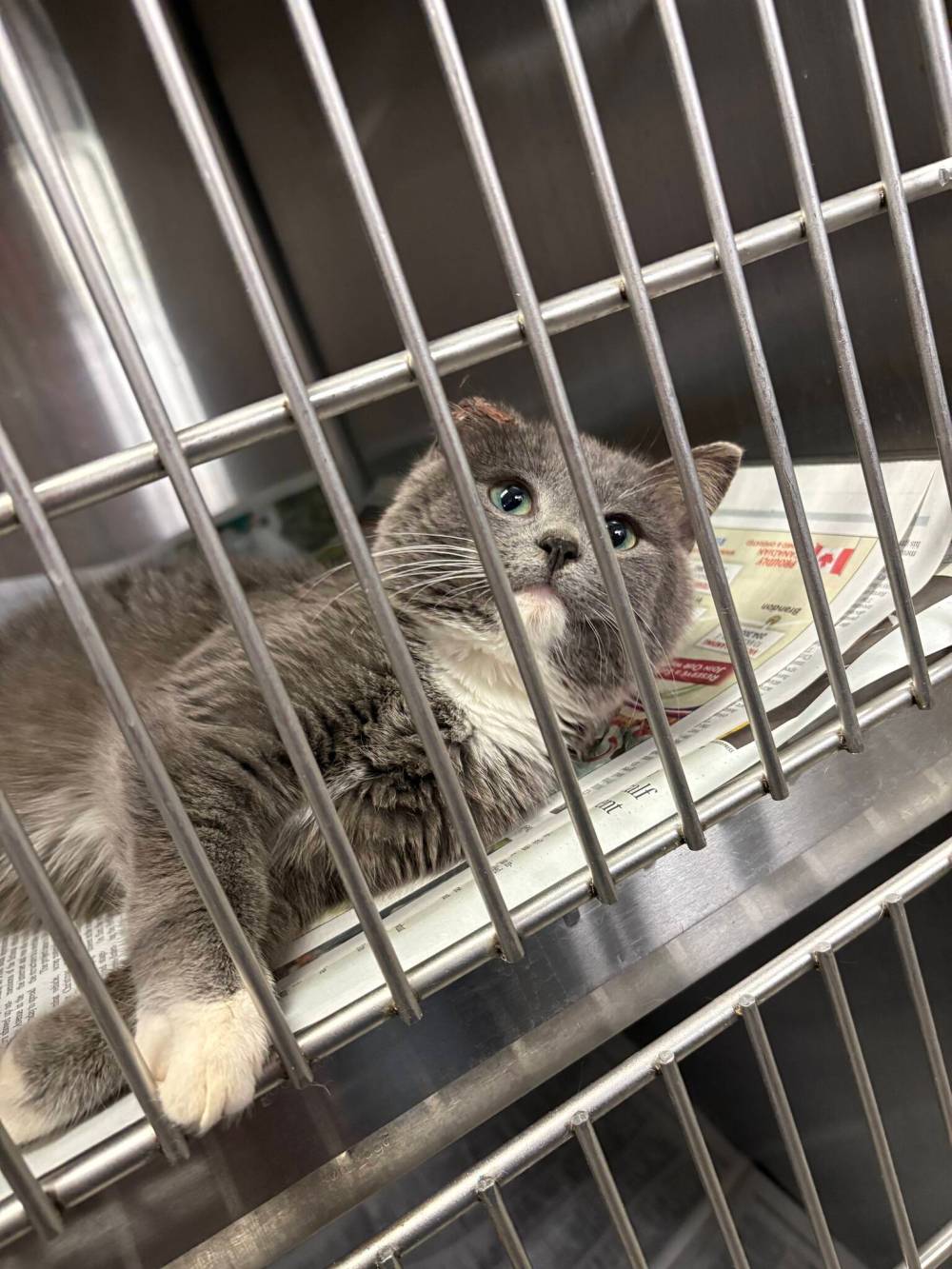
The intended patient of that last surgery is waiting in a nearby holding kennel, happily unaware of what’s in store. His name is Sushi; he’s a tiny cat with a quirky, alert expression and velvety grey fur. He arrived at the shelter as a stray the day before, brought in off the street by a concerned resident.
MIKAELA MACKENZIE / FREE PRESS
Starfish gets baby socks placed on her paws to help keep her warm during surgery.
Life outside in the bitter January cold has not been kind to Sushi. Half of his right ear is already missing, the ragged wound lined with bits of dead and dying tissue. His tail hangs limp behind him, most of its length succumbed to frostbite. He’ll feel better once it’s gone, even if he doesn’t know it yet.
11:30 a.m.
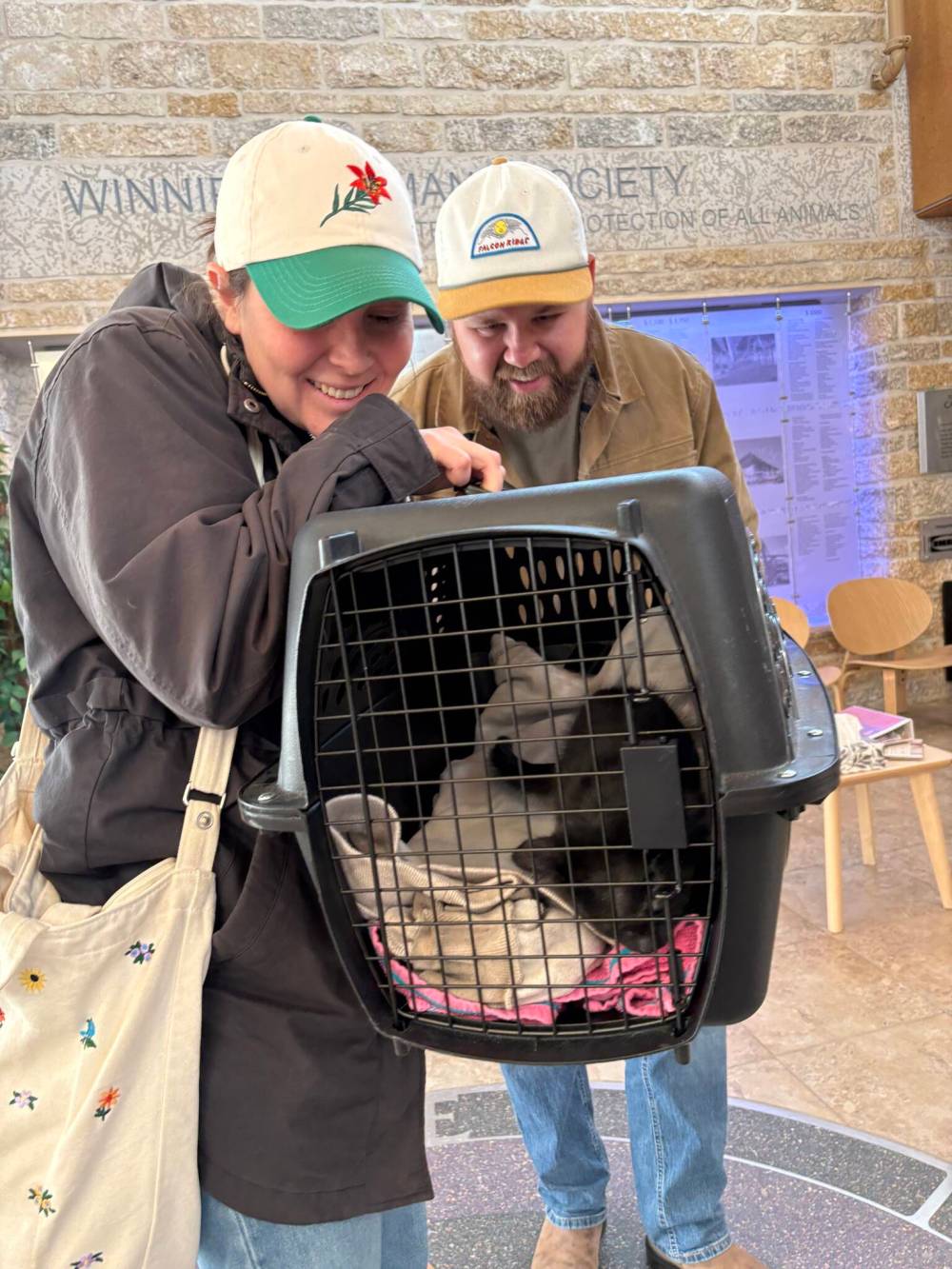
At the WHS intake desk, with its own entrance set beside the main shelter, intake adviser Sophie Helmer looks up as the door opens, sending a gust of frigid air into the room. A couple with a pet carrier walk in, stomping the snow from their boots.
Mike and Michelle Still have long cared for stray cats in their yard; they’ve even set up a warming shelter, with a tarp and a heated water dish that won’t freeze in winter. But the recent cold snap has them worried, especially about the small tuxedo-patterned female that has been staying there most nights.
“We love this one,” Mike says. “We’re trying to take care of her, but it’s so cold out there. We’re scared of the wind. Every morning we check, and we don’t know if she’s going to be dead. So I phoned this morning and they said we can bring her down, check her out and get her fixed, so she won’t have any kittens.”
Helmer peers into the carrier. “No health concerns you can see?” she asks.
“She seems very healthy,” Michelle replies. “And she’s good with me, because I’ve held her.”
The couple can’t take her in — they don’t think their other cats would get along with a potentially wild stray — but they are committed to ensuring she finds a safe place. If shelter staff decide she’s too feral for adoption, they say, they’d be glad to take her back to their backyard shelter.

MIKAELA MACKENZIE / FREE PRESS
Intake adviser Sophie Helmer coaxes GW into a larger kennel in the feral cat room.
WHS intake supervisor Makenna Warkentin has joined the discussion; she appreciates when they have options.
“We are pretty short on barns right now,” Warkentin says. “So if she does need to go back, we will call you to come pick her up. But in the case (WHS behaviour staff) do think she’s able to thrive in a better environment, they will choose that. It just depends on how she’s most comfortable.”
The couple nods, pleased. “A home would be better, yeah, of course,” Mike says.
As Warkentin and Helmer prepare to take the cat to the assessment room, the rescuers have one more thing to mention. To differentiate her from the other strays that swing by their yard, they started calling her GW, for her colours: grey and white. Can the name stay?
“We’ll keep GW,” Warkentin agrees.
With that, Helmer and Warkentin take the carrier into a small assessment room, closing the door to prevent a frantic feline escape. Their first order of business is to evaluate how sociable the cat is and how comfortable with people; but when they open the carrier door, GW refuses to come out.
“She’s just sitting there, looking around,” Warkentin says. “She’s not even looking up at me.”
MELISSA MARTIN / FREE PRESS
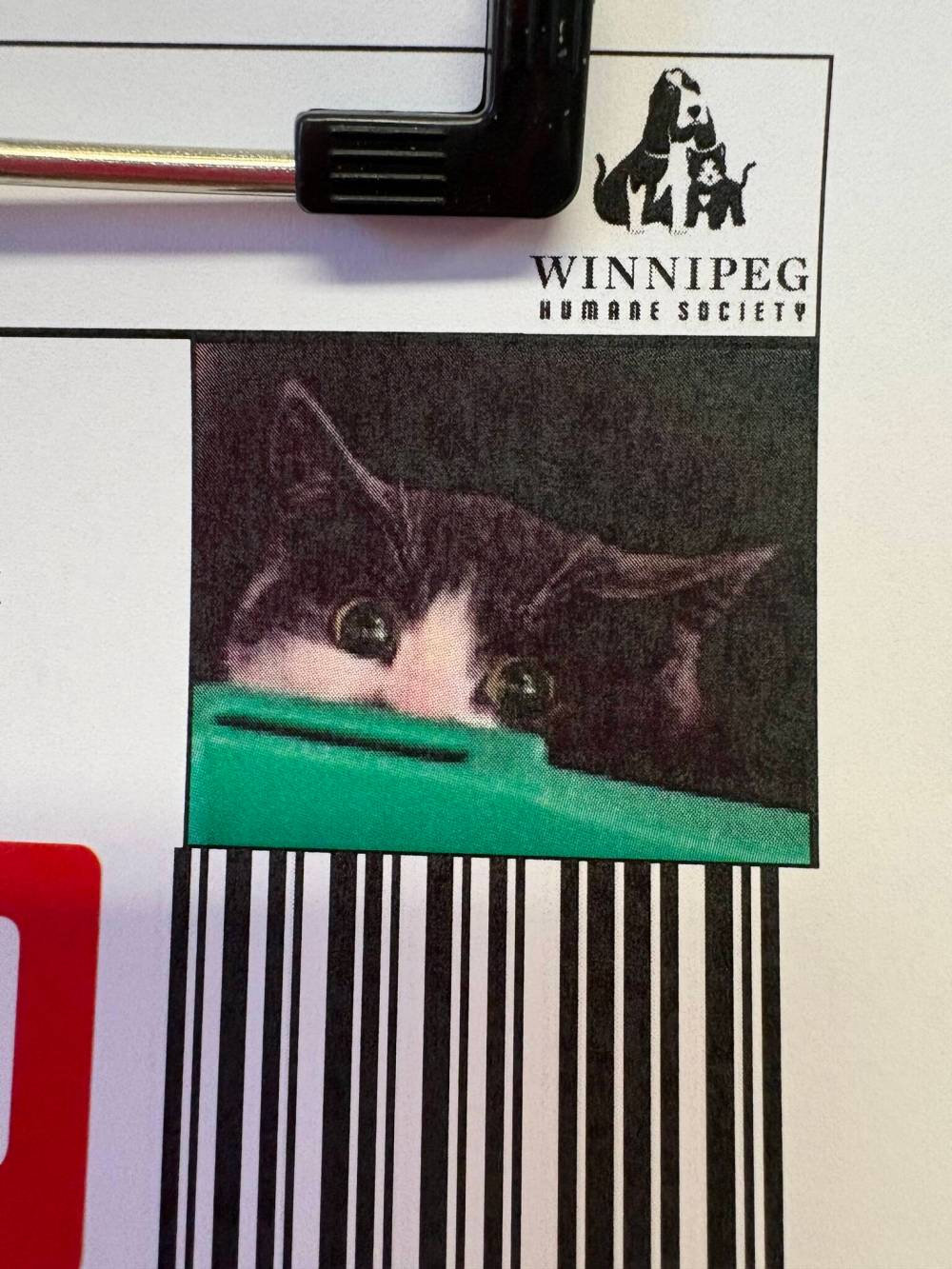
Frightened stray GW hid behind a green box in her kennel and wouldn’t come out all day. Clinic staff did the best they could for her official clinic intake photo.
Carefully, the intake supervisor extends her hand into the carrier. The job has many rewards, but it isn’t risk-free: in her three years at the WHS, Warkentin has taken more than a few nips and scratches. She laughs as she gestures at her arms, which are often marked by thin scabs and scars.
“It happens,” she says. “Towels (to wrap animals) are our best friends with cats. When they’re a little bit more scared, we get two of us to come in here. Just because it can provide an extra hand if you need to grab something.”
GW is the second animal to arrive at the WHS intake today. The first, a big tabby with bright-green eyes and luxuriously long fur, stands in a nearby holding kennel, protesting her detention with an incessant meowing. She was also a stray, though she is far more confident; she will likely head to the adoption floor soon.
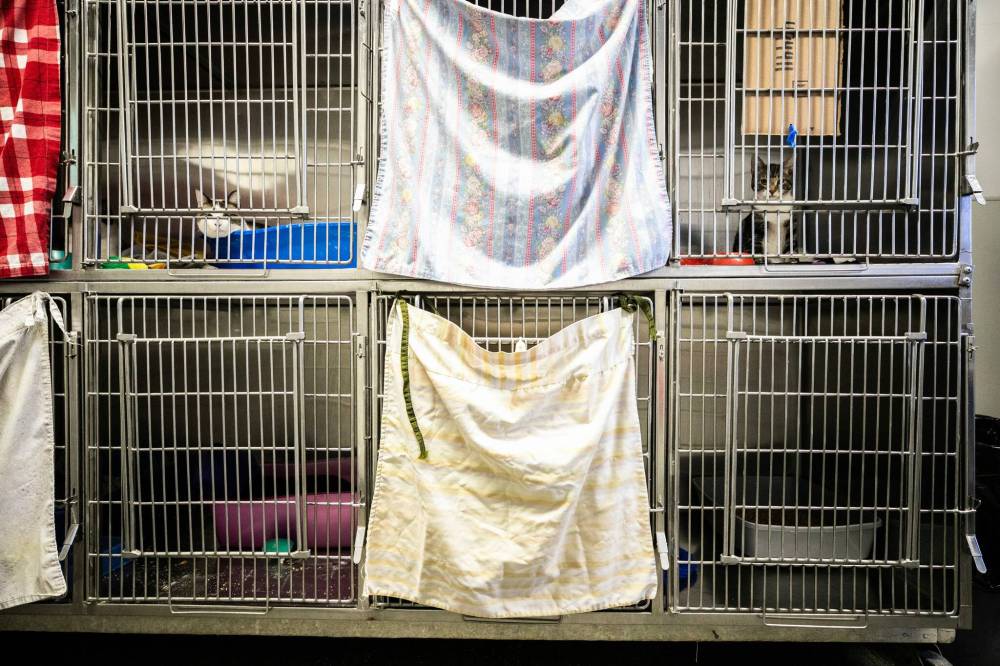
For now, intake staff have to decide what to do with GW. She’s still refusing to leave the carrier; when cats are this scared, Warkentin says, it’s best to get them into a quiet place to calm down. Helmer takes the carrier and heads down a hallway, turning into a door marked “feral holding.”
There’s nearly a full house in this room today. In a corner kennel, two magnificent tabby siblings lounge together; they’re here with the WHS’s emergency boarding program, after their owner had to go into hospital. In another kennel, a drowsy stray named Lavender lies bandaged: she lost both ears, a tail and some of her toes to frostbite.
Helmer selects an empty kennel on the bottom row, slides the door open and presses the carrier against the entrance. But GW won’t move. After a few minutes of carefully tilting the carrier, Helmer takes a small stick and gently nudges the cat’s rear end, urging her forward. GW issues a few warning hisses, and refuses to budge.
“You’re so close to going. I don’t want to keep poking you. Come on.”
With a sudden dash, GW darts out of the carrier and into the kennel, where she promptly flattens herself into a hiding spot behind a green plastic shopping basket. (A large store chain recently donated some of their bins, which serve as cat kennel beds.) Her angry eyes glisten from the shadows.
MIKAELA MACKENZIE / FREE PRESS
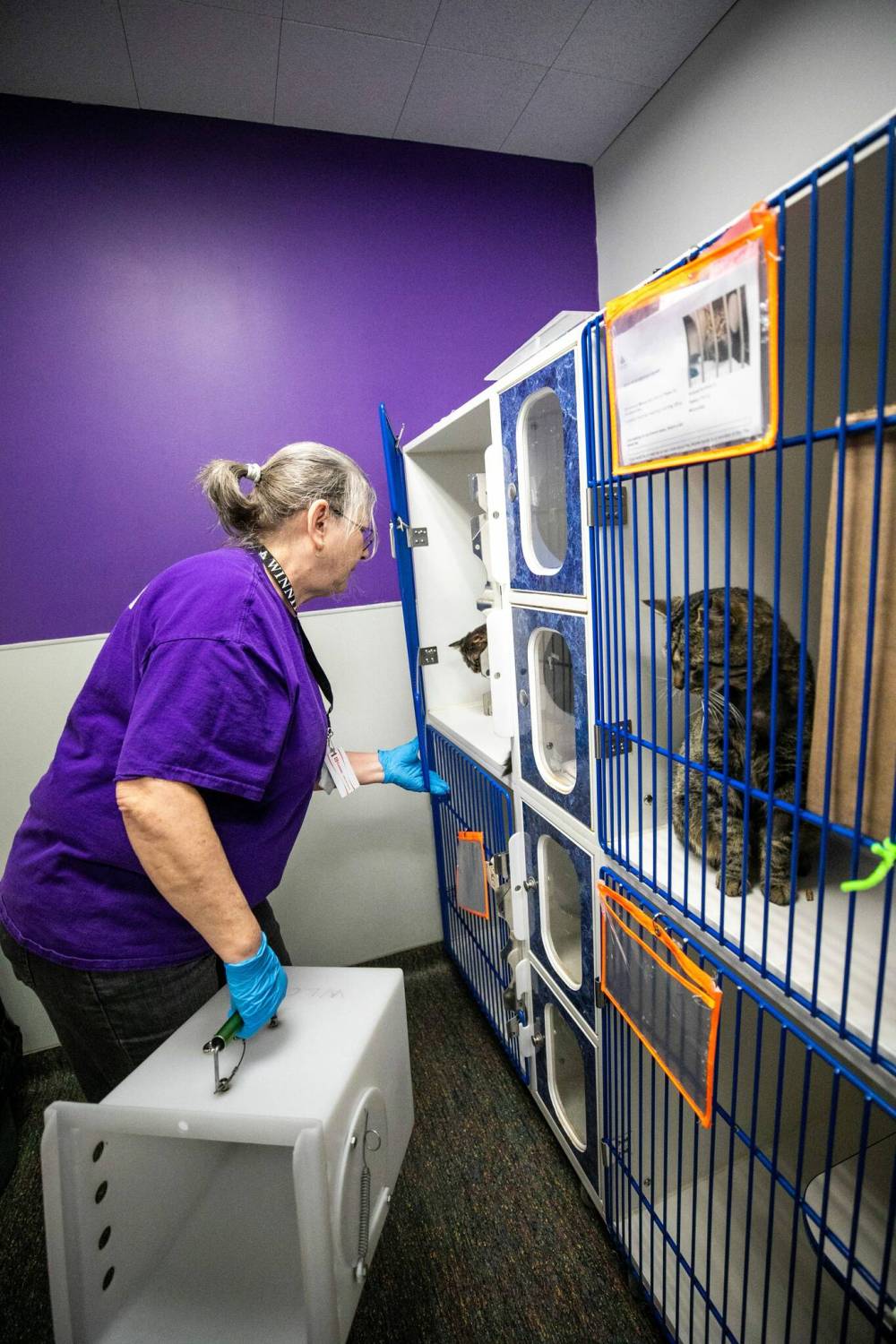
Volunteer Diane Young transfers Conrad into a cage in the adoption area.
“We’ll just let her calm down,” Helmer says. “She’s not super-feral. She’s more so just scared.”
As we leave the room, shelter volunteer Diane Young strolls by, pushing a cart with a cat carrier on top. Inside is the fluffy, talkative tabby who also had come in that morning. She’s headed to the adoption floor now, ready for what WHS staff call “open selection,” a chance to garner interest from potential adopters while she waits to be spayed.
Young rolls the cart into the shelter’s sunny public atrium and into one of the adjoining cat rooms, where a kennel stocked with food and water is waiting. The tabby makes little fuss about the change; she strides into her new lodging, pokes her nose into its litter box, then starts wolfing down mouthfuls of pâté.
WHS communications director Carly Peters strolls over to admire the new resident. She looks for the adoption card which would normally be affixed to the kennel, bearing the cat’s name and age; but the tabby’s card hasn’t been printed yet.
“What did they end up naming you?” Peters asks the cat, to no reply.
She takes out her phone and taps into the WHS online management system, a program called ShelterBuddy. It allows staff to track every animal in its system, almost to the minute. She pulls up the latest entry for the new tabby’s kennel, reads for a moment and laughs.
“Oh, we had it wrong this whole time,” she says. “He’s actually a boy. His name is Conrad.”
MELISSA MARTIN / FREE PRESS
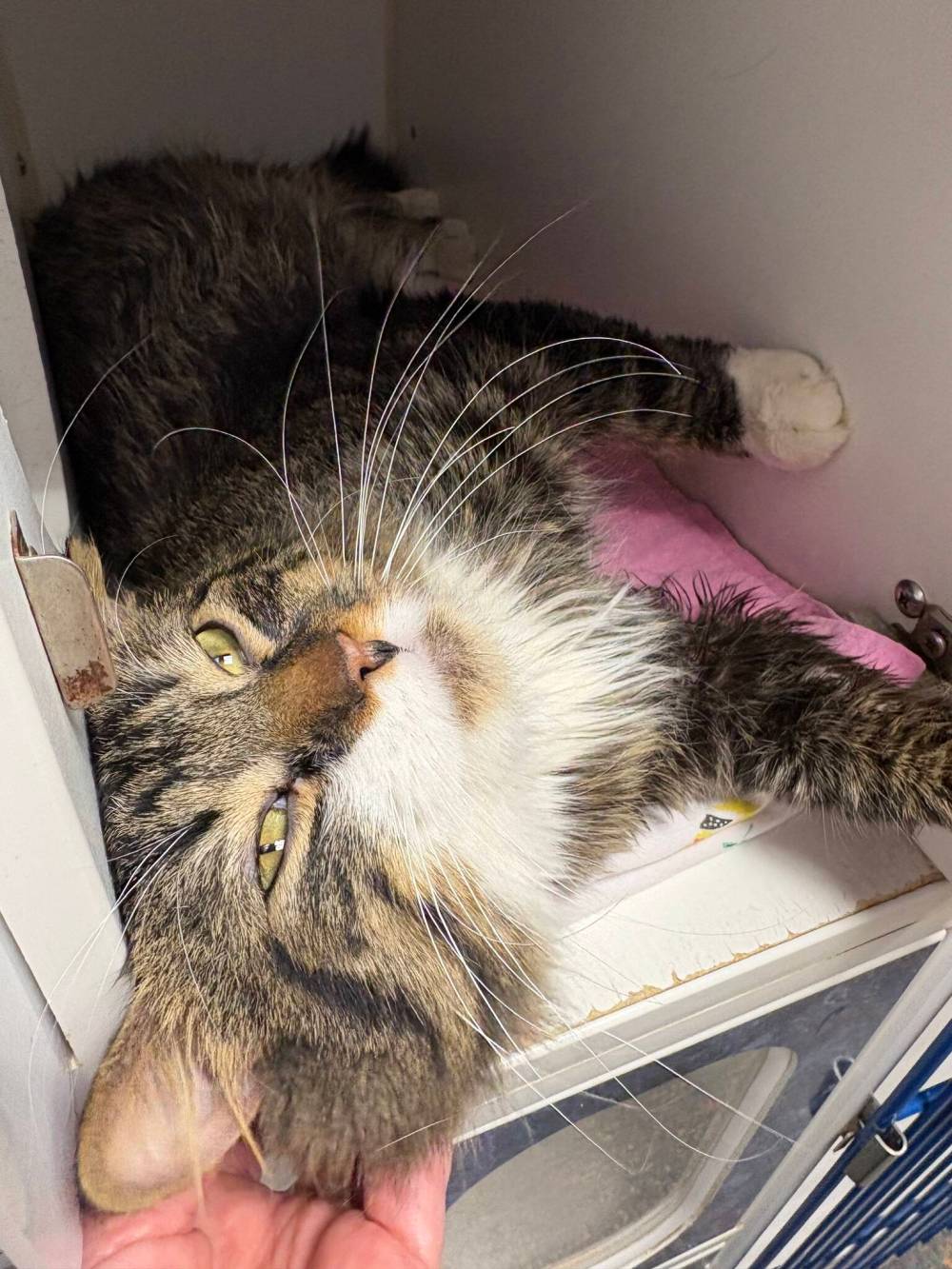
Conrad was adopted a week after arriving at the humane society.
Evidently pleased at now having a name, Conrad rolls on his back and accepts cheek scratches with a soft, rasping purr. He stretches his paws towards his visitors, happily kneading the air with his toes.
“Oh yeah, you won’t be here long,” Peters says.
2:30 p.m.
As soon as Tyson Heckert opens the kennel door, the tiny black kitten inside makes a rush to escape. Heckert grins and scoops the kitten into his hands, while Grace Armstrong laughs: the couple fell in love with this little rascal as soon as they saw him. It was just something about how he looked at them, all mischief and hope.
A WHS adoption volunteer strolls up, chuckling at the scene. “So this is still the one?”
Heckert tickles the wriggling kitten’s belly. “Yeah, he’s coming home.”
This kitten is listed as Nello, though his new family has another name in mind: Fry. He’s one of a big litter of seven, carbon copies of each other. City of Winnipeg animal protection officers brought them to the shelter last month; they’d been found abandoned in an apartment after the tenant was evicted.
Fry is the first of the siblings to be chosen. The others will almost certainly fly out the door in the coming days: kittens and puppies are always in high demand, WHS adoption supervisor Kyra Loewen says. It’s when the animal is older, needs a special diet or has “quirky” behaviours, that barriers to finding a home can arise.
MELISSA MARTIN / FREE PRESS
Grace Armstrong and Tyson Heckert take home newly named Fry.
Still, those barriers aren’t insurmountable: “Once we give them more information, they are a little bit more open,” Loewen adds. “That being said, we’re never going to force someone to adopt an animal if it doesn’t feel like it’s a good fit for them.”
To make those connections, the WHS employs seven permanent adoption counsellors at its main shelter, as well as casual staff. Their work is varied: they process adoption paperwork, write descriptions for adoption charts and work closely with communications staff to promote animals who need a little more help finding a home.
For Fry at least, finding the right match was easy. Heckert and Armstrong recently moved into a new house, with more space. They have a dog and another cat they adopted from the WHS last year; they think that cat will enjoy having a young friend to play with, after unhurried introductions.
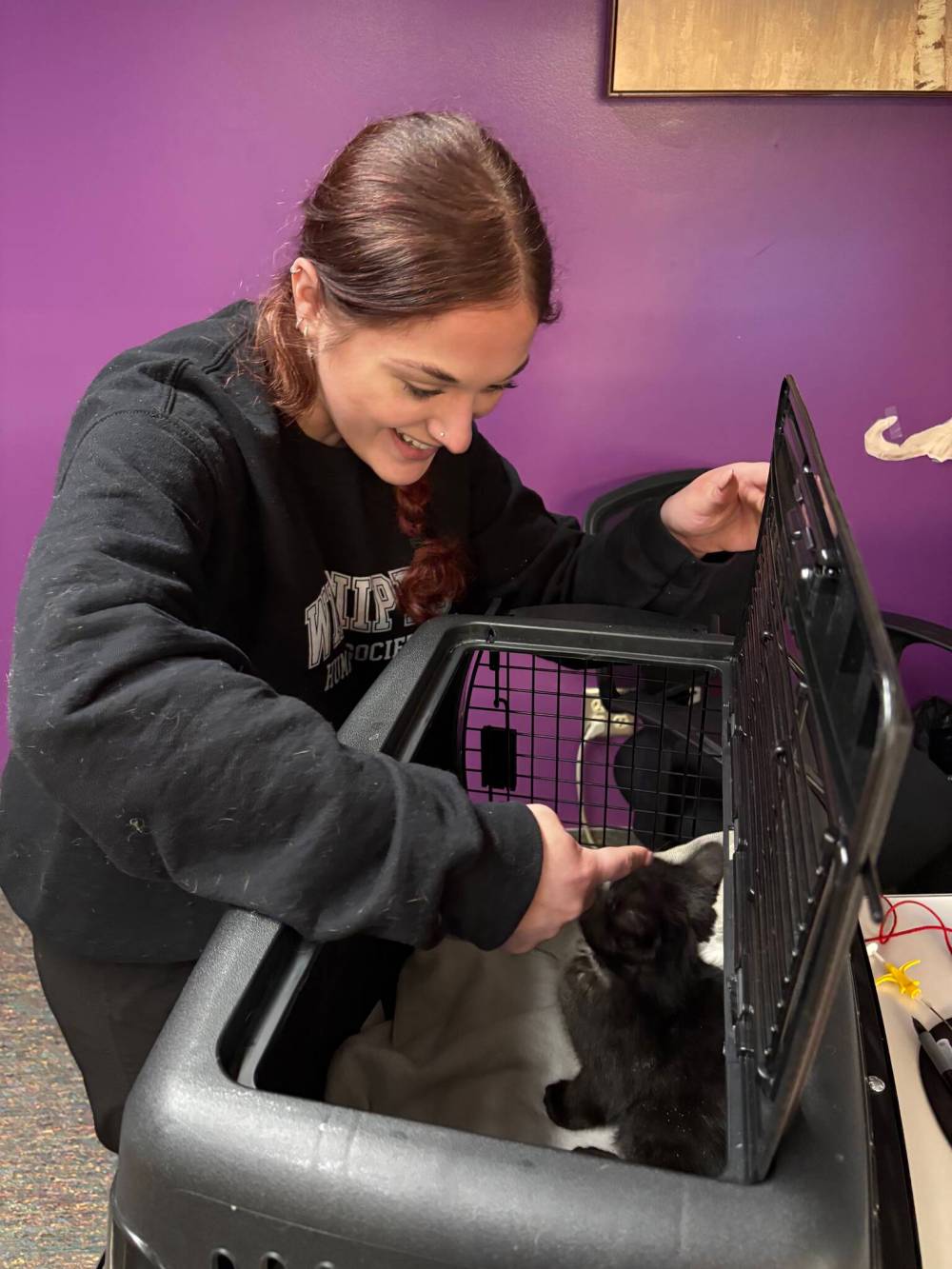
Now, it’s time for him to go to home. The paperwork is done; all that’s left is to insert a microchip. Adoption counsellor Annika Patterson plucks Fry from his kennel, nestles him in a carrier and brings him back to her office. She unwraps an injection device, distracts the kitten with her fingers and pokes the needle under his skin.
The kitten whips his head around and squeaks indignantly, but quickly relaxes; it’s just a little pinch. Patterson ruffles Fry’s ears, laughing as he returns to playing with string. That’s the best part of the job, she says: getting to cap off every adoption with a little cuddle.
Patterson closes the carrier and heads to the front lobby, where Heckert and Armstrong are waiting.
“He did so good,” she assures them.
It’s a joyful moment. Fry is alert and wide-eyed with excitement. His adopters are beaming. They linger to chat, reviewing how to safely introduce the new kitten to their other pets. Then they snap a celebratory photo, wave goodbye to Patterson and turn to head out the door.
MELISSA MARTIN / FREE PRESS
Winnipeg Humane Society feature Annika Patterson, a Winnipeg Humane Society adoption counsellor, gives Fry some pets before injecting the newly-adopted kitten with a microchip.
“Thank you so much for your help,” Armstrong says.
On this Friday, Fry is the fifth animal to be adopted. By the end of the day, nine more pets will have gone to a new home. That’s a pretty good day at the WHS, though some are even better: the all-time daily adoption record, Loewen says, is 24.
3:20 p.m.
In the corner of the adoption floor set aside for small animals, a trio of shelter staff huddle around a white cage. The clinic’s medical manager, Kara Holik, has been summoned to take a look at a cream-coloured domestic rat named Periwinkle; she peers into the critter’s enclosure with a drawn, worried face.
Periwinkle came to the WHS in December, spending her first weeks in its care being fostered. All the rats she arrived with have already been adopted. Rats rarely stay long at the shelter; sometimes they don’t even make it onto the adoption floor, Peters says. Rat enthusiasts are a passionate community, eager to bring new rescues home.
Yet now, staff fear Periwinkle’s story may not have such a happy ending. Minutes before, a shelter worker noticed a smear of fresh blood by the rat’s nostrils, and immediately alerted the clinic. The symptom is alarming; rats are prone to certain types of cancer. The sudden bleeding could be a sign of that.
Holik gently lifts Periwinkle from the cage and up to her chest. The rat nestles into Holik’s shoulder, nuzzling her neck with its nose. Holik whispers to the little creature softly, blinks back a few welling tears, and quickly carries Periwinkle off to the clinic to be examined.
3:30 p.m.
In her office, somewhere deep in the maze-like warren of hallways that houses much of the WHS’s staff, animal behaviour counsellor Jamie Murphy hangs up the phone. She’s just finished her two-week check-in call with the family who adopted Starsky, a “spicy little puffball” of a kitten who left the shelter two weeks ago.
MIKAELA MACKENZIE / FREE PRESS
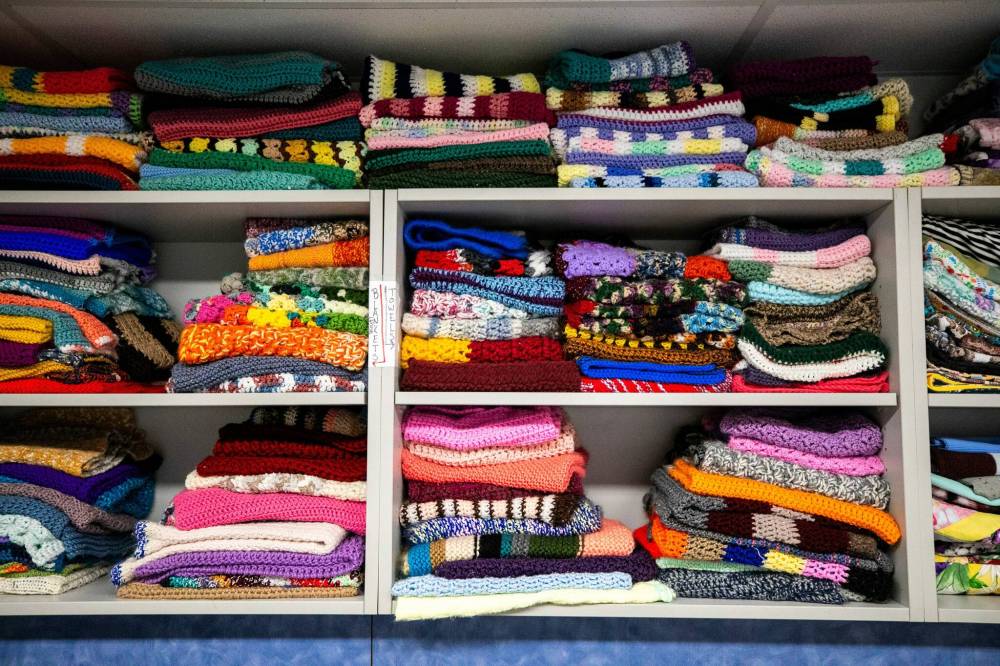
Donated handmade blankets are used to keep animals cosy.
These calls are part of a relatively new program aimed to help smooth the shelter’s trickiest transitions. Now, whenever an animal that landed on the behaviour team’s radar is adopted, staff check in after three days, and again at two weeks. In the last year, counsellors have made nearly 600 of these calls.
“We find that some people will adopt from us, and then they don’t give us the call when they probably should,” Murphy says. “They assume that (problems are) just part of the settling-in process, so this lets us get ahead of that really well, and start the conversation earlier.”
In most cases, Murphy says, adopters report that everything is going great; many behaviour issues evaporate once a pet is out of the shelter and into a loving home. But sometimes there are problems, often with how a new arrival is getting along with other animals in the house.
“In that case, we have all their information, we can send them resources, I can do our home consultations,” Murphy says. “We all kind of do everything, but our primary goal is keeping those animals in the home, and keeping animals out of the shelters.”
The latest check-in brought good news. After a tense first couple of days in his new home, Starsky is now thriving, frolicking and racing around doing “zoomies.” The adopters are happy. It’s usually around the two-week mark that longer-term issues start to show, Murphy says, so the fact the once-hissy kitten is settling in bodes well.
Murphy pauses for a moment. Her eyes twinkle.
“Do you want to see the bad cats?”
MIKAELA MACKENZIE / FREE PRESS
The feral cat room (with G.W. hiding in the bottom right cage).
We do, in fact, want to see the bad cats; or just one in this case, a stout orange tabby named Carl. It’s been over a week since Bad Carl arrived at the shelter; behaviour staff quickly noticed that he was, to put it mildly, not a big fan of humans. To help him adjust, he’s been given a cosy room all to himself.
When we walk into the room, Carl is curled on a fluffy pet bed set on a table. He raises his head and fixes us with a skeptical glare, but shows no signs of aggression. Behaviour staff often take their lunch breaks on the chair beside his bed, letting him grow accustomed to peacefully being around people.
Murphy carefully reaches out her hand. Carl sniffs her fingers, then lets her stroke between his ears for just a few moments before pulling his head back. Murphy is elated: this is progress. Just one week ago he wouldn’t have allowed that, she says.
It’s too early to judge whether he will eventually be suitable for home adoption, or go to the WHS’s barn-cat program, which allows the most stubbornly independent ferals the sort of life they need, with guaranteed food and warm shelter. But there’s hope for him yet.
4 p.m.
“Show us your butt, Sushi.”
On the adoption floor, two vet techs have come to check on the petite stray, who is recovering in a kennel after his surgery that morning. Sushi stands to greet them, wobbling from the lingering effects of painkillers and anesthesia, giving a quick glimpse of the shaved and neatly-sutured nub where his frost-damaged tail used to be.
The techs chuckle as he quickly sits back down. “I know, it’s so embarrassing, right? It’s OK. You’re doing good.”
For Sushi, the future looks bright. He’s cute and friendly, and comfortable with people. It may be a longer road forward for GW, the frightened stray brought in that morning. Nearly five hours since she arrived, the cat is still huddled in the back of her kennel, showing no signs of calming down.
MELISSA MARTIN / FREE PRESS
Sushi waits for surgery to amputate his frostbite-damaged tail.
So GW’s behaviour assessment will have to wait. So will her first photo shoot. Staff did their best to coax her out of hiding and in front of a camera; she refused. In the end, her official intake photo shows only the top half of her face, peering just over the edge of the green bed box, her eyes round and glaring with a distinctive feline fury.
Epilogue
Five days after our Free Press visit on Jan. 23, there was much good news to go around.
Sushi, the friendly grey stray who lost his tail and one ear to frostbite, had a smooth recovery from his surgery and attracted lots of attention. Fluffy stray Conrad turned out to be just as charming to visitors as Peters predicted. And on Jan. 28, just a week since they’d been living on the street, both kitties were adopted.
Others need more time.
For her first four days at the shelter, frightened stray GW cowered in her kennel, hostile to people. But on her fifth morning, when behaviour counsellors went to check on her, they were amazed to find her cheerful, friendly and asking for affection: “GW decided today they love people,” Peters said.
Five days after our visit, Carl, the taciturn feral, was still “chilling in his VIP suite,” Peters said. He was becoming more comfortable with people, though he still didn’t like to be touched.
But WHS behaviour staff kept working with him, and before long, Carl began to relax and become more sociable — and just one week later, shortly before this story went to press, Carl found his match, and was adopted into a forever home.
MIKAELA MACKENZIE / FREE PRESS
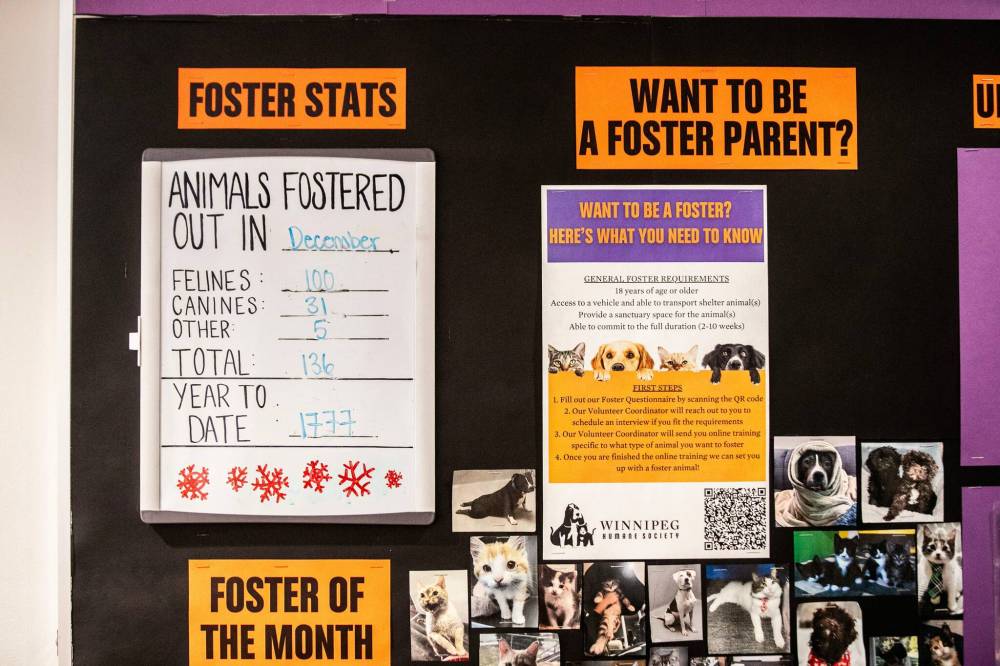
The intake centre at the Winnipeg Humane Society.
That’s the joy of animal rescue; there is also sadness. The gentle rat, Periwinkle, didn’t make it. In the clinic that day, her medical condition continued to decline; in the end, the most compassionate thing vet staff could do was provide humane euthanasia. In her last moments, she was safe, warm and comforted.
Just one day at the Winnipeg Humane Society, where the myriad paths of human and animal life intertwine: in love, in joy, in kindness, in hope.
But also, because this too is an unavoidable part of life, sometimes in grief.


Melissa Martin
Reporter-at-large
Melissa Martin reports and opines for the Winnipeg Free Press.
Every piece of reporting Melissa produces is reviewed by an editing team before it is posted online or published in print — part of the Free Press‘s tradition, since 1872, of producing reliable independent journalism. Read more about Free Press’s history and mandate, and learn how our newsroom operates.
Our newsroom depends on a growing audience of readers to power our journalism. If you are not a paid reader, please consider becoming a subscriber.
Our newsroom depends on its audience of readers to power our journalism. Thank you for your support.