FIFA’s financial fiefdom Despite its non-profit status, global soccer’s governing body is no team player when it comes to World Cup costs and windfall
Read this article for free:
or
Already have an account? Log in here »
To continue reading, please subscribe:

Digital Subscription
One year of digital access for only $205*
- Enjoy unlimited reading on winnipegfreepress.com
- Read the E-Edition, our digital replica newspaper
- Access News Break, our award-winning app
- Play interactive puzzles
*First annual payment billed as $205.00 + GST for one year. This annual subscription will automatically renew at $233.00 + GST every 52 weeks (10% off the regular annual price of $259.35). Offer available to new and qualified returning subscribers only. Cancel any time.
To continue reading, please subscribe:
Add Free Press access to your Brandon Sun subscription for only an additional
$1 for the first 4 weeks*
- Enjoy unlimited reading on winnipegfreepress.com
- Read the E-Edition, our digital replica newspaper
- Access News Break, our award-winning app
- Play interactive puzzles
*Your next Brandon Sun subscription payment will increase by $1.00 and you will be charged $17.95 plus GST for four weeks. After four weeks, your payment will increase to $24.95 plus GST every four weeks.
Read unlimited articles for free today:
or
Already have an account? Log in here »
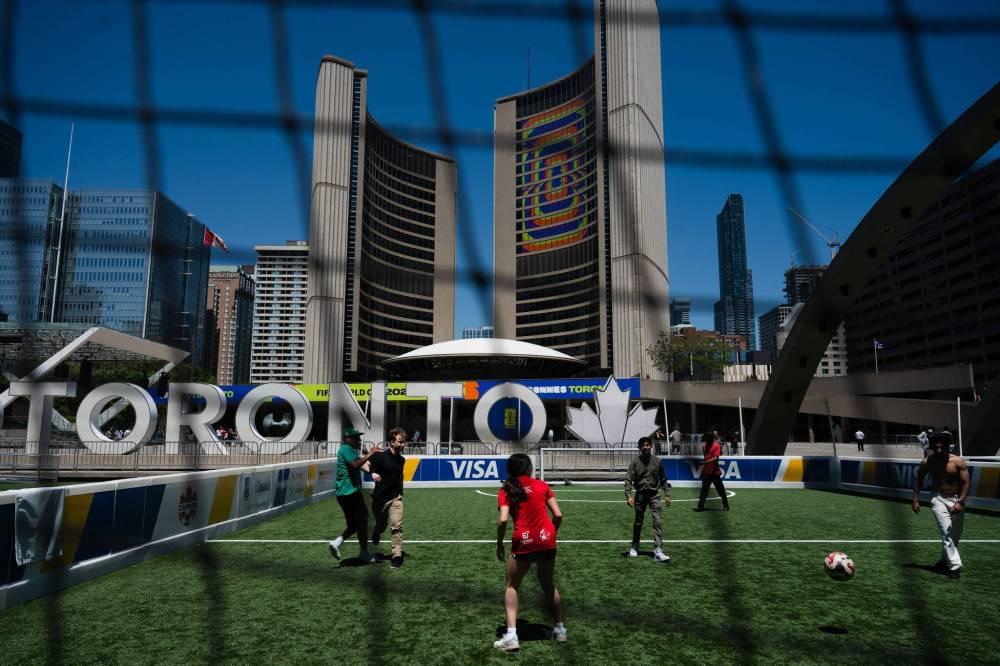
TORONTO — Mayor Olivia Chow looks glowingly out of the windows of her second-floor office in Toronto’s stunning city hall, drinking in the panoramic view of Nathan Phillips Square, which has been converted into temporary soccer pitches to celebrate the arrival of the FIFA World Cup.
Two artificial-surface pitches — surrounded with white hockey boards — sit atop of what is usually a water fountain in the summer, and a skating rink in the colder months. About two dozen people are playing pickup matches in the blazing midday heat.
“Isn’t this great?” a smiling Chow said last week as she took in the scene, a World Cup-logo scarf draped around her neck.

Laura Proctor / Free Press
Mayor Olivia Chow says hosting World Cup games allows Toronto to showcase itself to a global audience.
Chow wasn’t always a fan of co-hosting the world’s biggest single sporting event. The deal to participate in the World Cup and co-host 13 games in Canada along with Vancouver was signed by her predecessor, John Tory.
In 2024, less than a year after winning the Toronto mayoral election, Chow discovered the initial $300-million cost estimate calculated by Tory and the bid committee had ballooned to $380 million. Upon learning the cost had gone up by nearly 30 per cent, Chow infamously said she wouldn’t have signed the contract if she had been in charge of negotiations with FIFA.
“I didn’t sign this deal,” Chow said at the time. “I’m saddled with it.”
Now that the tournament is fast approaching kickoff, Chow has come to embrace the most-watched global event as a prime opportunity to showcase Toronto.
“I am always very practical,” she said. “This is what’s in front of me. I will make the best of it. And here we are.”
That means being in Toronto Stadium for the opening ceremonies before Canada’s first match against Bosnia-Herzegovina on Friday. After that, Chow said she will make a deliberate effort to steer clear of the VIP box for other games, preferring instead to visit municipal-funded watch parties in ethnic communities throughout the city.
Whenever the Fédération Internationale de Football Association — the world governing body for soccer — is involved, financial shenanigans and morally questionable subplots are not too far away.
FIFA has openly embraced dictators and despots, deliberately turned a blind eye to racism, human-rights abuses and rampant homophobia, and fashioned contracts that allow the organization to make obscene profits while dumping all of the quadrennial tournament’s financial costs onto host nations and cities.
Pushing those costs — from building or upgrading facilities, to providing security and massively increased public transit during the event — is pro forma for large, global sporting events, such as the World Cup and the Olympics. But there is something about FIFA’s pervasive, aggressive business model that stands alone.
FIFA’s suffocating presence and branding is evident throughout Toronto’s downtown.
“I don’t think we should be looking at this like a business. It’s not about ROI. It really is about whether the population wants to host something like this.”
In addition to the temporary pitches, city hall has been festooned with green, yellow and blue World Cup logos and branding. The highest windows of the curved, east tower of city hall have been filled in with the tournament logo. Throughout most of downtown, shops selling official merchandise — which appears to be just about any kind of convenience retailer — are adorned with posters in their windows. “We are 26” FIFA banners hang from streetlights across the entirety of the city’s core.
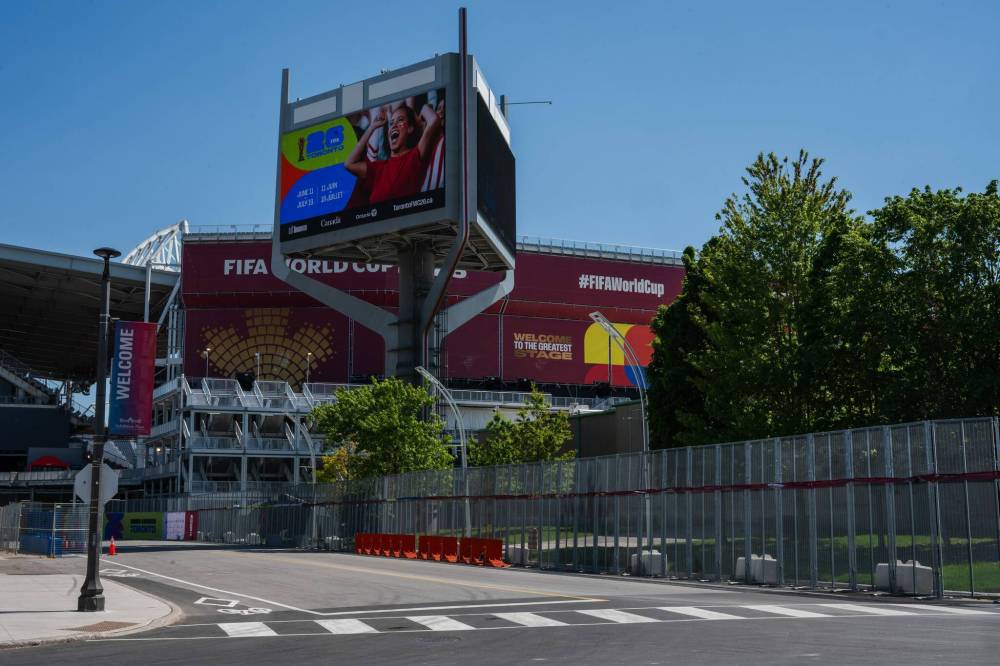
All references to BMO Field — home to the MLS’s Toronto Football Club and the site for all six of the games Toronto is hosting — have been scrubbed. It has been rebranded Toronto Stadium since BMO, one of Canada’s oldest chartered banks, is not an official sponsor.
FIFA also went as far as to paste over the words “BMO Field” on the wayfinding signs around the GO Train station that will bring people to the games. Now, the signs direct visitors to “Toronto Stadium.”
The field has been wrapped in enormous maroon tarps featuring World Cup logos and messages, allowing FIFA to cover up the undercarriage of controversial temporary seating. Digital and traditional billboards in and around Exhibition Place, the site of the stadium, are fully dedicated to official FIFA sponsors.
The signage is not the only way FIFA will announce its presence with authority. It has commandeered several of the last remaining surface parking lots in Liberty Village, the neighbourhood directly north of the stadium.
And FIFA will also be dispatching copyright police to patrol the streets looking for unauthorized uses of the FIFA or World Cup logos at bars and restaurants, or by rogue souvenir merchants.

It’s all part of what will easily be the most expensive World Cup in history, as-yet uncalculated billions of dollars in public expenditures spread across three host countries — Canada, Mexico and the U.S. — and 16 cities, including Toronto and Vancouver.
Since the first World Cup in 1930, hosted by then-Olympic soccer champions Uruguay, FIFA has aggressively expanded both the format of the tournament — including a relentless series of regional qualifying playdowns — and the total number of teams. Where 13 teams competed in 18 matches in the inaugural tournament, this year, 48 teams will play 104 games.
With an expanded roster of nations creating more matches, the tournament’s financial value has grown exponentially. FIFA is, technically speaking, a non-profit organization. However, when considering the salaries of its executives — President Gianni Infantino made $6 million last year — and the billions of dollars it earns in the four years between World Cups, it is hard to view FIFA as anything other than a profit-motivated behemoth.
Laura Proctor / Free Press
Toronto’s BMO Field will host six games. Because the bank is not an official sponsor, the venue has been renamed Toronto Stadium for the duration of the World Cup.
Almost all of the profits from the 2026 tournament will flow directly into FIFA’s coffers. Sportsvalue, a global sports marketing and business agency, has estimated FIFA could earn more than $15 billion on the 39-day event, claiming the lion’s share of everything from ticket sales to concessions, merchandise and a whopping $5.5 billion from broadcast rights and another $4 billion from sponsorships.
FIFA does have to carry some costs. Professional clubs that release players to participate in qualifying games and the tournament will receive more than $500 million in compensation. Participating nations are eligible for a share of more than $1.2 billion in prize money, with each receiving a minimum of $17 million just for showing up, with additional payments depending on how deep they go. The winning nation gets $70 million.
However, FIFA ensures its potential net profits stay high. FIFA does not, for example, pay any rent or other charges to use the stadiums that host the games. In Toronto, that means BMO Field is provided to FIFA for free. In addition, Maple Leaf Sports and Entertainment (owners of the Toronto Maple Leafs, Raptors, Argos and the Toronto Football Club) and the city spent $158 million on upgrades to the field, the bulk of which was covered by the city.
And in an extraordinary concession to FIFA, the federal government agreed to waive the GST on ticket sales. That is a bitter pill to swallow given that FIFA’s controversial dynamic-pricing model — where ticket costs soared in lockstep with demand — resulted in the top face-value price for the most popular games exceeding $13,000.
The three levels of government also pay for all of the costs of security, the fan festivals (which provide off-site game-day experiences for fans that cannot get into stadiums), and other infrastructure upgrades. Additionally, FIFA gets the benefit of free labour; both Vancouver and Toronto recruited, trained and outfitted 3,000 volunteers to help staff the game venues.
In a special report issued this spring, the Parliamentary Budget Office calculated total Canadian taxpayer support for the World Cup at $1.066 billion. That includes $473 million in federal support with the remaining $593 million split between provincial and municipal governments. The City of Toronto alone is on the hook for $178.7 million. Put it all together, and Canadian governments are paying $82 million for each of the 13 games to be played in this country.
And that number is likely headed for an upcharge.
Vancouver, for example, budgeted $578 million for its costs to host the tournament. However, last month, that city’s host-committee officials acknowledged the price tag could go up to as much as $729 million, with a new barrage of security-related costs added at the last moment. The B.C. government has spent $196 million alone on upgrades to BC Place, which include a temporary grass surface.
Of course, FIFA, the host committees and the governments that opened the tax-dollar floodgates for the privilege of hosting the tournament have argued there are untold billions of dollars in economic spinoffs to be had.
Laura Proctor / Free Press
Residents enjoy one of the two temporary soccer pitches set up in downtown Toronto as part of the city’s month-long World Cup celebration.
In 1994, the last time the U.S. hosted a World Cup, governments of all levels were told by FIFA in pre-tournament financial modelling that they would receive a net benefit of more than $5.5 billion. When the dust settled, the nine host cities reported a cumulative loss of more than $12.5 billion. Los Angeles, which underwrote the use of the Rose Bowl stadium in Pasadena, alone reported net losses of $4.8 billion.
Real-world results like that have not stopped FIFA and host cities from making similar claims for this year’s tournament.
In late 2024, FIFA released the results of a study it commissioned from Deloitte that claimed Canada would see $3.8 billion in “positive economic output” as a host nation, and $940 million in the Greater Toronto Area alone. This included “positive contributions of $2 billion in GDP, $1.3 billion in “labour income” and $700 million in government revenue. Deloitte said more than 24,000 jobs would be created over the period from June 2023 — when the bid was secured — and August 2026.
If those numbers proved to be true, then one might argue that spending more than $1 billion on hosting the games is a great trade-off. ‘If’ being the operative word.
“I think the claim of $3.8 billion in economic output is a misleading number,” said Pedro Antunes, chief economist for Signal49, previously known as the Conference Board of Canada. “It’s misleading because it really is essentially a double counting of how money flows through a system.”
Antunes said the Deloitte estimate of $2 billion in contribution to GDP may be accurate, but there may be no way to know whether that is a gross contribution to Canada’s economy, or net economic activity on top of what Toronto, Vancouver and Canada would normally generate in the summer, which is a high-point in the tourism economy.
Antunes said the intangible benefits of hosting a marquee event like the World Cup cannot really be captured in a return-on-investment calculation.
“I don’t think we should be looking at this like a business. It’s not about ROI. It really is about whether the population wants to host something like this. You know, are taxpayers willing to do this, because not everything the government spends on is supposed to earn or generate a return.”
The irony runs deep and thick through Liberty Village, a diverse and aggressively gentrified neighbourhood located just north of BMO Field.
Its name dates back to the turn of the previous century, when the area was home to a variety of penal facilities, including the Toronto’s Central Prison and the Andrew Mercer Reformatory for Women. When inmates were released, the thoroughfare where they took their first steps to freedom was named Liberty Street. Eventually, the entire neighbourhood became known as Liberty Village.
Laura Proctor / Free Press
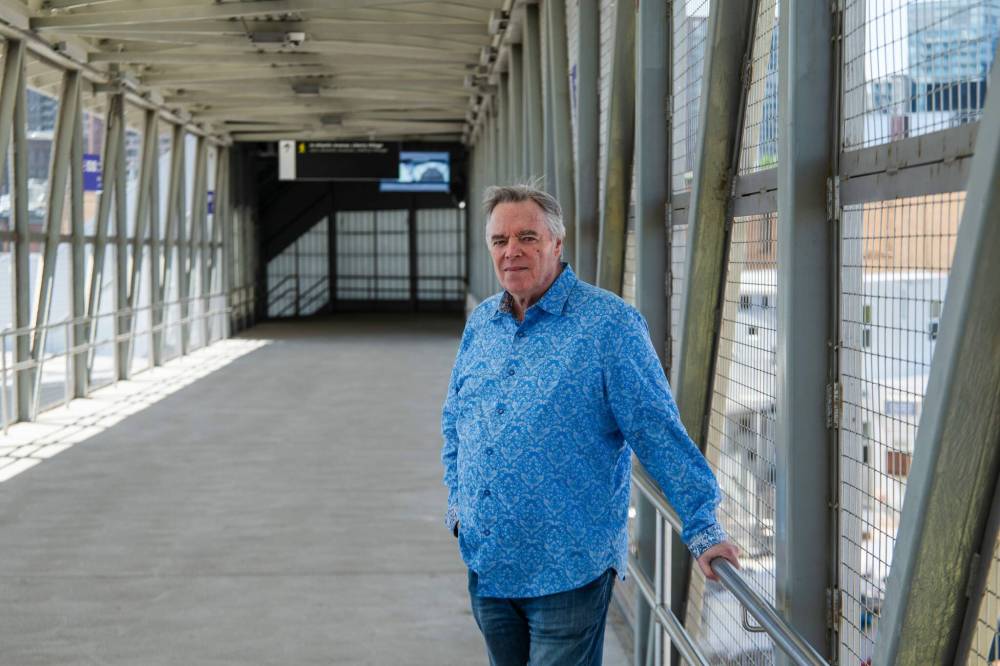
Robert Howley says FIFA restrictions could pose a challenge to residents who live near the stadium.
The irony arrives in the form of a decision by the city and FIFA to essentially imprison all of the neighbourhood’s residents and businesses for the duration of the World Cup.
Robert Howley, president of the Liberty Village Residents’ Association, said the city and tournament officials will be creating a cordon around the neighbourhood to control vehicle and pedestrian traffic. Residents and businesses will be given passes to get through checkpoints.
“Look, we’re behind (the World Cup) 100 per cent but the residents’ association has some pretty simple concerns,” Howley said. “One of those concerns being, ‘How are we going to get in and out of here, you know, for 39 days, with the crowds that are coming through here?’ There has been some confusion on our end about how that’s going to work.”
Howley said there are also some concerns about how soccer fans will behave once they’ve come to Liberty Village to take advantage of the area’s robust hospitality industry. “The bars are going to be allowed to stay open to like four in the morning, they’re going to open at nine or 10 in the morning. So we’re thinking, well, there could be some issues with that.”
Adding to the frustration is the fact that few Liberty Village residents will be able to afford to attend matches.
”I was offered two tickets for $900 for Ghana (ranked 74th in the world) versus Paraguay (ranked 40th), so not your, not your top choice. I’m sure they’re absolutely fantastic athletes, and it could be very, very exciting, but that is a lot of money.”
Notwithstanding those concerns, area businesses are still hoping to enjoy a World Cup boom.
Star Jackman, who has lived in Liberty Village for more than a decade, operates Wilbur Mexicana in the neighbourhood’s north end with a group of friends. Around the time FIFA confirmed Toronto would be one of the host cities, he and his partners laid plans to open another eatery, Wilbur Taco Co., located within eyesight of BMO Field.
The restaurant — named after Wilbur Scoville, the man who created the Scoville scale that rates the spiciness of chili peppers — had its grand opening on June 8, just four days before Canada plays its first game.
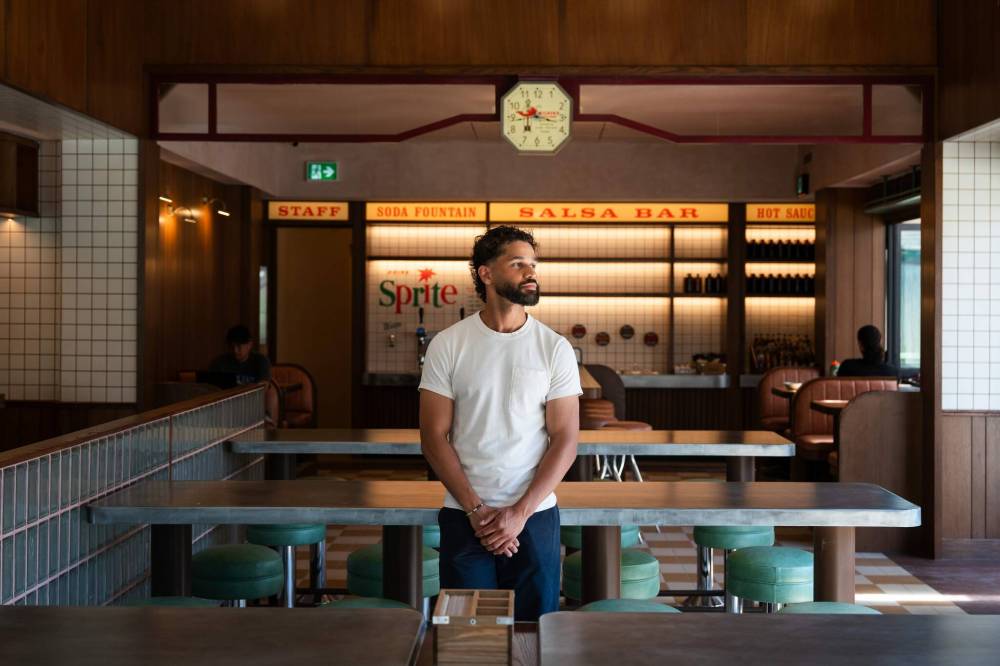
Laura Proctor / Free Press
Restaurateur Star Jackman opened a second location in the hopes of capitalizing on World Cup visitors.
“I think you know everyone wants the opening of a restaurant to be busy, and I think it would be impossible for us to not be busy just because of proximity,” Jackman said.
Is he worried about overcrowding and general mayhem for businesses located right on the path to matches?
“It’s going to be nuts but I think Toronto needed it, and I think Liberty Village really needed it,” he said.
“It’s not just about us, right? I know Toronto sometimes can seem a little bit cold to outsiders. We’ve always wanted to remove ourselves from that identity and I think this is a good opportunity to do that.”
The situation is less certain for non-hospitality businesses in the area.
Last December, Katherine Lannin opened Liberty Street Blooms, the area’s only florist. Lannin’s tiny but fragrant shop is located so close to BMO Field that she might be able to hear the crowd cheering on game days.
Lannin said she is somewhat concerned that while bars and restaurants will see overflow crowds, service-industry businesses like hers may be left out of the economic spinoffs.
“I’m really not sure how beneficial this is going to be for people like myself who are not involved in food and drinks,” Lannin said. “I am of the opinion that all eyes are good eyes at this point. People who live here are still just discovering me, so I hope we see some visitors who are curious and want to come in and have a look.”
Are there any concerns of lasting damage to her carefully crafted business model?
“I put a lot of work into planning this. This business is my 20-year investment. And I’ll be here long after FIFA and the World Cup is gone.”
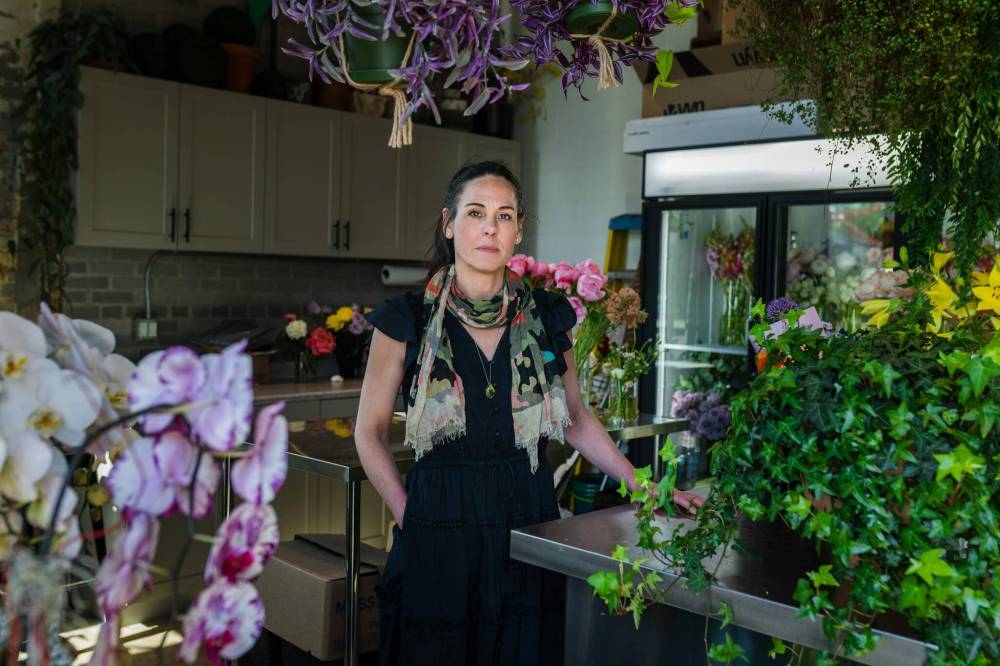
Laura Proctor / Free Press
Katherine Lannin, owner of Liberty Street Blooms, is unsure how the World Cup will impact her business.
Which raises another important question: Given the enormous outlay of public money, will there be a lasting legacy in Toronto from the World Cup?
The nine-figure improvements to BMO Field largely involve temporary capital upgrades, so there won’t be much of a lasting impact there. All of the games will be played in that single facility, so the direct economic impact for bars, restaurants, hotels and other small businesses will be mostly focused on Liberty Village and, to a lesser extent, the downtown.
Mayor Chow has said the two temporary pitches in the city hall courtyard will be relocated to a community recreational facility in an as-yet-unidentified part of the city.
Given the maximum short-term disruptions and the minimum long-term impacts, does the mayor still think the World Cup is of good value for Toronto.
“Any time the world shows up in the city of Toronto is always positive,” said Chow, who launched her re-election campaign just a week earlier. “We have a lot that we’re proud of, and we are very ready.”
dan.lett@freepress.mb.ca

Dan Lett is a columnist for the Free Press, providing opinion and commentary on politics in Winnipeg and beyond. Born and raised in Toronto, Dan joined the Free Press in 1986. Read more about Dan.
Dan’s columns are built on facts and reactions, but offer his personal views through arguments and analysis. The Free Press’ editing team reviews Dan’s columns before they are posted online or published in print — part of the our tradition, since 1872, of producing reliable independent journalism. Read more about Free Press’s history and mandate, and learn how our newsroom operates.
Our newsroom depends on a growing audience of readers to power our journalism. If you are not a paid reader, please consider becoming a subscriber.
Our newsroom depends on its audience of readers to power our journalism. Thank you for your support.
Related Articles
Australia spoils Turkey's return to the World Cup with a 2-0 victory