
Divided they stand The chaotic year in U.S. politics began with the impeachment trial and acquittal of Donald Trump; it will end, after racial unrest and a bitter election campaign, with democracy held hostage in the Oval Office
Read this article for free:
or
Already have an account? Log in here »
To continue reading, please subscribe:
Monthly Digital Subscription
$1 per week for 24 weeks*
- Enjoy unlimited reading on winnipegfreepress.com
- Read the E-Edition, our digital replica newspaper
- Access News Break, our award-winning app
- Play interactive puzzles
*Billed as $4.00 plus GST every four weeks. After 24 weeks, price increases to the regular rate of $19.95 plus GST every four weeks. Offer available to new and qualified returning subscribers only. Cancel any time.
Monthly Digital Subscription
$4.99/week*
- Enjoy unlimited reading on winnipegfreepress.com
- Read the E-Edition, our digital replica newspaper
- Access News Break, our award-winning app
- Play interactive puzzles
*Billed as $19.95 plus GST every four weeks. Cancel any time.
To continue reading, please subscribe:
Add Free Press access to your Brandon Sun subscription for only an additional
$1 for the first 4 weeks*
*Your next subscription payment will increase by $1.00 and you will be charged $16.99 plus GST for four weeks. After four weeks, your payment will increase to $23.99 plus GST every four weeks.
Read unlimited articles for free today:
or
Already have an account? Log in here »
Hey there, time traveller!
This article was published 30/12/2020 (1939 days ago), so information in it may no longer be current.
It started with a trial that was soon forgotten. It ended nine months later with the people’s verdict.
The 2020 U.S. presidential election was unprecedented from start to finish. For millions of Americans harbouring suspicions fuelled by spurious claims, it’s still not over.
President Donald Trump’s impeachment trial in the Republican-controlled Senate began in January. He allegedly pressured Ukrainian authorities to investigate former vice-president Joe Biden, a potential Democratic opponent.
That month, the crowded field of Democrats was stumping before Iowa’s first-in-the nation caucuses. Biden would finish a dismal fourth on Feb. 3, and Sen. Bernie Sanders was declared the early front-runner for the party’s nomination.
Two days later, Trump’s trial ended in his acquittal. He would go on to become the first impeached president to win a party’s nomination, and there’s nothing to suggest the episode changed many opinions of him.
After his poor showing in Iowa, Biden placed fifth in New Hampshire. He saved his campaign with a massive win in South Carolina in late February, earning the support of a majority of the party’s Black voters.
Several candidates dropped out, making Biden the consensus moderate choice. He won 10 of 14 states on Super Tuesday, three days after South Carolina’s primary.
Biden took over the delegate lead, and it became clear he would cruise to the nomination. Polls had long shown broad support for Biden nationally and that he would likely fare well against Trump in a general election. However, winning the nomination was a near-miracle given Biden’s early struggles and the fact he’d run for president twice before and lost.
As the COVID-19 pandemic worsened, it began to shape the election campaign and the process itself. Many states made it easier to vote by mail or at early ballot sites. The Democratic convention was almost entirely virtual, while the GOP meeting was more of a hybrid affair.
In public, Trump played down the pandemic and blamed China. Biden made fewer campaign appearances to prevent the spread of the coronavirus, while the Trump campaign accused him of hiding in “his basement.”

Trump also mocked Biden for wearing a mask and for his smaller, physically distanced crowd sizes. The president suspended his trademark rallies before resuming them in summer, flouting pandemic guidelines and even holding some indoors. Few of his supporters wore masks.
In May, protests erupted across the U.S. after George Floyd, a Black man, was killed during an arrest in Minneapolis. The unrest and related social issues became a major part of the election. Trump criticized the protests as being overtaken by violent extremists. On June 1, pepper spray was used to clear the way for a photo opportunity at a church near the White House, where Trump held up a Bible and said he was going to keep the country “nice and safe.”
In August, Biden announced he had chosen Sen. Kamala Harris of California as his running mate. Harris, who is of Indian and Jamaican heritage, became the first woman of colour on a major U.S. party’s presidential ticket.
On Sept. 18, less than two months before the election, U.S. Supreme Court justice and cultural icon Ruth Bader Ginsburg died. Democrats slammed Trump’s move to fill her seat as hypocritical after he previously criticized Barack Obama for trying to appoint a justice in his final year as president.
Trump and Biden met for their first debate on Sept. 29. It was a stunningly ugly affair, as Trump bullied and interrupted Biden throughout. It was a new low in U.S. politics.
Soon after, it was revealed that Trump and his wife, Melania, had tested positive for COVID-19. The ceremony where he announced Amy Coney Barrett as his Supreme Court nominee, three days before the debate, was cited as a possible super-spreader event.
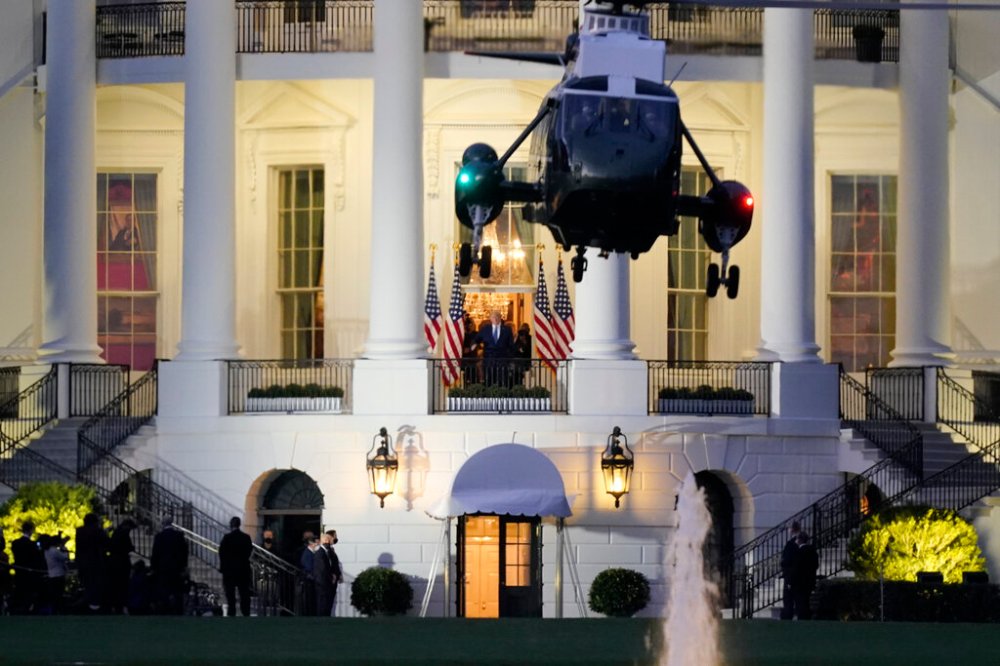
In a series of surreal moments, Trump was flown to hospital on the Marine One helicopter before returning to the White House to quarantine. While at the hospital, he left briefly so he could wave to supporters from a vehicle filled with Secret Service agents.
By election day, a record number of Americans had already voted. With few undecided voters in such starkly divided times, there was little opportunity for either candidate to gain support.
Trump was in the lead as the results rolled in on the night of Tuesday, Nov. 3, because the mail-in vote was largely Democratic and took longer to count. Before the night was over, Fox News and The Associated Press had made early calls giving Arizona, a state Trump won in 2016, to Biden. By early morning, Biden saw gains in several swing states. Pennsylvania, the key battleground where Biden was born, was called for the former vice-president four days after the election, on a Saturday morning. Biden had won the presidency.
He received the most votes in U.S. history, beating Trump in the popular vote by more than seven million. It was a closer race than some expected. Trump received the second-most votes in history and was about 65,000 votes away from winning the Electoral College, Dave Wasserman of the Cook Political Report said. Biden’s margin of victory in the Electoral College was only slightly larger than Trump’s win over Hillary Clinton in 2016.
Since the election, Trump has appeared in public infrequently. He has supported lawsuits seeking to overturn the results, refused to concede and stalled the transition of power. Anyone still paying attention has learned more about the minutiae of the election process than they likely ever wanted to.
No one could have predicted how the campaign would play out, but bitter resentment and eroding trust in democracy was inevitable in its wake.
adam.treusch@freepress.mb.ca
Twitter: @adamtreusch
History
Updated on Wednesday, December 30, 2020 7:04 AM CST: Adds photo
Updated on Wednesday, December 30, 2020 7:10 AM CST: Fixes cutline, adds story tag
Updated on Wednesday, December 30, 2020 7:38 AM CST: Adds photo
Updated on Wednesday, December 30, 2020 8:10 AM CST: Fixes cutline
Updated on Wednesday, December 30, 2020 9:24 AM CST: Replaces photo