Teach your visitors well Tourism operators, guides see climate impact but walk a fine line on the tundra between just providing entertainment and offering food for thought
Read this article for free:
or
Already have an account? Log in here »
To continue reading, please subscribe:
Digital Subscription
One year of digital access for only $1.44 a week*
- Enjoy unlimited reading on winnipegfreepress.com
- Read the E-Edition, our digital replica newspaper
- Access News Break, our award-winning app
- Play interactive puzzles
*Billed as $5.77 plus GST every four weeks. After 52 weeks, price increases to the regular rate of $19.95 plus GST every four weeks. Offer available to new and qualified returning subscribers only. Cancel any time.
To continue reading, please subscribe:
Add Free Press access to your Brandon Sun subscription for only an additional
$1 for the first 4 weeks*
- Enjoy unlimited reading on winnipegfreepress.com
- Read the E-Edition, our digital replica newspaper
- Access News Break, our award-winning app
- Play interactive puzzles
*Your next Brandon Sun subscription payment will increase by $1.00 and you will be charged $17.95 plus GST for four weeks. After four weeks, your payment will increase to $24.95 plus GST every four weeks.
Read unlimited articles for free today:
or
Already have an account? Log in here »
Hey there, time traveller!
This article was published 30/10/2020 (2182 days ago), so information in it may no longer be current.
The white behemoth of a vehicle rumbles across the tundra in the Churchill Wildlife Management Area, just east of town. It’s not a school bus, though the white cab of the vehicle certainly resembles one. It isn’t an industrial dump truck, though the size of the wheels can’t be far off, raising passengers more than two metres off the ground.
The tundra buggy is unlike any other vehicle. It was invented in Churchill for the sole purpose of rolling across the unforgiving landscape while remaining safely out of reach of the polar bears.
Tundra Buggy Adventures owns the trademark to the vehicle, but other tourism operators now have similar contraptions; tweaking their own designs since the invention emerged in the late ‘70s.

Today, Kevin Burke is the driver, one of the only Churchillians hired to drive for polar bear tours. Burke brings a lot of knowledge to the job, having worked in Churchill’s tourism industry for 35 years, as well as working for Parks Canada and the Canadian Armed Forces in that time.
“Over the last four, maybe five years now, what I’ve really noticed change is these willow bushes around here,” he tells the late-summer tourists onboard. “What I’ve noticed is how much and how thick they’ve grown. It’s crazy, I’ve been driving out here a long time. You used to be able to see over top of all these bushes.”
The bushes now brush up against the passengers’ windows, easily clearing three metres.
Burke also describes how the landscape itself is changing from year to year. With a larger active layer of the ground as permafrost thaws, he says he can watch as boulders are squeezed from the ground, forcing them to the surface. It makes his job of navigating the increasingly dilapidated pathways through the protected wildlife area that much more difficult.
While the tourists came to see polar bears, so far today caribou and countless migratory birds have also been on the slate. Forty-five minutes into the tour, even with Burke inviting questions about any topic at all, no one asks about climate change or its impacts on the bears.
It seems that if Burke hadn’t brought it up, no one would have cared to ask. Nor do they ask any further questions after the topic crops up.

The tour goes on. “When the bears come off the ice, we hope they’re fat, dumb and happy; that they’ve had a good spring or good summer,” Burke says.
Bears are generally fasting when they’re on land, Burke explains, but that doesn’t mean they won’t eat what smells good.
“Some seasons we see them grazing on seaweed and kelp. Or lyme grass, they’ll eat that. I’ve seen them blue from one end to the other eating blueberries. They roll in it too, get big blue stains. But the majority of their food comes from seal fat.”
It seems these tourists just want their pictures and a cool story about how they saw the incredible beasts up close.
● ● ●
About 1,000 kilometres south, at the Assiniboine Park Zoo in Winnipeg, Jill Bueddefeld sits on the raised seating next to the polar bear tunnel in the Journey to Churchill exhibit.
Bueddefeld is a post-doctoral fellow at the University of Alberta, an expert in nature-based tourism. In 2016, she travelled between Churchill and the zoo to study how communication on climate change was handled in the two places.
She wanted to know what tourists and visitors took away from their experiences and if those lessons ever turned into real-life changes for those people.
The reality is that the “a-ha” moments, where the message and urgency of the climate crisis sinks in for people are rare, and even when those moments are created by the impact of their experience, if it’s not paired with the perfect communication strategy, it likely won’t lead to any meaningful change.
“There are all these barriers in life to actually doing something, no matter how meaningful the experience is. And so really, what we need to do is be very specific and directive about the messaging. And any time we’re able to make connections, say, ‘Here is the issue, you’ve experienced this first-hand,’ so you’ve built that empathy on site. And then you say, ‘Here’s what you do about it.’ And you have to be incredibly specific. You can’t just say, ‘You need to reduce your carbon footprint,’” Bueddefeld says.
“At all these best places where you can go and learn about environmental issues and wildlife, and see them up close, we know that people do not necessarily take away conservation messages or change their behaviour because of that.”
– Jill Bueddefeld
It doesn’t matter whether people travel to Antarctica, the Galapagos Islands, Churchill or the zoo, she says. In the end what matters more is how the lessons are communicated, as well as a host of other factors, such as the motivation that led that person to go to that place to begin with.
“At all these best places where you can go and learn about environmental issues and wildlife, and see them up close, we know that people do not necessarily take away conservation messages or change their behaviour because of that,” she says.
“So we often hear things like, ‘support polar bears’ or ‘support climate change (initiatives)’ or ‘reduce your carbon footprint,’ but if you ask someone how to reduce a carbon footprint, or how does that even relate to climate change, that connection is often not made.”
It also matters who is delivering the message.
Bueddefeld says stories such as Burke’s might actually be the most impactful way of getting through to tourists. When the message comes from someone like Burke, what she calls a “trusted messenger” — a local with lots of experience and a personal story to tell — she says the impact is much longer lasting.
“Climate change, we all know it’s a thing — at least most of us do here in Canada. The science has been overwhelming since the ‘80s, so it’s not like we need more data, we need more convincing people to tell their stories about climate change,” Bueddefeld says.
● ● ●
Alex de Vries-Magnifico hops the puddles of water that remain between the rocks in the cove. The water seeps into his shoes through the worn-out holes on the sides despite his best efforts.
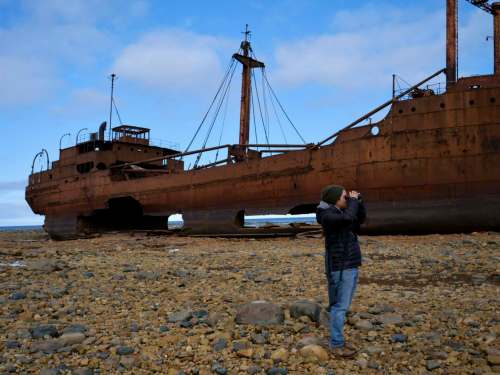
It’s low tide, and he’s guiding a tour out to the MV Ithaca, a ship that ran aground about 20 kilometres east of Churchill back in 1960. Left there to decay, the rusted-out old ship now serves as a tourist destination; at low tide you can walk all the way out to it.
De Vries-Magnifico is one of a group of people in town who visited Churchill once, in his case 11 years ago, fell in love with this unique and beautiful place, and wound up setting down roots.
“Just stepping off the train and smelling the sea breeze, or seeing the ocean for the first time, it’s like, ‘Wow, Manitoba is not just a Prairie province. It’s so much more,’” he says.
He asks as we navigate through the maze of puddles what constitutes enough of a trend to say he’s witnessed a changing climate in Churchill in the years since he arrived. He talks about the warm years, but also the years where sea ice stays longer than normal. He feels like he’s witnessed storms becoming more severe, and generally more bizarre or uncharacteristic weather. For a non-scientist, it is a confusing puzzle to piece together.
De Vries-Magnifico owns and operates Discover Churchill, a small tour company and photo gallery in town. He is well-informed about the geology, the wildlife and the history of the area. With a shotgun slung over his shoulder — a necessary and ubiquitous feature for guides here — he’s prepared to defend his clients against aggressive polar bears, if needed. There is a lot of pressure on guides to do and know it all. Is adding in-depth information about climate change to the list a realistic expectation?
“I definitely think I have the responsibility to convey the information. Especially with polar bears being the international symbol for climate change,” de Vries-Magnifico says. “All I can do is present the information that I have.”

For example, this year was a good ice year for the polar bears locally, but de Vries-Magnifico has been watching the news from Siberia, where there was a record-setting heat wave this year. The urgency isn’t felt in Churchill yet, he says, but he tries to keep that in a global context.
Practically speaking, as he lines up polar bear tours years in advance, the unpredictable weather creates a great deal of uncertainty.
“Trying to figure out what the ideal weeks are to run tours, that is becoming more unpredictable,” he says. “My clientele are fighting for this two-week window where there’s snow on the ground, but the ice hasn’t formed yet. It’s usually the last week of October, the first week of November. But then three years ago, we had open water behind (the town’s main complex) well after Christmas. Then, the last three years, most of the bears are gone by Nov. 11th, 12th, when the season typically runs until the third week of November.”
In his experience, climate change and the fear that polar bears might be gone by the century’s end is not generally a motivating factor for people to come here. They are likely aware of the connection between the animals and the issue, but it isn’t any more than that in most cases, he says.
“They want to see this apex predator that just so happens to also look so cute and cuddly.”
Apart from a general lack of interest, some tourists headed to the subarctic are more hostile to receiving information about climate change. And Americans represent the biggest piece of the tour business.
“I definitely think I have the responsibility to convey the information. Especially with polar bears being the international symbol for climate change. All I can do is present the information that I have.”
– Alex de Vries-Magnifico
“We’ve always been very mindful that our guests are coming from the red states and the blue states, figuratively speaking,” says John Gunter, president and CEO of Frontiers North Adventures, one of the biggest tour operators in town.
And Gunter is first to admit that he is not an expert on all things climate change, nor are his drivers. “So we’re very mindful of how we present our tourism company and our tourism products. And we will defer on climate change — which tends to be a hot-button issue — we’ll defer the climate change narrative to the scientists.”
But to that end, Gunter and Frontiers North have invested in conservation initiatives. One of the company’s tundra buggies is devoted entirely to the use of scientists and their research. Polar Bears International, a non-profit polar bear conservation organization, uses it during bear season to livestream informational sessions on the internet.
Frontiers North also runs some special tours that have scientists onboard and they give lectures on climate change and its impacts on wildlife.
“This is an important issue for us and I think we’re holding up our end of the bargain as much as we can to work towards a brighter future for polar bears, whatever that means,” Gunter says.
“Let me put it this way. Very few people go to the internet and search ‘educational vacations’ but we’ve found that everybody really enjoys having had them. They do really enjoy having learned more about the destination than they thought they would.”
Reading between the lines it seems clear that Gunter worries about selling packages to people if the tours are tagged with the term climate change, but he’s happy to sneak in education where he can. It’s like feeding vegetables to a toddler.
“We’re selling the romance. Right? We’re selling the romance of kayaking amongst beluga whales, but we’re really delivering on a more important or greater promise of an educational or conservation-oriented departure. So arguably, I’d say we’re covertly conservation-oriented.”
● ● ●
Bueddefeld is not surprised by operators’ fears of being associated with feeding people their vegetables.
“I think there is this assumption (by operators) that if we push too many climate messages — and I don’t just mean this for Churchill, I mean this for tourism operators around the world — that if we talk about challenging problems, our visitors aren’t going to like it; that it takes away from the fun of their holiday. It’s not as entertaining, it’s not as enjoyable, unless it’s marketed as a learning tour,” she says.
“But what I found, across the board, with anyone I talked to, is that those conversations… improved their holiday, if anything. So having those complicated conversations improves the visitor experience. It adds nuance to their encounter. It makes them realize that it’s more than just a holiday where you might see some cool bears.”
In Churchill not all tour operators offer the same level of educational value, Bueddefeld explains. Some won’t even mention the words but instead recite bear facts for the duration of the tour. Some of the companies offering tours in Churchill even openly dispute the scientific findings of researchers who have studied polar bears in the area for decades.
But on the other end of the spectrum, on one of the science educational tours she audited, Bueddefeld was blown away by a scientist that was able to use an instance where a bear cub was abandoned by its mother to not only use that event to drive home lessons about climate change, but also spur future actions.
“It was a really sad and emotional moment but she paired it with, ‘OK climate change is this bigger problem. Here is all the data about why we think climate change is real. It’s happening, it’s affecting the Arctic the most and the fastest. It’s affecting polar bears in a really dramatic way, as you’ve just seen. And here are some things that you can do about it.’”
When compared to Churchill, Bueddefeld found that the transformational aspect of visiting the zoo didn’t compare. However, guides at the zoo were more likely to be able to direct people to effective action items; meaningful ways for them to lower their own carbon footprint and participate in the conversation. Without that final piece of the puzzle, people find themselves overwhelmed and despairing about their inability to make a change.
There are many obstacles to good communication on climate change in Churchill. But Bueddefeld hopes that tour operators keep working to do better, to have more impact on the people who visit.
● ● ●
Stepping off the tundra buggy, tourists thank Burke profusely having spent most of the afternoon gazing at a mother polar bear and her two cubs. It was a successful outing.
He’s happy to share the beauty of the bears with others. He’s happy to try to educate others, as best he can. But he isn’t a researcher, he says. He comments on what he knows, or he’ll quote from other sources if he’s read something he thinks others might find interesting.
“I love people. I’d like to consider myself an educator, if you will. I like to keep things as simple as I possibly can. There are a lot of words I can’t pronounce, or spell, for that matter, but if I don’t know the answer to a question, I’m not going to make something up,” Burke says.
“I think a lot of people are, in a way, oblivious to their surroundings. That’s not a slam. We just tend not to observe what’s going on in our own backyard. There’s been a lot of negative press coming from researchers and with what’s going on lately, politically with fake news, and so on — you don’t know what to believe anymore.
“I know what I know. I’ve seen changes. I know there are changes going on. And in my 35 years of doing tourism in this area, going to the same place at the same time every year, you’re darn right there’s changes. There’s no if, ands or buts about it. It was very slow at first, and let’s say in the last six or eight years, it has really shown itself.”
sarah.lawrynuik@freepress.mb.ca