Fringe movements key to changing the world
Advertisement
Read this article for free:
or
Already have an account? Log in here »
To continue reading, please subscribe:
Digital Subscription
One year of digital access for only $1.44 a week*
- Enjoy unlimited reading on winnipegfreepress.com
- Read the E-Edition, our digital replica newspaper
- Access News Break, our award-winning app
- Play interactive puzzles
*Billed as $5.77 plus GST every four weeks. After 52 weeks, price increases to the regular rate of $19.95 plus GST every four weeks. Offer available to new and qualified returning subscribers only. Cancel any time.
To continue reading, please subscribe:
Add Free Press access to your Brandon Sun subscription for only an additional
$1 for the first 4 weeks*
- Enjoy unlimited reading on winnipegfreepress.com
- Read the E-Edition, our digital replica newspaper
- Access News Break, our award-winning app
- Play interactive puzzles
*Your next Brandon Sun subscription payment will increase by $1.00 and you will be charged $17.95 plus GST for four weeks. After four weeks, your payment will increase to $24.95 plus GST every four weeks.
Read unlimited articles for free today:
or
Already have an account? Log in here »
Hey there, time traveller!
This article was published 22/07/2017 (3374 days ago), so information in it may no longer be current.
“The more things change, the more they stay the same” is a common interpretation of a French quote by critic Jean-Baptiste Alphonse Karr. Yet, as events of the past year and a half have demonstrated, sometimes things change so much that underlying assumptions must be questioned.
Western society has always had its share of extremist, fringe activists, who are generally dismissed — tolerantly or not — by the mainstream culture.
British journalist and tech blogger Jamie Bartlett points out that successful radicals of the past are now heroes who changed both history and culture. For instance, in the United States: “American revolutionaries, the abolitionists, the civil rights activists, the LGBTQ rights groups.”
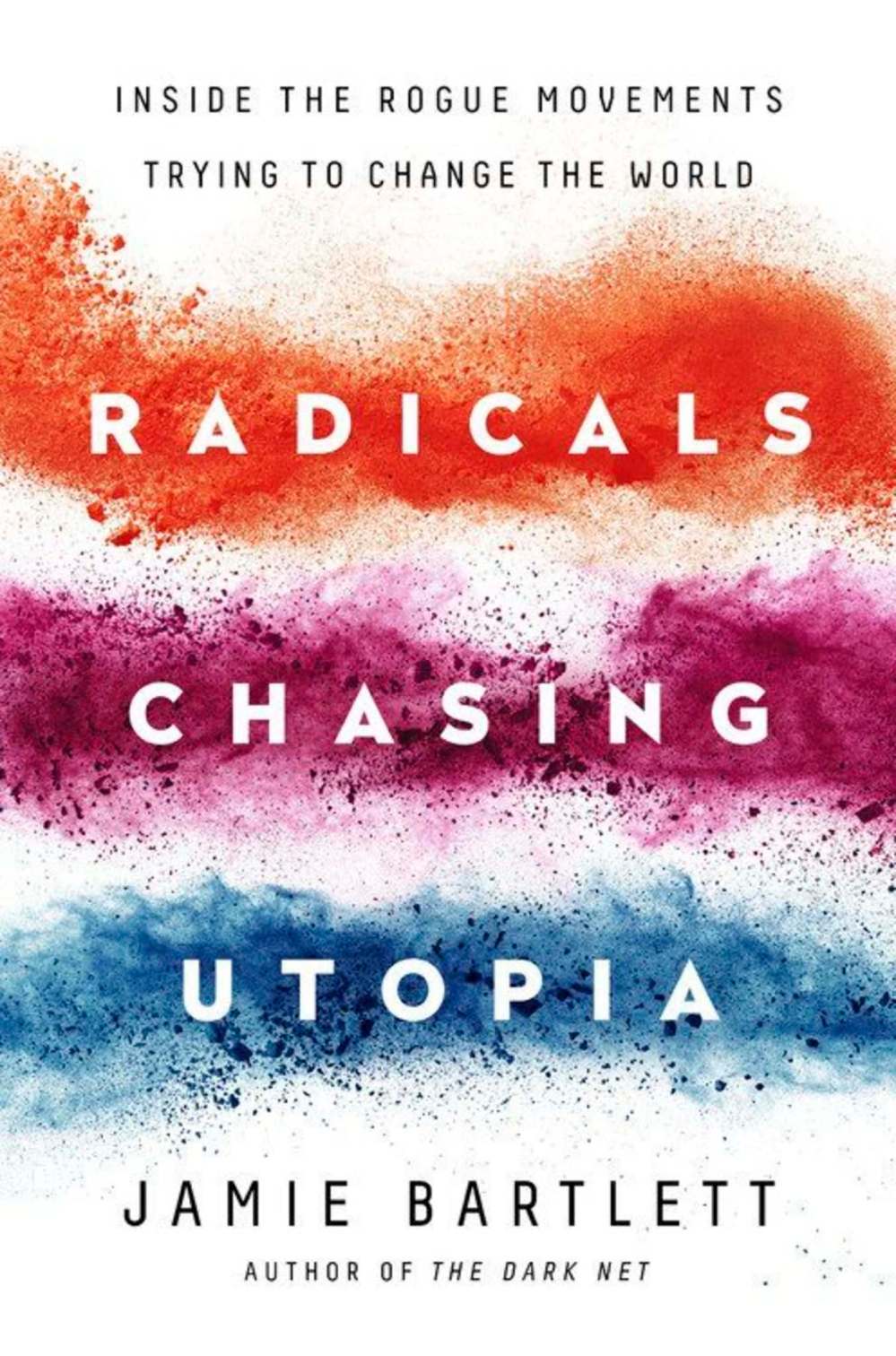
Radicals Chasing Utopia interestingly, if unevenly, chronicles Bartlett’s experiences embedding himself in various radical groups.
“In streets, halls, fields, chat rooms and even parliaments, more and more people are trying to change the world. And for the last two years, I’ve tried to find them.”
Bartlett’s 2014 book The Dark Net, about underground and sketchy sub-cultures in various corners of the internet, included “transhumanism,” and that’s where Radicals Chasing Utopia begins.
Transhumanists “believe that technology can make us physically, intellectually, even morally better.”
Bartlett accompanied other journalists and fellow travellers on Zoltan Istvan’s quixotic 2016 presidential campaign, in a bus “redesigned to look like a giant coffin.”
Some transhumanists believe even mortality can be overcome by scientific advances and obsessively careful living.
Other chapters cover anti-immigration activists in Europe, psychedelic drug experiences, the Italian Five Star Momentum movement, and a commune in Portugal attempting to establish “a healing biotope, a template of how man could live in harmony with himself, his fellow man and his environment.”
Bartlett’s reports on most groups achieve his stated goal of “assessing them as honestly and objectively” as possible, but retaining “a degree of scepticism.”
The chapter Interlude: Prevent examines the U.K. government’s difficulties attempting to “deal with the spread of radical ideas that directly seek to undermine or destroy” liberal democracy.
His chapter about taking part in direct action to protest a coal mine in Wales somewhat exposes his own bias, but the rest of the book does not come across as a polemic either for or against the radicals he observes.
That chapter, The Activist’s Paradox, discusses the tendency of some radicals to turn off the general public, whose participation in the machinery of change is so important to fundamental shifts in cultural or political norms.
Engaging as Bartlett’s coverage is, reading the book can be frustrating, partly due to the overwhelming documentation. Over 50 pages of endnotes — often containing additional exposition or explanation, not just attribution — compete with numerous explanatory or illustrative footnotes.

Some passages point the reader to both a footnote and an endnote. Much of that information would be less intrusive if it were included in the text, rather than interrupting it.
Bartlett’s observations and analyses of particular groups culminate in an especially thoughtful and challenging epilogue, discussing the dilemmas and difficulties inherent in radicals who are trying to change the world.
“Their energy, imagination and passion might save us; but those very attributes might also lead to ruin and desperation. Yet, for all this, radicals remain our best hope.”
Whether one agrees or disagrees with this conclusion, Bartlett’s book is an enjoyable and thought-provoking addition to the conversation.
Bill Rambo teaches at The Laureate Academy in St. Norbert. He adheres to the radical idea that knowledge of Shakespeare could arrest virtually all decay of the English language.