Thriller turns audience into enablers, pulling for Denzel Washington’s booze- and drug-addicted pilot

Advertisement
Read this article for free:
or
Already have an account? Log in here »
To continue reading, please subscribe:
Digital Subscription
One year of digital access for only $1.44 a week*
- Enjoy unlimited reading on winnipegfreepress.com
- Read the E-Edition, our digital replica newspaper
- Access News Break, our award-winning app
- Play interactive puzzles
*Billed as $5.77 plus GST every four weeks. After 52 weeks, price increases to the regular rate of $19.95 plus GST every four weeks. Offer available to new and qualified returning subscribers only. Cancel any time.
To continue reading, please subscribe:
Add Free Press access to your Brandon Sun subscription for only an additional
$1 for the first 4 weeks*
- Enjoy unlimited reading on winnipegfreepress.com
- Read the E-Edition, our digital replica newspaper
- Access News Break, our award-winning app
- Play interactive puzzles
*Your next Brandon Sun subscription payment will increase by $1.00 and you will be charged $17.95 plus GST for four weeks. After four weeks, your payment will increase to $24.95 plus GST every four weeks.
Read unlimited articles for free today:
or
Already have an account? Log in here »
Hey there, time traveller!
This article was published 02/11/2012 (5100 days ago), so information in it may no longer be current.
In the first minutes of this provocative drama from director Robert Zemeckis, we bounce between the worlds of hard-living airline pilot Whip Whitaker (Denzel Washington) and down-on-her-luck photographer/junkie Nicole (Kelly Reilly). One worries screenwriter John Gatins made a too-obvious play on the word the title Flight. He flies with a plane (and also prodigious quantities of alcohol and cocaine). She flies with a syringe.
But once the captain gets in the cockpit on a routine flight from Orlando to Atlanta, the resulting havoc will likely drive all semantics from the mind. Whip is already loaded as he guides the plane through heavy turbulence after takeoff, and afterwards has the effrontery to sneak a few bottles of vodka into his water bottle while assuring his passengers that the worst is over.
Not by a long shot. The flight suddenly, inexplicably loses altitude and goes into an uncontrolled dive. While Whip’s starched co-pilot (Brian Geraghty) goes into near hysterics, Whip calculates, turns the plane upside down to take it out of its death dive and rights it in time to crash land on a field.
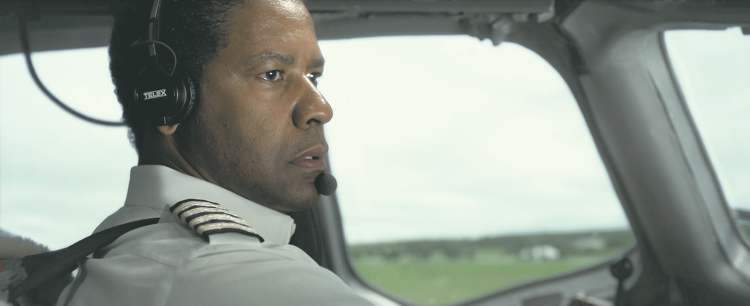
Of the 102 souls on board, only four are killed. Whip Whitaker is credited with saving their lives with his quick thinking and unconventional piloting know-how.
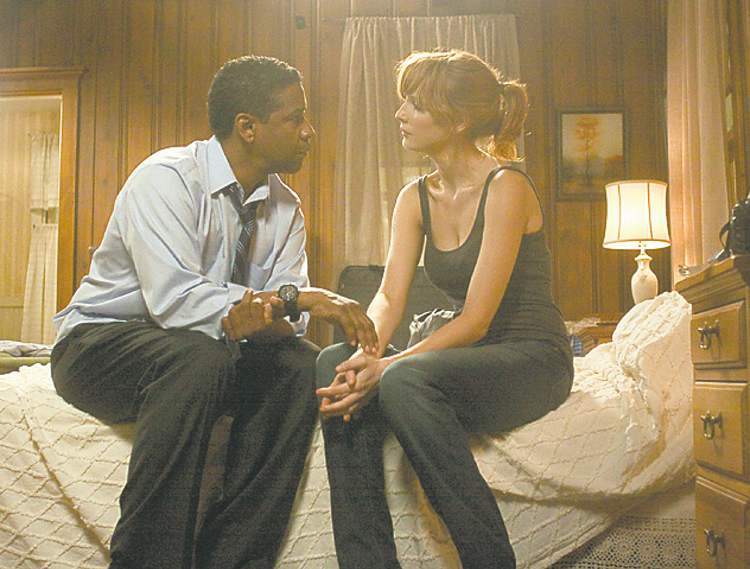
But when he regains consciousness in the hospital, his life will be turned around, first by meeting Nicole, hospitalized for a heroin overdose, and next with the knowledge that, as a matter of procedure, a sample of his blood was taken while he was unconscious, and the well-kept secret of his alcoholism and drug abuse is at risk of being disastrously exposed.
From there, Flight proceeds with the momentum of a thriller but the gravitas of a gritty character drama. Whip simultaneously evades the truth about his addiction and his responsibility to the public. The title takes on another meaning: Flight is the act of a fugitive.
Whip is soon surrounded by three different variations of enabler: His union rep (Bruce Greenwood) is a former flying partner and friend intent on guarding Whip’s career in the face of evidence of serious substance abuse. His tightly wound lawyer-for-hire (Don Cheadle) is intent on protecting the airline by protecting Whip’s reputation from an investigation by the National Transportation Safety Board headed by the hard-nosed Ellen Block (Melissa Leo). Finally, there’s Harling Mays (John Goodman), a good-time Charlie who may be Whip’s only remaining friend. Harling is also his drug supplier.
Set against this lot, it soon becomes clear that the recovering addict Nicole may be Whip’s last, best hope.
Washington is especially fine here, taking a breather from his more action-oriented roles to demonstrate what a versatile actor he can be, playing such a damaged individual.
It is difficult to discuss the merits of Flight without revealing too much of its third act. The term Hitchcockian could be used to describe a bravura sequence in a hotel room where Whip attempts to dry out before testifying at an NTSB hearing. What follows that is Hitchcockian in the most perverse sense, reminiscent of the sequence in Psycho when Norman Bates disposes of Marion Crane’s body by sinking her car in a swamp, and the audience collectively holds its breath, wanting the car to sink.
I’m not sure it’s intentional, but Zemeckis actually makes the audience feel complicit by getting us onside with Whip’s deception, even if that means he loses his soul.
The film is a fascinating look at addiction, but in its finale, it packs a provocative correlative punch: We are all enablers.
randall.king@freepress.mb.ca
Other voices
“Slowly but surely, Flight degenerates from a tale of moral paradox and wounded romance into a mid-1990s after-school special about addiction and recovery.”
— Andrew O’Hehir, Salon.com
“Not often does a movie character make such a harrowing personal journey that keeps us in deep sympathy all of the way.”
— Roger Ebert, Chicago Sun-Times

“A riveting character study, and a sometimes moving and sometimes amusingly amoral morality tale set in the vodka-and-coke friendly skies.”
— Roger Moore, McClatchy-Tribune News Service
“Flight doesn’t quite soar past its narrative limitations. There’s plenty of virtuosity to go around here — just precious little transcendence.”
— David Fear, Time Out New York
Our newsroom depends on a growing audience of readers to power our journalism. If you are not a paid reader, please consider becoming a subscriber.
Our newsroom depends on its audience of readers to power our journalism. Thank you for your support.
MovieReview
Flight
- Starring Denzel Washington and Kelly Reilly
- Grant Park, McGillivray, McGillivray VIP, Polo Park
- 18A
- 138 minutes
- Three and a half stars out of five
Our newsroom depends on a growing audience of readers to power our journalism. If you are not a paid reader, please consider becoming a subscriber.
Our newsroom depends on its audience of readers to power our journalism. Thank you for your support.
Advertisement Advertise With Us
Advertisement Advertise With Us