The Winnipeg Free Press would like to show you notifications for breaking news and noteworthy local journalism.
No Thanks
Allow
Notification Settings
This browser doesn't support push notifications at the moment. Check browsers features, update your browser or try to use one from the list of recommended to manage your notifications settings:
Firefox (27+)
Google Chrome (30+)
Safari ( MacOS 13+ with browser 16.1+ and iOS 16.4+ ) / Note make sure Push API support enabled under Settings > Safari > Advanced > Experimental Features
Microsoft Edge
If you wish to manage your notification settings from this browser you will need to update your browser's settings for this site. Just click button below and allow notifications for this site
Note Safari 16.4+ working on iOS devices also need this site app to be installed at device's Home Screen for Push Notifications to work
Notifications are blocked for this site. If you wish to manage your notification settings from this browser you will need to update your browser's settings. Usually you'd need to click on site options icon to the left of address bar and change notifications preferences/permissions from there
*First annual payment billed as $205.00 + GST for one year. This annual subscription will automatically renew at $233.00 + GST every 52 weeks (10% off the regular annual price of $259.35). Offer available to new and qualified returning subscribers only. Cancel any time.
To continue reading, please subscribe:
Add Free Press access to your Brandon Sun subscription for only an additional
*Your next Brandon Sun subscription payment will increase by $1.00 and you will be charged $17.95 plus GST for four weeks. After four weeks, your payment will increase to $24.95 plus GST every four weeks.
CÁDIZ, Spain -- Along the southern edge of Spain, one of the oldest cities in Europe sits at the end of a narrow peninsula, jutting out into the sea.
Hey there, time traveller!
This article was published 30/07/2014 (4440 days ago), so information in it may no longer be current.
CÁDIZ, Spain — Along the southern edge of Spain, one of the oldest cities in Europe sits at the end of a narrow peninsula, jutting out into the sea.
Cádiz, founded around 1100 B.C. by seafaring Phoenicians from the Mediterranean’s eastern shore, has served as a gateway to Africa, the Atlantic and the New World for centuries. It was an important port for the Romans, who succeeded the Phoenicians, the Moors who followed the Romans and the modern Spaniards who housed immense quantities of South American silver within an old city whose walls still stand.
Today, Cádiz is a relatively quiet city of 123,000, where the narrow streets and sandy beaches appear to attract as many Spanish tourists as foreigners. The sea, however, remains its defining aspect.
At Playa de la Caleta, a rock-rimmed beach made famous in 2002 by Halle Berry’s bikini-clad homage to original Bond girl Ursula Andress, neoprene-clad divers come ashore in small fishing skiffs, carrying mesh bags of still-writhing octopuses past sunbathers.
Fish and seafood is a big part of the cuisine of Andalucia, the semi-autonomous region that covers southern Spain and still displays strong architectural and culinary ties to several medieval centuries of North African Muslim rule.
But even among Andalucian cities, Cádiz is blessed with an unusual embarrassment of seafood riches. The diversity of species on ice at the stalls in the centre of Cádiz’s Mercado Central is enough to make a marine biologist weep.
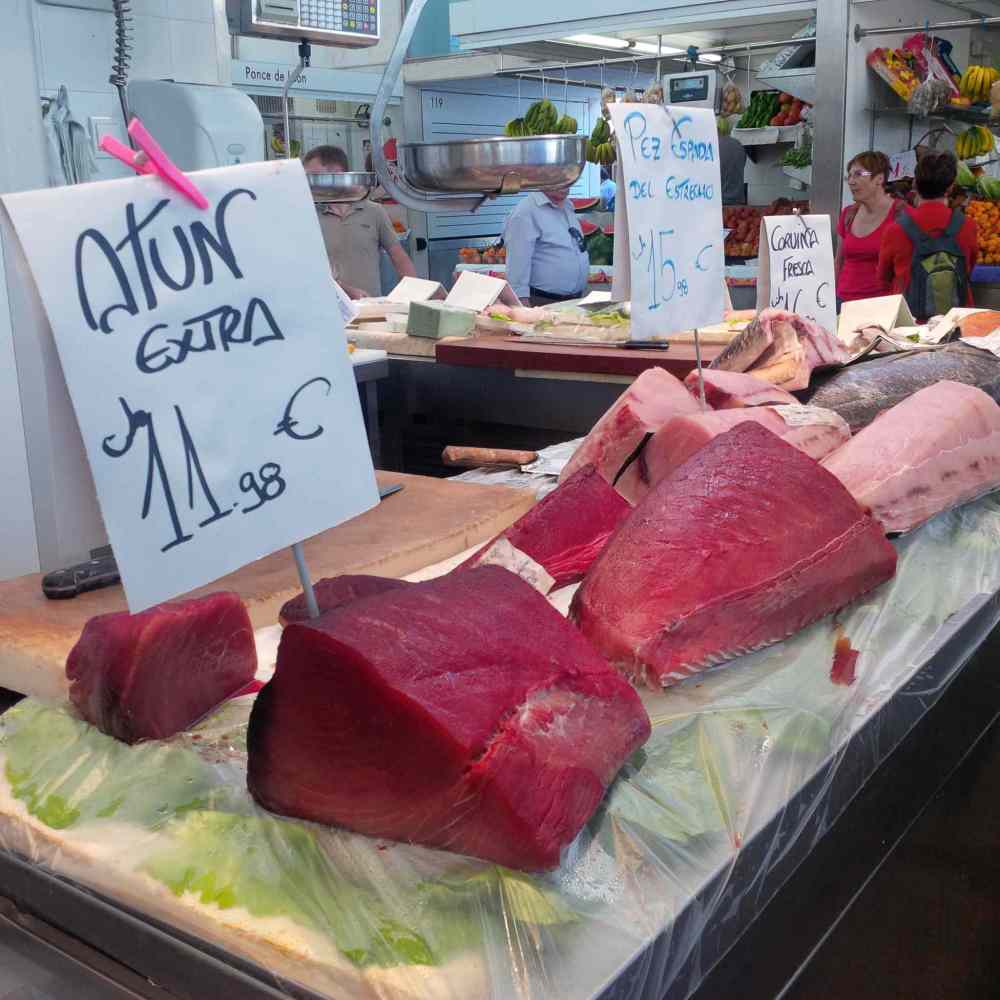
There are large chunks of bright-pink albacore and deep-red bluefin tuna, the latter an unfortunately tasty but endangered apex predator. There are even-deeper-red scarlet prawns, which the Spanish call carabineros, whose heads yield a marine essence so rich they’re used to flavour croquetas.
Bartley Kives / Winnipeg Free Press
Stalls bearing tuna at Mercado Central in Cádiz, Spain.
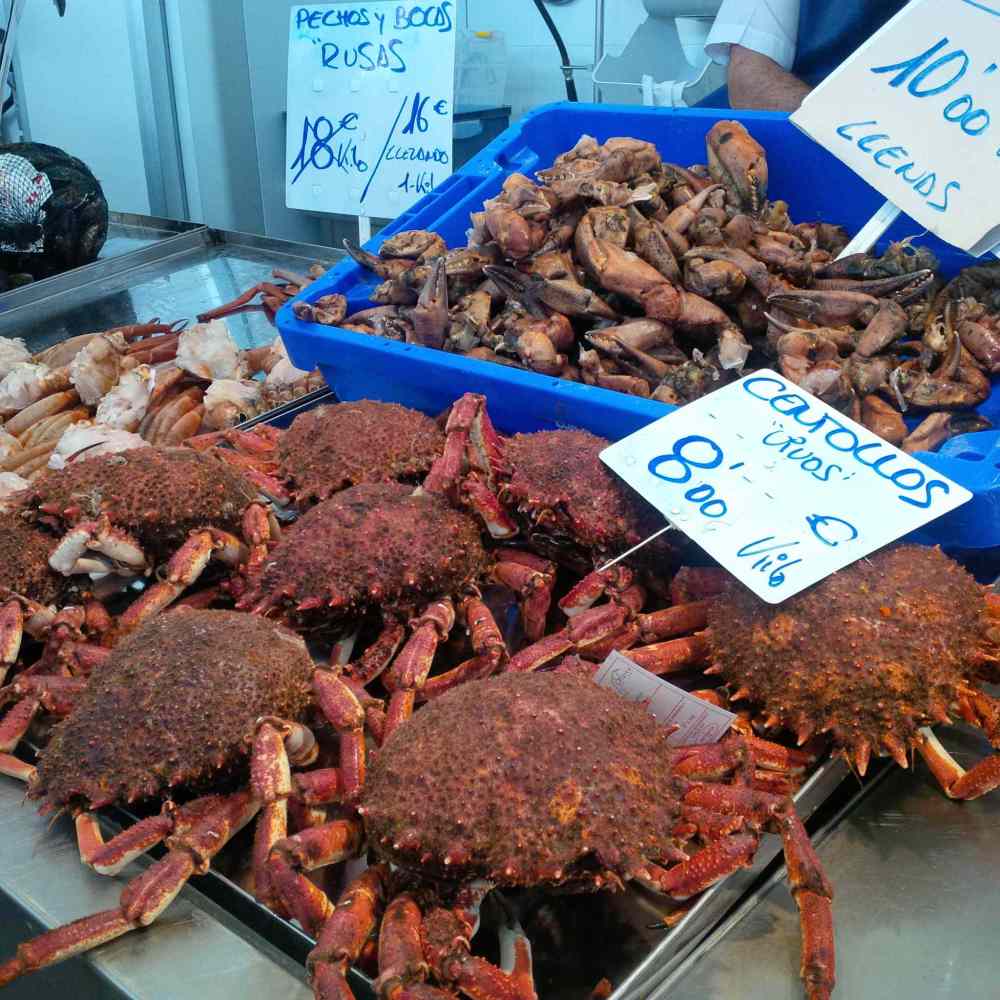
There are spider crabs the size of melons, rows of impeccably fresh mackerel and entire, intact dogfish, the small sharks killed in unconscionable numbers not for their fins, but for a firm, white flesh that tastes remarkably sweet due to the creature’s preferred diet of shellfish.
Some restaurants in Cádiz also serve something you won’t find anywhere else: the unusual (but nowhere near endangered) ortiguillas, or snakelocks anemones, which are dusted in flour, deep-fried and taste a lot like mild, if oversized oysters. Freiduria, or fried-fish restaurants that stay open late, also serve tortillitas, which are green-onion-flecked little pancakes of tiny shrimp, paper cones full of fried whitebait and chunks of dogfish, which are similarly fried after a lengthy soak in a tangy and slightly spicy adobo marinade.
Full disclosure: I helped consume platefuls of cazon en adobo in two different Andalucian cities before I realized what I was eating, breaking a self-imposed rule against chowing down on any fish or seafood species that can’t be harvested sustainably. I deserve whatever punishment awaits me in a shark-infested afterlife.
But this dish continues to haunt me. Happily, the Andalucian talent for frying up itty-bitty shark bits can be approximated by cooking firm-fleshed fish that don’t require protection from the International Union for the Conservation of Nature.
The closest thing to dogfish in texture may be haddock or hake, but good luck finding fresh fillets in Winnipeg supermarkets. High-quality frozen fish can be just as firm — and independent Winnipeg fish markets do have seasonal access to Pacific halibut, swordfish from the U.S. East Coast and on occasion, sustainably caught monkfish, all of which are tastier.
In reality, any firm-fleshed fish will do, though given the astronomical price of halibut, you may want to stick to something you don’t mind breading and frying.
So if you’re willing to forgo the environmental destruction, here’s a guilt-free version of the Andalucian fried-marinated-fish recipe. The end result will look like fish McNuggets, so don’t be put off by the pedestrian appearance.
You can serve these bits alone as an appetizer or make a plate into a meal, along with a bowl of the thick Andalucian tomato-and-bread soup known as salmorejo, as well as a dish of salpicon, a marinated salad.
Bartley Kives / Winnipeg Free Press
Spider crab at Mercado Central. Fish and seafood make up an essential component of the cuisine of Andalucia.
Pescado en adobo (fried marinated fish bites)
500 g (1 lb) firm-fleshed white ocean fish, such as haddock, swordfish or monkfish, cut into two-centimetre cubes
50 ml (1/4 cup) wine vinegar
50 ml (1/4 cup) of olive oil
Two cloves of garlic, peeled and finely minced
15 ml (1 tbsp) of smoked hot paprika (or more, to taste)
10 ml (2 tsp) of ground cumin
10 ml (2 tsp) of dried, crushed oregano
Flour for dredging
Sea salt, to taste
Frying oil of your choice
Combine olive oil, vinegar, garlic and spices together. If you can’t find smoked hot paprika, replace with sweet paprika and some hot chili powder or flakes.
Coat the fish in marinade, seal in a container and refrigerate overnight.
On a shallow plate, dredge fish pieces in flour, ensuring they’re coated with a light dusting.
Heat oil in a shallow pan to medium-high. In Spain, this would be olive oil. Feel free to choose another oil if you have health concerns about heating olive oil.
Fry fish pieces in small batches until they brown, which should take no more than a few minutes, turning when necessary. Remove with a slotted spoon to paper towel or a drying rack. Sprinkle with sea salt and serve with a lemon wedge.
The overseas arrest of a disgraced former law dean who defrauded the University of Manitoba out of more than $600,000 is being met both with relief and renewed frustration in the local legal community.
Joshua Frey-Sam6 minute readYesterday at 4:48 PM CDT
Every time Joshua Brown takes the court, the line between dreams and reality blurs.
You see, Brown, born and raised in East St. Paul, was diagnosed with cerebral palsy early in life. Understanding his condition, he came to terms with the challenge it would be to play stand-up sports competitively.
That didn’t stop him from dreaming, though.
Brown remembers watching Canada’s best in wheelchair basketball at the Paralympic Games on television as a youngster, and vividly recalls what went through his mind at the time.
Ben Sigurdson6 minute readWednesday, Sep. 23, 2026
He was born Colin Munn in Regina in 1964, but he’s best known by the name given to him onstage by his late friend Stevie Ray Vaughan in Ann Arbor, Mich., 20-plus years later — Colin James.
Alison Gillmor5 minute readYesterday at 6:06 PM CDT
The title sounds direct, straight-up and, well, concrete.
This is, however, a sweetly aimless, sneakily hilarious, completely unclassifiable documentary.
If you’re a real concrete wonk, you might end up frustrated. Yes, there will be some wild revelations about the world’s most common building material, but this is not exactly a comprehensive examination.
If you’re a John Wilson fan, on the other hand, you’ll find exactly what you want here. Known for his HBO series How To With John Wilson, the New York-based creator makes his move to the big screen with The History of Concrete, and that means more bizarro street footage, more funny business signs, and more encounters with weird and wonderful NYC randos.
By Bartley Kives5 minute readWednesday, Jul. 30, 2014
CÁDIZ, Spain -- Along the southern edge of Spain, one of the oldest cities in Europe sits at the end of a narrow peninsula, jutting out into the sea.
Cádiz, founded around 1100 B.C. by seafaring Phoenicians from the Mediterranean's eastern shore, has served as a gateway to Africa, the Atlantic and the New World for centuries. It was an important port for the Romans, who succeeded the Phoenicians, the Moors who followed the Romans and the modern Spaniards who housed immense quantities of South American silver within an old city whose walls still stand.
Today, Cádiz is a relatively quiet city of 123,000, where the narrow streets and sandy beaches appear to attract as many Spanish tourists as foreigners. The sea, however, remains its defining aspect.
At Playa de la Caleta, a rock-rimmed beach made famous in 2002 by Halle Berry's bikini-clad homage to original Bond girl Ursula Andress, neoprene-clad divers come ashore in small fishing skiffs, carrying mesh bags of still-writhing octopuses past sunbathers.