What’s wrong with the anti-Keystone argument
Advertisement
Read this article for free:
or
Already have an account? Log in here »
To continue reading, please subscribe:

Digital Subscription
One year of digital access for only $205*
- Enjoy unlimited reading on winnipegfreepress.com
- Read the E-Edition, our digital replica newspaper
- Access News Break, our award-winning app
- Play interactive puzzles
*First annual payment billed as $205.00 + GST for one year. This annual subscription will automatically renew at $233.00 + GST every 52 weeks (10% off the regular annual price of $259.35). Offer available to new and qualified returning subscribers only. Cancel any time.
To continue reading, please subscribe:
Add Free Press access to your Brandon Sun subscription for only an additional
$1 for the first 4 weeks*
- Enjoy unlimited reading on winnipegfreepress.com
- Read the E-Edition, our digital replica newspaper
- Access News Break, our award-winning app
- Play interactive puzzles
*Your next Brandon Sun subscription payment will increase by $1.00 and you will be charged $17.95 plus GST for four weeks. After four weeks, your payment will increase to $24.95 plus GST every four weeks.
Read unlimited articles for free today:
or
Already have an account? Log in here »
Hey there, time traveller!
This article was published 20/02/2013 (4933 days ago), so information in it may no longer be current.
Americans who are concerned about pollution and climate change have traditionally stood with science, in particular the consensus that greenhouse-gas emissions from human activity are warming the earth and changing the climate.
Opponents of the Keystone XL pipeline, in contrast, seem to deliberately ignore the evidence that the pipeline wouldn’t lead to environmental disaster. Missing from their argument — on prominent display in Washington protests this past weekend — are a few salient points. The pipeline would do little to increase greenhouse-gas emissions in North America. It would merely enable Canada to send its crude to Gulf Coast refineries via a north-south pipeline rather than rail or ship, and allow the United States to get more of the eight million barrels of oil it imports each day from a good neighbour.
Now that Nebraska has accepted a revised route for the pipeline around the state’s sensitive Sand Hills region, President Barack Obama is expected to decide this spring whether to allow its construction. He has already encouraged TransCanada Corp. to build the southern part of the line — from Cushing, Okla., to the Gulf Coast, and has only to consider the northern section, which crosses the Saskatchewan-Montana border.
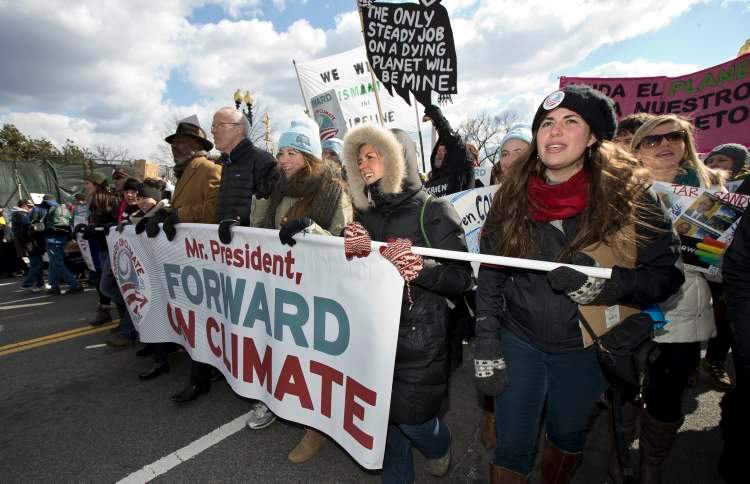
Even if, in making his decision, Obama takes concern for the environment into account, he will have no reason not to approve the project.
Here’s what’s wrong with the environmental argument against the Keystone project. Pipeline foes say that by pumping 700,000 barrels of crude a day to the U.S. it would encourage maximum development of the Athabascan oil sands in Alberta, Canada. Extraction of this thick, dirty crude requires heavy equipment to inject steam underground to unearth the liquefied tar. The process is therefore relatively expensive and high in carbon emissions compared with simple drilling for liquid oil.
Similar steam-injection processes that are used to extract oil from deposits in California’s San Joaquin Valley, however, haven’t received the kind of attention that anti-Keystone forces have aimed at the Alberta oil sands, as an editorial in the journal Nature recently pointed out. If these processes are so intolerable, why would the U.S. oppose Canada’s using them but still allow them to proceed at home?
In any case, extraction methods are getting cleaner. By 2015, carbon-capture technology is expected to reduce emissions from Canadian oil sands by as much as 35 per cent. Even now, when you look at the entire well-to-wheels life cycle of the oil sands crude, its emissions are at most 20 per cent greater than normal, because most of oil’s emissions come from burning the fuel.
Like most every sentient being, the project’s foes are worried about the pipeline’s potential to leak oil within the U.S. TransCanada is taking pains to ensure that the pipeline is designed for the heavy crude it is meant to carry and that it would be safely operated. Even so, we could expect a leak or two a year of more than 2,000 gallons of oil, according to the 2011 environmental impact statement on the project issued by the U.S. State Department. In most cases, however, such spills are expected to be contained in a small area and readily cleanable. This is the calculated risk we take with other oil and gas pipelines, thousands of miles of which crisscross the U.S.
So blocking the Keystone pipeline wouldn’t save the world from environmental catastrophe.
Nor would it save the U.S. economy, as its supporters have argued. The $7 billion project is forecast to bring 20,000 temporary jobs during its construction, but once built it will be operated and maintained by perhaps as few as 20 people.
The reason to approve the pipeline is that it would keep Canadian oil flowing to U.S. refineries in the most efficient way, within the bounds of safety, and this is reason enough.