Tabata and hit training

Benefits associated with work-to-rest intervals

Advertisement

Advertise with us

Q. For the last year or so, I have heard the term tabata thrown around in the gym and have been told it's the best form of exercise. What exactly does it mean and should I be incorporating it into my fitness routine?

Read this article for free:


By clicking the button above, an account will be created and you will begin to receive some of our recommended newsletters. You may opt out of any newsletter by visiting your Email and Communication Preferences page or by clicking "unsubscribe" at the bottom of any email.

or

Already have an account? Log in here »

To continue reading, please subscribe:

Digital Subscription

One year of digital access for only $1.44 a week*

  • Enjoy unlimited reading on winnipegfreepress.com
  • Read the E-Edition, our digital replica newspaper
  • Access News Break, our award-winning app
  • Play interactive puzzles

*Billed as $5.77 plus GST every four weeks. After 52 weeks, price increases to the regular rate of $19.95 plus GST every four weeks. Offer available to new and qualified returning subscribers only. Cancel any time.

To continue reading, please subscribe:

Add Free Press access to your Brandon Sun subscription for only an additional

$1 for the first 4 weeks*

  • Enjoy unlimited reading on winnipegfreepress.com
  • Read the E-Edition, our digital replica newspaper
  • Access News Break, our award-winning app
  • Play interactive puzzles
Start now

*Your next Brandon Sun subscription payment will increase by $1.00 and you will be charged $17.95 plus GST for four weeks. After four weeks, your payment will increase to $24.95 plus GST every four weeks.

Hey there, time traveller!
This article was published 20/07/2013 (4840 days ago), so information in it may no longer be current.

Q. For the last year or so, I have heard the term tabata thrown around in the gym and have been told it’s the best form of exercise. What exactly does it mean and should I be incorporating it into my fitness routine?

I was inundated with the term tabata two or three years ago and was totally in the dark. As a trainer, I am not usually the first to institute the newest training fad, but I eventually succumbed and did a bit of digging. Here is what I found.

Izumi Tabata is a researcher in Japan who did a study on high intensity interval training (HIIT) and its benefits. His study, performed on speedskaters, determined an interval of 20 seconds of work paired with 10 seconds of rest and repeated eight times over the course of four minutes (take a minute to digest all of those numbers), was the most effective and time-efficient way to improve cardiovascular fitness — both aerobic and anaerobic (we will get into that in a bit). His name and this specific interval have been popularized and are now synonymous with interval training.
TREVOR HAGAN / WINNIPEG FREE PRESS
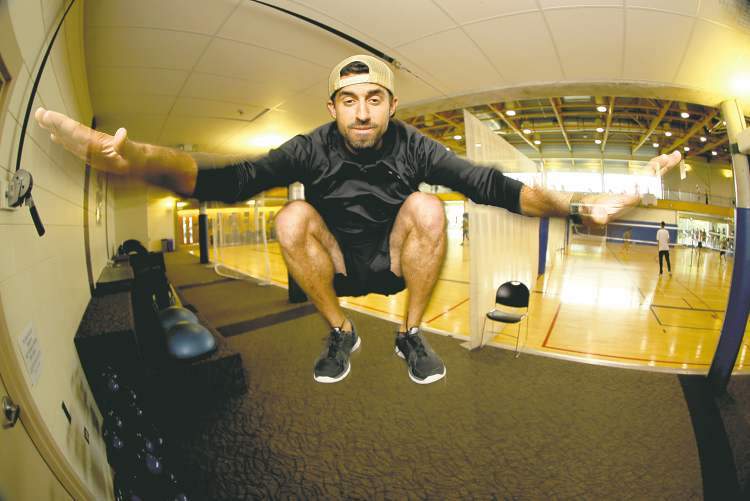
Wes Pomarensky completes a high intensity interval training drill. The burst of intensity is followed by a defined period of rest.
TREVOR HAGAN / WINNIPEG FREE PRESS Wes Pomarensky completes a high intensity interval training drill. The burst of intensity is followed by a defined period of rest.

So tabata training is simply high intensity interval training with a specific work-to-rest interval and length. HIIT training is defined as a period of high-intensity work paired with a period of low-intensity work or rest. This is beneficial, because your body has several systems at work to supply you with energy during exercise. At a lower intensity, your body will use primarily its aerobic system to create a muscle contraction, which uses oxygen and takes considerably longer to complete its pathway. Conversely, when you exercise at a high intensity, your body uses the anaerobic pathway to create a contraction and it does so through a highly expedited process without the immediate use of oxygen. Here is the kicker: When you exercise at high intensity, you get improvements in both systems, while low intensity exercise doesn’t achieve as significant anaerobic improvements.

So why should you care about aerobic and anaerobic improvements? Because it translates into increased fat loss and strength gains; when done properly, it can help train many specific movement patterns, and because you can incorporate almost any movement patterns involving large muscle groups, you can avoid some nasty overuse injuries caused by too much of one repetitive motion.

The caveat is this, and if you read the last piece on the functional movement screen this may already be apparent: Many of us are limited in which large-movement exercises we can perform properly without risking injury. Let’s revisit the burpee. If, as your trainer, I have to modify your burpee to a level that doesn’t challenge your anaerobic system, it’s no longer HIIT or tabata training. Therefore, this type of training is often reserved for fitter individuals.

My other issue with tabata training is the confines of the work-to-rest interval. If your goal is to consistently challenge your body by changing different variables in your exercise routine, why would you limit yourself to one interval length? Eventually, your body will acclimatize to that interval and will no longer be challenged. My approach to HIIT is to treat your interval length like all the other variables in your training routine and continue to modify them.

So approach tabata training with caution and select exercises you can do safely at high intensity while acknowledging HIIT is probably a better term for a broad and effective form of training. If you’ve performed this type of training, you know the feeling you experience when finished, and if you are going to try it — have fun.

We want your questions! Whether you are looking for guidance on a new pair of shoes or have a nagging shoulder injury that just won’t go away, email us at tim@eastmantherapy.ca and you could be featured in the next Q&A article.

Report Error Submit a Tip

More Stories

Puzzles Palace

1 minute read Friday, Oct. 16, 2026

To solve our puzzles, please subscribe with this special offer: |

Empty desks: Advocates talk chronic school absenteeism

Maggie Macintosh 5 minute read Preview

Empty desks: Advocates talk chronic school absenteeism

Maggie Macintosh 5 minute read 6:00 AM CDT

Concerned school and government leaders are downplaying the state of student absenteeism, as community organizers are strategizing to create urgency around who’s regularly missing class — and why — in Winnipeg.

The inaugural Youth at Risk in Winnipeg Symposium, held over the weekend at the Canadian Mennonite University, drew roughly 100 people to discuss barriers to attendance and brainstorm ways to remove them.

Nearly 20 years after he began calling attention to the issue, first as a volunteer with the Point Douglas Residents Committee, Sel Burrows gave an impassioned speech about the lack of political will to take meaningful action to help students from “dysfunctional homes.”

“I’ve dealt with nine cabinet ministers, Conservative and NDP, and five deputy ministers, and the issue has not gotten any better,” Burrows told teachers, reseachers and community support workers gathered Saturday on CMU’s Shaftesbury campus.

Read
6:00 AM CDT

Salvation Army calls on Winnipeggers to donate merchandise as sales soar

Kelly-Anne Riess 4 minute read Preview

Salvation Army calls on Winnipeggers to donate merchandise as sales soar

Kelly-Anne Riess 4 minute read Yesterday at 2:01 AM CDT

The Salvation Army is taking donated merchandise from other regions to stock its Winnipeg thrift stores as increasing sales outpace local donations.

Retail activity at the charity’s eight Winnipeg locations grew more than 10 per cent year over year during several months, from January through April, and again in June.

Although local donations remain strong, they haven’t kept pace with demand, prompting the organization to supplement inventory with merchandise from elsewhere.

Ted Troughton, managing director of the Salvation Army’s thrift store operations, said rising living costs are bringing in new customers.

Read
Yesterday at 2:01 AM CDT

Best move is to get honest, not ‘even’

Maureen Scurfield 4 minute read Yesterday at 2:01 AM CDT

DEAR MISS LONELYHEARTS: I just got a racy birthday card in the mail at work, with a letter inside it from an old girlfriend! Her praise of my body and intelligence was extravagant — almost poetic — but it felt really good.

I took it home and showed the card and letter to my wife, to make her jealous, I admit. All she said was, “Perhaps your old girlfriend’s getting into the booze in her old age!” That made me really mad.

Now I suddenly want to call up my ex and go visit her for a weekend. (She lives in another province.) I doubt if my wife would even suspect anything, as I travel a lot for my work.

Plus, when it comes to our own sex life, it seems like my wife couldn’t care less about being with me anymore. My wife’s big excitement is going out with girlfriends and flying to concerts with them. Things have gotten so petty between us now that I wouldn’t mind the feeling of evening things up! Please advise.

New twist in Hellebuyck saga, suspension ends Friday

Ken Wiebe 7 minute read Preview

New twist in Hellebuyck saga, suspension ends Friday

Ken Wiebe 7 minute read Saturday, Oct. 17, 2026

Connor Hellebuyck has played the reverse Uno card. What we don’t know is if he has any intention of coming back to friendly Manitoba or if this is simply the latest attempt to put the Winnipeg Jets' feet to the flames in an effort to move him to an American market.

Read
Saturday, Oct. 17, 2026

Addressing homelessness and toxic drug use

Kate Kehler and Molly McCracken 5 minute read 2:00 AM CDT

Winnipeg is facing a housing and toxic drug crisis that is not going away. Every day, we see the consequences — people living without safe homes, encampments in neighbourhoods and public spaces, increasingly toxic drugs, overdoses and emergency services stretched to their limits.

These are symptoms of a deeper crisis of inter-generational trauma related to colonization of the original peoples of these lands, compounded by a crisis in housing, income security, mental health and addictions services and the availability of community based supports.

Winnipeg’s next city council must decide whether it is prepared to invest in solutions that address the root causes.

Weaving a Better Winnipeg: The Alternative Municipal Budget 2026, proposes a five-point action plan that would put housing, outreach, human rights and Indigenous leadership at the centre of Winnipeg’s response.