

City lab solves flu mystery
Discovers Mexican, Canadian strains the same
Advertisement
Read this article for free:
or
Already have an account? Log in here »
To continue reading, please subscribe:

Digital Subscription
One year of digital access for only $205*
- Enjoy unlimited reading on winnipegfreepress.com
- Read the E-Edition, our digital replica newspaper
- Access News Break, our award-winning app
- Play interactive puzzles
*First annual payment billed as $205.00 + GST for one year. This annual subscription will automatically renew at $233.00 + GST every 52 weeks (10% off the regular annual price of $259.35). Offer available to new and qualified returning subscribers only. Cancel any time.
To continue reading, please subscribe:
Add Free Press access to your Brandon Sun subscription for only an additional
$1 for the first 4 weeks*
- Enjoy unlimited reading on winnipegfreepress.com
- Read the E-Edition, our digital replica newspaper
- Access News Break, our award-winning app
- Play interactive puzzles
*Your next Brandon Sun subscription payment will increase by $1.00 and you will be charged $17.95 plus GST for four weeks. After four weeks, your payment will increase to $24.95 plus GST every four weeks.
Read unlimited articles for free today:
or
Already have an account? Log in here »
Hey there, time traveller!
This article was published 07/05/2009 (6318 days ago), so information in it may no longer be current.
WINNIPEG – It’s not easy to run a race when you’re suited up in bulky biohazard gear.
But for the Winnipeg scientists staring at the DNA of the deadly H1N1 influenza that’s sparked a global panic, they had both the speed and the stamina.
And after working round-the-clock for six days on the flu samples from Mexico flown into Winnipeg, they cracked the genetic code behind an influenza outbreak that’s baffled some of the world’s top scientific minds.
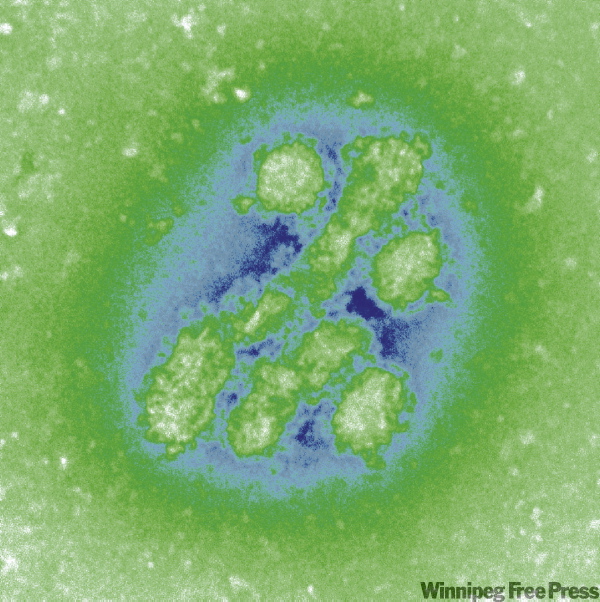
Their breakthrough — that it’s the same strain that’s infected more than 160 Canadians — has pushed scientists one step closer to answering the burning question of why cases of H1N1 in Mexico are far more severe than those reported in Canada and elsewhere around the world. It has also laid the groundwork for scientists to begin mapping the history of the virus to determine when it first appeared in humans.
Dr. Frank Plummer, scientific director of the Winnipeg-based National Microbiology Lab, said a team of scientists worked 24 hours a day to sequence the DNA of three H1N1 virus samples — one from Nova Scotia, one from Ontario, and one from Mexico.
"The fact that we did it in less than a week working through the night is pretty incredible," Plummer said, during a teleconference in Ottawa.
"This is a considerable scientific achievement and will help advance understanding of this virus. We’re very proud of that work and the people that made it possible…" Plummer said.
Unlike 400 other recent samples that arrived from Mexico in President Felipe Calderón’s private plane, the Mexican sample was part of the original batch sent to the Winnipeg lab in April, when the country noticed a strange severe respiratory illness had surfaced.
Plummer said the genetics of all three samples have no significant differences, which means the virus itself is not the reason more severe cases of respiratory illness have been reported in Mexico than in Canada.
Plummer said the discovery suggests that differences in human genetics could explain why some people fall severely ill while others experience a mild flu. He said the environment in Mexico is much different than in Canada, and that scientists will continue to investigate possible explanations.
To date, only one Canadian, a young girl in Alberta, reported a severe case of H1N1, also known as swine flu. By comparison, 42 Mexicans died from the illness.
A Brandon girl is recovering from a mild case of human swine flu. No new cases of the illness were reported in Manitoba Wednesday.
Federal Health Minister Leona Aglukkaq applauded the lab’s work, and said it is a big step forward in understanding the new virus.

"This is the world’s first and a real validation of Canada’s scientific excellence," Aglukkaq said.
While human swine flu initially raised fears the disease could unleash a severe global pandemic, Plummer said the new data suggests its virulence is similar to seasonal flu. Seasonal flu kills between 4,000 and 5,000 Canadians a year, and a range of mild and severe cases is usually reported. Understanding the virus structure and how it spreads and mutates will also be key to developing a vaccine, Plummer said.
"I don’t think there’s reason to panic," Plummer said. "Considering what we’re seeing, it’s going to be like the seasonal flu."
Mexico approached the lab on April 17 for help. More than 50 samples were sent to the lab and scientists worked diligently to determine the cause of the illness.
jen.skerritt@freepress.mb.ca
Related Articles
Showing support by piggin' out
Advertisement Advertise With Us
Advertisement Advertise With Us