

Bucking big-box grocers
Personal touch, customer service allow independent stores to survive
Advertisement
Read this article for free:
or
Already have an account? Log in here »
To continue reading, please subscribe:

Digital Subscription
One year of digital access for only $205*
- Enjoy unlimited reading on winnipegfreepress.com
- Read the E-Edition, our digital replica newspaper
- Access News Break, our award-winning app
- Play interactive puzzles
*First annual payment billed as $205.00 + GST for one year. This annual subscription will automatically renew at $233.00 + GST every 52 weeks (10% off the regular annual price of $259.35). Offer available to new and qualified returning subscribers only. Cancel any time.
To continue reading, please subscribe:
Add Free Press access to your Brandon Sun subscription for only an additional
$1 for the first 4 weeks*
- Enjoy unlimited reading on winnipegfreepress.com
- Read the E-Edition, our digital replica newspaper
- Access News Break, our award-winning app
- Play interactive puzzles
*Your next Brandon Sun subscription payment will increase by $1.00 and you will be charged $17.95 plus GST for four weeks. After four weeks, your payment will increase to $24.95 plus GST every four weeks.
Read unlimited articles for free today:
or
Already have an account? Log in here »
Hey there, time traveller!
This article was published 14/01/2017 (3519 days ago), so information in it may no longer be current.
It’s Monday afternoon on an unusually mild winter day in Winnipeg, and Bob Upton is making the first of what will likely be five trips that week to his neighbourhood grocery store — Dakota Family Foods.
“I don’t do a weekly shopping,” the self-employed business consultant explains. “I shop almost every day, because I never know what I want (to eat).”
On this particular day, Upton has a couple of bananas, a few oranges, some tuna, a small carton of milk and a few fresh buns in his shopping basket. He says he’ll shop at big-box stores such as Safeway, Sobeys or Real Canadian Superstore if they’re offering a special on something he needs, “but I probably do about two-thirds of my shopping here.”
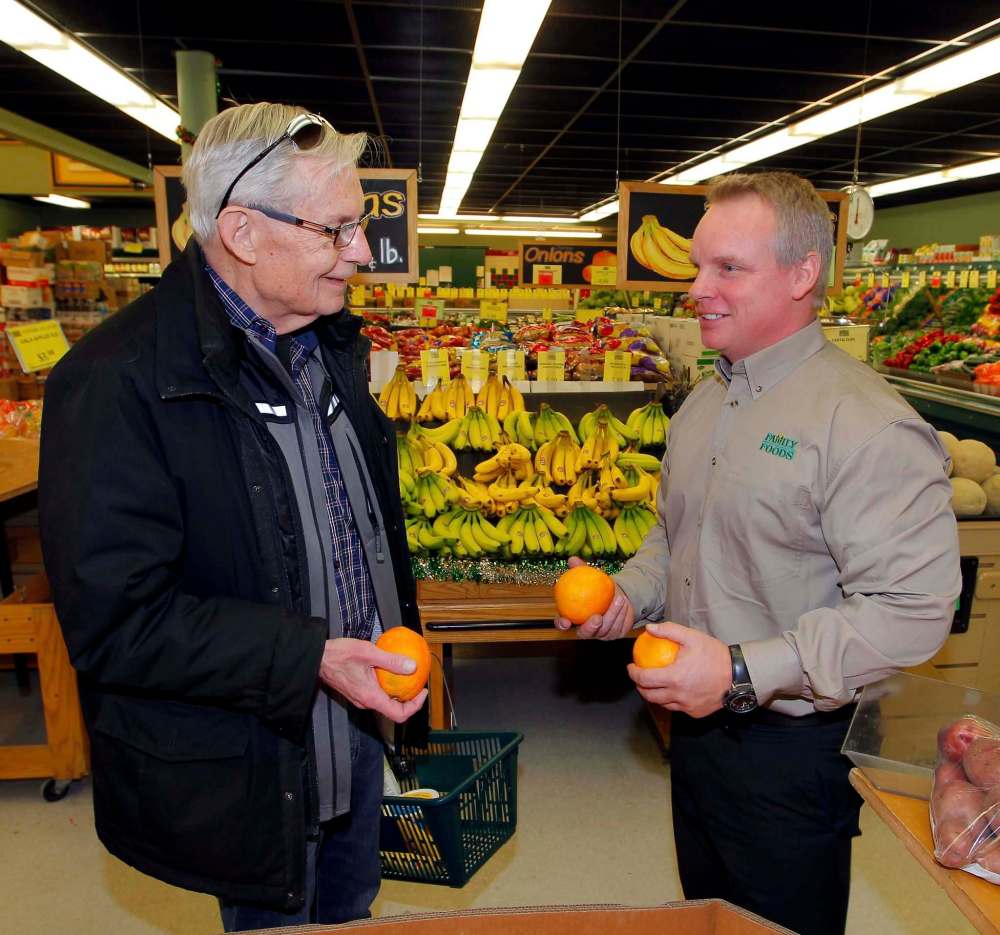
Ask him what keeps him coming back to his neighbourhood store, and Upton rattles off a bunch of reasons: He lives nearby, so it’s handy to shop there. The store isn’t really big, so he knows where to find things. Because he shops there often, he knows a lot of the department managers and employees and trusts their advice on different products.
He also likes the way store owner Scott Clement will roll up his sleeves and help restock the shelves or assist a customer.
“I grew up working in retail… and I have a lot of respect for people like that,” Upton explains.
Last but not least, he shops there because he finds prices on most items are competitive with big-box stores.
“And I do compare (prices),” he adds.
Shoppers such as Upton are the bread and butter for independent grocers such as Clement and Munther Zeid, whose family owns and operates five Foodfare stores in Winnipeg. It’s why these grocers try to go that extra mile to keep their customers coming back.
“It (grocery retailing) is one of the most competitive industries right now,” Clement says, noting he has a Walmart, a Red River Co-op store, a Sobeys, a Safeway and a Real Canadian Superstore within a short drive of his store. Then there are the non-traditional grocery retailers that are popping up.
“Everybody is selling food now, almost,” he says. “You can go into Canadian Tire and buy chips and pop and all of that, and all of the pharmacies now are doing that kind of stuff (selling more food products).”
Asked for an example of something he does that his chain competitors don’t do, Clement tells the story about how another independent grocery store in the area recently closed and a lot of its customers began shopping at his store. One of them stopped him one day to say the other store used to carry a brand of frozen pizzas made by Winkler-based Spenst Brothers Premium Meats that he really liked but can no longer find.
Clement told him he’d be right back, ran and placed an order with Spenst Brothers, then returned to tell the customer the pizzas would be arriving within in two days. Maybe it’s karma, but that simple act is paying dividends.
“The shipment I brought in sold out right away,” Clement says, so he’s ordering more of the pizzas and will continue carrying them as long as they sell.
Ask Zeid for an example of why he thinks his Foodfare stores continue to survive and he tells the story about the customer who asked him to bring in some chicken’s feet. So he called all of his suppliers, but none of them carried the product. Then one day he was checking out the new Save-On-Foods store on McPhillips Street and noticed it sells chicken’s feet. So he told his customer and even offered to pick up a few boxes for her the next time he’s out that way.
“She gives me a weird look and says, ‘Why would you do that?’ I said because you’re my customer, and I know you’re looking for them. And she said, ‘You know what? You just gained me as a loyal customer because of that.’”
‘She gives me a weird look and says, “Why would you do that?” I said because you’re my customer and I know you’re looking for them. And she said, “You know what? You just gained me as a loyal customer because of that”‘– Foodfare’s Munther Zeid
Zeid and Clement say that’s one of the advantages independent grocers have over chain stores — they can respond quickly to customer demands.
“We don’t have to go through head office,” Clement notes. ‘“The decision is made right here, right away.”
The same goes for responding to changing market conditions. Clement noticed more immigrant families were moving into his area, so he opened a small ethnic-foods section in his store. He also started carrying gluten-free products after more customers starting asking for them.
Both grocers say they’re carrying more locally grown or locally produced products because that’s what a growing number of their customers want. Being an independent, Clement says he has the freedom to source products from many different wholesalers and suppliers. If one of them is offering a special on a certain product, he can pass on the savings to his customers. He thinks it’s one of the reasons his store is able to offer such competitive prices on many of the meat products it sells.
He says Family Foods stores enjoy the best of both worlds because their main supplier is the wholesale division of Sobeys/Safeway.

“So we can also take advantage of their purchasing power.”
He notes his store makes its own smoked meat, “and we have a lot of people who come from all over the city for our garlic rings, garlic sausages and garlic coils.”
Tom Barlow, president and CEO of the Canadian Federation of Independent Grocers, says it sounds like Clement is doing the things independent grocers need to do to survive in today’s highly competitive marketplace.
“The independents that are doing well are the ones that have figured out what the big guys can’t do. They’ve found that kind of keystone… that thing that kind of separates them.”
murray.mcneill@freepress.mb.ca
History
Updated on Saturday, January 14, 2017 9:03 AM CST: Photo added.