

High-frequency trading is reshaping the investment landscape
Advertisement
Read this article for free:
or
Already have an account? Log in here »
To continue reading, please subscribe:

Digital Subscription
One year of digital access for only $205*
- Enjoy unlimited reading on winnipegfreepress.com
- Read the E-Edition, our digital replica newspaper
- Access News Break, our award-winning app
- Play interactive puzzles
*First annual payment billed as $205.00 + GST for one year. This annual subscription will automatically renew at $233.00 + GST every 52 weeks (10% off the regular annual price of $259.35). Offer available to new and qualified returning subscribers only. Cancel any time.
To continue reading, please subscribe:
Add Free Press access to your Brandon Sun subscription for only an additional
$1 for the first 4 weeks*
- Enjoy unlimited reading on winnipegfreepress.com
- Read the E-Edition, our digital replica newspaper
- Access News Break, our award-winning app
- Play interactive puzzles
*Your next Brandon Sun subscription payment will increase by $1.00 and you will be charged $17.95 plus GST for four weeks. After four weeks, your payment will increase to $24.95 plus GST every four weeks.
Read unlimited articles for free today:
or
Already have an account? Log in here »
Hey there, time traveller!
This article was published 02/03/2013 (4932 days ago), so information in it may no longer be current.
The leading edge of market finance is of little concern for most average investors.
They buy, they hold and they hope their investment grows over time to a size that can provide enough money for retirement.
Yet increasingly, the public is becoming aware of the relatively unseen world of investing that is both a boon and bane for all investors, and it’s changing the investing world forever — for better and for worse.
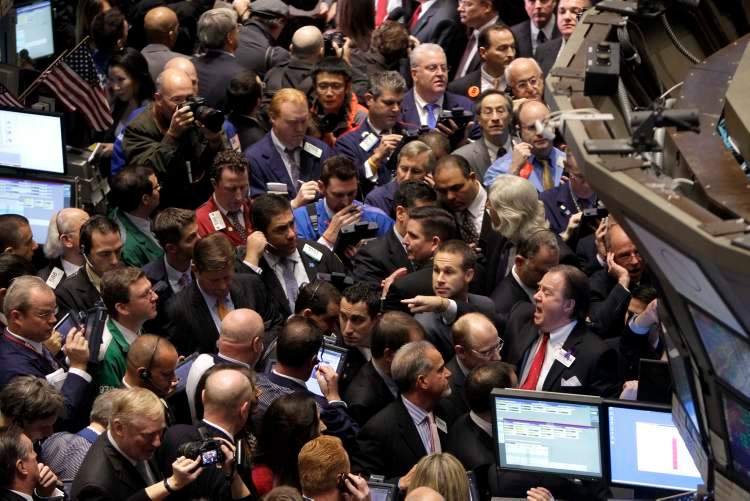
Few have heard of the term high-frequency trading, which generally involves small firms run using big, fast silicon brains to trade large amounts of securities, often buying, holding and selling them within seconds, thousands of times a day.
This high-volume, high-frequency strategy can result in big profits off microscopic differences in pricing on investments bought and sold on exchanges.
For the most part, this supercomputer-driven form of investing involves very secretive strategies based on complex mathematical algorithms that allow high-frequency trades to hum along without drawing much attention.
Yet when these systems are alleged to cause trouble, such as in the 2010 Flash Crash that saw the Dow Jones Industrial Average drop 1,000 points in minutes, they come to the attention of the investing public and legislators who demand tighter regulation and fairer play.
Despite the concerns, high-frequency trading has made the world a better place to trade, says one of the leading academic experts on the subject, in town recently to speak to members of Winnipeg’s CFA Society, an organization of investment analysts.
“I think there’s a general feeling that high-frequency trading is inherently bad or unethical, or that the people involved are unethical,” says Dr. Ben Van Vliet, an assistant professor at the Illinois Institute of Technology’s Stuart School of Business in Chicago.
But this is largely a misconception, says Van Vliet, who has worked in the high-frequency trading industry.
“High-frequency traders actually provide a valuable service for every investor,” he says.
“They make for tight spreads and deep liquid markets, so that when individual investors want to buy and sell, they can do so at minimal cost.”
Bid-ask spreads — the difference between what a buyer wants to pay and what a seller is willing to accept as payment — have become much tighter as a result of high-frequency trading. Furthermore, because more trades are occurring, it’s likely easier for investors to sell or buy a security much more quickly.
“When I was a broker, we had spreads a dollar wide,” Van Vliet says about his work in the 1990s.
“Now, spreads are pennies wide, and that’s due to automation and high-frequency traders.”
Yet despite its upside, high-frequency trading isn’t without its profound problems, he says. To be blunt, its players lack a code of ethics or standards that apply to many industries that are equally as technical, complex and important.
Even stock analysts, financial planners and advisers have rules by which they have to play the game, but the individuals building high-speed computers that use highly secretive trading formulas lack those standards.
Yet it’s not just high-frequency trading that isn’t standardized. It just happens to be the red flag calling for the need for automated-investing standards, Van Vliet says. Our entire financial system is now run by computers. In fact, you practically can’t do anything financial without involving electronics.
And unlike the aerospace industry, for example, no set of clear, universal standards exists to ensure the computers and the people building and using them in the investment world are behaving as they should.
“We’ve gone from what used to be a face-to-face business to an engineered industry, and quantification and automation have led to this machine perspective of finance, and yet we’ve got a bit ahead of ourselves because no new norms have been developed,” he says.
At the moment, regulators and the industry are moving in “fits and starts” trying to rein in this complex new world, but it’s a work in progress.
“We’re moving from what has traditionally been more of a gambling culture to now more of an engineering culture,” Van Vliet says.
But unlike civil engineering, there are no standards that stipulate how a bridge should be built.
“If you build bridges, the standard is to test your bridge. Why? Because it’s your ethical obligation to the people who will use the bridge,” Van Vliet says. “The ethics are implicit in the standards.”
The current lack of rules for financial automation has led to all sorts of problems in the last few years, creating an atmosphere of “blamelessness,” where those who come from the investment side, often heading these firms using increasingly engineered strategies, can claim they didn’t really know what was going on when something goes wrong.
In some ways, this is understandable. More often than not, the individuals helping develop high-frequency trading programs are highly specialized.
Often referred to as quants, their discipline of study — quantitative mathematics — is a complex area of study that initially attracted some of the world’s most talented physicists.
“Because there’s so much in common between physics and financial math, in large part, originally quantitative analysis started by borrowing quants from physics because physics doesn’t pay, so you had all these PhDs with nothing to do, and Wall Street used their same mathematics in finance to try and make money,” he says.
This led to the explosion of automated finance over the last 15 years, with high-frequency trading as the frontier of computers’ ability to seek out profits like never before.
“They’re basically using mathematical models that originally dealt with the movements of very small particles and applying them to the movement of very small price movements,” Van Vliet says.
While the advent of the big brains, with the help of even bigger silicon brains, turning their scientific gaze toward finance has largely made investment better for all, this area of growth needs standards so “planes don’t crash and hurt people.”
Van Vliet says the aim is for industry to develop a set of standards similar to the self-regulating international standard of ISO (International Standards Organization), used for engineering, health care, agriculture and other industries, which also involve complex processes.
As a member of working group AT 9000, he is teaming up with government, industry players and other parties to develop a new set of standards that will not only standardize high-frequency trading but all automation in investment finance.

“One of the things we’re trying to say is that there needs to be a kind of profession of automated trading, like an engineering discipline, because we really do live in an engineered world of automated finance without any engineering standards, and therefore without any engineering ethics,” he says.
“We’re still in the barnstorming days of automated trading.”
It’s similar to the early days of aerospace when hotshot pilots who flew planes through barns and walked down wings eventually became airline pilots. The days of stunt-piloting in finance must end, too, Van Vliet says.
“What we’re trying to say is, ‘You don’t get to fly upside down anymore for a pretty good reason — there are other people aboard the plane.’ “
giganticsmile@gmail.com
History
Updated on Saturday, March 2, 2013 12:14 PM CST: adds fact box