

More ‘incubators’ growing tech firms
Advertisement
Read this article for free:
or
Already have an account? Log in here »
To continue reading, please subscribe:

Digital Subscription
One year of digital access for only $205*
- Enjoy unlimited reading on winnipegfreepress.com
- Read the E-Edition, our digital replica newspaper
- Access News Break, our award-winning app
- Play interactive puzzles
*First annual payment billed as $205.00 + GST for one year. This annual subscription will automatically renew at $233.00 + GST every 52 weeks (10% off the regular annual price of $259.35). Offer available to new and qualified returning subscribers only. Cancel any time.
To continue reading, please subscribe:
Add Free Press access to your Brandon Sun subscription for only an additional
$1 for the first 4 weeks*
- Enjoy unlimited reading on winnipegfreepress.com
- Read the E-Edition, our digital replica newspaper
- Access News Break, our award-winning app
- Play interactive puzzles
*Your next Brandon Sun subscription payment will increase by $1.00 and you will be charged $17.95 plus GST for four weeks. After four weeks, your payment will increase to $24.95 plus GST every four weeks.
Read unlimited articles for free today:
or
Already have an account? Log in here »
Hey there, time traveller!
This article was published 03/11/2011 (5388 days ago), so information in it may no longer be current.
Business incubators are designed to help technology companies grow in all sorts of ways.
Often, those companies need help with management issues, sales and marketing and protection of intellectual property.
Many also want the incubator to help them find enough working capital to realize their dream of commercializing their technology.
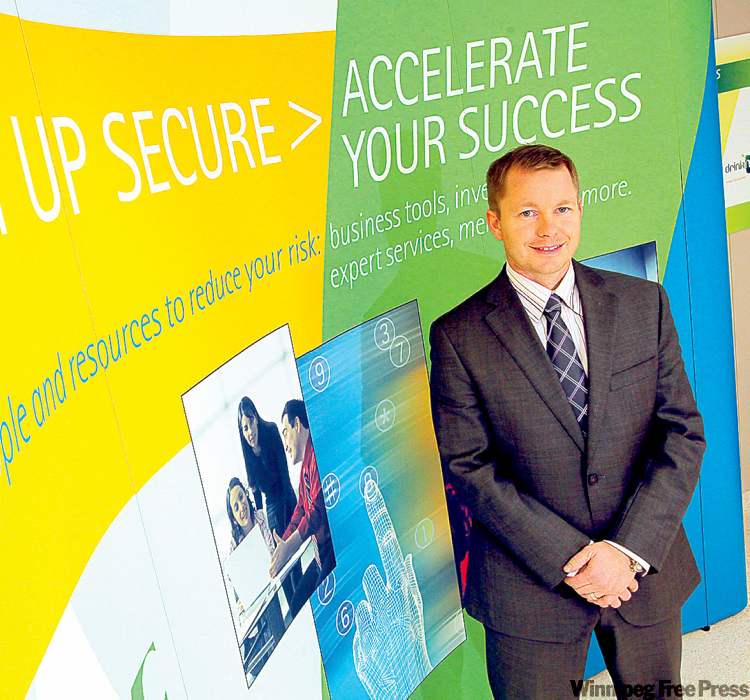
BCC (originally an acronym for Biomedical Commercialization Canada) is an incubator funded by contracts with the National Research Council-Industrial Research Assistance Program and the provincial government and is located beside the NRC building on Ellice Avenue.
Marshall Ring, CEO of BCC, says there is a real “subculture of commercialization” growing in the city.
BCC helps foster that by holding regular community engagement events, or open houses. At one such event this week, a potential investor attended because he’s looking for a new company after selling one he’d spent 20 years building.
Ring said one of BCC’s eight client companies received a $125,000 investment from two investors who met the company at such an event six months ago.
It’s a long way from a slam dunk, but there are more — and higher-quality — places to turn for the serious technology entrepreneur who wants to commercialize technology and start a business.
At the University of Manitoba’s Smartpark, the Eureka Project incubator doubled its size a year and a half ago and doubled — and in some cases, as much as quadrupled — the fees it charges clients in its own quest for self-sufficiency. Its CEO, Gary Brownstone, said the changes were made to pre-empt any possible disruption in provincial funding.
The fact the increase in rent did not drive away clients showed its services are valuable.
“We have decreased our (government) funding by 70 per cent,” Brownstone said. “I can’t say with certainty when we’ll get to zero, but we are certain it won’t go higher.”
The Eureka Project has a stable of award-winning companies it’s fostering to financial self-sustainability. Some of those companies are generating more than $1 million in revenue but are not yet at the stage where they can meet all their internal management needs.
But when Eureka clients such as Invenia, Project Whitecard and Global Wind Group leave the incubator, their chances of long-term success will have arguably increased.
Last week, Deloitte became a corporate sponsor of the incubator, joining law firm Thompson Dorfman Sweatman and RBC Financial. Such a blue-chip group indicates the potential to be mined from the 16 client companies at Eureka.
Carol Paradine, Deloitte’s managing partner in Winnipeg, said it’s important to the economy for new companies to be able to grow.
“We are involved in a number of incubators across the country,” Paradine said. “If we do a good job and invest time with the early-stage companies, we can build loyalty and later on, as they grow and become bigger, they go to us for additional work.”

This month, the city’s technology commercialization infrastructure deepened with the opening of AssentWorks, a membership-driven “makerspace” for entrepreneurs and inventors to do rapid prototyping, among other things. Priming its own pump, the Eureka Project became one of the original core sponsors of AssentWorks, establishing a relationship in which they steer members to each other.
“We want to cast as wide a net as possible and be where the early-stage enterprises take place,” Brownstone said.
It’s too early to say how well a $3-million, five-year technology commercialization package the province unveiled in spring will work.
But there are plenty of companies out there looking for the smartest path to success and an increasing number of quality service providers who can help.
martin.cash@freepress.mb.ca