

‘Pig whisperer’ urges an end to mega-barns
More freedom for hogs in Europe
Advertisement
Read this article for free:
or
Already have an account? Log in here »
To continue reading, please subscribe:

Digital Subscription
One year of digital access for only $205*
- Enjoy unlimited reading on winnipegfreepress.com
- Read the E-Edition, our digital replica newspaper
- Access News Break, our award-winning app
- Play interactive puzzles
*First annual payment billed as $205.00 + GST for one year. This annual subscription will automatically renew at $233.00 + GST every 52 weeks (10% off the regular annual price of $259.35). Offer available to new and qualified returning subscribers only. Cancel any time.
To continue reading, please subscribe:
Add Free Press access to your Brandon Sun subscription for only an additional
$1 for the first 4 weeks*
- Enjoy unlimited reading on winnipegfreepress.com
- Read the E-Edition, our digital replica newspaper
- Access News Break, our award-winning app
- Play interactive puzzles
*Your next Brandon Sun subscription payment will increase by $1.00 and you will be charged $17.95 plus GST for four weeks. After four weeks, your payment will increase to $24.95 plus GST every four weeks.
Read unlimited articles for free today:
or
Already have an account? Log in here »
Hey there, time traveller!
This article was published 27/03/2010 (5993 days ago), so information in it may no longer be current.
The "pig whisperer" is trying to soothe an embattled hog industry in Manitoba.
Speaking at a panel discussion at the University of Manitoba on Thursday, Dr. Kees Scheepens, a veterinarian and sow farmer from the Netherlands, is an advocate for a less-intensive hog production system.
Dubbed the pig whisperer for his rather unique ability to ‘communicate’ with swine, Scheepens provided a European view on what the hog industry in Canada should aspire to look like, using his own backyard as the basis for his argument.
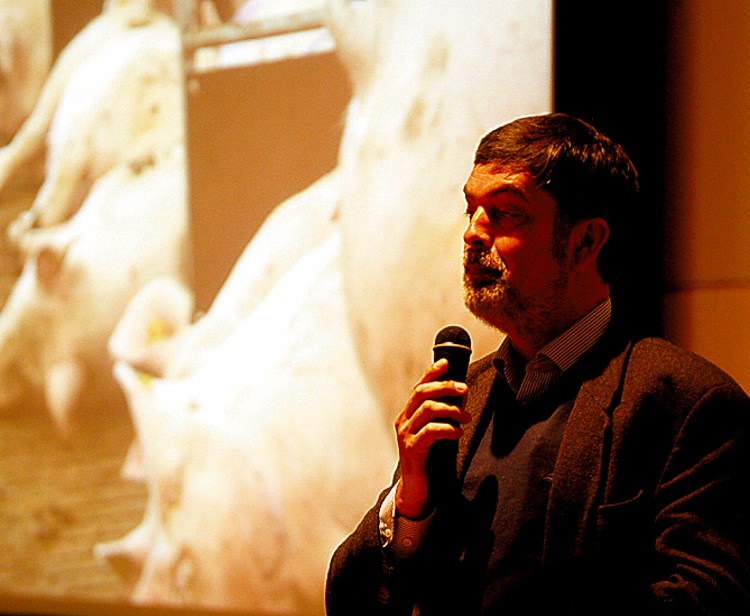
Scheepens said the Netherlands, a country of 16 million people and 12 million pigs, is a prime example of how a hog industry can work in conjunction with everyday life. There are some 2,500 non-corporate lots, with each farm containing about 400 animals.
On top of that, more than 75 per cent of those barns have made the move from a gestation stall configuration to a group housing, straw-feed system.
Smaller is better, according to Scheepens, and when you look at the environmental moves the Dutch have instituted over the years — upgrades in both manure management and air washing to remove the smell — while getting away from the mega-barn, his point gives local producers something to chew on. "How big does a company need to be?" he said. "Let’s go back to a human size of industry and let’s go back to a human size of farming. Let humans be humans and let pigs be pigs."
Vicki Burns, former director of the Winnipeg Humane Society who now oversees the Lake Winnipeg Watershed Initiative, wonders why the industry is waiting so long to make the switch.
"The problem is, when you keep any animal so confined for its entire adult life that it cannot even turn around, that is basically not humane," Burns said.
"We don’t need to make the argument any more complex than that."
That argument, however, comes with a high cost. At a time when Manitoba hog producers are stretched to the limit by a drop in animal prices and any consumer fallout to a swine flu epidemic, moving away from gestation crates is next to impossible.

Marg Rempel owns a small sow operation near Ste. Anne, and at any one time she’ll have about 5,000 animals in her barns. She is open to the group housing system, but changing over the stalls she has would cost roughly $1,000 per unit, so making the switch right now is a major financial concern — and one that simply isn’t in the cards.
"The change is (determined) by financial viability to move in that direction," she said. "For me to exist, I still have to be able to pay the bills."
In Canada, major producers (Smithfield, Maple Leaf) have announced they are phasing out the gestation stalls by 2017, perhaps making way for smaller, more humane barns in the future.
The movement towards a more wide-open space for hogs is already underway around the world. In Europe, all 27 countries have started the process to get rid of adult gestation stalls by 2012 and in the United States, individual jurisdictions have begun phasing out the stalls before the end of the decade. Major food service companies (Safeway, McDonald’s) have announced they will be buying more of their meat from farms that do not use the confinement crates.
adam.wazny@freepress.mb.ca