

Pulse flour may be next hit
Processors say milled product could be big new export
Advertisement
Read this article for free:
or
Already have an account? Log in here »
To continue reading, please subscribe:
Digital Subscription
One year of digital access for only $75*
- Enjoy unlimited reading on winnipegfreepress.com
- Read the E-Edition, our digital replica newspaper
- Access News Break, our award-winning app
- Play interactive puzzles
*Billed as $5.77 plus GST every four weeks. After 52 weeks, price increases to the regular rate of $19.95 plus GST every four weeks. Offer available to new and qualified returning subscribers only. Cancel any time.
Monthly Digital Subscription
$4.99/week*
- Enjoy unlimited reading on winnipegfreepress.com
- Read the E-Edition, our digital replica newspaper
- Access News Break, our award-winning app
- Play interactive puzzles
*Billed as $19.95 plus GST every four weeks. Cancel any time.
To continue reading, please subscribe:
Add Free Press access to your Brandon Sun subscription for only an additional
$1 for the first 4 weeks*
- Enjoy unlimited reading on winnipegfreepress.com
- Read the E-Edition, our digital replica newspaper
- Access News Break, our award-winning app
- Play interactive puzzles
*Your next Brandon Sun subscription payment will increase by $1.00 and you will be charged $17.95 plus GST for four weeks. After four weeks, your payment will increase to $24.95 plus GST every four weeks.
Read unlimited articles for free today:
or
Already have an account? Log in here »
Hey there, time traveller!
This article was published 24/01/2015 (4137 days ago), so information in it may no longer be current.
Food processors want to take our pulses.
Pulses — high-protein, high-fibre, low-glycemic-index crops such as peas and lentils — are growing in popularity for their health and nutrition, and their flours are in demand by food processors looking to create cereals, bread and snack food.
Canada is the world’s largest exporter of pulse crops and now wants to be the world’s largest at milling pulses into flour for export.
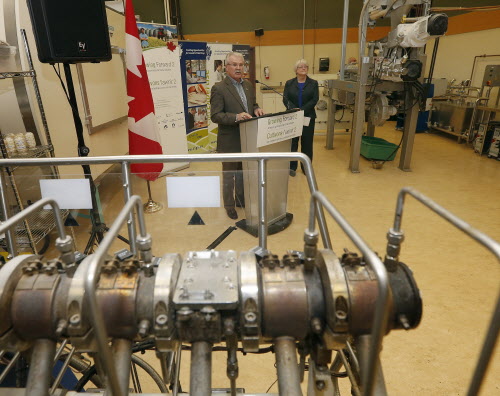
To that end, the Canadian International Grains Institute (CIGI) recently finished Phase 1 of a five-year federally funded project on pulse-flour milling and utilization and is about to move into Phase 2.
Friday, federal Agriculture Minister Gerry Ritz announced CIGI was getting an additional $950,000 for the next five-year phase of applied research — called the Advancing Pulse Flour Processing and Applications project — to further advance the work.
“These are beginning days in the pulse-flour business as opposed to using it whole in soups or as additives like in hummus,” Ritz said Ritz. “Making it into flour means a whole world of opportunities and demand.”
Pulse flours have only been on the market for about 10 years, and there is all sorts of market development that still needs to happen.
But Ritz said there is good demand around the world, especially in China and the Pacific Rim.
JoAnne Buth, CEO of CIGI, said, “We will focus on optimizing the nutritional quality of pulse flour through the milling process and also the applications for value-added ingredients.”
Julianne Curran, director of nutrition, scientific and regulatory affairs at Pulse Canada, said there are several attributes of pulse flour that are attractive to food processors. She said there is interest across the board from all types of processors in North America and around the world.
“It can increase the protein content of cereal-based products like snack food, breakfast cereal and bread products,” Curran said. “And there are potential health benefits as well, like satiety or feeling fuller and glycemic response.”
‘Making (pulses) into flour means a whole world of opportunities and demand’
— Federal Agriculture Minister Gerry Ritz

But since pulse flours are still so new, there is a lot of work that needs to be done to understand the nutritional impact of various types of milling processes.
“We know the way you process, using different milling techniques, will impact the functionality. We have already seen that,” she said. “We can speculate that you can make adjustments that will impact the nutritional quality and flavour attributes as well. We want to know how they behave.”
Buth, a former Conservative senator, said the work on pulse flour will help CIGI “to promote their use on behalf of farmers.”
The project will be supported by contributions from the industry, including Pulse Canada which has already committed $527,000.
martin.cash@freepress.mb.ca