

A whole lot of guessing, not much science going on
Advertisement
Read this article for free:
or
Already have an account? Log in here »
To continue reading, please subscribe:
Monthly Digital Subscription
$0 for the first 4 weeks*
- Enjoy unlimited reading on winnipegfreepress.com
- Read the E-Edition, our digital replica newspaper
- Access News Break, our award-winning app
- Play interactive puzzles
*No charge for 4 weeks then price increases to the regular rate of $19.00 plus GST every four weeks. Offer available to new and qualified returning subscribers only. Cancel any time.
Monthly Digital Subscription
$4.75/week*
- Enjoy unlimited reading on winnipegfreepress.com
- Read the E-Edition, our digital replica newspaper
- Access News Break, our award-winning app
- Play interactive puzzles
*Billed as $19 plus GST every four weeks. Cancel any time.
To continue reading, please subscribe:
Add Free Press access to your Brandon Sun subscription for only an additional
$1 for the first 4 weeks*
*Your next subscription payment will increase by $1.00 and you will be charged $16.99 plus GST for four weeks. After four weeks, your payment will increase to $23.99 plus GST every four weeks.
Read unlimited articles for free today:
or
Already have an account? Log in here »
Hey there, time traveller!
This article was published 26/12/2010 (5475 days ago), so information in it may no longer be current.
Science and the Near-Death Experience
How Consciousness Survives Death
By Chris Carter
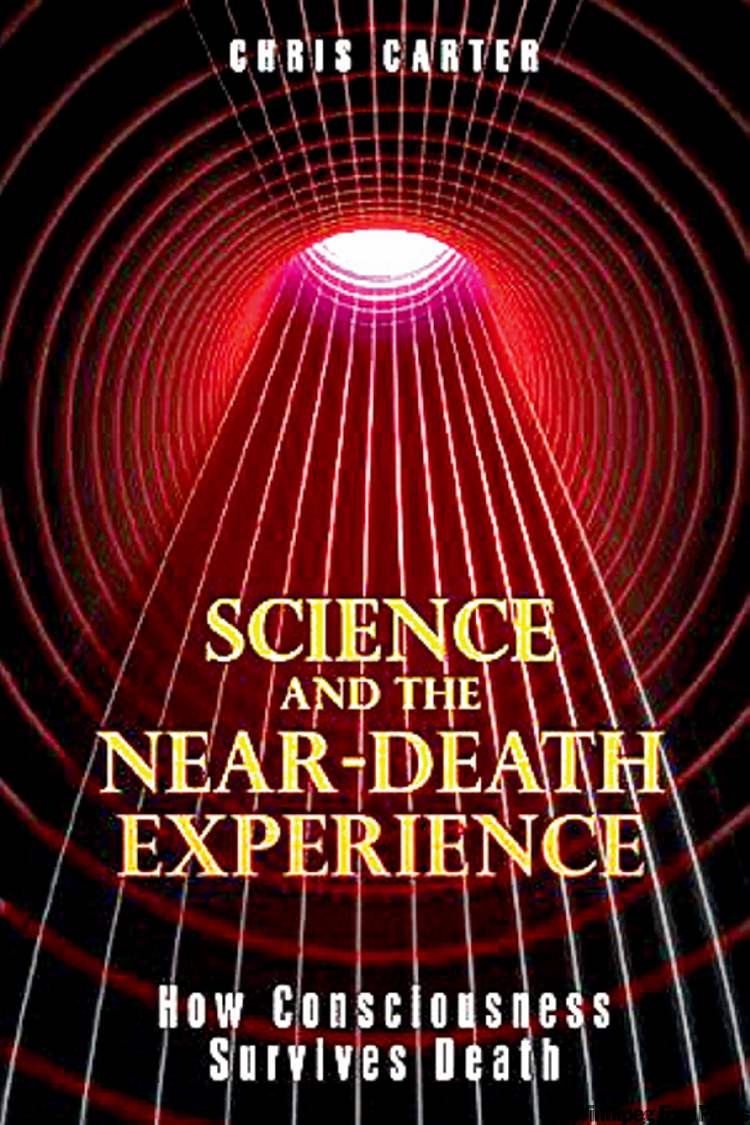
Inner Traditions, 303 pages, $19
UNFORTUNATELY, the word “science” in the title of this odd book is somewhat misleading, as there really isn’t a lot of actual science going on.
First, to avoid any confusion, this is not the screenwriter Chris Carter of X-Files fame but one who grew up in Winnipeg.
According to his biography, this is his second book, his first being Parapsychology and the Skeptics. He received his undergraduate and master’s degrees from the University of Oxford, but his field of study is not included. He now lives in Venezuela.
To summarize Carter’s introduction, the materialist view of the mind and the brain as a single entity is wrong. Therefore, those who reject the theory of dualism — of a mind (or soul) existing separately from the physical brain — are old-fashioned and closed-minded.
Never mind that an acceptable mechanism for any sort of dualism has yet to be proven. Carter subscribes to Rupert Sheldrake’s “theory of morphogenetic fields,” which “are thought to be invisible regions of influence that connect similar things across space, but Sheldrake postulates that they also connect similar things across time.”
As genes are passed on materially from ancestors, Carter contends that “morphic fields are inherited nonmaterially.” However, anyone with any knowledge of evolutionary biology accepts that DNA uses Hox genes to reproduce future generations just fine.
Carter then looks at the various psychological and physiological explanations that have been put forward to explain near-death experiences (NDEs). These include such possibilities as fantasies, semiconscious perception, oxygen starvation, temporal lobe seizures and the drug ketamine. Going through them one by one, Carter tries to show how each of these theories fail to account for the most common features of reported NDEs.
However, just because none of the current explanations satisfactorily answer the question, it doesn’t necessarily follow that the NDE is proof of an afterlife. All it means is that none of the current theories fit.
There is no doubt that many people have had what they think are near-death experiences, and their accounts can appear remarkable and astonishing. However, they appear to suffer greatly from their initial relating and the assumptions that underlie them.
The problem with researching NDEs lies in the fact that they are invariably anecdotal. In some cases, they are even second- or third-hand accounts.
What may first appear unexplainable may easily be answered through logical reasoning. NDEs don’t necessarily mean that the person had an authentic glimpse of an afterlife, since there are still other simpler answers. Carter, like many others, including Pim Van Lommel, the cardiologist and author of the recent Consciousness Beyond Life: The Science of the Near-Death Experience, assumes that people’s memories are infallible and don’t change over time. This has been demonstrated to be false in several experiments.
Why may someone’s NDE recollection be questionable? The account may not have been captured right away, allowing for contamination of the memory. The interviewer may have used leading questions.

The person could have been influenced by family or friends, or by popular culture (haven’t we all seen a movie or TV show where dying people go towards the light?). The individual may just be plain lying.
As well, Carter bases his entire argument on the presupposition of psychic abilities, such as telekinesis and ESP, which, in spite of popular interest, have no scientific basis.
This book would actually be useful in a class on critical thinking, as an exercise in spotting a variety of logical fallacies.
Donna Harris is a Winnipeg skeptic with a master’s degree in English from the University of Manitoba.