Bullock provides film’s spark as southern firecracker

Advertisement
Read this article for free:
or
Already have an account? Log in here »
To continue reading, please subscribe:

Digital Subscription
One year of digital access for only $205*
- Enjoy unlimited reading on winnipegfreepress.com
- Read the E-Edition, our digital replica newspaper
- Access News Break, our award-winning app
- Play interactive puzzles
*First annual payment billed as $205.00 + GST for one year. This annual subscription will automatically renew at $233.00 + GST every 52 weeks (10% off the regular annual price of $259.35). Offer available to new and qualified returning subscribers only. Cancel any time.
To continue reading, please subscribe:
Add Free Press access to your Brandon Sun subscription for only an additional
$1 for the first 4 weeks*
- Enjoy unlimited reading on winnipegfreepress.com
- Read the E-Edition, our digital replica newspaper
- Access News Break, our award-winning app
- Play interactive puzzles
*Your next Brandon Sun subscription payment will increase by $1.00 and you will be charged $17.95 plus GST for four weeks. After four weeks, your payment will increase to $24.95 plus GST every four weeks.
Read unlimited articles for free today:
or
Already have an account? Log in here »
Hey there, time traveller!
This article was published 20/11/2009 (6138 days ago), so information in it may no longer be current.
Released to coincide with the American Thanksgiving holiday, The Blind Side is, in its commercial aspect, an ingenious synthesis of chick movie (note the presence of Sandra Bullock) and guy movie (note the presence of a hulking football player).
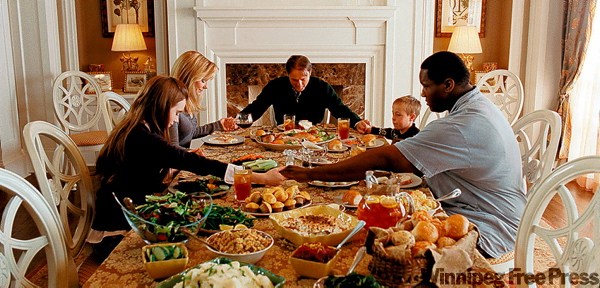
A key scene is even set during a Thanksgiving dinner, suggesting the whole film was tailor-made for its release date.
But if that seems calculated, screenwriter-director John Lee Hancock (The Rookie) still manages to give this film a beating heart. It is, after all, based on a truly inspiring true story.
Kicking off with footage of Joe Theismann’s career-ending leg injury during a telecast of Monday Night Football, the title refers specifically to the place where a football quarterback is most vulnerable.
Less specifically, the title may also refer to the implicit colour-blindness that resulted in a homeless black teenager being adopted by an affluent white southern family.
The Tuohy family is a matriarchy that tends to follow the will of its benign-dictator mom, Leigh Ann (Bullock). It is she who spots the homeless, nearly mute Michael Oher (Quinton Aaron) wandering a cold Memphis street dressed in shorts and a shirt. Ascertaining that he has no place to sleep ("Don’t you dare lie to me," she snaps) Leigh Ann takes him home, gives him a couch on which to lie, and goes to bed worrying if her valuables will still be downstairs in the morning.
She soon realizes her fears are groundless. Michael, known as "Big Mike," is a gentle soul in spite of his harsh circumstances. Leigh Ann learns he is the son of a crack-addict mother and an absent father, and he has lived most of his life relying on the charity of others — a history movingly summarized when he tells Leigh Ann he’s never had a bed.
Michael clearly has the physical attributes of a football player for the school team, but is considered unteachable at the Christian school he attends, a result of the academic neglect suffered in his formative years. Leigh Ann and her wisely acquiescent hubby Sean (Tim McGraw) arrange a tutor (Kathy Bates) to help boost his grade-point average and establish his eligibility, a strategy that will help secure Oher’s future, even if it ultimately draws suspicion towards the Tuohys’ motivations.
Aaron is sufficient but amorphous as Oher, but Bullock is there to compensate with a strong, smart performance as the quintessential, don’t-you-mess-with-me southern firecracker.
If the movie is ostensibly about the reclamation of a soul, its more singular achievement is to reclaim the credibility of the term "compassionate conservative," a notion that frankly seemed left for dead in the aftermath of the Bush years.
Bullock is especially effective at capturing the essence of that idea in a scene in which Leigh Ann, after contemplating Michael’s abject poverty, glances around at the expensive surroundings of her mansion-like home, now thrown in sharp relief.
Perhaps the Thanksgiving release date wasn’t a purely commercial consideration after all.
randall.king@freepress.mb.ca
Our newsroom depends on a growing audience of readers to power our journalism. If you are not a paid reader, please consider becoming a subscriber.
Our newsroom depends on its audience of readers to power our journalism. Thank you for your support.
Movie review
The Blind Side
Starring Sandra Bullock and Quinton Aaron
Grant Park, Polo Park, St. Vital.
PG
3 out of five
Our newsroom depends on a growing audience of readers to power our journalism. If you are not a paid reader, please consider becoming a subscriber.
Our newsroom depends on its audience of readers to power our journalism. Thank you for your support.
Advertisement Advertise With Us