

Flu overshadows apology anniversary
Advertisement
Read this article for free:
or
Already have an account? Log in here »
To continue reading, please subscribe:
Monthly Digital Subscription
$0 for the first 4 weeks*
- Enjoy unlimited reading on winnipegfreepress.com
- Read the E-Edition, our digital replica newspaper
- Access News Break, our award-winning app
- Play interactive puzzles
*No charge for 4 weeks then price increases to the regular rate of $19.95 plus GST every four weeks. Offer available to new and qualified returning subscribers only. Cancel any time.
Monthly Digital Subscription
$4.99/week*
- Enjoy unlimited reading on winnipegfreepress.com
- Read the E-Edition, our digital replica newspaper
- Access News Break, our award-winning app
- Play interactive puzzles
*Billed as $19.95 plus GST every four weeks. Cancel any time.
To continue reading, please subscribe:
Add Free Press access to your Brandon Sun subscription for only an additional
$1 for the first 4 weeks*
*Your next subscription payment will increase by $1.00 and you will be charged $16.99 plus GST for four weeks. After four weeks, your payment will increase to $23.99 plus GST every four weeks.
Read unlimited articles for free today:
or
Already have an account? Log in here »
Hey there, time traveller!
This article was published 11/06/2009 (6050 days ago), so information in it may no longer be current.
WINNIPEG — A celebration to mark the first-year anniversary of Prime Minister Stephen Harper’s apology to Indian residential school survivors is overshadowed in Manitoba by the H1N1 flu virus that’s hit a northern native community, Assembly of Manitoba Chiefs Grand Chief Ron Evans said today.
When a deadly tsunami swept through Southeast Asia on Dec. 26, 2004, Ottawa responded with a relief effort totalling $425 million that included airlifting emergency teams consisting of doctors and soldiers who brought medicine and badly needed supplies.
But when the H1N1 virus struck the native communities of Garden Hill and St. Theresa Point, local officials point out, Ottawa and Manitoba have been unable to provide them with basic medical care like a full-time doctor and hand sanitizers.
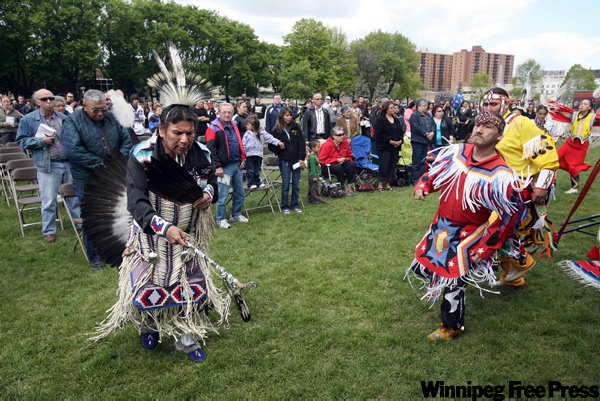
“The H1N1 virus that is seriously impacting our communities today demonstrates that our communities and people continue to suffer in poor living conditions,” Evans told a gathering at Memorial Park in Winnipeg.
“It is important that Manitobans and the Canadian public understand the obstacles and hurdles First Nations are facing in accessing the basic health-care services that many others take for granted.”
Evans said aboriginal leadership has tried to work with federal officials starting almost three years ago to develop pandemic planning, but nothing happened until the H1N1 virus hit the northern community of St. Theresa Point over the past two weeks.
“We are on the verge of a full-scale pandemic and we are once again calling upon all levels of government, the minister of health and Indian and Northern Affairs Canada, for immediate action,” Evans said, adding systemic poverty issues like poor housing and access to decent medical care need to be quickly addressed. “We have no time for jurisdictional battles. We must all work together on this.
“The first wave of the pandemic demonstrates that poverty among our people make them very vulnerable.”
Local pharmacy owner Daren Jorgenson said he has been trying to send doctors to those communities for several years and has been repeatedly rebuffed by provincial and federal officials.
“We have repeatedly requested permission to have our physicians work in the nursing stations of these two communities for years now and have always been told no,” Jorgenson said in an email distributed to the media Thursday.
Jorgenson said Ottawa seems more intent on protecting non-existent federal jobs than ensuring residents in the Island Lakes area receive proper health care.
“The system is so poorly managed and all efforts over the years to work with the system have failed,” Jorgenson said.
Ottawa doesn’t want a private health care provider like himself placing doctors on reserves because it would rob Ottawa of fees it collects from the province but added that Ottawa won’t place doctors in those communities.
Jorgenson said Ottawa and the province would rather spend millions flying patients south than having doctors living in the community every day.
And in Ottawa, Phil Fontaine told Parliament this afternoon the apology to Canada’s first nations for the residential schools tragedy freed Canada from its past but not enough has been done to give first nations children a future.
Fontaine, national chief of the Assembly of First Nations, spoke in the Senate on the one year anniversary of the residential school apology.
"How can the potential of all Canadians be realized when the dreams of first nations children are not allowed to flourish," said Fontaine.
He said the post-apology era has not seen enough action, and called on the government to do more to improve education, health care and living condition on reserves.
He noted there are over 100 first nations in Canada with a boil water advisory in place and another 40 with high risk water systems.
He said there should be three times as many aboriginal students in universities and colleges as there are now, and that the government should finally get rid of the two per cent cap on increases in spending for core programs of first nations.
That cap, in place since 1996, means first nations governments can’t keep up with the cost of living increases and the rapidly growing first nations’ population.
"Our governments are being forced to do more with less, year after year," said Fontaine.
Today’s events, one of many across the country, commemorate last year’s historic apology by Ottawa to First Nations for the treatment of aboriginal people in the residential school system.
The Assembly of Manitoba Chiefs organized the event at Memorial Park to honour school survivors who’ve made a significant contribution to Canada and those that have contributed to indigenous cultures and heritage.
Education Minister Peter Bjornson and Culture and Heritage Minister Eric Robinson also introduced the province’s new curriculum to mark the first-year anniversary of the apology. Students in grades 9 and 11 will learn about the residential school system through new resources, which include personal interviews with survivors.
bruce.owen@freepress.mb.ca
“It is important that Manitobans and the Canadian public understand the obstacles and hurdles First Nations are facing in accessing the basic health-care services that many others take for granted,” Ron Evans, Grand Chief of the Assembly of Manitoba Chiefs, told a noon-hour gathering at Memorial Park Thursday to mark the first anniversary of Prime Minister Stephen Harper’s apology to Indian residential school survivors.
The apology, however, was overshadowed by the lack of federal and provincial response to the situation at Garden Hill and St. Theresa Point.
“The H1N1 virus that is seriously impacting our communities today demonstrates that our communities and people continue to suffer in poor living conditions,” Evans said. Evans said aboriginal leadership has tried to work with federal officials starting almost three years ago to develop pandemic planning, but nothing happened until the H1N1 virus hit the northern community of St. Theresa Point over the past two weeks.