

Federation seeks ban on spotlighting
Says hunting practice threatens moose numbers
Advertisement
Read this article for free:
or
Already have an account? Log in here »
To continue reading, please subscribe:

Digital Subscription
One year of digital access for only $205*
- Enjoy unlimited reading on winnipegfreepress.com
- Read the E-Edition, our digital replica newspaper
- Access News Break, our award-winning app
- Play interactive puzzles
*First annual payment billed as $205.00 + GST for one year. This annual subscription will automatically renew at $233.00 + GST every 52 weeks (10% off the regular annual price of $259.35). Offer available to new and qualified returning subscribers only. Cancel any time.
To continue reading, please subscribe:
Add Free Press access to your Brandon Sun subscription for only an additional
$1 for the first 4 weeks*
- Enjoy unlimited reading on winnipegfreepress.com
- Read the E-Edition, our digital replica newspaper
- Access News Break, our award-winning app
- Play interactive puzzles
*Your next Brandon Sun subscription payment will increase by $1.00 and you will be charged $17.95 plus GST for four weeks. After four weeks, your payment will increase to $24.95 plus GST every four weeks.
Read unlimited articles for free today:
or
Already have an account? Log in here »
Hey there, time traveller!
This article was published 27/03/2015 (4156 days ago), so information in it may no longer be current.
The recent illegal killing of 15 moose has the Manitoba Wildlife Federation concerned.
“We are calling on the province to bring a stop to spotlighting. It is too effective and not sustainable for the moose,” said Rob Olson, MWF managing director.
With the help of the Manitoba Natural Resources Officers Association (MNROA) in trying to catch poachers through social media, the federation said it needs to crack down on illegal moose hunting and introduce a ban on spotlighting for all hunters.
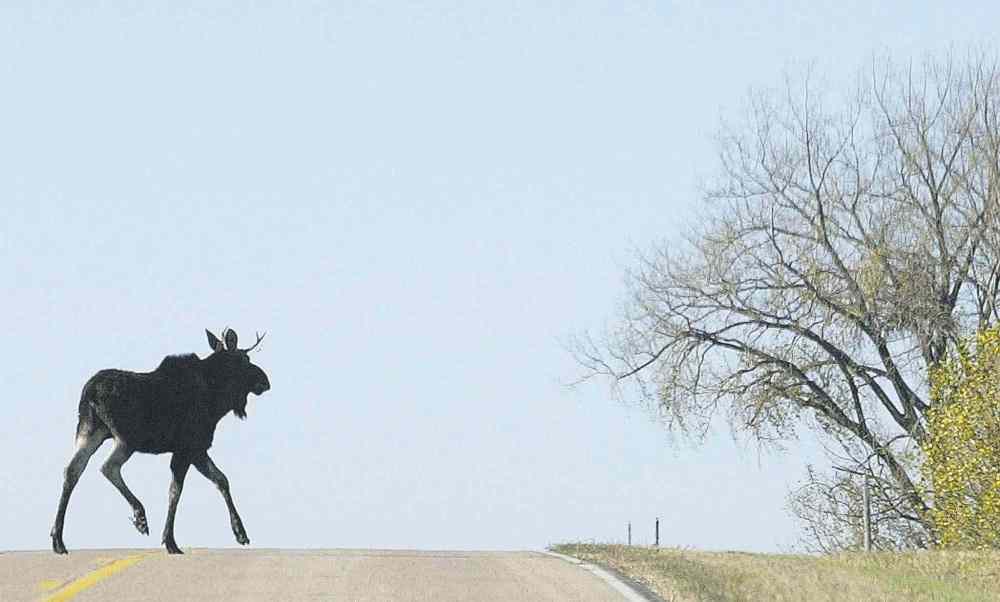
“Our suspicion is that many or maybe all of the moose were shot at night,” Olson said. “Winters are hard for moose; along the edges of the road, (moose eat) shrubs that are growing and moose come to lick the salt off the road. Also, it takes a long time to process a moose — the only way that I can see, to process a moose along a highway like that, would be at night.”
In spotlight hunting, hunters use a high-power spotlight beam (typically handheld) at night to light up a larger area moose might be in. Often done from a vehicle, it is an effective way to locate the animal, because the eyes are reflective and visible.
Typically, the animal will freeze from fear, becoming an easy target, Olson explained.
Manitoba big-game hunting laws state hunting and the discharge of any firearms is permitted only from half an hour before sunrise to half an hour after sunset.
Status Indians, however, are allowed to hunt year-round on unoccupied Crown lands and any other lands to which they may have the right of access, with no daylight restrictions.
“It is not going to be a quick or easy conversation, (but) to deal with the moose crisis, aboriginal hunting rights are going to have to be discussed. Right now, moose hunting isn’t sustainable for anyone,” Olson said.
The MWF wants the government to take inspiration from other provinces such as Saskatchewan. That province worked with aboriginal people, adopting a spotlight-hunting ban while still allowing status Indians to call moose in the moonlight, staying true to traditional practices.
Chief Andrew Colomb from Marcel Colomb First Nation said he doesn’t believe aboriginal people should have to suffer because of others’ mistakes.
“I am a harvester, and I don’t hunt like that,” Colomb said, referring to the spotlight technique.
“To survive and live off the land, we need common sense. We don’t shoot moose in the spring because they are carrying; harvesters know that… (Now) somebody else has to pay because nobody uses common sense.”
The use of spotlighting during night hunting was initially brought up as a safety issue with the MFW about five years ago.
Night hunting raises the chances of near misses and in one case, death, such as when First Nation hunter Jason Guimond was killed in 2010 north of Winnipeg during a night hunting trip with a friend.
“It is preventable,” Olson said.
“There are many other close calls, and it is just a matter of time before there is another accident. And in this case, it is also unsustainable to the moose.”
The recent poaching comes at an all-time low for the Manitoba moose population, with one of the killings including a pregnant cow.
A photo of a slaughtered cow with two fully developed unborn moose fetuses was posted to the MNROA Facebook page, with the caption saying moose have been killed from the provincial trunk highways and within protective wildlife corridors.
“Seeing cow moose killed is just disheartening,” Olson said.
“The moose hunters realize there is a problem; too many are being shot… (and) the moose is culturally critical to aboriginal and Métis hunters. It is going to take people that have a passion and respect for the moose to come together and say it is not OK to poach.”
MFW started a campaign called the Manitoba Big Game Crisis to bring awareness to the issues surrounding moose hunting, such as low population numbers and poachers.

Olson said the next step is to team up with First Nations to move forward to find a solution.
“Ultimately, if there is no moose left, then everyone loses,” Olson said.
“We need a change.”
MFW and MNROA are urging the public to call their TIP line at 1-800-782-0076 if anyone sees signs of someone hunting moose from a road, or any other kind of wildlife infraction.
jenna.dulewich@freepress.mb.ca