

Feds hide proof: chief
Documents could show Ottawa knew dam harmful to band
Advertisement
Read this article for free:
or
Already have an account? Log in here »
To continue reading, please subscribe:
Monthly Digital Subscription
$1 per week for 24 weeks*
- Enjoy unlimited reading on winnipegfreepress.com
- Read the E-Edition, our digital replica newspaper
- Access News Break, our award-winning app
- Play interactive puzzles
*Billed as $4.00 plus GST every four weeks. After 24 weeks, price increases to the regular rate of $19.95 plus GST every four weeks. Offer available to new and qualified returning subscribers only. Cancel any time.
Monthly Digital Subscription
$4.99/week*
- Enjoy unlimited reading on winnipegfreepress.com
- Read the E-Edition, our digital replica newspaper
- Access News Break, our award-winning app
- Play interactive puzzles
*Billed as $19.95 plus GST every four weeks. Cancel any time.
To continue reading, please subscribe:
Add Free Press access to your Brandon Sun subscription for only an additional
$1 for the first 4 weeks*
*Your next subscription payment will increase by $1.00 and you will be charged $16.99 plus GST for four weeks. After four weeks, your payment will increase to $23.99 plus GST every four weeks.
Read unlimited articles for free today:
or
Already have an account? Log in here »
Hey there, time traveller!
This article was published 04/03/2010 (5855 days ago), so information in it may no longer be current.
Buried in government filing cabinets and secret court dossiers are 259 documents that could prove the federal government knew for years it had failed to protect three northern First Nations from hydro-dam flooding and might owe millions in compensation.
A key hearing in the case that’s dragged on for nearly 20 years in obscurity is set to begin Monday. That hearing, too, could be shrouded in secrecy.
The Canadian government has asked a Federal Court judge to hold the hearing entirely behind closed doors, beyond the prying eyes of journalists and even some First Nations leaders who might want to get a glimpse of the secret documents.
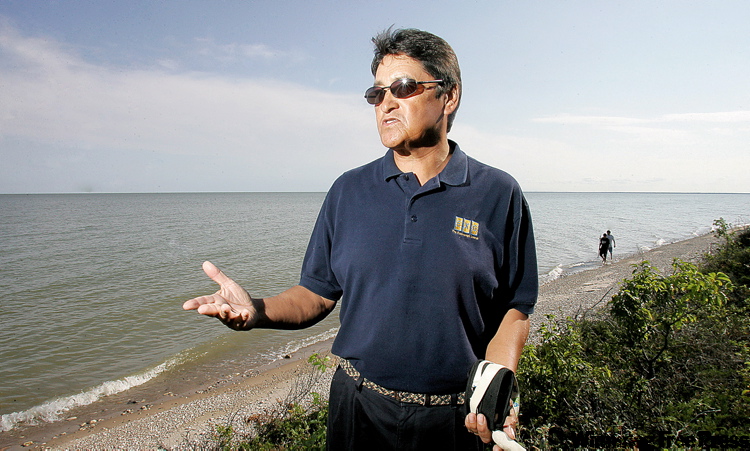
It’s a Kafkaesque situation that has infuriated Grand Rapids Chief Ovide Mercredi and his lawyer.
"They’re trying to hide documents so the truth of what happened to us will never be told," said the chief, who plans to fill the courtroom with elders on Monday.
Lawyer Harley Schachter, who has spent years representing Grand Rapids on the labyrinthine case, called it "astounding."
"I have never heard of a situation like this whereby the press and the public could be barred from court proceedings to protect information the government doesn’t want to come out."
Crown lawyer Cary Clark said he could not speak about the case without approval from media officials at Indian and Northern Affairs Canada.
An INAC spokesman said Canada’s position is that the documents are protected by solicitor-client privilege and can’t be shared with First Nations.
In 1992, Grand Rapids First Nation sued Ottawa for failing to stick up for the band, its treaty rights and its right to be properly consulted and represented during the construction of Manitoba Hydro’s Grand Rapids dam.
Chemawawin Cree Nation and Opaskwayak Cree Nation also sued for the same reason.
As the trustee and protector of First Nations, Ottawa had a fiduciary duty to the bands and promised to share all its reports and information, according to Grand Rapids’ statement of claim.
A 1985 letter to Grand Rapids from then-Indian affairs minister David Crombie promised Ottawa would negotiate a settlement with the band if evidence arose showing Ottawa failed to meet its legal obligations.
The First Nations say that’s exactly the evidence Canada is now trying to keep secret.
A little more than a year ago, Canada sought to have 259 documents — ministerial briefing notes, internal correspondence and legal opinions — declared off-limits and kept confidential from the public and the First Nations forever.
The documents describe Ottawa’s position in the 1980s regarding its role in getting the dam built and its obligations to the First Nations.
Because of an interim court order that bars any disclosure or discussion of the potentially damning documents, Schachter couldn’t offer any more detail about the files.
He would only say they would help the First Nations prove that Ottawa knew for years it was liable for some of the damages caused by the dam.
He said the documents will show that Ottawa’s internal discussions were at odds with repeated public claims that it bore no fault and was pursuing a "close relationship" based on co-operation with the First Nations.
The federal government gave 96 of the 259 documents to the First Nations on at least three occasions over the years as the case plodded along.
It’s absurd to argue they should now be kept confidential, Schachter said.
Canada is asking the bands to return the documents and may even ask that Schachter resign from the case because he has seen too much.
The lawyer said the Canadian government is also arguing its officials hadn’t actually read the documents before handing them over to him years ago.
"I don’t think Canada is that stupid," he scoffed. "I give their lawyers more credit than that."
If the judge sides with the band, the federal government could owe Grand Rapids and the two other First Nations tens of millions of dollars in compensation.
maryagnes.welch@freepress.mb.ca

The dispute
The bands: Grand Rapids is the main one suing, but Opaskwayak Cree Nation and Chemawawin Cree Nation have filed similar lawsuits that hinge on the progress of the Grand Rapids suit.
The case: It was filed in 1992, but has dragged on incessantly, producing thousands of court files, orders, affidavits, exhibits and documents housed in the Federal Court on Broadway. Delays were caused by attempts at negotiation, changes of council, a fight to get the claim amended and the recent procedural mess over secret documents.
The claim: When the Grand Rapids dam opened in the mid-1960s, thousands of acres were flooded or altered, sacred burial grounds were deluged, fish stocks and fur-bearing animals disappeared, incomes fell, political autonomy and self-sufficiency were lost and poverty and alcoholism took hold. The federal government knew or ought to have known about that devastation, but failed to protect the First Nations.
Ottawa’s defence: It fulfilled all its obligations to the First Nations when the dam was built. The First Nations agreed to give up their reserve land and were properly compensated.