

Forming bonds through kangaroo care
Hospitals use annual challenge to encourage skin-to-skin contact as benefit to parents, premature newborns
Advertisement
Read this article for free:
or
Already have an account? Log in here »
To continue reading, please subscribe:
Monthly Digital Subscription
$1 per week for 24 weeks*
- Enjoy unlimited reading on winnipegfreepress.com
- Read the E-Edition, our digital replica newspaper
- Access News Break, our award-winning app
- Play interactive puzzles
*Billed as $4.00 plus GST every four weeks. After 24 weeks, price increases to the regular rate of $19.95 plus GST every four weeks. Offer available to new and qualified returning subscribers only. Cancel any time.
Monthly Digital Subscription
$4.99/week*
- Enjoy unlimited reading on winnipegfreepress.com
- Read the E-Edition, our digital replica newspaper
- Access News Break, our award-winning app
- Play interactive puzzles
*Billed as $19.95 plus GST every four weeks. Cancel any time.
To continue reading, please subscribe:
Add Free Press access to your Brandon Sun subscription for only an additional
$1 for the first 4 weeks*
*Your next subscription payment will increase by $1.00 and you will be charged $16.99 plus GST for four weeks. After four weeks, your payment will increase to $23.99 plus GST every four weeks.
Read unlimited articles for free today:
or
Already have an account? Log in here »
Hey there, time traveller!
This article was published 11/05/2017 (3217 days ago), so information in it may no longer be current.
Anne Eberhard drives 45 kilometres each day to hold her baby against her skin for 10 hours in the St. Boniface Hospital neonatal intensive care unit (NICU).
That’s because her son, Jeremiah, was born at 29 weeks of pregnancy — much earlier than the usual 40 weeks — and weighed just 1,290 grams. He must stay in the NICU until he is strong enough to go home.
In the meantime, Eberhard is one of more than 20 mothers in the NICU who are using Kangaroo Care — skin-to-skin contact between parents and their babies — as a way to bond with their babies and improve their overall health and well-being. Parents have 24-hour access to their babies to hold, feed and care for them. Skin-to-skin contact has been proven to also play an important role in the breastfeeding relationship between new moms and their babies.
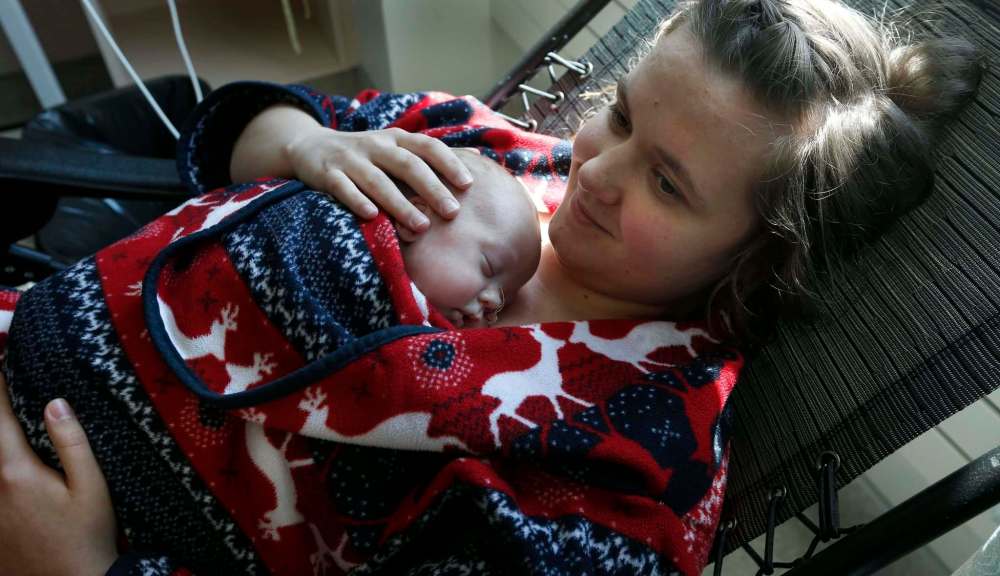
“It helps me bond with him and makes me so happy to see that every time I take him skin-to-skin, he’s calm, he sleeps,” said Eberhard, 21, as she and Jeremiah sat cosy under a blanket in an anti-gravity chair near a sunny window. Eberhard spends her whole day with her baby. Her husband joins them after work.
“It also has some benefits to him. It helps with his breathing and helps keep his temperature (regulated), and it helps him with his growth,” she said.
Eberhard and the other moms in the NICU are participating in the third annual Kangaroo Care Challenge, an event being held from May 1 until Monday among about 30 hospitals in Canada and the United States. The goal is for every baby to snuggle against the skin of one of their parents every day.
The amount of time mothers hold their babies skin-to-skin is recorded daily in a log book, and the tallies among hospitals will be compared at the end of the challenge. There are prizes within the hospital for moms to earn while doing what they love: cuddling with their babies.
Last year, the St. Boniface NICU recorded more than 650 hours of baby-holding during its two-week challenge.
Diane Schultz, a nurse for 28 years in the NICU, said the long list of proven benefits of Kangaroo Care for babies includes improved brain maturation and growth because they are having healing sleep, protection against skin infections, helping to stabilize their vital signs and improving breastfeeding and breastfeeding duration. Fathers are encouraged to participate because it helps both parents with attachment and bonding and has proven to prevent postpartum depression in both to create better family outcomes.
“We make every effort to fully educate our parents in the benefits of skin-to-skin and why they do it, and our parents respond amazingly to it. We have parents who will hold their babies in skin-to-skin for six to eight hours,” Schultz said.
She said many medical treatments and procedures can be accomplished while babies are being held, such as starting intravenous lines and doing bloodwork, because it decreases the pain response by babies, which in turn helps them remain calm.
“It brings parents back to their babies. Our parents are grieving the loss of a healthy pregnancy and the loss of an uncomplicated delivery. They’re in a difficult situation in here, with a lot of stress, and this helps decrease the stress for the baby and the parents,” Schultz said, adding it is also encouraged for full-term babies.
The due date for Betty Atusasire’s twin babies was May 12, but Ethan and Alisha were born at 22 weeks on Jan. 12. Alisha weighed 620 grams at birth and is now up to 2,494 grams, while Ethan, who weighed just 500 grams at birth, is up to 3,175 grams.
Atusasire arrives early every morning to breastfeed the babies, and she stays until 11 p.m., only taking a break to go home for supper. Both babies are continuing to receive breathing support, but Atusasire said she believes Kangaroo Care has played a role in moving the twins closer to breathing on their own.
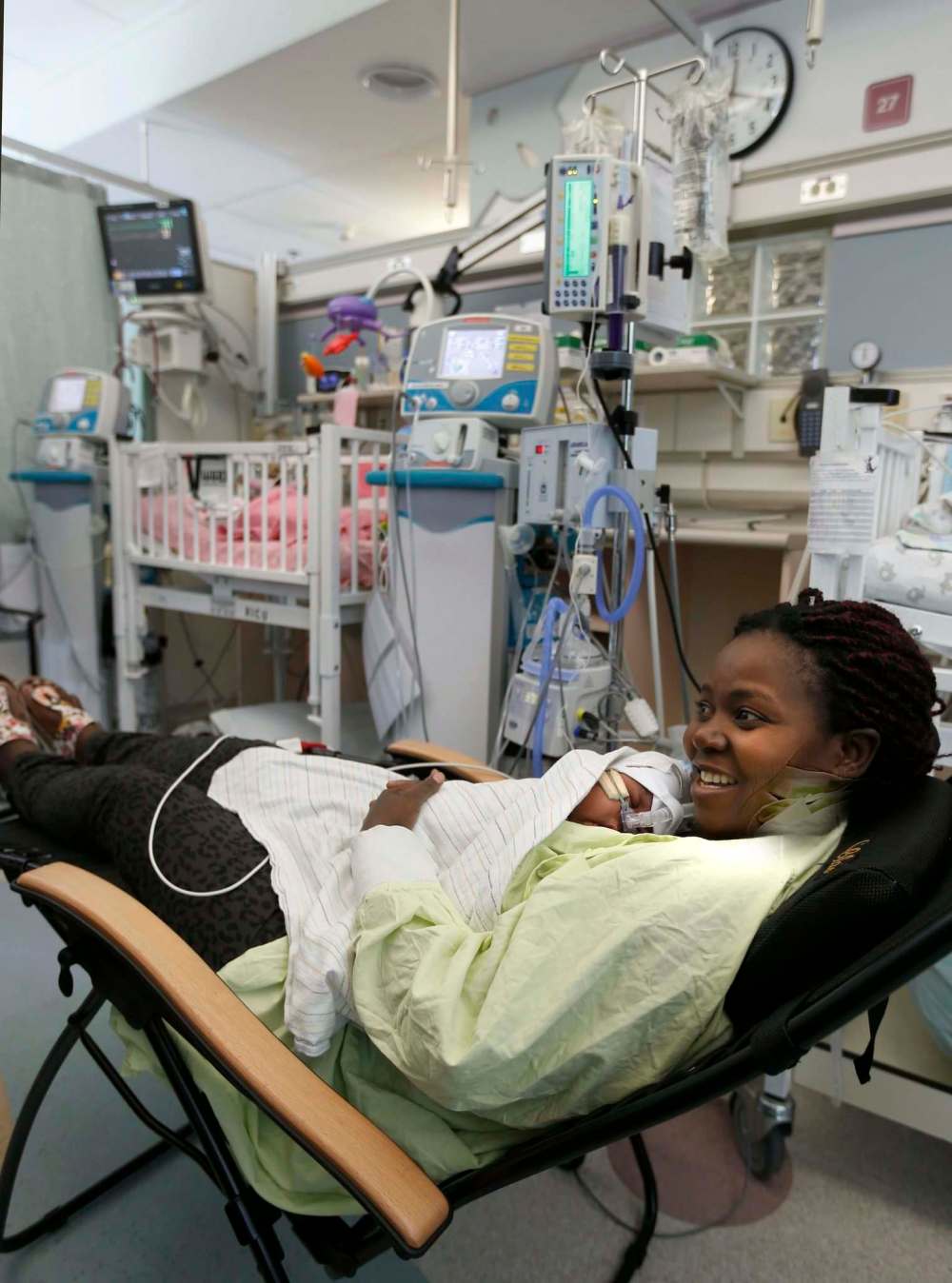
“They were intubated for two months. With the skin-to-skin and the medication, they were able to get off (intubation),” Atusasire, 42, said as she held Ethan during his turn.
“Because I’m doing more skin-to-skin, it’s helped my kids to breastfeed faster, which sometimes (premature) babies struggle (with), and it helps with their heart rates.
“This is something that also helps me to cope. Because I’m spending this time with my kids skin-to-skin, when I go home I don’t feel as bad (that) I don’t have my kids.”

In the NICU, Bella Rain Bushie is the new kid on the block — she was born on May 1 at 31 weeks. Her mom, Glennis, snuggled with Bella into an anti-gravity chair with Bella’s tiny hand holding her index finger, said it was a shock to have Bella come so early. The skin-to-skin contact has calmed both of them.
“There’s a lot of emotions. It’s hard being at home without her at home,” Bushie, 42, said.
“The staff here have been great, I’ve been able to come all hours of the night. I’m just really encouraged to know I can come and be with her like this any time.”
“I’ve noticed she settles quickly when I hold her in skin-to-skin. She’s also breastfeeding, and I pump at home. We just want her home, but she’s probably here another week or two. Knowing I can come any time to be with her calms me.”
ashley.prest@freepress.mb.ca