

Peacemaker
Group pushes for Truth and Reconciliation chairman to get Nobel Prize
Advertisement
Read this article for free:
or
Already have an account? Log in here »
To continue reading, please subscribe:
Digital Subscription
One year of digital access for only $1.44 a week*
- Enjoy unlimited reading on winnipegfreepress.com
- Read the E-Edition, our digital replica newspaper
- Access News Break, our award-winning app
- Play interactive puzzles
*Billed as $5.77 plus GST every four weeks. After 52 weeks, price increases to the regular rate of $19.95 plus GST every four weeks. Offer available to new and qualified returning subscribers only. Cancel any time.
To continue reading, please subscribe:
Add Free Press access to your Brandon Sun subscription for only an additional
$1 for the first 4 weeks*
- Enjoy unlimited reading on winnipegfreepress.com
- Read the E-Edition, our digital replica newspaper
- Access News Break, our award-winning app
- Play interactive puzzles
*Your next Brandon Sun subscription payment will increase by $1.00 and you will be charged $17.95 plus GST for four weeks. After four weeks, your payment will increase to $24.95 plus GST every four weeks.
Read unlimited articles for free today:
or
Already have an account? Log in here »
Hey there, time traveller!
This article was published 19/12/2015 (3957 days ago), so information in it may no longer be current.
OTTAWA — Murray Sinclair already has an impressive resumé.
He’s the first aboriginal judge appointed to the bench in Manitoba, co-commissioner of the Aboriginal Justice Inquiry and chairman of the Truth and Reconciliation Commission.
But if a group of Canadians has its way, he will get one of the highest honours in the world to add to the list: Nobel Peace Prize recipient.
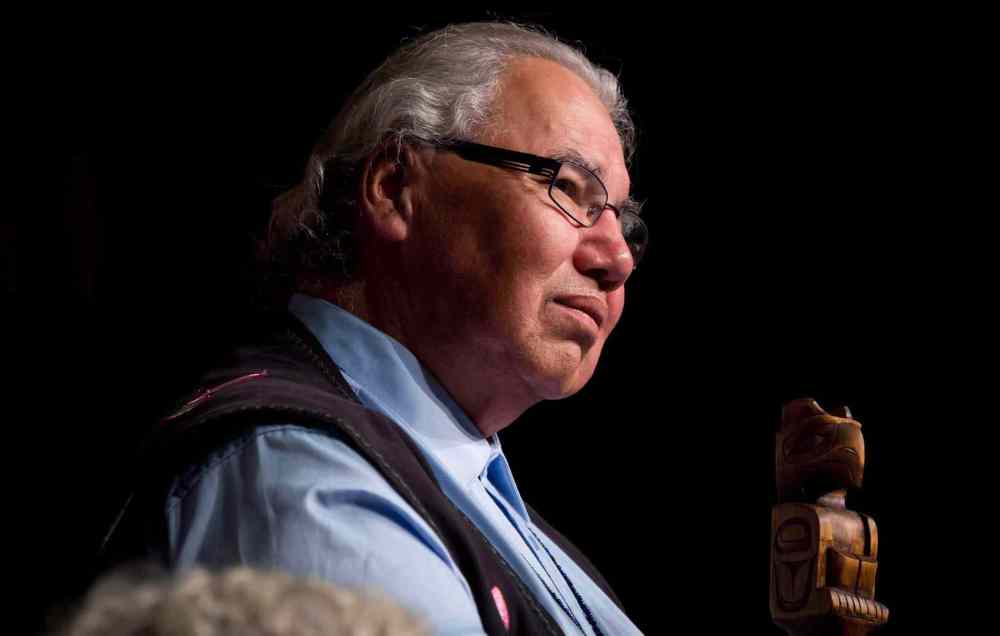
“He and Phil Fontaine should share a Nobel Peace Prize,” said Wab Kinew, associate vice-president for indigenous relations at the University of Winnipeg.
Kinew said a group of people in Winnipeg, Toronto and Ottawa are collaborating to nominate the two men, who they believe are jointly responsible for giving back hope to Canada’s indigenous people that hasn’t existed in a long time.
“They made it into something that is peace-building and nation-building,” Kinew said. “It has really transformed our country.”
When he was the national chief of the Assembly of First Nations, Fontaine helped push for a settlement for victims of residential schools. It led to financial compensation, a process to make claims as well as the creation of the commission.
In 2009, Sinclair took over as chairman of the commission, and led it through six years of hearings involving interviews with 7,000 survivors and several hundred former teachers. He wrote a six-volume, 4,000 page report that looks at the history and the legacy of residential schools.
“Phil Fontaine was the quarterback who got things started, and he handed the ball to Murray Sinclair, and he ran it across the finish line,” Kinew said.
The commission concluded the residential schools were nothing short of “cultural genocide,” a systematic attempt by the Canadian government to assimilate aboriginal children by forcing them into schools where they were kept from their parents, detached from their culture and prevented from speaking their mother tongues.
Fontaine said he’d been told a few weeks ago the nomination was in the works. He was taken aback.
“I appreciate the thought,” he said. “It’s just, gosh, it’s a humbling thought.”
Fontaine wouldn’t say if he thought nominating him was appropriate. But for Sinclair, he said, it’s obvious.
“We recognized we needed someone with gravitas to spearhead this very difficult process, and Justice Sinclair was the obvious choice,” Fontaine said. “I think he demonstrated we were right. He did a remarkable job.”
Sinclair is a celebrity among aboriginals. Whether he’s taking the podium at commission events, chatting with people informally or walking through the lobby of a downtown Ottawa hotel, he is greeted with respect and admiration.
Kinew said Sinclair is seen as “someone who is very thoughtful” and while many survivors were skeptical about the commission at the start, they came to believe in it under Sinclair’s careful guidance.
“Many survivors were won over in large part because of the tone Murray Sinclair set,” he said.
It almost didn’t happen.
Sinclair, who had overseen two emotionally charged investigations — the Aboriginal Justice Inquiry in the late 1980s and an inquest into pediatric cardiac deaths in Winnipeg in the 1990s — wasn’t eager to jump in to another one. Initially, he turned down the request to be chairman.
But after the original team of commissioners fell apart in a power struggle, his family urged him to accept the role.
Sinclair is at the tail end of a whirlwind 10 days in Ottawa. He flew in at first for an Assembly of First Nations meeting, and stayed to deliver the final commission report a week later. On Wednesday, seated in a bright red leather chair, he leans forward with his hands on his knees and reflects the last six years.
He says there isn’t a single word that could describe how it feels now that it’s over.
The process was as demanding and exhausting as he expected, but he gives enormous credit to the survivors for lifting him through it.
“The survivors were much more supportive of us than we were of them,” he said. “At the end of the day, we went home actually quite energized.”
The report makes 94 recommendations, what Sinclair deemed “calls to action.” They are wide-ranging and ambitious, and include addressing the long-standing concerns of aboriginals. A key recommendation is to educate non-aboriginals about residential schools and the social ills the system created. The report says racist attitudes that led to the creation of the residential schools — allowing Canadians to believe in the “inferiority” of aboriginals — are still prevalent. Earlier this year, Winnipeg was singled out by Maclean’s magazine for being ground zero of Canada’s racism problem. Sinclair said that’s an impossible thing to measure and there is racism in every city in Canada.
“It really is an issue of education,” he said. “A lot of racism that’s out there is unconscious and inadvertent. People assume things. People don’t have information provided to them at an early enough age where it becomes incorporated into their basic memory. (They are) are easily mislead to believe something that’s not true.”
Moving forward requires leadership and commitment from all in Canada, Sinclair said. He acknowledges his calls to action are lofty goals but is heartened by the new Liberal government’s response.
Sinclair doesn’t hide his derision at the former government of Stephen Harper.
“We didn’t anticipate leadership to be shown by the previous government,” he said. “But I said governments come and go.”
And that proved to be true, as the Tories lost the Oct. 19 election to Justin Trudeau, who has made a large effort since then to prove he plans to live up to his promise to repair the relationship between Canada and aboriginals.
He promised in June, and reiterated last week, he intends to implement or push for others to do their part, on all 94 calls to action.
“We will remember that reconciliation is not an aboriginal issue, it is a Canadian issue,” Trudeau said at the commission event Tuesday.
Sinclair headed to Winnipeg Wednesday surrounded by his family. He plans to spend time with them and catch up on some sleep.
“I need some decompression time,” he said.
He has called for a National Council on Reconciliation to monitor and evaluate how Canada is doing on the 94 recommendations, but he doesn’t want a formal role in that.
“At this point in time, I just want to step back from this process for a bit and see where things go,” he said.
He will do some work related to the Indian Residential Schools Settlement Agreement for the law school at the University of Manitoba.

In the spring, he intends to return part time to the Manitoba Court of Queen’s Bench, where he will hear cases.
“I may finish my career that way,” he said.
Sinclair doesn’t think reconciliation will happen in his lifetime. He thinks he has seen signs in the last six months that it’s possible.
“It’s certainly a situation where I’m beginning to have high expectations,” he said.
mia.rabson@freepress.mb.ca
History
Updated on Saturday, December 19, 2015 6:12 AM CST: Updates picture.