

Reject bid to rewrite Criminal Code

Advertisement
Read this article for free:
or
Already have an account? Log in here »
To continue reading, please subscribe:
Digital Subscription
One year of digital access for only $1.44 a week*
- Enjoy unlimited reading on winnipegfreepress.com
- Read the E-Edition, our digital replica newspaper
- Access News Break, our award-winning app
- Play interactive puzzles
*Billed as $5.77 plus GST every four weeks. After 52 weeks, price increases to the regular rate of $19.95 plus GST every four weeks. Offer available to new and qualified returning subscribers only. Cancel any time.
To continue reading, please subscribe:
Add Free Press access to your Brandon Sun subscription for only an additional
$1 for the first 4 weeks*
- Enjoy unlimited reading on winnipegfreepress.com
- Read the E-Edition, our digital replica newspaper
- Access News Break, our award-winning app
- Play interactive puzzles
*Your next Brandon Sun subscription payment will increase by $1.00 and you will be charged $17.95 plus GST for four weeks. After four weeks, your payment will increase to $24.95 plus GST every four weeks.
Read unlimited articles for free today:
or
Already have an account? Log in here »
Hey there, time traveller!
This article was published 15/04/2013 (4815 days ago), so information in it may no longer be current.
Deveryn Ross is not only fighting for his own innocence, he is now carrying the fight for all the wrongly convicted who hope one day to prove they were denied justice.
This morning in a federal courtroom in Toronto, Deveryn Ross gets his last and perhaps best chance to prove he is a victim of a miscarriage of justice. But before he can do that, he must convince the court federal Justice Minister Rob Nicholson is trying to profoundly, and perhaps permanently, pervert a section of the Criminal Code of Canada that helped free David Milgaard, Stephen Truscott, Romeo Phillion, James Driskell and countless other wrongly convicted men and women.
Once a successful Brandon lawyer, Ross was convicted of fraud in connection with a botched restaurant investment in Brandon in 1995. Although he was acquitted on most of the charges against him, he was eventually convicted of two counts of fraud. He spent five months in Headingley Correctional Institution, lost his right to practise law and has spent the intervening years trying to prove his innocence.
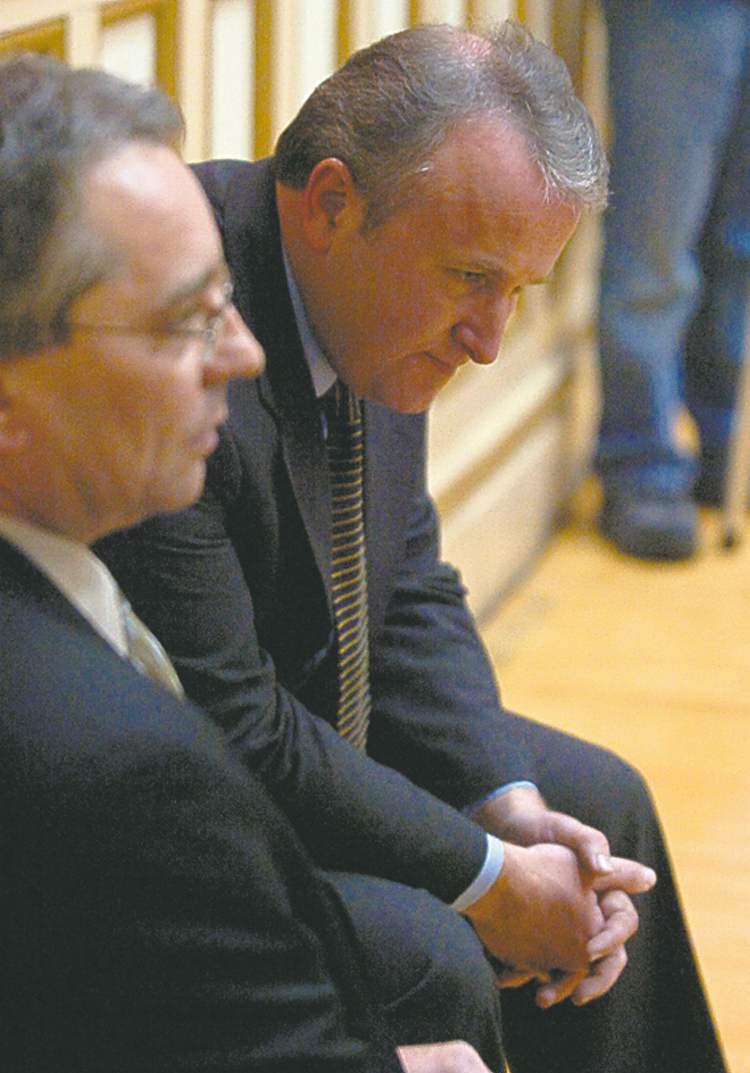
At the heart of the case is an allegation the original prosecutor in the case, Paul Jensen, failed to disclose evidence of the unreliability of two key Crown witnesses: mutual fund salesmen Sheldon Gray and William Knight.
Just prior to testifying against Ross, Gray and Knight signed off on settlement agreements with the Manitoba Securities Commission, admitting they deceived their clients when enlisting them in the restaurant investment. Knight was suspended from selling securities and ordered to pay $8,000 in costs. Gray pleaded guilty to 54 violations of securities law and had to repay $500,000 to his clients. In settling with the MSC, Knight and Gray admitted doing many things that formed the basis of charges against Ross.
Ross made application to the federal justice minister in 2004 for a review of his conviction under Sec. 696 of the Criminal Code. An investigator was hired in 2007 and finished a report on the case in June 2009. A year later, Nicholson wrote to Ross and said his application for review had been denied.
Nicholson’s decision was remarkable because even in denying to take any action, he actually agreed with Ross’s central argument: namely, that evidence was not disclosed. This has been, in countless other cases, enough to warrant a new trial or judicial review. However, Nicholson said the new evidence would not have affected the outcome of the trial. In making this argument, Nicholson is essentially trying to redraw a key part of the Criminal Code.
Sec. 696 allows the federal attorney general to intervene in a criminal case if there is a “reasonable basis” that a miscarriage of justice has “likely” occurred. Intervention can mean quashing a conviction, ordering a new trial or referring new evidence to an appellate court. In previous wrongful convictions, attorneys general have limited their actions to determining whether an applicant had a fair trial, or whether new evidence should fairly be put before a court. The attorney general is never asked to determine innocence.
In Milgaard, Ottawa referred new circumstantial evidence to the Supreme Court of Canada for review. In Truscott, a hearing to review new evidence was ordered before the Ontario Court of Appeal. In Driskell and, later, in the case of Kyle Unger, Ottawa vacated the original convictions and told Manitoba to hold new trials. The province declined in both cases.

Lawyer David Asper, a member of Milgaard’s legal team who now teaches criminal law at the University of Manitoba, said the importance of the Ross hearing cannot be overstated. Asper said if the Federal Court accepts Nicholson’s argument, it would completely change the law dealing with claims of wrongful conviction. “(Nicholson) appears to be exercising a judicial function, which is well beyond the powers granted to him by the Criminal Code. In doing so, he is usurping the function of the courts.”
Why is Nicholson trying to establish new law in the Ross case? Perhaps Nicholson is hoping to use the Ross case as the precedent on which to permanently shut down an extraordinary avenue of legal appeal that has helped free numerous wrongly convicted people. Wrongful convictions are embarrassing, expensive and not consistent with the Conservative government’s tough-on-crime posture.
However, the Ross hearing would also potentially change laws dealing with disclosure of evidence. Based on the Supreme Court’s Stinchcombe decision, disclosure must be complete and absolute. No individual is given the authority to decide if evidence is relevant; that is the responsibility of the court. Nicholson is now arguing non-disclosure is OK if the evidence isn’t likely to change the outcome of the trial. If his argument were accepted, it would profoundly corrupt one of the most important principles in our justice system.
The stakes are very high now. One can only hope Nicholson’s bid to rewrite the Criminal Code is summarily rejected — for Ross’s sake and for the sake of our justice system.
dan.lett@freepress.mb.ca
Dan Lett is a columnist for the Free Press, providing opinion and commentary on politics in Winnipeg and beyond. Born and raised in Toronto, Dan joined the Free Press in 1986. Read more about Dan.
Dan’s columns are built on facts and reactions, but offer his personal views through arguments and analysis. The Free Press’ editing team reviews Dan’s columns before they are posted online or published in print — part of the our tradition, since 1872, of producing reliable independent journalism. Read more about Free Press’s history and mandate, and learn how our newsroom operates.
Our newsroom depends on a growing audience of readers to power our journalism. If you are not a paid reader, please consider becoming a subscriber.
Our newsroom depends on its audience of readers to power our journalism. Thank you for your support.
Dan Lett is a columnist for the Free Press, providing opinion and commentary on politics in Winnipeg and beyond. Born and raised in Toronto, Dan joined the Free Press in 1986. Read more about Dan.
Dan’s columns are built on facts and reactions, but offer his personal views through arguments and analysis. The Free Press’ editing team reviews Dan’s columns before they are posted online or published in print — part of the our tradition, since 1872, of producing reliable independent journalism. Read more about Free Press’s history and mandate, and learn how our newsroom operates.
Our newsroom depends on a growing audience of readers to power our journalism. If you are not a paid reader, please consider becoming a subscriber.
Our newsroom depends on its audience of readers to power our journalism. Thank you for your support.
Advertisement Advertise With Us
Advertisement Advertise With Us