

Rejigging climate-change plan
Industry, public to be consulted on post-Kyoto goals
Advertisement
Read this article for free:
or
Already have an account? Log in here »
To continue reading, please subscribe:
Monthly Digital Subscription
$0 for the first 4 weeks*
- Enjoy unlimited reading on winnipegfreepress.com
- Read the E-Edition, our digital replica newspaper
- Access News Break, our award-winning app
- Play interactive puzzles
*No charge for 4 weeks then price increases to the regular rate of $19.00 plus GST every four weeks. Offer available to new and qualified returning subscribers only. Cancel any time.
Monthly Digital Subscription
$4.75/week*
- Enjoy unlimited reading on winnipegfreepress.com
- Read the E-Edition, our digital replica newspaper
- Access News Break, our award-winning app
- Play interactive puzzles
*Billed as $19 plus GST every four weeks. Cancel any time.
To continue reading, please subscribe:
Add Free Press access to your Brandon Sun subscription for only an additional
$1 for the first 4 weeks*
*Your next subscription payment will increase by $1.00 and you will be charged $16.99 plus GST for four weeks. After four weeks, your payment will increase to $23.99 plus GST every four weeks.
Read unlimited articles for free today:
or
Already have an account? Log in here »
Hey there, time traveller!
This article was published 31/07/2013 (4535 days ago), so information in it may no longer be current.
The Manitoba government is delaying a ban on coal-fired heating, outlawing a dirty heating fuel that’s not used here and farming out the development of new greenhouse-gas-emissions targets.
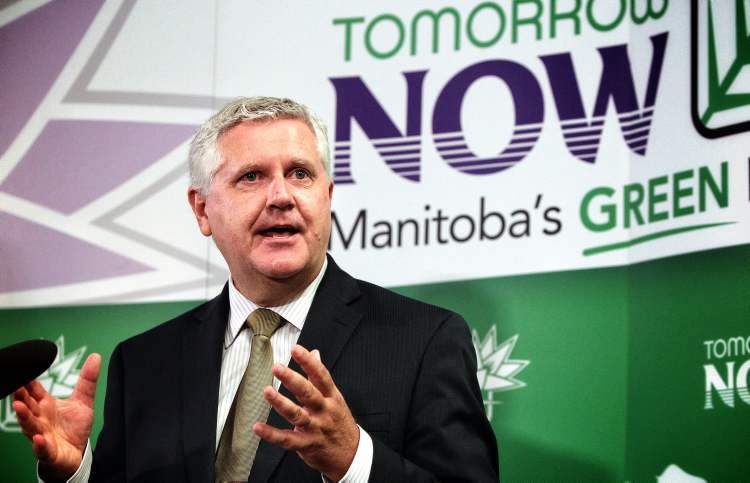
That’s the upshot of Conservation Minister Gord Mackintosh’s announcement Tuesday on the province’s post-Kyoto climate-change plans.
Manitoba had a comprehensive plan, released five years ago, to meet its Kyoto targets — curbing pollution to six per cent below 1990 levels. Despite slowly shrinking emissions, those Kyoto targets were never met, even though they are enshrined in legislation.
Now, the province has tasked a Winnipeg environmental think-tank with consulting the public and industry to come up with more realistic short- and long-term targets. The International Institute for Sustainable Development will start consultations this fall and hopes to have a report ready within a year.
Mackintosh would not reveal what he believes might be reasonable targets, saying the best way to determine the way forward is through public engagement.
“You have to engage Manitobans to decide where we go from here. It impacts on everyday life. It impacts on the economy. You have to have eyes wide open,” said Mackintosh. “We don’t want to make targets that aren’t based on the Manitoba experience.”
In the meantime, the province is delaying one of its climate-change initiatives and banning a heating fuel not used in Manitoba.
After pushback from the Keystone Agricultural Producers, the province is postponing a ban on coal-fired heating, used mostly by large farm operations and Hutterite colonies who need to warm barns and workshops.
The ban, announced two years ago, was to begin in January and already about half of the 70-odd agricultural users of coal-fired heat have converted to greener fuel.
Now, the remaining users of coal heat will have until July 2017 to convert to biomass — farming or logging leftovers such as crop stubble or sawdust that can be burned for energy.
Another 200-plus rural homeowners also heat with coal and will have to convert to another heating source, with the help of government grants.
The ban, when it comes into force, will save as much as 100,000 tonnes of greenhouse-gas emissions. That’s about five per cent of Manitoba’s total emissions, not insignificant for a province with few large point-source emitters.
‘We don’t want to make targets that aren’t based on the Manitoba experience’
— Conservation Minister Gord Mackintosh
The province is also banning the use of petroleum coke for heating. “Petcoke” is a dirty but cheap byproduct of oil refining. No one in Manitoba uses petcoke for heating, so the ban pre-empts fears the handful of people who heat their homes or farms with coal might turn to cheap petcoke.

Only Graymont’s lime plant near Moosehorn uses petcoke, though not for heating. The company runs its kilns mostly on coal and will pay a new provincial emissions tax on its petcoke fumes as it already does for its coal pollution. Graymont is the province’s fourth-largest point-source emitter, though Mackintosh said the government is working with the company on greener fuel options. Graymont officials say they are open to using more biomass.
Despite Manitoba’s modest progress on reducing emissions, an environmentalist said Tuesday’s measures are a step in the right direction. Bruce Duggan is part of a group called 50by30 that wants Manitoba running on 50 per cent renewable energy by 2030, including the transportation and home-heating sectors.
“I’m moderately hopeful,” he said. “But I think, actually, saying, ‘Oh it’s all the government’s fault’ is lame and wrong. It’s lame because we all know we could have done more, and it’s wrong because governments don’t actually control everything.”
There was no mention in the announcement of new green transportation initiatives such as transit or curbs on urban sprawl even though vehicle emissions make up more than one-third of the province’s emissions and are on the rise. There was also no mention of wind energy or the creation of a regional cap-and-trade system, a project that has largely fizzled.
maryagnes.welch@freepress.mb.ca
History
Updated on Wednesday, July 31, 2013 6:46 AM CDT: replaces photo